



 by
Tom Gurney
Tom Gurney BSc (Hons) is an art history expert with over 20 years experience
Published on June 19, 2020 / Updated on October 22, 2026
Email:
tomgurney1@gmail.com
/ Phone:
+44 7429 011000
Head of an Apostle Looking Upward by Albrecht Dürer: Introduction
The eyes move first. Set beneath sharply lifted brows, they turn towards something above and to the right, drawing the whole face into an attitude of attention. A slightly parted mouth reinforces the sense of a man arrested by what he sees. This Head of an Apostle Looking Upward is the drawing dated 1508 in Berlin’s Kupferstichkabinett, inventory KdZ 14. The museum calls it Nach rechts gewandter Kopf eines Apostels : head of an apostle turned to the right. [1]
Dürer has combined a turn across the sheet with an upward movement of the eyes, so that the head seems actively engaged with a space beyond its own boundaries. We see enough of the nearer ear and side of the skull to understand the turn, while the nose projects towards the right edge. The pupils sit high beneath the upper lids. The face acquires a direction before we know the religious scene for which it was studied.
At a Glance
- Date 1508 [1]
- Collection Kupferstichkabinett, Berlin; KdZ 14 [1]
- Museum title Head of an apostle turned to the right [1]
- TypeDrawing [1]
This work across Albrecht Dürer’s career
Young Hare
1502Praying Hands
1508Melencolia I
1514Four Apostles
1526Contents
- A face made from different kinds of line
- Why the coloured ground matters
- An apostle beside the empty tomb
- Care, labour and the finished study
- A sheet altered for looking
- Doubt and renewed acceptance
- Frequently Asked Questions
A face made from different kinds of line
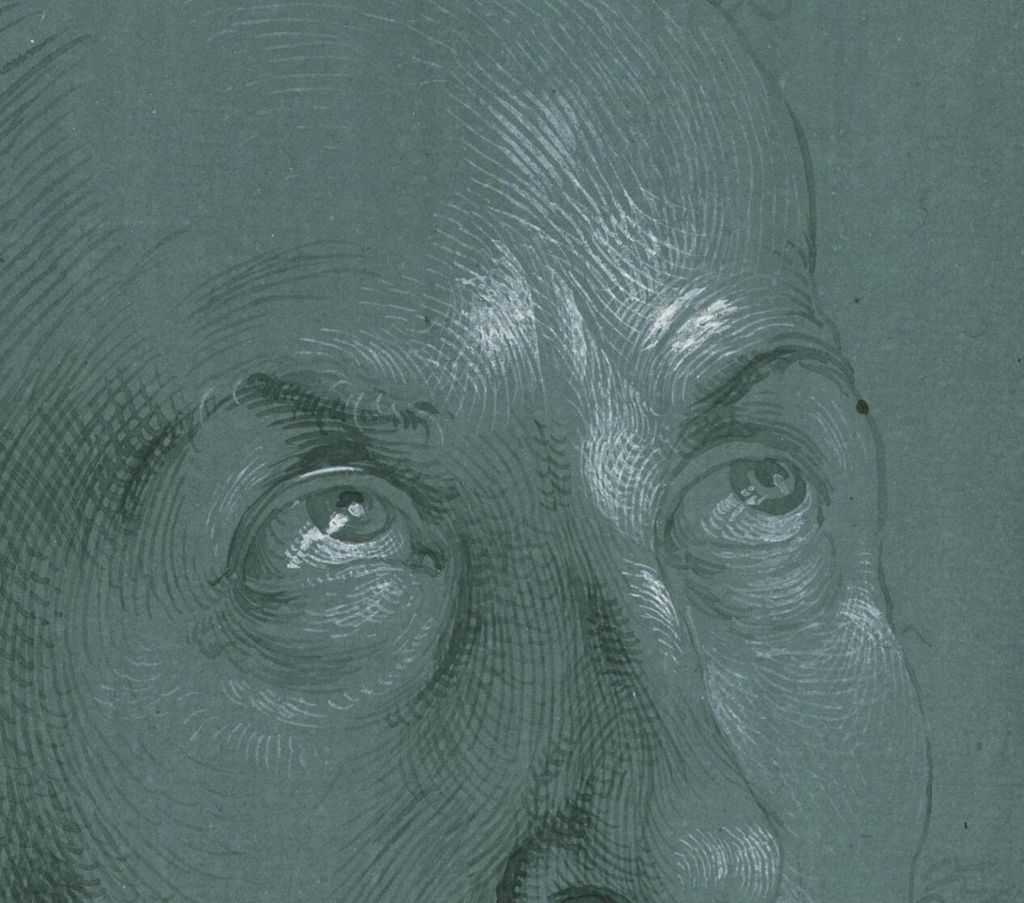
Across the forehead, fine strokes follow the swelling surface towards the brows. Around the nearer eye they contract into short curves, describing the lower lid and the flesh beneath it. The cheek carries a closely organised mesh of marks. Their changes of direction make the surface turn, whereas the stronger shadow beside the nose gives that projecting form an emphatic edge. Dürer asks an extraordinary amount of these small strokes: they describe texture while building a solid head.
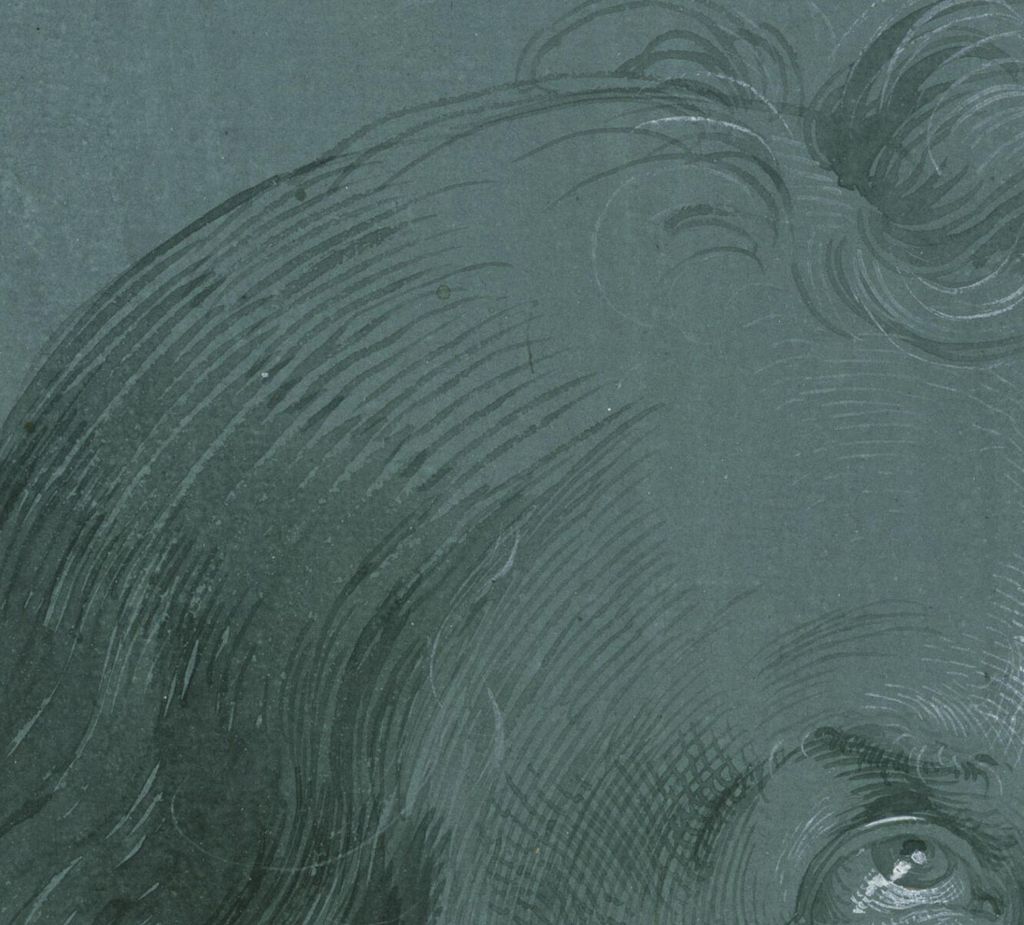
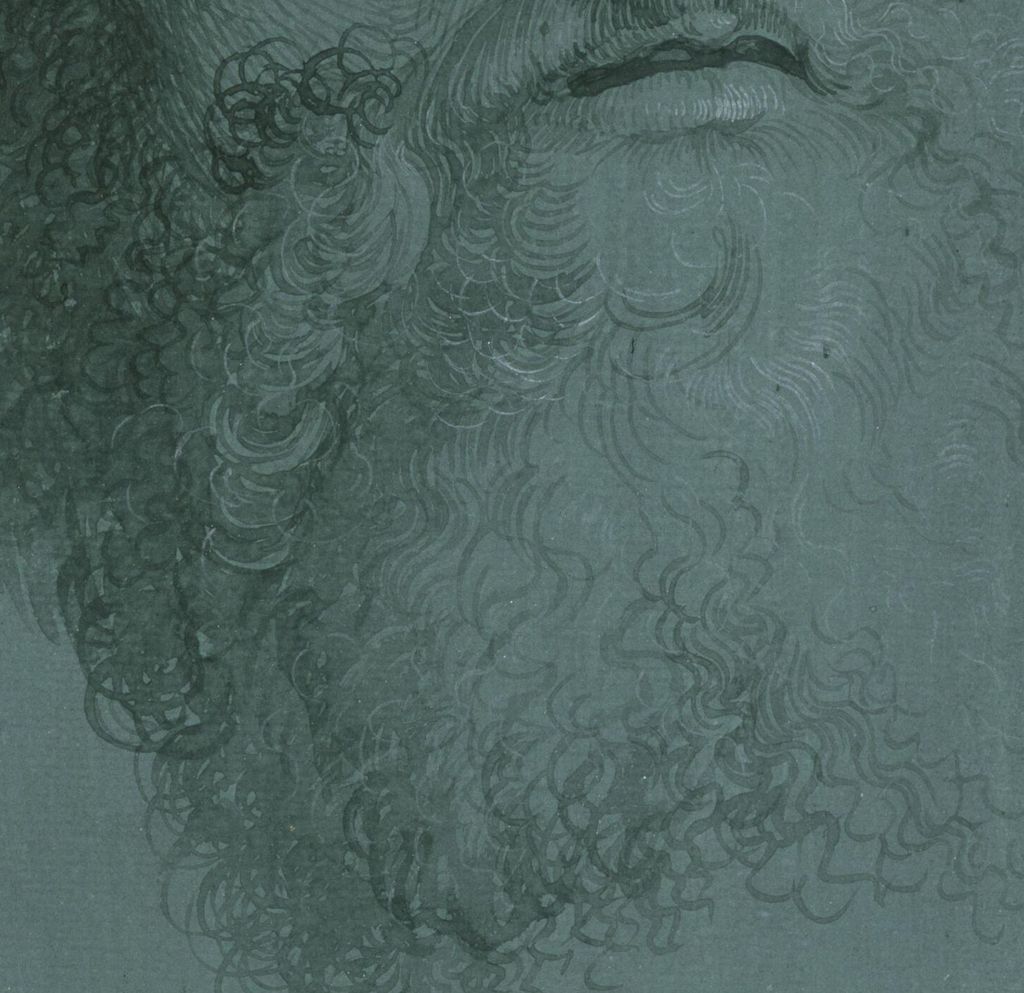
Hair introduces another rhythm. Long, swept lines pass over the crown and behind the ear; a few locks lift away from the skull. In the beard, the strokes become loops, hooks and closely nested curls. Dark marks gather beneath the cheek and at the lower edge of the beard. White curls open out around the chin. The hair on the head and the beard consequently belong to the same person without being treated as a single decorative pattern. One is drawn in flowing lengths, the other as a mass of individual coils.
The mouth is an especially economical passage. A dark opening separates the lips, with short strokes above and pale accents below. It remains small beside the elaborate beard, yet it changes the expression of the whole face. The apostle appears receptive, perhaps astonished. These are responses suggested by the drawing; the sheet supplies neither a spoken sentence nor an account of the model’s thoughts. Its emotional force rests on visible adjustments of eyes, eyebrows and lips.
Why the coloured ground matters
Berlin records a sheet measuring 28.8 × 20.8 centimetres. Its 2023 exhibition checklist specifies grey and black brushwork, white heightening and paper prepared on one side with a blue-green ground. The coloured surface is a working part of the image. It remains visible between the strokes, providing a middle value against which both the darkest hair and the brightest accents register. [12]
The ALBERTINA’s 2025 exhibition on drawings on coloured grounds places the Heller studies in the aftermath of Dürer’s Venetian experience. In Venice he had used blue paper coloured during manufacture; for the later studies he carefully prepared papers with blue or green grounds. The exhibition account stresses the fine surfaces this produced and the delicate brushwork they permitted. It also interprets such elaborate drawings as potential workshop showpieces, extending their usefulness beyond the immediate requirements of painting. [13]
Here the light can be followed most clearly over the brow, down the bridge of the nose and into the curls below the mouth. The pale strokes do more than pick out isolated bright spots. Their alignment helps explain the surface receiving the light. On the forehead they spread over a broad curve; in the beard they trace much tighter turns. The black-and-white reproduction makes the network of marks especially legible, while the colour image reveals how much of the modelling depends on the quieter ground between them.
Annotated Details from Head of an Apostle Looking Upward
Follow the light around the eyes, the sweeping hair and the tangled loops of the beard.
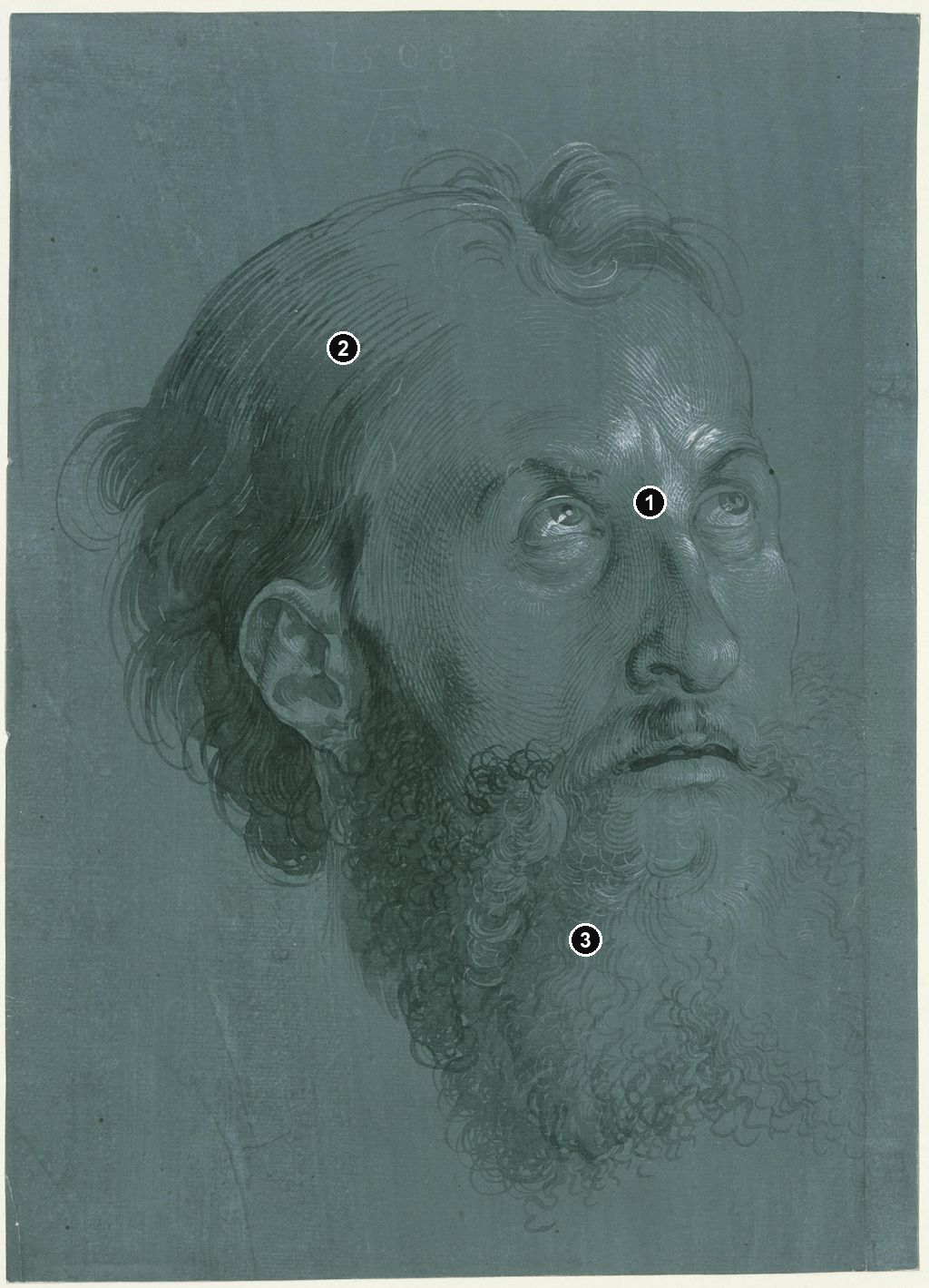
Details from HEAD OF AN APOSTLE LOOKING UPWARD
Open the details to compare dark and pale marks across the coloured surface.
Light around the upward-looking eyes
Pale strokes gather above the brows and curl beneath the eyes. Dark crossing lines deepen the side of the forehead and the hollow beside the nose.
Sweeping curves across the hair
Long dark curves sweep back from the forehead. Shorter pale lines run between them, while the hair’s outer strands open into the surrounding blue-green field.
The beard’s dark and pale loops
Small curls crowd together below the cheek and spread into larger loops towards the bottom. Pale strands cross darker ones, leaving openings where the coloured surface remains visible.
An apostle beside the empty tomb
The head belongs to the studies for the Heller Altarpiece, commissioned by Jakob Heller for Frankfurt’s Dominican church. Franziska Ehrl’s recent catalogue account connects this particular drawing with a standing apostle at the left of the central scene of the Assumption and Coronation of the Virgin. This gives the upward gaze a narrative purpose: the man participates in a gathering whose attention moves between the empty tomb and the heavenly event above. [14]
That arrangement survives in Jobst Harrich’s replacement of the central panel, commissioned in 1614. The copy, now in Frankfurt’s Historisches Museum, shows the apostles around the tomb beneath the Virgin’s coronation. Dürer’s original centre was subsequently destroyed by fire in Munich in 1729. Looking from the isolated head to the copy therefore involves a surviving study and another painter’s record of the lost composition. [15] [14]
Within the copy’s left-hand group, a bearded man in green looks up behind the large blue-cloaked foreground figure. His direction and disposition of features allow the relationship identified by the catalogue to be followed. He is part of a crowded group, with neighbouring heads, shoulders and gestures competing for space. On the drawing, by contrast, the blank surrounding ground gives his gaze room to travel. The comparison explains how a relatively small participant in an altarpiece can become the entire subject of a sheet.
It also changes the balance of our attention. In the copy, the tomb, the rising tiers of clouds and the great upper figures carry us through a religious narrative. In the drawing, a sequence of small physical events holds us: the tension above the eyes, the change from cheek to beard, the edge of the ear. The study makes visible the concentrated work that could underlie a face encountered only briefly within a larger ensemble.
Care, labour and the finished study
Dürer’s letters to Heller give this concentration a practical setting. In March 1508 he promised to paint the middle panel himself. During their subsequent disagreement over cost and effort, he explained that absolute painstaking finish could consume an immense amount of time: a single face might occupy half a year if taken to the extreme. This was an argument made to a demanding patron, not a record of the time spent on this drawing. Yet it reveals his awareness that detail had to be judged against the scale and viewing conditions of an altarpiece. In August 1509, sending the completed painting, he again emphasised its careful execution and the labour it had required. [16]
The head invites exactly that question about degrees of finish. Its minute marks reward close examination at a distance very different from viewing a painted face in an altar. The careful articulation of a curl does not become superfluous because it would be hard to see in the church. On paper it can establish a way of describing hair, preserve an expressive solution and offer a compelling demonstration of handling. Those possible uses can coexist with the drawing’s specific connection to the painting.
Heinrich Wölfflin, writing in 1905, was struck by Dürer’s elaboration of separate heads, hands, feet and garments for the Heller composition. He admired the intensity of the individual forms while questioning how freely they came together in the whole. His account offers a useful historical response to these studies, although its judgements are his own. The surviving sheets permit viewers to consider both the concentration within each fragment and the larger task of bringing many such fragments into a coherent scene. [17]
A sheet altered for looking
The present rectangle has a history of its own. Berlin’s 2023 checklist records an added paper strip at the right. Ehrl’s catalogue account explains that material was cut from the left and remounted on the right, and reports the interpretation that this brought the head nearer the centre for presentation. The drawing’s later appearance thus reflects decisions about how an individual head should be displayed. [12] [14]
This is a small alteration with a substantial visual consequence. Moving the edge changes the amount of room around the face, and particularly the space towards which it turns. The rectangular field can seem a neutral container until we learn that it has been adjusted. The apostle’s expression is Dürer’s concern; the balance between that expression and the sheet’s margins also belongs to its later life as a collected drawing.
Berlin purchased the drawing from the Posonyi-Hulot collection in 1877; Thomas Lawrence and Samuel Woodburn appear among its previous owners. Elfried Bock’s 1921 catalogue records a high-crown watermark. These traces concern the physical sheet and its passage through collections. They add a material history to the image without supplying a biography for the unidentified man whose features it preserves. [1] [18]
Doubt and renewed acceptance
Bock’s entry is memorable for a more contentious reason. Although he noted that previous literature had accepted the drawing, he thought its smoothness raised the possibility of a skilful old forgery after an original. The objection concerned his judgement of the handling. It should be read as a historical attribution opinion. Berlin’s current record assigns the drawing to Dürer and dates it 1508. Ehrl’s survey records the earlier doubts, including a workshop attribution by Hans Tietze and Erika Tietze-Conrat, and observes that the attribution was subsequently seldom questioned. [18] [1] [14]
The history of that disagreement encourages close looking at the very quality Bock distrusted. The surface is exceptionally controlled, but its textures are differentiated: the brows, smooth cheek, swept hair and curling beard each require a different movement of the brush. Whether one responds first to the finish or to the expression, the judgement has to engage with these particular passages. A general expectation that studies should be rapid and visibly searching would be a poor guide to such a carefully elaborated sheet.
There is also another upward-looking Heller head in Vienna’s ALBERTINA, inventory 3112. It faces the other way and belongs to the kneeling apostle associated with the Praying Hands . The ALBERTINA records that its head and hands originally shared one sheet. That cutting history belongs to the Vienna drawing. The Berlin head discussed here has its own support, dimensions and later alteration; the similarity of English titles can easily obscure the difference. [19]
Returning to Berlin’s apostle, the gaze still supplies the strongest connection between detail and whole. Its direction leads out of the sheet towards the event represented above the tomb, while the small movements around the eyes make that attention feel physically present. The finished head preserves an individual act of looking within a lost painting’s larger gathering of witnesses.
Frequently Asked Questions
Artworks directory
These 187 records include individual works, reverse sides, detail views, paired panels and reconstructed arrangements. Three additional catalogue images repeat works already listed. Related views are not counted as separate originals; qualified attributions and published dating are retained.
Discussion
Look again at the images and ideas explored in Head of an Apostle Looking Upward by Albrecht Dürer. These editorial prompts invite your observations.
Reader Insights
Which detail or idea in Head of an Apostle Looking Upward by Albrecht Dürer most changed your reading, and why?
How does the discussion of “A face made from different kinds of line” affect your understanding?
What comparison would you bring to the discussion of “Doubt and renewed acceptance”?
Join the Conversation
Share a detail, comparison or question about Head of an Apostle Looking Upward by Albrecht Dürer below.
References
- Staatliche Museen zu Berlin , Kupferstichkabinett, Nach rechts gewandter Kopf eines Apostels , KdZ 14, current collection record, updated 9 October 2026. German. View source .
- ALBERTINA, Selbstbildnis als Dreizehnjähriger, inv. 4839 (German). View source.
- Metropolitan Museum, Four Horsemen from The Apocalypse, 19.73.209 (English). View source.
- Bayerische Staatsgemäldesammlungen, Selbstbildnis im Pelzrock, inv. 537 (German). View source.
- ALBERTINA, Feldhase, inv. 3073 (German). View source.
- ALBERTINA, Das große Rasenstück, inv. 3075 (German). View source.
- Metropolitan Museum, Adam and Eve, 19.73.1 (English). View source.
- ALBERTINA, Betende Hände, inv. 3113 (German). View source.
- Metropolitan Museum, Knight, Death, and the Devil, 43.106.2 (English). View source.
- Metropolitan Museum, Melencolia I, 43.106.1 (English). View source.
- Bayerische Staatsgemäldesammlungen, inventory 545: current collection record (German; descriptive citation). View source.
- Staatliche Museen zu Berlin , Dürer für Berlin: Werkliste , 2023, p. 13, cat. 72. German. View source .
- ALBERTINA , Leonardo–Dürer: Renaissance Master Drawings on Colored Ground , 2025 exhibition texts, especially pp. 6 and 9–10; curators Achim Gnann and Christof Metzger. English. View source .
- Franziska Ehrl , Nach rechts gewandter Kopf eines Apostels , Dürer.online , 20 November 2024, DOI: 10.11588/duerer.online.687dd7739f7ed. German. View source .
- Städel Museum , Zeitreise, Jobst Harrich, Ascension and Coronation of the Virgin , B 265, Historisches Museum Frankfurt. English interface; German provenance and historical catalogue transcriptions. View source .
- Albrecht Dürer , letters to Jakob Heller, in William Martin Conway, with Lina Eckenstein, Literary Remains of Albrecht Dürer , Cambridge University Press, 1889, pp. 64–70, especially letters of 19 March and 4 November 1508 and 26 August 1509. Historical English translation. View source .
- Heinrich Wölfflin , Die Kunst Albrecht Dürers , “Italien und die großen Gemälde”, 1905, Heller discussion, especially pp. 147–152. German. View source .
- Elfried Bock , Die Deutschen Meister: beschreibendes Verzeichnis sämtlicher Zeichnungen , vol. 1, Berlin, 1921, p. 26, entry 14. German. View source .
- ALBERTINA , Aufwärts blickender Apostelkopf (Detail aus dem “Heller-Altar”) , inventory 3112, current record with Heinz Widauer’s 2003 catalogue text. German and English introduction; German extended text. View source .
- Germanisches Nationalmuseum, Barbara Dürer (German and English). View source.
- Web Gallery of Art, Tucher–Rieter reverse (English). View source.
- National Gallery of Art, Portrait of a Clergyman (English). View source.
- Dürer Art, Portrait of a Man (English). View source.
- Hessen Kassel Heritage, Elsbeth Tucher (German). View source.
- Web Gallery of Art, Hans Tucher (English). View source.
- Germanisches Nationalmuseum, Emperor Maximilian I (German and English). View source.
- National Gallery of Art, Lot and His Daughters, reverse (English). View source.
- Bayerische Staatsgemäldesammlungen, Glim Lamentation (German). View source.
- Museo Nacional del Prado, Portrait of a Man (Spanish). View source.
- Bayerische Staatsgemäldesammlungen, Madonna of the Carnation (German). View source.
- Städel Museum, Job on the Dungheap (German). View source.
- Wallraf-Richartz-Museum, Piper and Drummer (German). View source.
- Italian Ministry of Culture / Uffizi, Head of Saint James (Italian). View source.
- Klassik Stiftung Weimar, Dresden Altarpiece (German). View source.
- Staatliche Museen zu Berlin, Girl with a Red Beret (German and English). View source.
- Dresden State Art Museums / Roland Enke, Bernhard von Reesen (German). View source.
- Royal Collection Trust, Burkhard von Speyer (English). View source.
- Dresden State Art Museums, Seven Sorrows of the Virgin (English). View source.
- Bayerische Staatsgemäldesammlungen, Mater Dolorosa (German). View source.
- Bayerische Staatsgemäldesammlungen, Lucretia (German). View source.
- Städel Museum, Young Woman with Her Hair Down (English). View source.
- ALBERTINA, Portrait of a Young Man (German). View source.





