



 by
Tom Gurney
Tom Gurney BSc (Hons) is an art history expert with over 20 years experience
Published on June 19, 2020 / Updated on October 22, 2026
Email:
tomgurney1@gmail.com
/ Phone:
+44 7429 011000
Hymn in Adoration of the Lamb: Introduction
A small lamb commands an immense congregation in Albrecht Dürer's Hymn in Adoration of the Lamb , also called The Adoration of the Lamb—The Hymn of the Chosen . Surrounded by a brilliant ring, it stands above a crowd whose raised palms almost conceal the sky. Near the bottom, Saint John kneels with his back towards us, turning to an elder who helps him understand what he sees. Dürer designed the woodcut around 1496–97 for his Apocalypse . The Cleveland Museum of Art owns an impression printed in 1511, with an image measuring 39.2 × 28 centimetres: a substantial sheet on which this densely populated heaven could unfold. [1]
The scene brings together visions scattered through Revelation. Its crowded worship has the energy of a public celebration. The eye can travel upwards from a single questioning witness to a company extending beyond any easy count. Within the Apocalypse , a book filled with violent confrontations, this gathering gives salvation a visible human presence.
At a Glance
- Design date About 1496–1497 [1]
- Process Woodcut [1]
- Series Apocalypse; Cleveland example printed in 1511 [1]
This work across Albrecht Dürer’s career
Hymn in Adoration of the Lamb (current article)
c. 1496–1497Young Hare
1502Praying Hands
1508Melencolia I
1514Four Apostles
1526Contents
- A centre made of light
- Several visions gathered together
- John at the threshold
- Black lines and white robes
- A design with more than one printed life
- A kneeling figure travels
- Frequently Asked Questions
A centre made of light
The Lamb's dominance depends on the space around it. Its body occupies only a modest portion of the sheet, but a broad pale circle separates it from the crowded figures. Short rays bristle outwards into the surrounding darkness. The worshippers overlap, while the Lamb remains legible against an unusually open field. Dürer makes visual clarity itself a sign of importance.
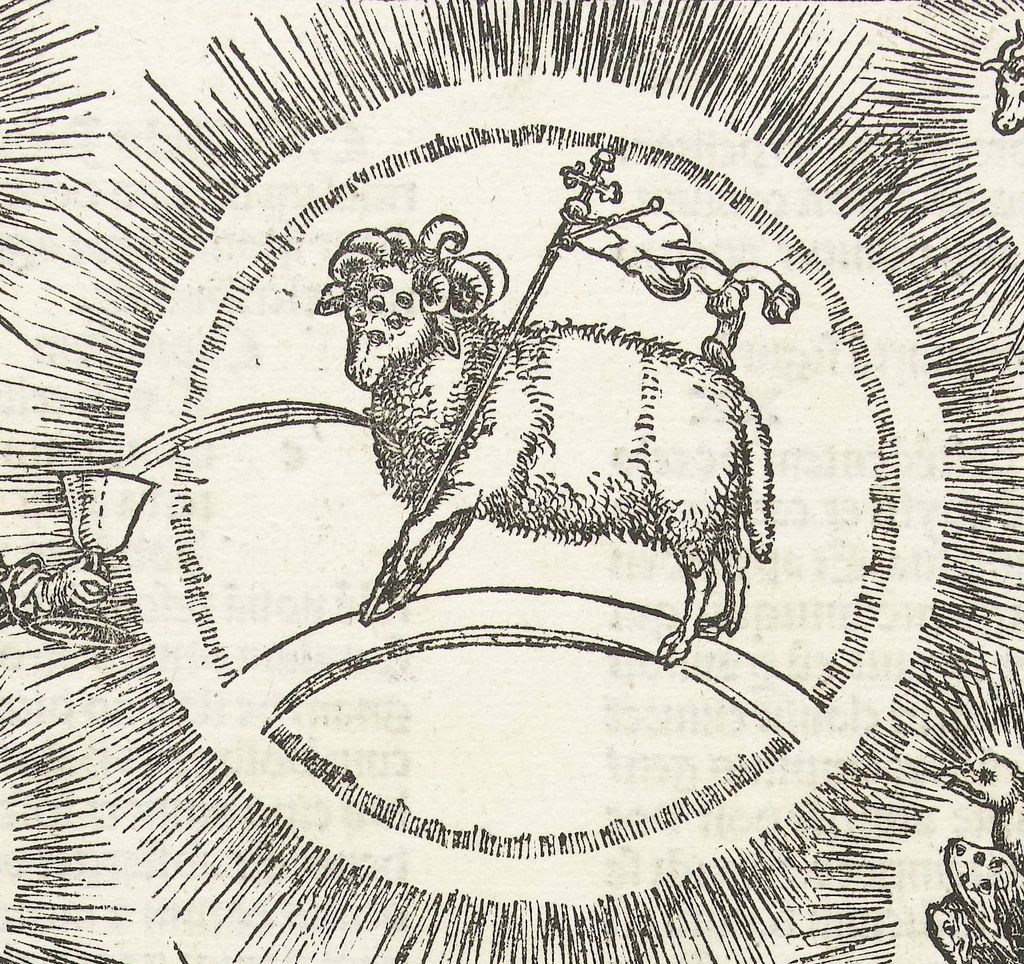
The animal carries a cross staff and banner, and stands upon a curved support. A stream from its wounded side reaches towards a chalice at the left. This is the Lamb of Christian sacrifice and victory: the image makes the wound part of its heavenly authority. Revelation 5 describes the living Lamb as bearing the marks of slaughter and possessing seven horns and seven eyes. Those attributes belong to the biblical description; the broad effect of this small figure is easier to grasp in a reproduction than every individual horn or eye. [12]
Around it appear the four winged creatures: the lion, ox, eagle and human-faced being. The Rijksmuseum identifies the curved support as a rainbow and the surrounding creatures as the apocalyptic animals. Their different profiles interrupt the human congregation, placing beings of the visionary text within the same gathering. Dürer gives each a pocket of radiance, echoing the larger light around the Lamb. Their wings also turn the corners of the composition inwards, helping to hold its many figures together. [13]
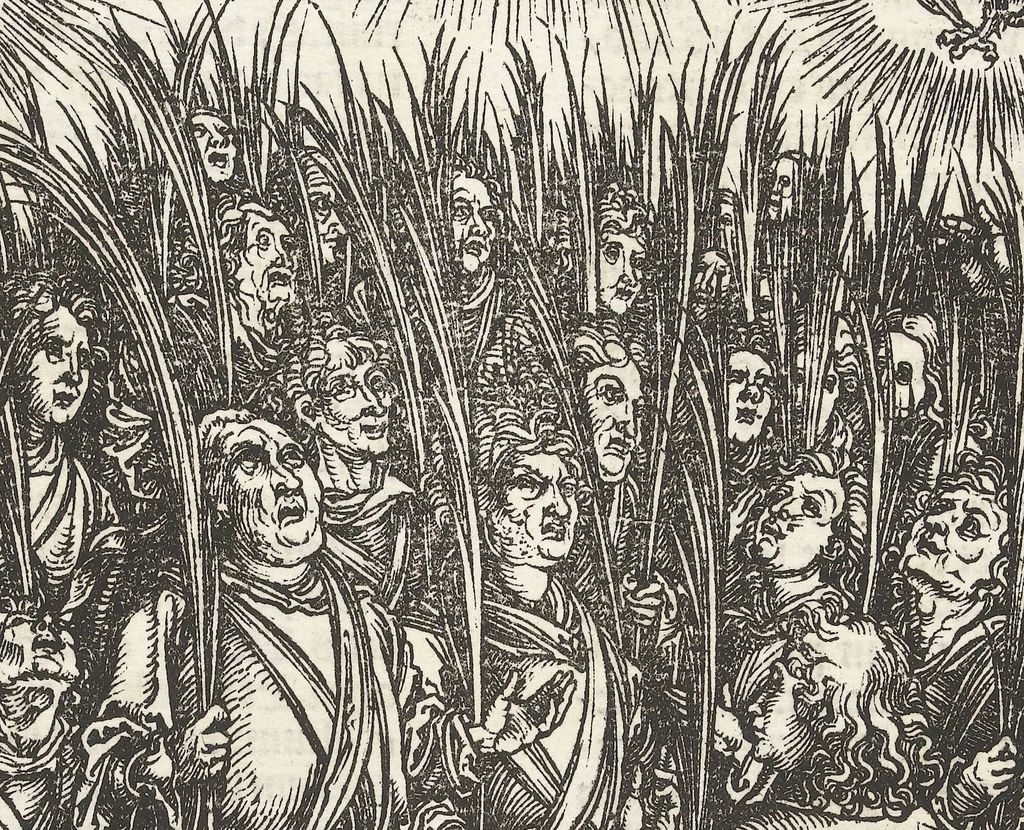
Below, the palms produce a different kind of pattern. Their narrow stems and pointed leaves make a thicket above the worshippers' heads. Some branches rise almost vertically; others lean across their neighbours. Against this busy fringe, the rounded circle above seems especially complete. The contrast supplies both direction and rest: the palms lead the gaze upwards, and the luminous enclosure gives it somewhere to settle.
Annotated Details from Adoration of the Lamb
Follow the numbered details from the radiant centre to the crowded worshippers and the foreground conversation.
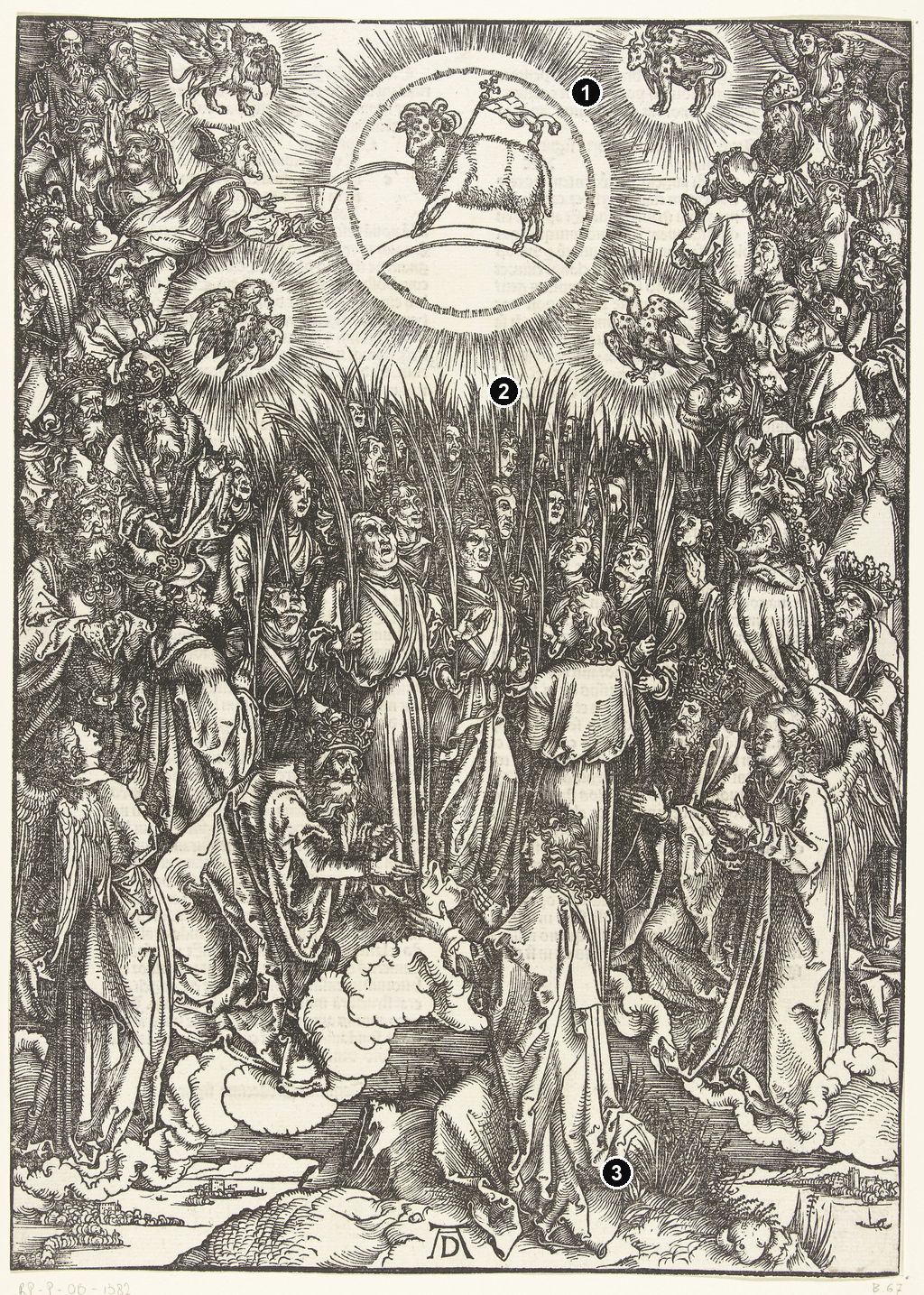
Details from ADORATION OF THE LAMB
These details show the Rijksmuseum’s 1511 impression. [13] Compare the long rays, narrow palms and broad folds.
The Lamb within a ring of light
Long rays surround a broad, pale circle. Short curved strokes describe the fleece, while a narrow stream reaches the cup at the left.
Palms among the faces
Narrow branches rise between overlapping heads. Small changes in the outlines distinguish faces even where the gathering becomes densely packed.
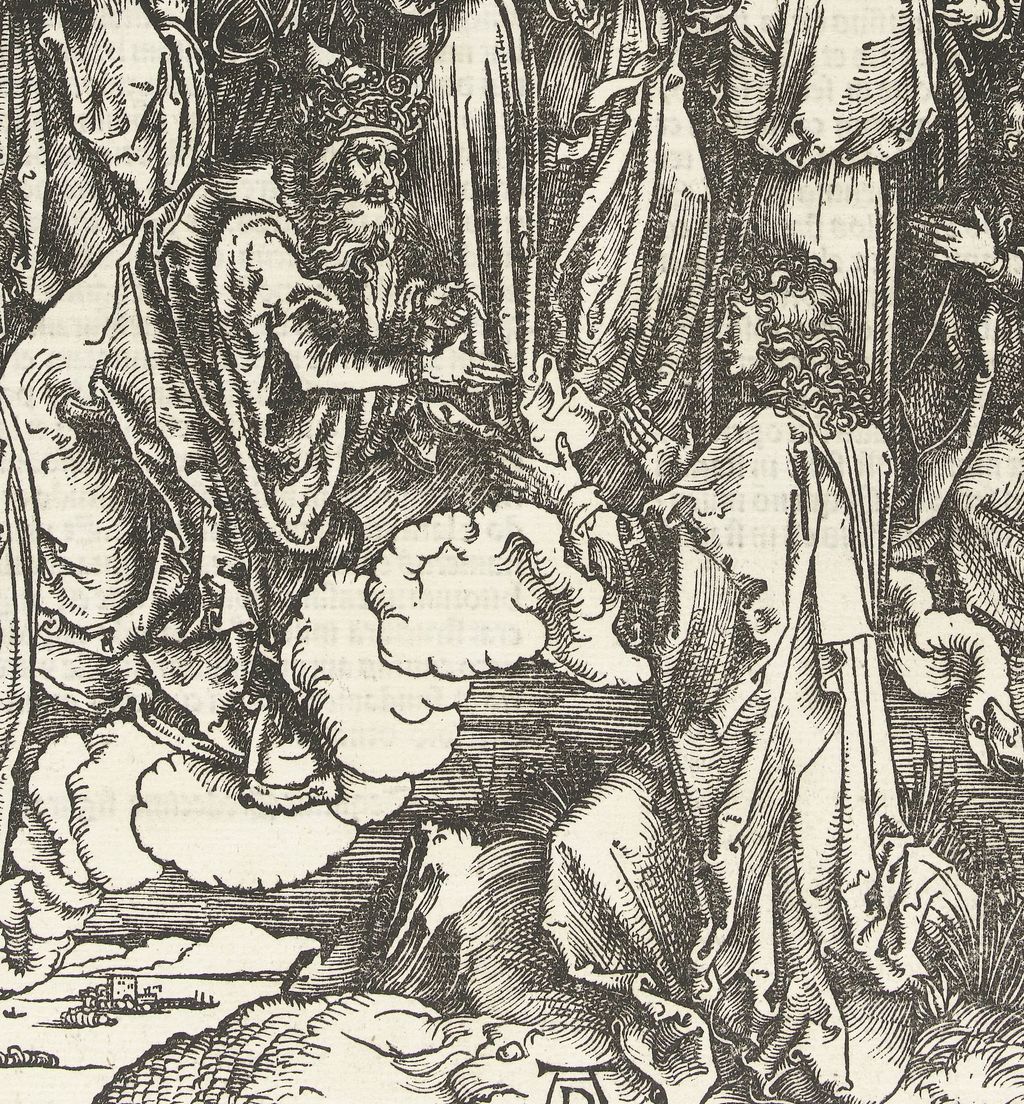
A foreground conversation
The kneeling figure turns towards a crowned elder. Their open hands face each other across a pale interval, framed by long folds of cloth.
Several visions gathered together
Reading the relevant passages explains why the picture contains several kinds of worshipper. Revelation 4 establishes a heavenly court, with twenty-four crowned elders and four living creatures surrounding God's throne. Chapter 5 introduces the Lamb, whose worthiness to open the sealed book prompts a new song of praise. Dürer's assembly draws on that courtly structure, with crowned figures forming a conspicuous part of the congregation. [12]
Revelation 7 supplies the palms and white robes, together with the conversation in the foreground. Its great multitude comes from every nation and language. An elder asks John who the white-robed people are, then explains that they have passed through tribulation. Their whiteness is associated with the Lamb's blood, a striking reversal in which sacrifice becomes the means of purification. The crowd's apparent security therefore carries a memory of suffering. [12]
In Revelation 14, the Lamb stands on Mount Zion with the hundred and forty-four thousand, and a new song is heard before the throne, creatures and elders. Dürer gives that collective praise a form which also incorporates the palm bearers of chapter 7. These passages distinguish a numbered company from an innumerable multitude; the woodcut gathers their related images of redemption into one view. [12]
A reader encounters these descriptions at different moments, whereas the print permits an almost simultaneous view of Lamb, creatures, elders and palms. Its upper circle establishes the focus of worship; its middle shows the community of worshippers; and its foreground introduces the witness learning their identity. The composition makes relationships across the text immediately visible.
The alternative titles each catch part of this arrangement. Adoration of the Lamb directs attention to its radiant centre. Hymn of the Chosen brings the surrounding company forward. Much of the impression of collective sound comes from repetition: upright branches, closely packed heads and hands lifted in related gestures. The page is silent, but its gathering has the visual rhythm of people acting together.
John at the threshold
John occupies the foreground on a rough rise of earth, facing into the vision. His bent knee, turned head and extended hand give his response a bodily immediacy. The elder leans towards him from the left, bringing an explanatory gesture into the midst of prayer. Their exchange introduces a small, readable action beneath a scene of enormous spiritual scale.
Showing John's back is an effective invitation to follow his gaze. We approach the gathering from behind him, without sharing the elder's knowledge. His position gives the picture an accessible beginning: first a person looking and asking, then the assembly he is trying to understand. The hands carry the conversation across the gap between the two figures, while the elder's bending body brings heavenly instruction close to the witness.
The biblical scholar Knut Backhaus emphasises how Revelation draws its audience into the visionary experience through repeated acts of seeing and hearing. He understands its imagery as a means of involving and changing the reader. Dürer's foreground offers a visual counterpart to that participation: John models an attentive response to what initially exceeds his understanding. [14]
Below the clouds, narrow glimpses of landscape preserve another scale of existence. Buildings, water and distant ground are compressed along the lower edges, beneath bodies that dominate the page. The small terrestrial world makes the heavenly assembly seem immense, although John remains large enough for us to read his reaction. Dürer bridges the two scales through a human figure, allowing the vision to feel both remote and immediately encountered.
Black lines and white robes
The picture's brightness is particularly striking because its medium supplies black ink and paper rather than painted light. In woodcut, the printable lines stand in relief on the block; the surrounding material is cut away. Here dense patches of line make the areas of unprinted paper appear luminous. The rays surrounding the Lamb are especially direct demonstrations of that relationship: ink defines the brilliance by marking its edges and outward movement. [15]
Across the lower half, long folds make the robes feel heavy. Deep black intervals separate limbs and overlapping bodies, while relatively clear stretches preserve the breadth of sleeves and cloaks. The clothing has weight even where the figures stand upon clouds. Dürer gives this supernatural assembly a physical conviction through the familiar behaviour of cloth.
The clouds themselves curl into rounded, irregular forms. Their lighter expanses separate figures without becoming a single empty band. Compare those broad curves with the sharp foliage above, or the tiny marks of the landscape below: each passage has a different pace. Such changes keep the crowded sheet readable. The eye can recognise a cloud, palm, sleeve or stretch of ground before resolving every detail within it.
At the centre, many faces become partly hidden behind other faces and branches. Towards the foreground, gestures and drapery open into larger shapes. This shift allows the multitude to seem continuous while giving individual figures room to act. The image balances the scale of a congregation with the visible presence of separate people.
A design with more than one printed life
The Adoration stands late in the Apocalypse . In the sequence catalogued by the National Museum of Western Art, it is the thirteenth of the fifteen narrative woodcuts, counting the preliminary Martyrdom of Saint John . It is sheet fourteen when the additional title image of the 1511 edition is included. The following images are The Whore of Babylon and The Angel with the Key of the Bottomless Pit . Its worship therefore belongs within a continuing sequence of judgement and deliverance. [16]
The date of the design and the date of a particular impression can differ considerably. Cleveland dates its sheet to the 1511 printing. Bridwell Library at Southern Methodist University identifies its own impression, BRA0252, as printed around 1518 without text on the reverse, from a woodcut completed by 1498. These are separate surviving objects with different printing histories. [1] [17]
A further example at the Rijksmuseum, RP-P-OB-1382, belongs to the 1511 Latin edition and retains biblical text printed in two columns on its reverse. That physical feature recalls the image's life as part of a book. Seen as a loose print, the composition offers a complete spectacle; encountered with the text, its gathered motifs invite the reader to move between seeing the vision and following its words. [13]
A kneeling figure travels
John's pose also had a life beyond this subject. James Bugslag, drawing on Michel Hérold's research, connects him with the Saint John in Valentin Bousch's Transfiguration , Window 111 at Saint-Nicolas-de-Port, made in 1514–20. Bousch combined figures and motifs from different prints to create a new composition. The borrowing suggests how readily Dürer's attentive witness could serve another scene of revelation, even when the Lamb and its congregation were left behind. [18]
Returning from the palms and radiant circle to the foreground conversation brings the scene into focus again: the elder explains the people whom the viewer has just been studying. Across the page, raised hands express worship; here, two outstretched hands make room for a question and an answer.
Frequently Asked Questions
Artworks directory
These 187 records include individual works, reverse sides, detail views, paired panels and reconstructed arrangements. Three additional catalogue images repeat works already listed. Related views are not counted as separate originals; qualified attributions and published dating are retained.
Discussion
Look again at the images and ideas explored in Hymn in Adoration of the Lamb. These editorial prompts invite your observations.
Reader Insights
Which detail or idea in Hymn in Adoration of the Lamb most changed your reading, and why?
How does the discussion of “A centre made of light” affect your understanding?
What comparison would you bring to the discussion of “A kneeling figure travels”?
Join the Conversation
Share a detail, comparison or question about Hymn in Adoration of the Lamb below.
References
- Cleveland Museum of Art , Apocalypse: The Adoration of the Lamb—The Hymn of the Chosen , c. 1496–97, printed 1511, accession 2015.580. Current collection record. View source .
- ALBERTINA, Selbstbildnis als Dreizehnjähriger, inv. 4839 (German). View source.
- Metropolitan Museum, Four Horsemen from The Apocalypse, 19.73.209 (English). View source.
- Bayerische Staatsgemäldesammlungen, Selbstbildnis im Pelzrock, inv. 537 (German). View source.
- ALBERTINA, Feldhase, inv. 3073 (German). View source.
- ALBERTINA, Das große Rasenstück, inv. 3075 (German). View source.
- Metropolitan Museum, Adam and Eve, 19.73.1 (English). View source.
- ALBERTINA, Betende Hände, inv. 3113 (German). View source.
- Metropolitan Museum, Knight, Death, and the Devil, 43.106.2 (English). View source.
- Metropolitan Museum, Melencolia I, 43.106.1 (English). View source.
- Bayerische Staatsgemäldesammlungen, inventory 545: current collection record (German; descriptive citation). View source.
- The Holy Bible , King James Version (1611), Revelation chapter 4, chapter 5, chapter 7 and chapter 14. View source 1 . View source 2 . View source 3 . View source 4 .
- Rijksmuseum , Johannes de Evangelist aanschouwt de aanbidding van het lam , 1496–97, printed 1511, RP-P-OB-1382. Current collection record. Dutch. View source .
- Knut Backhaus , “Apokalyptische Bilder? Die Vernunft der Vision in der Johannes-Offenbarung”, Evangelische Theologie 64, no. 6 (2004), pp. 421–437, especially pp. 432–434. German. View source .
- Suzanne Boorsch and Nadine M. Orenstein , The Print in the North: The Age of Albrecht Dürer and Lucas van Leyden , The Metropolitan Museum of Art Bulletin 54, no. 4 (Spring 1997), pp. 3–4. View source .
- Shinfuji Atsushi , “Albrecht Dürer: Apocalypsis cum figuris”, Annual Bulletin of the National Museum of Western Art 55 (2022), pp. 12–14, particularly the numbered catalogue on p. 13. Japanese and English. View source .
- Bridwell Library Special Collections , Southern Methodist University, “Apocalypse: Adoration”, Books and Prints by Albrecht Dürer , BRA0252. Online exhibition entry. View source .
- James Bugslag , “Valentin Bousch's Artistic Practice in the Stained Glass of Flavigny-sur-Moselle”, Metropolitan Museum Journal 33 (1998), pp. 169–182, particularly pp. 174–175, figure 30 on p. 172 and note 34 on p. 181. View source .
- Germanisches Nationalmuseum, Barbara Dürer (German and English). View source.
- Web Gallery of Art, Tucher–Rieter reverse (English). View source.
- National Gallery of Art, Portrait of a Clergyman (English). View source.
- Dürer Art, Portrait of a Man (English). View source.
- Hessen Kassel Heritage, Elsbeth Tucher (German). View source.
- Web Gallery of Art, Hans Tucher (English). View source.
- Germanisches Nationalmuseum, Emperor Maximilian I (German and English). View source.
- National Gallery of Art, Lot and His Daughters, reverse (English). View source.
- Bayerische Staatsgemäldesammlungen, Glim Lamentation (German). View source.
- Museo Nacional del Prado, Portrait of a Man (Spanish). View source.
- Bayerische Staatsgemäldesammlungen, Madonna of the Carnation (German). View source.
- Städel Museum, Job on the Dungheap (German). View source.
- Wallraf-Richartz-Museum, Piper and Drummer (German). View source.
- Italian Ministry of Culture / Uffizi, Head of Saint James (Italian). View source.
- Klassik Stiftung Weimar, Dresden Altarpiece (German). View source.
- Staatliche Museen zu Berlin, Girl with a Red Beret (German and English). View source.
- Dresden State Art Museums / Roland Enke, Bernhard von Reesen (German). View source.
- Royal Collection Trust, Burkhard von Speyer (English). View source.
- Dresden State Art Museums, Seven Sorrows of the Virgin (English). View source.
- Bayerische Staatsgemäldesammlungen, Mater Dolorosa (German). View source.
- Bayerische Staatsgemäldesammlungen, Lucretia (German). View source.
- Städel Museum, Young Woman with Her Hair Down (English). View source.
- ALBERTINA, Portrait of a Young Man (German). View source.





