by
Tom Gurney
Tom Gurney BSc (Hons) is an art history expert with over 20 years experience
Published on June 19, 2020 / Updated on October 22, 2026
Email:
tomgurney1@gmail.com
/ Phone:
+44 7429 011000
Innsbruck Seen from the North: Introduction
The town rises out of its reflection: pale walls, steep roofs and a gathering of towers, with mountains showing through the gaps. Above it, clouds spread across a much larger field of blue. Albrecht Dürer gives this small view a strikingly spacious setting. The buildings invite close inspection, but water and sky determine how we approach them. Innsbruck Seen from the North , in the ALBERTINA, Vienna, is a watercolour with traces of opaque colour and white heightening, measuring 12.7 × 18.7 centimetres. The museum currently dates it to around 1495. [1]
Its scale matters. A reproduction enlarged to fill a screen can make the town seem like the subject of a substantial architectural painting. On the sheet, windows, roof ornaments, people and the boat occupy minute areas. The eye passes between two kinds of attention: following the great horizontal divisions of the landscape and picking its way through an intricate built environment. Even the tallest roofs leave ample room above them. Dürer lets the sky surround the town without allowing the cloud forms to obscure its sharply articulated outline.
At a Glance
- Current museum date About 1495 [1]
- Materials Watercolour, traces of opaque colour and white heightening [1]
- Collection ALBERTINA, Vienna [1]
This work across Albrecht Dürer’s career
Innsbruck Seen from the North (current article)
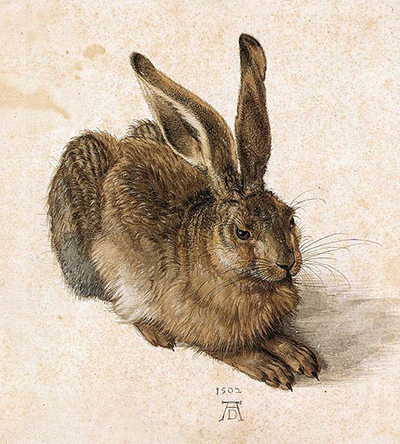
c. 1495; dating debatedYoung Hare
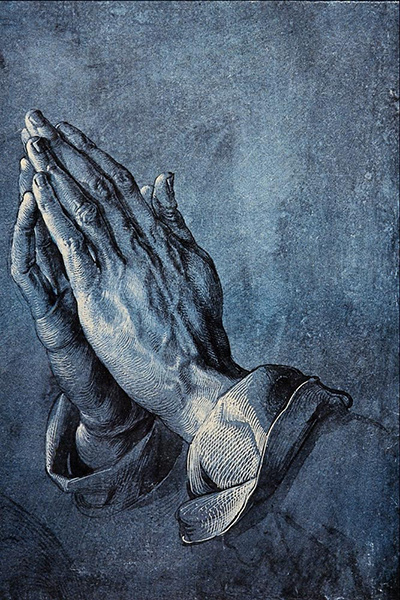
1502Praying Hands
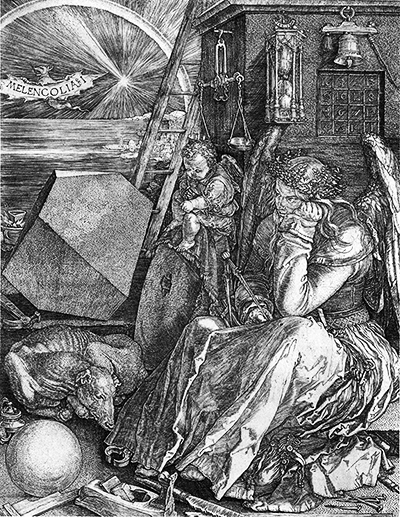
1508Melencolia I
1514Four Apostles
1526Contents
A closer look
The view crosses the Inn towards the old town. The ALBERTINA places the viewpoint near today's Waltherpark: the Hofburg is at the left and the Inn bridge at the right. Glungezer and Patscherkofl rise behind the buildings. A long, low riverfront binds the separate structures together. Within that band, roofs turn in different directions: a tall triangular face catches the light, a narrower roof presents its dark side, and little projecting turrets interrupt larger masses. The skyline offers a sequence of surprises. It can be followed almost as a line drawing, yet each turn is given weight through colour and shade. [1]
The water makes that architecture doubly visible. Reflections extend the buildings downward, carrying patches of pale masonry and darker roofing into an unsettled surface. These inverted forms do not have the clean edges of the structures above. They break into strips and darker strokes, especially towards the bottom of the sheet. Long horizontal marks cross the vertical reflections, so that the river seems to hold and disturb the town at the same time. Looking closely, one can see how much of the picture's movement occurs here. The buildings remain still while their colours travel through the foreground.
At the left, a low house stands close to the water beyond the more imposing enclosure. A long boat lies in front of the walls, its dark hull answering the horizontal bank. Tiny reddish and dark marks along the shore suggest the human activity that a distant view can easily swallow. They give the architecture a measure without becoming separate narrative episodes. There is no prominent traveller greeting us, no figure whose action explains the scene. We remain on the opposite bank, looking towards a town that has its own life beyond our immediate reach.
Dürer's contrast between the two sides is especially engaging. The left half crowds together contrasting roof heights, narrow gaps and repeated points. To the right, larger surfaces are less interrupted, and broad pale passages allow the buildings to spread. A wedge of mountainous distance appears between the groups. This small opening is important: it lets the eye escape the riverfront and establishes depth behind the architecture. The mountains consequently do more than frame a picturesque town. They enter the spaces left by its buildings and help make the city legible as a place within a landscape.
Friedrich Winkler's catalogue entry of 1936 responds to precisely this tension between minuteness and overall structure. He praised the exceptionally exact detail, warning that colour reproductions lost something of its precision and freshness. Yet he also found the buildings and mountains insufficiently grounded and the principal motifs insufficiently concentrated. His appraisal is useful because it preserves a critical response to a view that can otherwise seem effortless. The sheet rewards both readings: one may admire each little structure while noticing how lightly the entire town sits between the water and the sky. Winkler also cautioned against deciding the season from the sparse vegetation, snow and apparent water level; those indications could support more than one reading. [12]
The picture's layers of colour raise another question: how did this view become a finished image? The ALBERTINA's account proposes three campaigns: the left-hand buildings and all the river first, the right-hand town next, and the upper sky last. It describes the right side's paint as glassier and its detail as less precise, and suggests that the final clouded sky helped unite the work. This is an interpretation of the sheet's construction, not a record of three documented painting sessions. It encourages us to look across the image for differences in density and finish. On the left, many dark accents bind small architectural units together; on the right, colour spreads more broadly across the pale facades. Above, the cloud forms vary from softer grey patches to longer, more emphatic bands. These variations give the finished view an internal rhythm even when their exact working sequence remains uncertain. [1]
The date deserves similar care. In a letter from Venice of 7 February 1506, Dürer told Willibald Pirckheimer about the painters he encountered, praising Giovanni Bellini and contrasting his present judgement with what had pleased him eleven years earlier. That retrospective remark became an important basis for placing an earlier Venetian visit in 1495. The letter is vivid evidence of changing artistic taste, but it supplies no itinerary through Innsbruck and no date for this watercolour. Its usefulness depends on remembering the difference between a passing recollection in correspondence and the detailed travel chronology later built around it. [13]
Architectural history supplies another line of investigation. In his 2007 study, G. Ulrich Großmann questioned the precision of the familiar 1494–95 itinerary and made the scaffolded Wappenturm, left of centre, central to the argument. He also stressed that neither the snow nor the greenery could securely fix the season of a picture potentially developed after its initial observations. The ALBERTINA's extended 2012 discussion proposes observations made on a return journey around 1496–97, distinguishing this argument from the museum's current approximate date of 1495. It also describes the expanded river and compressed skyline as deliberate transformations. [14] [1]
Nicole Riegel's architectural study clarifies the difficulty. An inscription dated 1496, recorded in a later engraving, stood below the spire: the argument depends on how its position relates to construction. Riegel also notes that a sketched tower roof survives in the south-facing courtyard view, challenging earlier reasoning based on its supposed absence. The building's state and the painting's execution consequently require separate consideration. [15]
The buildings also carried political meaning. Riegel situates the Hofburg and Wappenturm within Maximilian's connected programme of residence building and public representation. After taking over Tirol in 1490, he inherited substantial buildings enlarged under Sigmund and developed them further; he was shaping an existing town. Riegel emphasises the strategic effect of princely architecture at its approaches and centre. Seen across the river, the varied towers accordingly belong to an urban contest of scale and presence. Their concentration gives Dürer's small sheet something of the imposing effect such buildings could make on an approaching visitor. This connection does not establish that Maximilian commissioned the watercolour. It helps explain why its architecture deserves attention as more than an attractive assortment of old roofs. [15]
The lettering offers a quieter distinction between the artist and the sheet's later life. Winkler identifies the place name Insprug above the view as Dürer's own addition and the adjacent AD monogram as another hand's work. The museum confirms this division. The name tells us what place the artist meant to preserve; the added initials belong to the subsequent identification of the object. The much larger visual evidence remains below them: a town observed with care and organised for looking. The picture makes room for both the recognisable place and the painter's decisions about distance, emphasis and finish. [12] [1]
Its appeal has also carried it into other forms. In 2026, the Innsbruck City Archive and City Museum published an oil version by Eduard Tenschert and reported eight versions of Dürer's view in its holdings, including reproductions, prints, a postcard and a metal replica. That local afterlife is revealing. An image made at a traveller's distance has become a reusable image of the city itself. In Dürer's sheet, however, the long stretch of shifting water continues to hold the viewer apart from the buildings. The town remains intimately described and physically distant, within a landscape large enough to exceed it. [16]
Frequently Asked Questions
Artworks directory
These 187 records include individual works, reverse sides, detail views, paired panels and reconstructed arrangements. Three additional catalogue images repeat works already listed. Related views are not counted as separate originals; qualified attributions and published dating are retained.
Discussion
Look again at the images and ideas explored in Innsbruck Seen from the North. These editorial prompts invite your observations.
Reader Insights
Which detail or idea in Innsbruck Seen from the North most changed your reading, and why?
How does the discussion of “A closer look” affect your understanding?
What comparison would you bring to the discussion of “A closer look”?
Join the Conversation
Share a detail, comparison or question about Innsbruck Seen from the North below.
References
- ALBERTINA , Innsbruck von Norden , inv. 3056. Current collection record and extended text from Kaiser Maximilian I. und die Kunst der Dürerzeit , edited by Eva Michel and Maria Luise Sternath, 2012, pp. 140–141; catalogue entry credited to Christof Metzger in the object's bibliography. German. View source .
- ALBERTINA, Selbstbildnis als Dreizehnjähriger, inv. 4839 (German). View source.
- Metropolitan Museum, Four Horsemen from The Apocalypse, 19.73.209 (English). View source.
- Bayerische Staatsgemäldesammlungen, Selbstbildnis im Pelzrock, inv. 537 (German). View source.
- ALBERTINA, Feldhase, inv. 3073 (German). View source.
- ALBERTINA, Das große Rasenstück, inv. 3075 (German). View source.
- Metropolitan Museum, Adam and Eve, 19.73.1 (English). View source.
- ALBERTINA, Betende Hände, inv. 3113 (German). View source.
- Metropolitan Museum, Knight, Death, and the Devil, 43.106.2 (English). View source.
- Metropolitan Museum, Melencolia I, 43.106.1 (English). View source.
- Bayerische Staatsgemäldesammlungen, inventory 545: current collection record (German; descriptive citation). View source.
- Friedrich Winkler , Die Zeichnungen Albrecht Dürers , vol. I, no. 66, pp. 52–53, Berlin: Deutscher Verein für Kunstwissenschaft, 1936. German. View source .
- Albrecht Dürer , letter to Willibald Pirckheimer, Venice, 7 February 1506, in William Martin Conway, Literary Remains of Albrecht Dürer , pp. 48–49, Cambridge University Press, 1889. Historical English translation; transcripts and notes credited to Lina Eckenstein. View source .
- G. Ulrich Großmann , “Albrecht Dürer in Innsbruck. Zur Datierung der ersten italienischen Reise”, in Das Dürer-Haus: Neue Ergebnisse der Forschung , edited by G. Ulrich Großmann and Franz Sonnenberger, Nuremberg, 2007. Publisher's excerpt, abstract p. 228 and text pp. 229–235. German, with English abstract. View source .
- Nicole Riegel , “Bausteine eines Residenzprojekts. Kaiser Maximilian I. in Innsbruck”, in The Habsburgs and their Courts in Europe, 1400–1700 , edited by Herbert Karner, Ingrid Ciulisová and Bernardo J. García García, PALATIUM e-Publications 1, 2014, especially pp. 28–32 and note 11, pp. 43–44. German. View source .
- Zoe Gabbe , “Innsbruck von Norden”, Innsbruck erinnert sich , Stadtarchiv/Stadtmuseum Innsbruck, 7 September 2026. German. View source .
- Germanisches Nationalmuseum, Barbara Dürer (German and English). View source.
- Web Gallery of Art, Tucher–Rieter reverse (English). View source.
- National Gallery of Art, Portrait of a Clergyman (English). View source.
- Dürer Art, Portrait of a Man (English). View source.
- Hessen Kassel Heritage, Elsbeth Tucher (German). View source.
- Web Gallery of Art, Hans Tucher (English). View source.
- Germanisches Nationalmuseum, Emperor Maximilian I (German and English). View source.
- National Gallery of Art, Lot and His Daughters, reverse (English). View source.
- Bayerische Staatsgemäldesammlungen, Glim Lamentation (German). View source.
- Museo Nacional del Prado, Portrait of a Man (Spanish). View source.
- Bayerische Staatsgemäldesammlungen, Madonna of the Carnation (German). View source.
- Städel Museum, Job on the Dungheap (German). View source.
- Wallraf-Richartz-Museum, Piper and Drummer (German). View source.
- Italian Ministry of Culture / Uffizi, Head of Saint James (Italian). View source.
- Klassik Stiftung Weimar, Dresden Altarpiece (German). View source.
- Staatliche Museen zu Berlin, Girl with a Red Beret (German and English). View source.
- Dresden State Art Museums / Roland Enke, Bernhard von Reesen (German). View source.
- Royal Collection Trust, Burkhard von Speyer (English). View source.
- Dresden State Art Museums, Seven Sorrows of the Virgin (English). View source.
- Bayerische Staatsgemäldesammlungen, Mater Dolorosa (German). View source.
- Bayerische Staatsgemäldesammlungen, Lucretia (German). View source.
- Städel Museum, Young Woman with Her Hair Down (English). View source.
- ALBERTINA, Portrait of a Young Man (German). View source.