


 by
Tom Gurney
Tom Gurney BSc (Hons) is an art history expert with over 20 years experience
Published on June 19, 2020 / Updated on October 22, 2026
Email:
tomgurney1@gmail.com
/ Phone:
+44 7429 011000
Innsbruck: The Hofburg and Wappenturm (Detail): Introduction
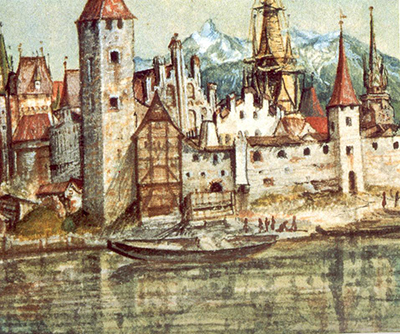
This is a detail of Albrecht Dürer’s Innsbruck Seen from the North , concentrating on the Hofburg and the scaffolded Wappenturm in the left part of the city. The complete watercolour belongs to the ALBERTINA in Vienna, inventory 3056, and is currently dated around 1495. Its dimensions, 12.7 × 18.7 cm, describe the whole sheet; the architectural group reproduced here occupies only part of that already small surface. The museum records watercolour, traces of opaque colour and white heightening. [1]
Enlargement changes the encounter with the buildings. In the complete view they belong to a low urban strip between river and sky. Here the roofs crowd the upper edge, and a tall, pale tower presses towards the spectator. Windows, timber framing and the broken rhythm of the gables become the main subjects. The boat below provides breathing space: its long hull lies almost horizontally beneath a cluster in which nearly everything points upwards. Dürer gives these small structures enough differences of shape and colour for the eye to move among them without losing the larger group.
At a Glance
- Object Detail of Innsbruck Seen from the North [1]
- Whole-sheet museum date About 1495 [1]
- Collection ALBERTINA, Vienna; 3056 [1]
- TypeDrawing [1]
This work across Albrecht Dürer’s career
Young Hare
1502Praying Hands
1508Melencolia I
1514Four Apostles
1526Contents
- A palace made from the city
- The tower inside its scaffold
- A public face beyond this viewpoint
- Architecture held in paint
- Frequently Asked Questions
A palace made from the city
The buildings have the accumulated appearance of a place repeatedly enlarged. A steep roof meets a stepped gable; a broad wall rises beside a narrow spire. Some surfaces are pale and relatively uninterrupted, while others are divided into small compartments by dark timbers. There is no single frontage from which the whole complex can be understood at once. Overlap supplies much of the information: one roof disappears behind another, and a tower emerges above buildings that conceal its lower levels.
That complexity has a historical basis. The federal authority responsible for the Hofburg explains that the palace incorporated elements of Innsbruck’s medieval fortifications: the Rumer or Saggen Gate to the east, a round tower at the northeast corner and a defensive tower to the northwest. Under Duke Sigismund, purchases and building work in 1453–63 extended the residence along Hofgasse and the eastern edge of the town. The palace’s development therefore joined domestic and ceremonial accommodation to structures that already marked and controlled the city boundary. [12]
The high walls and narrow openings place the ruler’s residence against the protected perimeter of the town. Across the river, we see an outside face. The windows offer little access to what lies behind them; the stepped outlines and coloured roofs do most of the work of distinguishing one component from its neighbour. A large building can be present as a roof and a few exposed edges while its rooms remain entirely hidden.
Architectural historian Nicole Riegel places Maximilian’s alterations within a larger residential project after he assumed rule in Tyrol in 1490. He inherited substantial, recently enlarged buildings from Sigismund. Her reconstruction connects the Hofburg, Wappenturm and other princely sites through their practical functions and their effect on the town. The complex developed through additions and connections, with particular attention to its appearance from outside. In the watercolour, that mixture of inherited fabric and conspicuous new work gives the skyline its uneven energy. [13]
The tower inside its scaffold
Near the centre of this detail, the Wappenturm rises within a dark framework. Sloping braces interrupt the narrow vertical form, while horizontal members cross it at different heights. The structure is especially compelling beside the finished red roof to its right. There, a continuous coloured surface carries the eye cleanly to a point. Around the Wappenturm, the eye meets crossings, interruptions and exposed supports. The juxtaposition makes construction itself part of the architectural spectacle.
This scaffold has also become evidence in a difficult dating question. In his 2012 study of Dürer’s architecture, G. Ulrich Großmann relates it to the tower’s recorded date of 1496. That date appeared on the stone window lintel of its uppermost masonry storey. He argues that the high wooden roof and its scaffold followed, placing the view in later 1496 or spring 1497. He also distinguishes the tower from the parish church tower by its position in the skyline. The ALBERTINA’s present label nevertheless remains around 1495. [14] [1]
The disagreement is worth retaining because the dating argument depends on a particular part of a building. A dated masonry feature does not necessarily date the roof above it; a scaffold records a building operation rather than a completed monument. Riegel’s discussion likewise explains that the interpretation of the 1496 inscription affects the chronology assigned to Dürer’s Innsbruck views. The slender structure in the picture thus carries unusual historical weight. Its appearance is temporary, yet that temporary appearance is precisely what scholars examine when they try to locate the drawing in time. [13]
At the scale of the original, the scaffold occupies a small area. Dürer does not need to describe every joint for its character to register. Dark strokes mark the framework against warmer colour, and the surrounding pale gables help detach it from the buildings below. The roof reaches above the more crowded mass around its base. Following that upward movement is one of the pleasures of the enlargement, even where the crop cuts away the highest part of the complete skyline.
A public face beyond this viewpoint
The name Wappenturm means “coat-of-arms tower”. The completed tower’s significance extended beyond the scaffolded form visible in Dürer’s view. The Stadtarchiv/Stadtmuseum Innsbruck describes a display of 54 territorial coats of arms painted by Jörg Kölderer, including lands Maximilian possessed and lands he claimed. Figures beside the passage carried the Habsburg lion and Tyrolean eagle; the royal arms of Maximilian and Bianca Maria Sforza crowned the arrangement. The tower addressed people entering the town at the end of Hofgasse. [15]
Dürer’s distant northern view cannot show that programme as a readable wall of heraldry. The conspicuous height belonged to a gateway designed to announce authority. Across the Inn, the tower becomes a landmark among other landmarks; for a traveller passing beneath it, the building delivered its message at closer quarters. The watercolour preserves one relationship between the monument and the town, while the painted façade supplied another.
The building continued to change. The federal history records subsequent restoration and overpainting of its decoration in 1526, 1604 and 1733. The Stadtarchiv explains that the former tower was eventually absorbed into the Hofburg’s southern roundel during the Baroque rebuilding under Maria Theresa. Its survival is therefore partly concealed by a later architectural form. The sharp outline Dürer recorded cannot be recovered simply by looking for an identical tower in today’s palace. [12] [15]
Architecture held in paint
For all its usefulness to building historians, this detail remains an image made with colour. The pale walls vary between warm and cool passages. Tiny dark openings punctuate them without becoming equally emphatic, and the timbered gable introduces a denser pattern close to the water. Below, reflections loosen the upright structures into wavering marks. The boat’s dark rim remains comparatively firm, separating the built shore from its less stable reflection. The water gives the architecture a second, broken existence.
The ALBERTINA proposes several painting campaigns for the whole sheet, beginning with the carefully developed left city group and the river, followed by the right side and then the upper sky. It also identifies an enlargement of the river space and compression of the skyline. Those observations discourage treating the architectural precision as a complete survey. Dürer could preserve recognisable buildings while adjusting the space through which they were seen. [1]
Returning to the whole watercolour restores the breadth excluded by the detail: more of the town extends to the right, and a broad sky opens above it. Returning to the enlargement reveals how much the small cluster contributes. Masonry, timber, pointed roofs and temporary scaffolding each have their own visual rhythm. Together they show a residence bound into the fabric of a town and still being transformed. The scaffold gives that history a visible, unusually fragile shape.
Frequently Asked Questions
Artworks directory
These 187 records include individual works, reverse sides, detail views, paired panels and reconstructed arrangements. Three additional catalogue images repeat works already listed. Related views are not counted as separate originals; qualified attributions and published dating are retained.
Discussion
Look again at the images and ideas explored in Innsbruck: The Hofburg and Wappenturm (Detail). These editorial prompts invite your observations.
Reader Insights
Which detail or idea in Innsbruck: The Hofburg and Wappenturm (Detail) most changed your reading, and why?
How does the discussion of “A palace made from the city” affect your understanding?
What comparison would you bring to the discussion of “Architecture held in paint”?
Join the Conversation
Share a detail, comparison or question about Innsbruck: The Hofburg and Wappenturm (Detail) below.
References
- ALBERTINA , Innsbruck von Norden , inventory 3056, current object record and text from Kaiser Maximilian I. und die Kunst der Dürerzeit , edited by Eva Michel and Maria Luise Sternath (Vienna, 2012), pp. 140–41. German. View source .
- ALBERTINA, Selbstbildnis als Dreizehnjähriger, inv. 4839 (German). View source.
- Metropolitan Museum, Four Horsemen from The Apocalypse, 19.73.209 (English). View source.
- Bayerische Staatsgemäldesammlungen, Selbstbildnis im Pelzrock, inv. 537 (German). View source.
- ALBERTINA, Feldhase, inv. 3073 (German). View source.
- ALBERTINA, Das große Rasenstück, inv. 3075 (German). View source.
- Metropolitan Museum, Adam and Eve, 19.73.1 (English). View source.
- ALBERTINA, Betende Hände, inv. 3113 (German). View source.
- Metropolitan Museum, Knight, Death, and the Devil, 43.106.2 (English). View source.
- Metropolitan Museum, Melencolia I, 43.106.1 (English). View source.
- Bayerische Staatsgemäldesammlungen, inventory 545: current collection record (German; descriptive citation). View source.
- Burghauptmannschaft Österreich , Imperial Palace Innsbruck: Its History , sections on medieval fortifications, Duke Sigismund and Maximilian I. English. View source .
- Nicole Riegel , “Bausteine eines Residenzprojekts. Kaiser Maximilian I. in Innsbruck”, in Herbert Karner, Ingrid Ciulisová and Bernardo J. García García, eds., The Habsburgs and their Courts in Europe, 1400–1700: Between Cosmopolitism and Regionalism , PALATIUM e-Publications 1 (2014), pp. 28–45, especially pp. 28, 30–35 and note 11, pp. 43–44. German. View source .
- G. Ulrich Großmann , “Die Architektur im Werk des jungen Dürer”, in Daniel Hess and Thomas Eser, eds., Der frühe Dürer (Nuremberg, 2012), pp. 221–35, especially p. 223. German. View source .
- Angelika Kollmann-Rozin , Stadtarchiv/Stadtmuseum Innsbruck, “Der Wappenturm”, 29 January 2022. German. View source .
- Germanisches Nationalmuseum, Barbara Dürer (German and English). View source.
- Web Gallery of Art, Tucher–Rieter reverse (English). View source.
- National Gallery of Art, Portrait of a Clergyman (English). View source.
- Dürer Art, Portrait of a Man (English). View source.
- Hessen Kassel Heritage, Elsbeth Tucher (German). View source.
- Web Gallery of Art, Hans Tucher (English). View source.
- Germanisches Nationalmuseum, Emperor Maximilian I (German and English). View source.
- National Gallery of Art, Lot and His Daughters, reverse (English). View source.
- Bayerische Staatsgemäldesammlungen, Glim Lamentation (German). View source.
- Museo Nacional del Prado, Portrait of a Man (Spanish). View source.
- Bayerische Staatsgemäldesammlungen, Madonna of the Carnation (German). View source.
- Städel Museum, Job on the Dungheap (German). View source.
- Wallraf-Richartz-Museum, Piper and Drummer (German). View source.
- Italian Ministry of Culture / Uffizi, Head of Saint James (Italian). View source.
- Klassik Stiftung Weimar, Dresden Altarpiece (German). View source.
- Staatliche Museen zu Berlin, Girl with a Red Beret (German and English). View source.
- Dresden State Art Museums / Roland Enke, Bernhard von Reesen (German). View source.
- Royal Collection Trust, Burkhard von Speyer (English). View source.
- Dresden State Art Museums, Seven Sorrows of the Virgin (English). View source.
- Bayerische Staatsgemäldesammlungen, Mater Dolorosa (German). View source.
- Bayerische Staatsgemäldesammlungen, Lucretia (German). View source.
- Städel Museum, Young Woman with Her Hair Down (English). View source.
- ALBERTINA, Portrait of a Young Man (German). View source.







