by
Tom Gurney
Tom Gurney BSc (Hons) is an art history expert with over 20 years experience
Published on June 19, 2020 / Updated on October 22, 2026
Email:
tomgurney1@gmail.com
/ Phone:
+44 7429 011000
Iris Troiana: Introduction
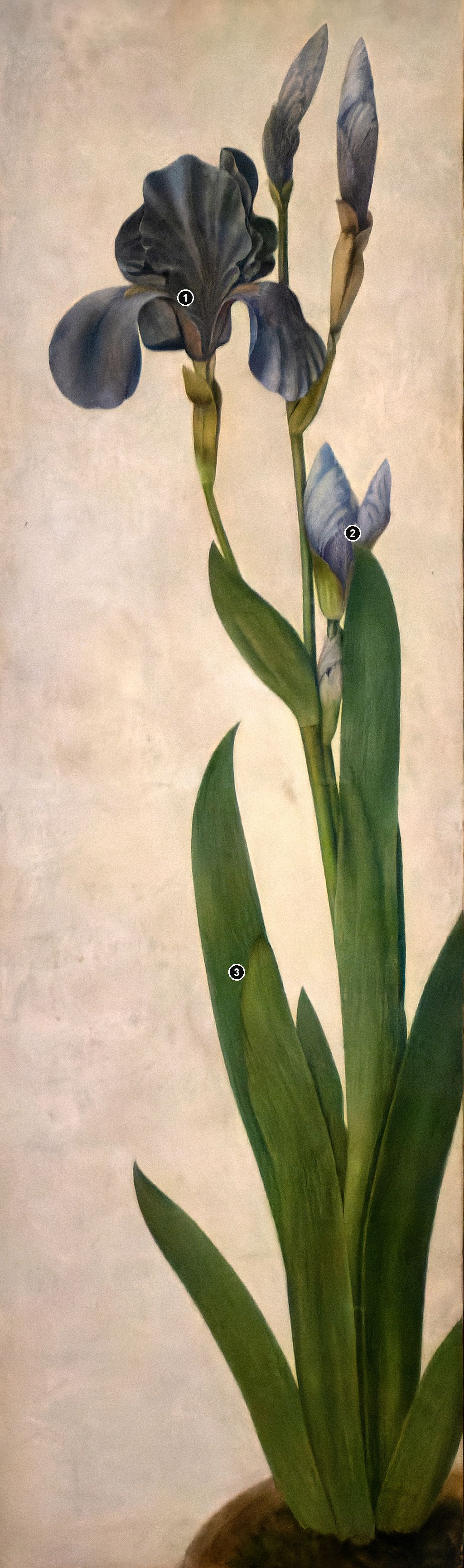
The iris usually called Iris Troiana rises through a remarkably narrow field of pale paper. Above the long green leaves, a dark blue flower spreads to the left; two closed buds stand higher on the right. The study belongs to Patrimonio Nacional at El Escorial. In the Museo Thyssen-Bornemisza’s 2007 exhibition guide it appears as Lirio , dated about 1503 and attributed to Albrecht Dürer. That qualification matters: this is a work associated with Dürer whose authorship should remain open in its description. [1]
The flower is immediately recognisable, yet its arrangement rewards a slower look. The open bloom has a broad, upright centre, with folds that converge towards its throat, and two heavy outer sections that turn downwards. Light catches the ridges between the dark hollows. The blue approaches black in the deepest recesses, while the projecting surfaces appear softer and greyer. The form suggests both the delicacy of a petal and the substantial weight of folded cloth. These details are especially clear in Ángel M. Felicísimo’s photograph, uploaded in September 2023, which records the whole slender image. [2]
At a Glance
- Attribution Attributed to Albrecht Dürer in the 2007 Thyssen exhibition guide [1]
- Date in that guide About 1503 [1]
- Collection Patrimonio Nacional, El Escorial [1]
- TypeDrawing [1]
This work across Albrecht Dürer’s career
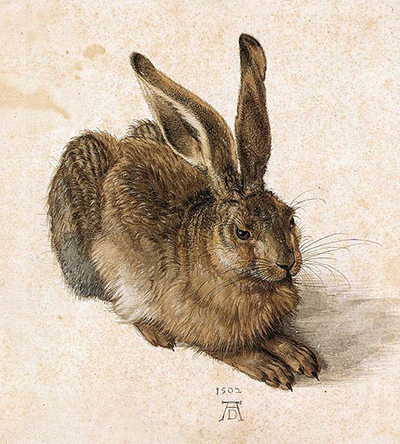
Young Hare
1502Iris Troiana (current article)
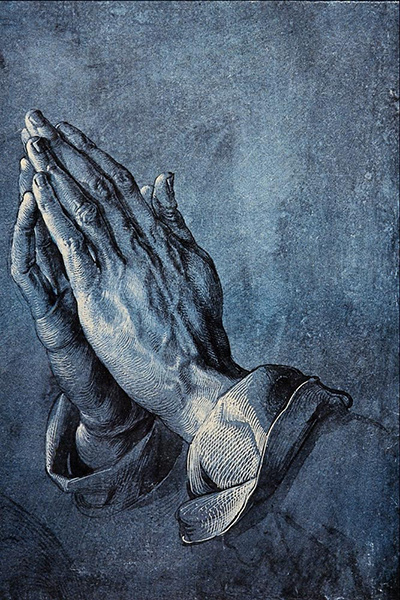
c. 1503; attributedPraying Hands
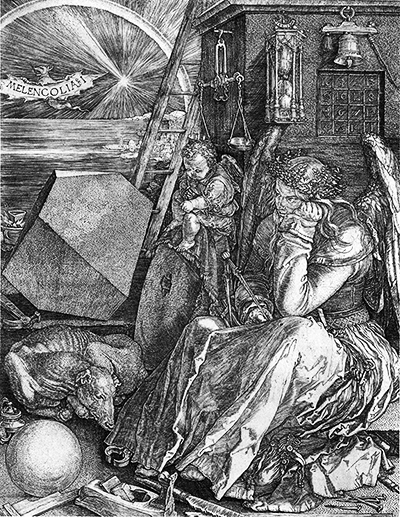
1508Melencolia I
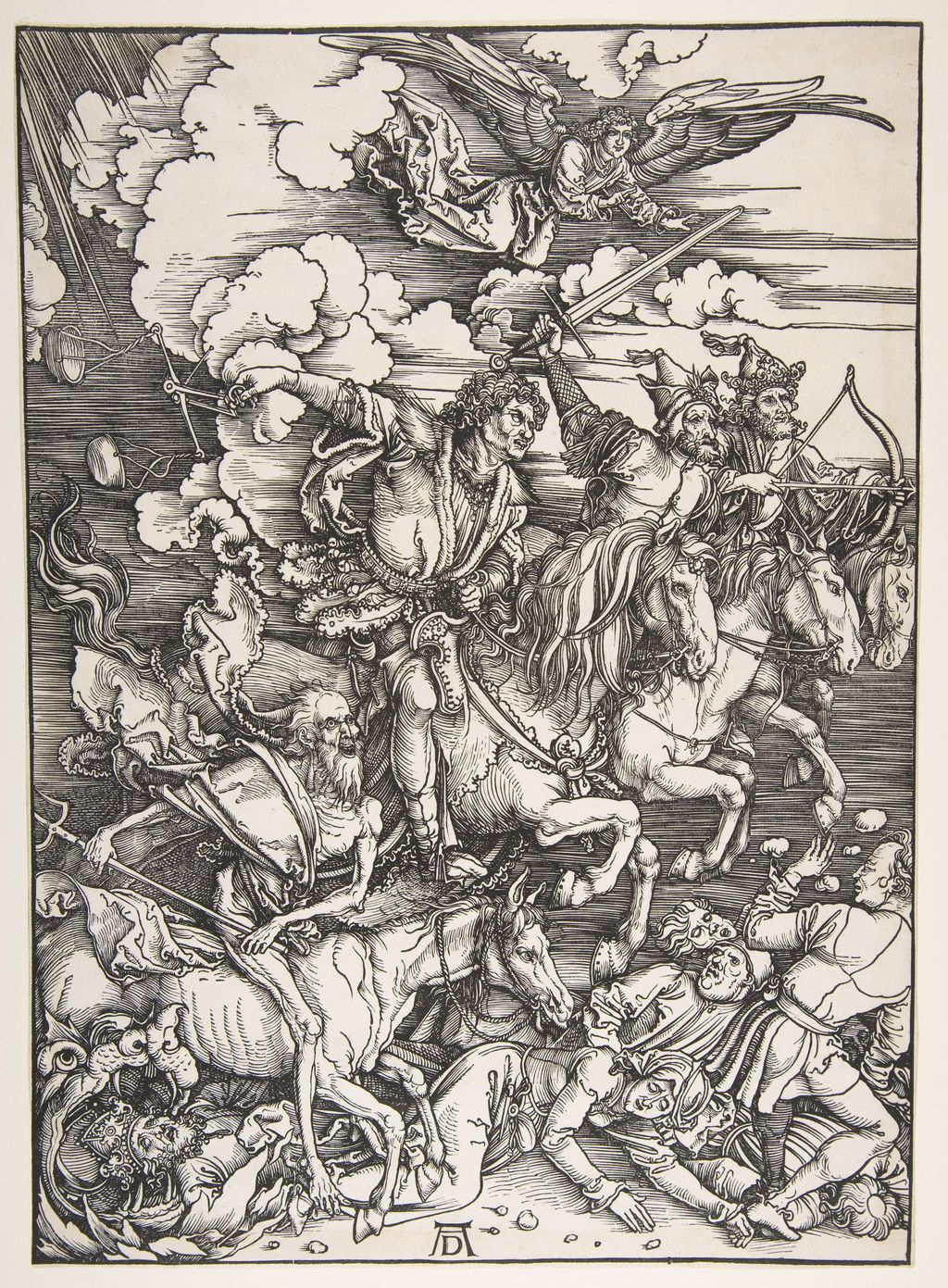
1514Four Apostles
1526Contents
- A plant arranged in space
- Colour, paper and the problem of dates
- Looking at nature, collecting its image
- An iris behind a blind
- Frequently Asked Questions
A plant arranged in space
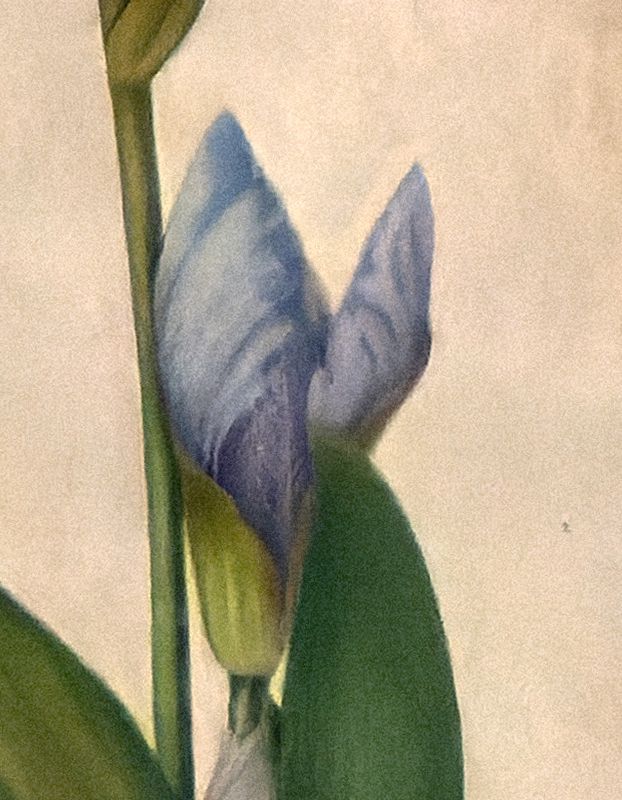
The open flower supplies the largest concentrated patch of blue, but it does not occupy the highest point. The two pointed buds extend above it, each on a narrow stem. Their closed surfaces keep the blue enclosed within a compact outline, making the expanded bloom seem more generous. Farther down on the right, a paler flower is beginning to open. Its pointed sections separate above a tightly wrapped base. Together, these forms allow the eye to compare enclosure, opening and full expansion within one plant.
Their positions also create an uneven rhythm. The open bloom pulls towards the left; the buds and smaller flower draw attention back to the right. The stems pass between these different centres of interest. Following them downwards reveals how much of the composition consists of intervals: a thin strip of background between two stems, a light triangular opening beside a leaf, a broad area of empty paper next to the upper flower. The plant’s outline is elaborate, but the surrounding space keeps its parts legible.
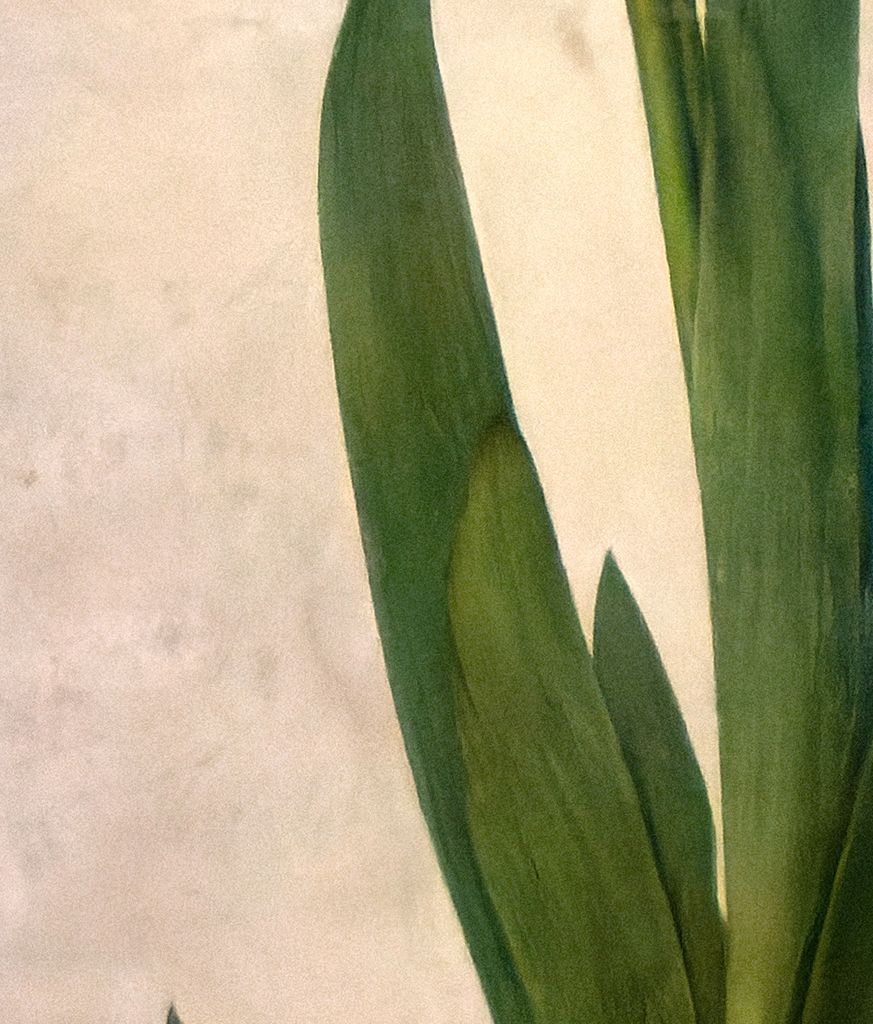
The leaves give the lower half a different character. Broad blades rise from a dense base and narrow towards sharp tips. Some remain nearly vertical; others swing outward, opening a fan around the central stalks. Darker streaks follow their length. Where a leaf bends or passes behind another, its edge helps distinguish one green surface from the next. The flower presents rounded, drooping forms above this more angular structure. That change of shape is one reason the bloom seems so soft.
At the bottom, the leaves gather above a small dark area enclosed by a rounded brown edge. Very little ground is supplied. There is no garden path, horizon or neighbouring plant to locate the iris within a larger scene. The pale field makes it possible to look from the base to the tallest bud without distraction. At the same time, the crowded leaves prevent the study from becoming a simple diagram of a single stem. Its subject is a particular growing form, with overlaps and uneven directions intact. [2]
Annotated Details from Iris Troiana: the Escorial study
Follow the open blue flower, the paler opening bloom and the overlapping green leaves.
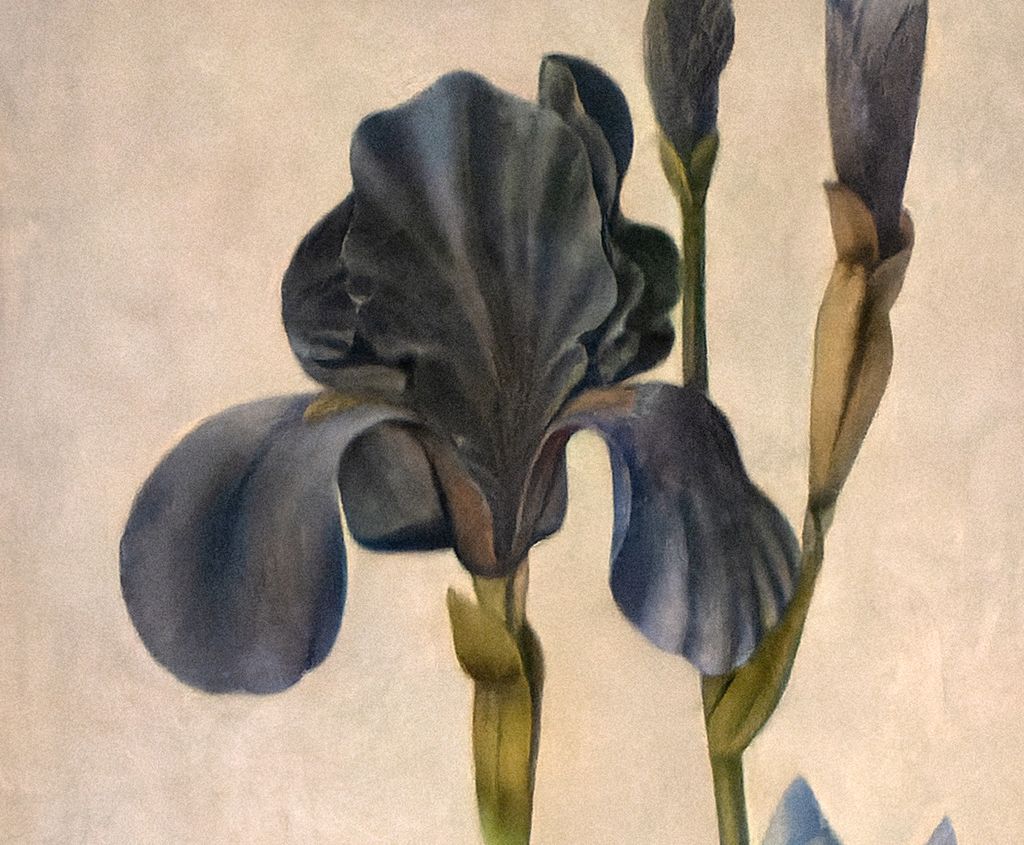
Details from IRIS TROIANA: THE ESCORIAL STUDY
Open the details to compare curved petals, pointed forms and the narrow spaces around the stems.
The open blue flower
Pale ridges run across the blue petals and converge towards the narrow throat. The outer sections turn downwards, leaving dark hollows beside their lighter folds.
A paler flower beginning to open
Pointed pale blue sections separate above a narrow green base. Their darker edges stand against the field of light paper.
Overlapping blades and pale openings
Long green blades overlap, their darker stripes running along the length of the leaves. Their sharp edges leave wedges of pale background.
Colour, paper and the problem of dates
The Thyssen guide describes the medium as watercolour and opaque colours and gives dimensions of 57.4 by 17.2 centimetres. The combination is useful to bear in mind while looking: the image includes fine tonal transitions as well as areas of dense blue and green. A photograph, however, cannot establish how individual passages were built up or identify their pigments. The visible modelling is clear; a reconstruction of the painter’s exact sequence would require examination of the object. [1]
Historical records preserve a broader set of material descriptions. A Spanish state exhibition-loan list published in 2002 identifies Lirio as Patrimonio Nacional inventory 10034458, dated about 1503, but calls it oil on paper and gives 60.5 by 20.5 centimetres. A 2017 selection list for the royal-collections museum repeats that inventory number and size, while listing wash, tempera and oil, with paper and board as supports. These administrative descriptions should be kept beside the more specific 2007 exhibition caption. They do not establish a new technical analysis, and the different measurements cannot safely be explained as framing or mounting without further evidence. [13] [14]
The name Iris Troiana can also lead to confusion with the much larger iris in the Kunsthalle Bremen. The Bremen sheet measures 77.5 by 31.3 centimetres and consists of two pieces of paper joined together. Its current museum record dates it to 1508, while explicitly stating that the date and monogram were added by another hand. Those are facts about the Bremen drawing. They do not give the narrow El Escorial study a secure date of 1508. Keeping the two objects distinct preserves the differences in their scale, format and documentary history. [15]
The tall format of the El Escorial image is itself expressive. It gives the leaves room to rise at length before the flowers appear. The viewer experiences a gradual ascent through green, followed by the release of the open blue bloom and the final, pointed accents of the buds. A reproduction reduced to the flower alone loses that proportion between the long supporting growth and the relatively small flowering crown.
Looking at nature, collecting its image
Ana Moreno’s text for the 2007 guide places the iris within an interest in scrutinising nature and demonstrating painting’s capacity to represent it convincingly. The leaves differ in width and direction; the flowers present more than one stage of opening. Their arrangement invites comparison between parts, as well as attention to the whole. [1] [2]
That experience has affinities with botanical illustration, although a plant portrait and a working herbal could serve different purposes. Arthur K. Wheelock Jr., discussing sixteenth-century flower imagery, explains that Hans Weiditz’s illustrations for Otto Brunfels’s 1530 herbal isolated plants and exposed their roots to aid identification. Here, the iris remains gathered into a compact base, with the underground structure concealed. The distinction helps explain what the picture offers: a sustained encounter with visible growth, without all the information that a botanical account might require. [16]
Flower imagery could also hold religious associations. Wheelock notes the iris’s connection with Mary as Queen of Heaven. Such a tradition made the plant available for devotional imagery, but does not by itself establish the purpose of this separate study. No sacred figure or narrative appears in it. Its careful rendering can be appreciated without assigning it a particular commission or making every leaf the bearer of a fixed message. [16]
The royal setting gives the image another historical dimension. In a 1923 article about Philip II’s apartments at El Escorial, José María Florit transcribed an early delivery description of a tall panel bearing an iris represented from nature. He placed this entry among deliveries of 1571–72. Florit also described finding small nature pictures together near the library, divided by mouldings within a shared glazed frame. His account presents their later arrangement as a group, rather than documenting an uninterrupted original installation. [17]
Florit confidently assigned the nature pictures to Dürer. That certainty belongs to the history of their reception; it cannot replace the qualified attribution in modern exhibition literature. A further inventory transcription published by Julián Zarco Cuevas in 1930 records a small elongated panel with an iris depicted on paper. The entry, numbered 889 bis, names the subject and support but supplies no artist’s name. Such descriptions provide valuable evidence for early royal interest in the subject while leaving questions about authorship unresolved. [18]
Art historian Ira Oppermann has situated an iris associated with Dürer within Philip II’s wider interest in natural history at El Escorial. Her discussion places European nature imagery alongside the collecting of other plants and animals, and within the environment surrounding the emergence of Spanish still-life painting. This offers a useful collecting context for the iris. It does not establish that it was painted for Philip II or that a later Spanish painter copied this particular image. [19]
The royal collection’s presentation has continued to change. In January 2025, the Royal Collections Gallery announced that the attributed irises it called Los Lirios were returning to El Escorial as part of a rotation. The notice explains that delicate materials such as paper need periods of rest between displays. Collection, temporary exhibition and present visibility are therefore separate matters; the historical association with El Escorial is no guarantee of seeing the picture on any particular visit. [20]
An iris behind a blind
The image has also prompted a striking contemporary response. Eugene Hön’s read peep reap , made in 2014, incorporates a ballpoint-pen reinterpretation of Iris Troiana . In his own account, Hön describes changing the flower’s colours to suggest bruised skin and using the work to consider the survival of skilled handmade practices. The drawing stands behind an operable blind: exposing it to light will contribute to its eventual fading. A sculptural book and an accompanying sequence of images complete the installation. [21]
Hön’s photographs make the transformation tangible. The familiar folds of the flower reappear in red, pink and blue, articulated through fine pen marks. The exhibition view places the framed bloom behind horizontal slats, with folded paper objects on the table below. His reinterpretation concentrates attention on the flower head and turns access to it into an action performed by the viewer. The El Escorial study, with its long ascent of leaves and stems, offers a more continuous freedom to look. Both images make the time spent attending to a flower part of their effect. [21]
Frequently Asked Questions
Artworks directory
These 187 records include individual works, reverse sides, detail views, paired panels and reconstructed arrangements. Three additional catalogue images repeat works already listed. Related views are not counted as separate originals; qualified attributions and published dating are retained.
Discussion
Look again at the images and ideas explored in Iris Troiana. These editorial prompts invite your observations.
Reader Insights
Which detail or idea in Iris Troiana most changed your reading, and why?
How does the discussion of “A plant arranged in space” affect your understanding?
What comparison would you bring to the discussion of “An iris behind a blind”?
Join the Conversation
Share a detail, comparison or question about Iris Troiana below.
References
- Ana Moreno , Durero y Cranach: Guía didáctica , Museo Thyssen-Bornemisza, 2007, pp. 22–23. Spanish. View source .
- Ángel M. Felicísimo , Alberto Durero ?, c. 1503 , photograph uploaded 22 September 2023. Spanish caption; photograph CC BY 2.0. View source .
- ALBERTINA, Selbstbildnis als Dreizehnjähriger, inv. 4839 (German). View source.
- Metropolitan Museum, Four Horsemen from The Apocalypse, 19.73.209 (English). View source.
- Bayerische Staatsgemäldesammlungen, Selbstbildnis im Pelzrock, inv. 537 (German). View source.
- ALBERTINA, Feldhase, inv. 3073 (German). View source.
- ALBERTINA, Das große Rasenstück, inv. 3075 (German). View source.
- Metropolitan Museum, Adam and Eve, 19.73.1 (English). View source.
- ALBERTINA, Betende Hände, inv. 3113 (German). View source.
- Metropolitan Museum, Knight, Death, and the Devil, 43.106.2 (English). View source.
- Metropolitan Museum, Melencolia I, 43.106.1 (English). View source.
- Bayerische Staatsgemäldesammlungen, inventory 545: current collection record (German; descriptive citation). View source.
- Ministerio de Educación , Cultura y Deporte, Orden ECD/2867/2002, 31 October 2002, published 14 November 2002; entry for Lirio , inventory 10034458. Spanish. View source .
- Museo de las Colecciones Reales , Selección inaugural de piezas , 22 June 2017, p. 13, item 60. Spanish. View source .
- Kunsthalle Bremen , Blaublühende Schwertlilie – Iris , inventory 1851/25 Z, collection record. German. View source .
- Arthur K. Wheelock Jr. , From Botany to Bouquets: Flowers in Northern Art , National Gallery of Art, Washington, 1999, pp. 16–20. View source .
- José María Florit , “Los aposentos de Felipe II en San Lorenzo del Escorial”, Boletín de la Sociedad Española de Excursiones , 31, December 1923, pp. 296–300, especially p. 298. Spanish. View source .
- Julián Zarco Cuevas , Inventario de las alhajas, relicarios, estatuas, pinturas, tapices y otros objetos de valor y curiosidad donados por el rey don Felipe II al Monasterio de El Escorial. Años de 1571 a 1598 , I, Boletín de la Real Academia de la Historia , 96, 1930, p. 665, entry 889 bis. Spanish. View source .
- Ira Oppermann , “Juan Sánchez Cotán: Bodegón de caza (1600/03)”, in Ralf Junkerjürgen and Helmut C. Jacobs, eds., Meisterwerke der spanischen Malerei in Einzeldarstellungen , Erich Schmidt Verlag, Berlin, 2018, pp. 39–40. German. View source .
- Galería de las Colecciones Reales , “Rotación en la Galería. El Beato de Liébana se exhibe en el ámbito dedicado a El Escorial y Felipe II”, 23 January 2025. Spanish. View source .
- Eugene Hön , read peep reap , artist’s statement and photographs for the 2014 installation; and “Iris Troiana – Read Peep and Reap”, 25 October 2014. View source 1 . View source 2 .
- Germanisches Nationalmuseum, Barbara Dürer (German and English). View source.
- Web Gallery of Art, Tucher–Rieter reverse (English). View source.
- National Gallery of Art, Portrait of a Clergyman (English). View source.
- Dürer Art, Portrait of a Man (English). View source.
- Hessen Kassel Heritage, Elsbeth Tucher (German). View source.
- Web Gallery of Art, Hans Tucher (English). View source.
- Germanisches Nationalmuseum, Emperor Maximilian I (German and English). View source.
- National Gallery of Art, Lot and His Daughters, reverse (English). View source.
- Bayerische Staatsgemäldesammlungen, Glim Lamentation (German). View source.
- Museo Nacional del Prado, Portrait of a Man (Spanish). View source.
- Bayerische Staatsgemäldesammlungen, Madonna of the Carnation (German). View source.
- Städel Museum, Job on the Dungheap (German). View source.
- Wallraf-Richartz-Museum, Piper and Drummer (German). View source.
- Italian Ministry of Culture / Uffizi, Head of Saint James (Italian). View source.
- Klassik Stiftung Weimar, Dresden Altarpiece (German). View source.
- Staatliche Museen zu Berlin, Girl with a Red Beret (German and English). View source.
- Dresden State Art Museums / Roland Enke, Bernhard von Reesen (German). View source.
- Royal Collection Trust, Burkhard von Speyer (English). View source.
- Dresden State Art Museums, Seven Sorrows of the Virgin (English). View source.
- Bayerische Staatsgemäldesammlungen, Mater Dolorosa (German). View source.
- Bayerische Staatsgemäldesammlungen, Lucretia (German). View source.
- Städel Museum, Young Woman with Her Hair Down (English). View source.
- ALBERTINA, Portrait of a Young Man (German). View source.
- Splash image , Attributed to Albrecht Dürer, Iris (Lirio), about 1503. Patrimonio Nacional, El Escorial. Photograph Ángel M. Felicísimo, 2023, CC BY 2.0. Resized; detail images cropped. Image source . CC BY 2.0 .