by
Tom Gurney
Tom Gurney BSc (Hons) is an art history expert with over 20 years experience
Published on June 19, 2020 / Updated on October 22, 2026
Email:
tomgurney1@gmail.com
/ Phone:
+44 7429 011000
Blue-Flowering Iris: Introduction
Albrecht Dürer’s Blue-Flowering Iris stretches almost the full height of its unusually narrow support. Three open flowers gather near the top, while the long stems travel down to a fan of pointed leaves. Much of the space between them remains empty. That spareness makes the branching plant easy to follow: the eye can climb from its base to the highest bloom, then return along a side stem to the smaller flowers. The Kunsthalle Bremen, which owns the drawing, currently dates it to 1508 and records watercolour, opaque colour and pen on two joined sheets of paper, measuring 775 × 313 millimetres. [1]
The height is essential to the experience. In a small reproduction the iris can look like a delicate flower illustration. The original is more than three-quarters of a metre tall. Its vertical reach gives the stems an almost architectural role, carrying the weight of the blooms above an open lower expanse. Although the flowers provide the richest colour, the distance separating them from the leaves contributes just as much to the picture’s character.
At a Glance
- Current museum date 1508 [1]
- Materials Watercolour, opaque colour and pen on two joined paper sheets [1]
- Collection Kunsthalle Bremen [1]
This work across Albrecht Dürer’s career
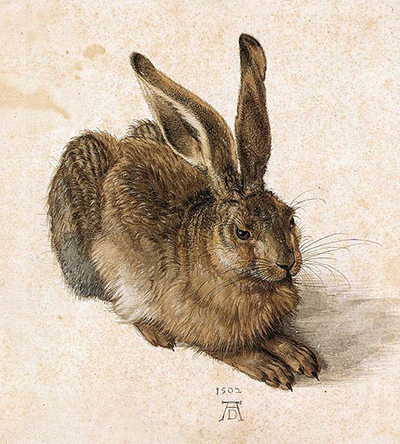
Young Hare
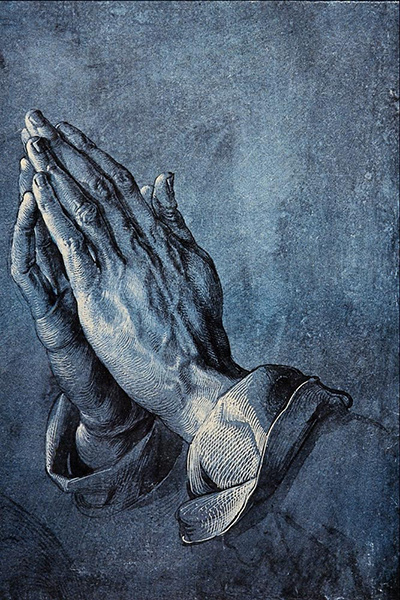
1502Praying Hands
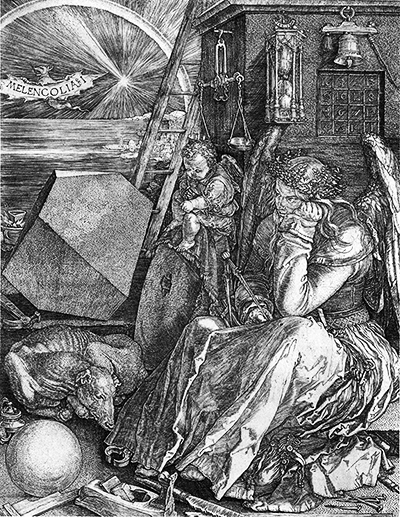
1508Melencolia I
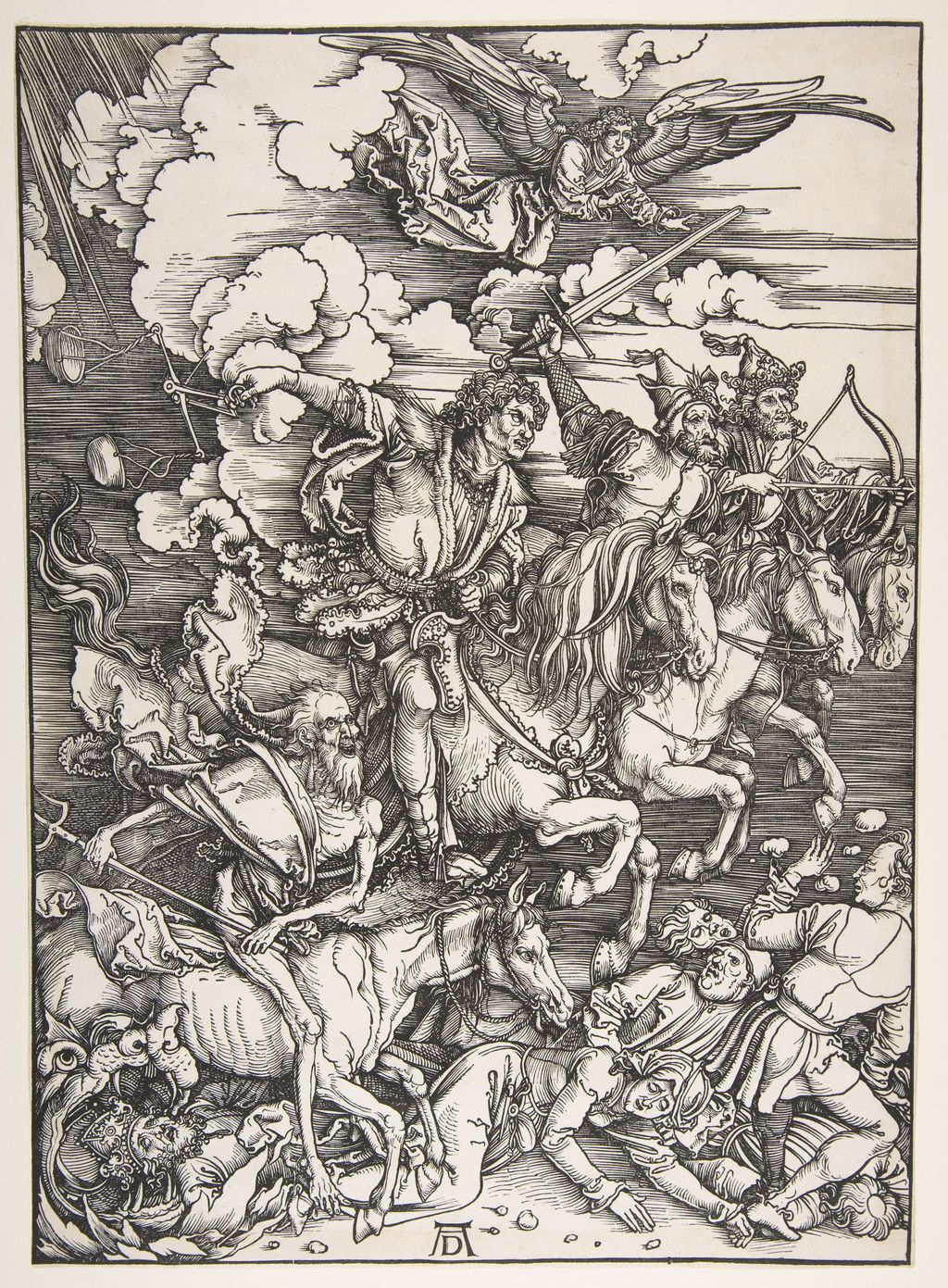
1514Four Apostles
1526Contents
- Following the plant
- A large painting on paper
- The date and the limits of exactness
- From the sheet to a painted garden
- The iris in Bremen
- Frequently Asked Questions
Following the plant
The main stem rises from the bottom towards the large flower slightly left of centre. A slender branch bends away to the left and ends in a closed bud, its dark violet point emerging from a green enclosure. On the right, another stem curves outward before supporting two flowers at different heights. The arrangement spreads gently as it rises. There is no rigid symmetry, yet the highest bloom and the two descending flowers make a loosely stepped crown.
The closed bud offers a particularly clear change of pace. Its shape is compact and sharply bounded; beside it, the upper flower opens into a complicated mixture of pale, curling surfaces and hanging dark forms. Looking between the two gives a sense of how much volume the blossom releases. The three open flowers also face and hang differently. Their variations invite comparison without needing to turn them into a fixed sequence of symbolic stages.
The colour becomes most intense in the downward petals. They appear deep blue-violet, almost black in their darkest folds, against much paler upper parts. Thin lines, changes of tone and irregular edges keep those pale areas from flattening into blank patches. The flowers look crumpled and pliable, with small turns of surface interrupting any simple outline. Their weight seems to pull against the upward movement of the stems.
Below them, green is equally varied. Some stretches of stem are yellow-green; others carry a darker edge that makes the stalk seem rounded. Small enclosing leaves hug the branches, while a longer pointed blade rises within the central opening. These interruptions prevent the tall stems from becoming anonymous lines. Each has local changes that reward the slow journey up the sheet.
The broadest leaves cluster towards the bottom, where their crossings create the densest part of the drawing. One sweeps through the left edge, and others bend, narrow or turn back on themselves. Dark bands run lengthways beside lighter green passages. Brownish tips and edges complicate the colour. The lowest forms curve away from the base, giving the plant a less tidy ending than the upright stems might suggest. Roots and a surrounding bed of soil are absent from the visible representation.
The blank ground helps all these shapes remain legible. There is no horizon or distant garden competing for attention, and no vase provides a second subject. Where the narrow stem crosses the pale support, a very small change in direction becomes conspicuous. Near the base, overlapping leaves briefly make the structure harder to untangle; above them, the long openings restore clarity. The drawing alternates between concentrated looking and generous intervals of space.
A large painting on paper
The joined support accommodates a plant whose proportions would resist a conventional compact rectangle. That physical extension matters even without knowing exactly when or how the two sheets were assembled. It would be speculative to reconstruct a moment when the artist ran out of paper and added another piece. What survives is a deliberately extended surface on which the flower can retain its long stems and widely separated parts. [1]
Watercolour and opaque colour offer different possibilities for describing those parts. A relatively transparent passage can suggest a thin, luminous surface; more covering paint can give a fold or edge greater substance. The visible result moves between slender linear description and broader coloured shapes. The museum also records pen, a reminder that the work combines drawing and painting rather than belonging neatly to only one category. [1]
The reproduction shows horizontal marks across the pale ground, alongside scattered spots and variations in its tone. These belong to the appearance of the surviving object. They should not all be read as joins: the catalogue specifies two sheets, and a photograph alone does not explain every line or change in the support. Equally, the present brownish and violet tones cannot establish the exact appearance of the freshly painted iris. The detailed colour relationships remain available to us, even where the material history needs specialist examination.
The date and the limits of exactness
The current Bremen catalogue’s 1508 date differs from the approximately 1503 given in the museum’s Google Arts & Culture entry. Bremen explicitly describes the date and monogram at the top, as well as the number 89 at the upper right, as being by another hand. The inscription therefore cannot serve as Dürer’s own dated declaration of authorship. The museum’s present dating and its identification of the added writing are separate judgements. [1] [12]
A similarly useful distinction concerns botanical precision. The plant is intensely particular: its bent leaves, variable flowers and tiny changes of colour are central to its appeal. Yet naturalistic conviction does not make a drawing an infallible botanical record. In his 1988 catalogue discussion of Dürer’s Stag Beetle , George R. Goldner reported the botanist M. A. Fischer’s observations of inaccuracies in both the Great Piece of Turf and the Bremen irises. Goldner used these examples to challenge the idea that scientific accuracy could decide an attribution by itself. [13]
This is an argument about how to assess pictures, rather than evidence that the Bremen drawing has lost its attribution. Goldner’s subject was the disputed beetle, and his discussion should not be converted into a new verdict on every nature study. For the iris, it usefully keeps two questions open at once: how closely the painter attended to a specimen, and how the finished image was organised. A convincing flower can contain selection, adjustment and error as well as exact observation.
From the sheet to a painted garden
The strongest specific connection with another work is the National Gallery’s Virgin and Child , often called The Madonna with the Iris . The Gallery currently attributes that painting to Dürer’s workshop with Hans Baldung Grien, possibly 1503–8. It identifies the painted iris as virtually identical to the Bremen watercolour. In the devotional picture, the iris belongs to a garden around Mary, and its sword-like form participates in the imagery of her sorrows. [14]
That context gives the flower a documented interpretive setting elsewhere. On the Bremen sheet, the isolated plant supplies no comparable narrative. The relationship allows us to see how a closely studied flower could acquire a particular religious role when placed beside a sacred figure. It offers a firmer connection than assigning a meaning to the purple colour alone.
Technical examination makes the relationship more interesting than a straightforward act of copying. Paul Ackroyd and his co-authors found that the London painting’s underdrawing contained a shorter iris, with two open flowers and several buds, positioned slightly to the right of the final flower. Areas had been reserved for that earlier design. The eventual iris was painted after the sky, without further drawing. A plant motif could thus be retained while its placement and treatment changed during the making of a larger image. [15]
This evidence supports the practical value of such studies within a workshop. It does not establish a dated commission for the Bremen sheet or prove that it was made solely for this painting. Nor do the dates settle into an effortless sequence: both the painting’s qualified date range and the different published datings of the watercolour require care. What the connection securely adds is a further life for the flower’s design, beyond its concentrated presence on paper.
The Great Piece of Turf offers a different comparison. The ALBERTINA dates that sheet to 1503 and records a width of 31.5 centimetres, remarkably close to the Bremen iris’s 31.3 centimetres, but a height of only 40.8 centimetres. Within nearly the same width, the two works accommodate very different kinds of growth. The turf gathers a crowded community of grasses and leaves close to the earth; the iris gives a single branching plant room to ascend. [6]
The ALBERTINA’s interpretation of the turf also emphasises the probable assembly of individually studied plants in the workshop. In its 2019 Dürer exhibition, curator Christof Metzger argued that highly finished nature studies could demonstrate the artist’s abilities to visitors and patrons. These proposals widen the possible uses of an elaborate sheet. A drawing could preserve a motif, support later painting and offer a compelling object of attention in its own right. None of those functions requires the iris to have been painted in one uninterrupted outdoor sitting. [6] [16]
The iris in Bremen
The lower-left collector’s stamp belongs to Josef Grünling, whose ownership is recorded by 1821. The drawing entered the Kunsthalle through Hieronymus Klugkist’s bequest in 1851. Before the Second World War, Bremen held 48 Dürer drawings and watercolours. The museum’s account of their subsequent dispersal places the surviving collection within a history of loss and recovery. [1] [12]
The connection with the painted Madonna with the Iris has a long history. In the English edition of his biography published in 1882, Moriz Thausing already suggested that the Bremen watercolour might have supplied the flower in that composition. He admired its broad handling and described its scale as natural size. His response draws attention to something easily lost when the work is reduced on a screen: minute detail operates within a large, confidently articulated plant. [17]
The iris continues to hold attention through the tension between its narrow format and expansive growth. At the top, pale and dark petals gather into intricate masses; below, the stems move through long stretches of open paper. The broad leaves finally bring those separate movements together. Its extraordinary detail is most persuasive when seen as part of that whole arrangement: a tall plant made readable through space, colour and the patient differentiation of its parts.
Frequently Asked Questions
Artworks directory
These 187 records include individual works, reverse sides, detail views, paired panels and reconstructed arrangements. Three additional catalogue images repeat works already listed. Related views are not counted as separate originals; qualified attributions and published dating are retained.
Discussion
Look again at the images and ideas explored in Blue-Flowering Iris. These editorial prompts invite your observations.
Reader Insights
Which detail or idea in Blue-Flowering Iris most changed your reading, and why?
How does the discussion of “Following the plant” affect your understanding?
What comparison would you bring to the discussion of “The iris in Bremen”?
Join the Conversation
Share a detail, comparison or question about Blue-Flowering Iris below.
References
- Kunsthalle Bremen , Blaublühende Schwertlilie – Iris , inventory 1851/25 Z. Current collection record. German. View source .
- ALBERTINA, Selbstbildnis als Dreizehnjähriger, inv. 4839 (German). View source.
- Metropolitan Museum, Four Horsemen from The Apocalypse, 19.73.209 (English). View source.
- Bayerische Staatsgemäldesammlungen, Selbstbildnis im Pelzrock, inv. 537 (German). View source.
- ALBERTINA, Feldhase, inv. 3073 (German). View source.
- ALBERTINA , Das große Rasenstück , inventory 3075. Collection record, including Heinz Widauer’s 2003 catalogue text. German and English. View source .
- Metropolitan Museum, Adam and Eve, 19.73.1 (English). View source.
- ALBERTINA, Betende Hände, inv. 3113 (German). View source.
- Metropolitan Museum, Knight, Death, and the Devil, 43.106.2 (English). View source.
- Metropolitan Museum, Melencolia I, 43.106.1 (English). View source.
- Bayerische Staatsgemäldesammlungen, inventory 545: current collection record (German; descriptive citation). View source.
- Kunsthalle Bremen , Blue Flag Iris , Google Arts & Culture. Collection essay and object information. View source .
- George R. Goldner , with Lee Hendrix and Gloria Williams, European Drawings 1: Catalogue of the Collections , J. Paul Getty Museum, 1988, catalogue 129, pp. 287–290, especially p. 288 and note 1 on p. 290. View source .
- National Gallery , London, The Virgin and Child (‘The Madonna with the Iris’) , NG5592. Collection record and in-depth discussion. View source .
- Paul Ackroyd , Susan Foister, Marika Spring, Raymond White and Rachel Billinge, “A Virgin and Child from the Workshop of Albrecht Dürer?”, National Gallery Technical Bulletin 21, 2000, pp. 28–42, section “Evolution of the Composition”. View source .
- ALBERTINA , Albrecht Dürer , exhibition press dossier, 2019, pp. 5 and 9–10; exhibition curated by Christof Metzger. German. View source .
- Moriz Thausing , Albert Dürer: His Life and Works , vol. II, translated from the German, edited by Fred. A. Eaton, London: John Murray, 1882, p. 9. View source .
- Germanisches Nationalmuseum, Barbara Dürer (German and English). View source.
- Web Gallery of Art, Tucher–Rieter reverse (English). View source.
- National Gallery of Art, Portrait of a Clergyman (English). View source.
- Dürer Art, Portrait of a Man (English). View source.
- Hessen Kassel Heritage, Elsbeth Tucher (German). View source.
- Web Gallery of Art, Hans Tucher (English). View source.
- Germanisches Nationalmuseum, Emperor Maximilian I (German and English). View source.
- National Gallery of Art, Lot and His Daughters, reverse (English). View source.
- Bayerische Staatsgemäldesammlungen, Glim Lamentation (German). View source.
- Museo Nacional del Prado, Portrait of a Man (Spanish). View source.
- Bayerische Staatsgemäldesammlungen, Madonna of the Carnation (German). View source.
- Städel Museum, Job on the Dungheap (German). View source.
- Wallraf-Richartz-Museum, Piper and Drummer (German). View source.
- Italian Ministry of Culture / Uffizi, Head of Saint James (Italian). View source.
- Klassik Stiftung Weimar, Dresden Altarpiece (German). View source.
- Staatliche Museen zu Berlin, Girl with a Red Beret (German and English). View source.
- Dresden State Art Museums / Roland Enke, Bernhard von Reesen (German). View source.
- Royal Collection Trust, Burkhard von Speyer (English). View source.
- Dresden State Art Museums, Seven Sorrows of the Virgin (English). View source.
- Bayerische Staatsgemäldesammlungen, Mater Dolorosa (German). View source.
- Bayerische Staatsgemäldesammlungen, Lucretia (German). View source.
- Städel Museum, Young Woman with Her Hair Down (English). View source.
- ALBERTINA, Portrait of a Young Man (German). View source.