


 by
Tom Gurney
Tom Gurney BSc (Hons) is an art history expert with over 20 years experience
Published on June 19, 2020 / Updated on October 22, 2026
Email:
tomgurney1@gmail.com
/ Phone:
+44 7429 011000
Charlemagne: The Costume Study: Introduction
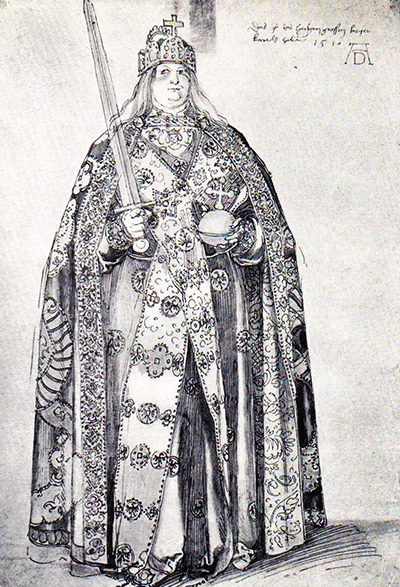
Charlemagne almost disappears into his clothes. A crown, an upright sword and an orb establish his rank, but the broad sweep of the mantle gives this figure its extraordinary presence. It expands from his shoulders to the ground, enclosing the body in a continuous, richly patterned shape. Dürer made the drawing in 1510, using a pen in black-blue ink and watercolour. The sheet measures 41.5 × 28.4 centimetres and belongs to the ALBERTINA in Vienna, inventory number 3125. [1]
The emperor stands alone on the paper, with little more than a few strokes beneath his feet to suggest a setting. That isolation directs attention to how everything fits together: the crown above the hair, the sword beside the shoulder, the orb supported at waist level, and the garments opening and overlapping beneath them. The drawing lets us examine a costume as a whole before following its transformation into the imposing painted Charlemagne now in Nuremberg.
At a Glance
This work across Albrecht Dürer’s career
Young Hare
1502Praying Hands
1508Melencolia I
1514Four Apostles
1526Contents
- A figure built from fabric
- What Dürer meant by *habitus*
- An old emperor in later clothes
- From study to civic painting
- A working sheet becomes a collected drawing
- Frequently Asked Questions
A figure built from fabric
Seen from a distance, the outline resembles a bell. The shoulders curve into the sides of the mantle, while the spreading hem gives the figure a broad base. Within that stable outline, Dürer creates considerable movement. Long folds descend between the hands and feet. Shorter lines gather around the wrists, where the cloth must accommodate the arms. At the bottom, the material bunches and turns over, bringing this apparently ceremonial figure into contact with the ground.
The two hands provide different kinds of support. On the left of the image, fingers close around the sword's grip; on the right, the other hand cups the orb from below. These actions make the objects feel held. The sword introduces a strong diagonal into the otherwise upright arrangement, reaching almost to the top edge. Its narrow, comparatively plain blade offers the eye a route through the surrounding ornament. The orb supplies an opposite shape: a broad, rounded surface beneath a small cross.
Most of the sheet's colour remains light enough for the pen work to show clearly. Yellow spreads across the front of the costume and the orb, red appears in the outer mantle and its ornamental borders, and cooler violet passages mark the deeper folds. The sword has a pale blue-grey tint. These washes help separate adjacent surfaces without covering the network of lines. Particularly around the central garment, an area of yellow can contain both a fold and a tiny ornamental curl; colour and drawing perform different jobs at the same time.
Dürer also varies the scale of decoration. Small eagles enclosed in circles recur down the front, while larger curling forms fill the outer mantle. Between them run narrow borders crowded with flowers and other repeated shapes. The patterns change direction as the fabric folds. Some are fully exposed, others cut off at an overlap or turned around an edge. This prevents the clothing from reading as a flat display of embroidery. Its abundance belongs to an object being worn, with some of its decoration necessarily hidden.
The head is remarkably quiet among these busy surfaces. Long, light hair falls onto the shoulders; the cheeks are full, the mouth small, the chin without the flowing beard familiar from the painting. The face occupies only a small part of the composition. Our attention repeatedly returns to the clothing that gives the standing figure its breadth and ceremonial weight.
What Dürer meant by *habitus*
At the upper right, Dürer identifies his subject in his own handwriting: “Das ist des heilgen grossen keiser karels habitus,” followed by the year. In English, the sense is: this is the attire of the holy great Emperor Charles. His monogram appears nearby. The word habitus makes the emphasis unusually explicit. The drawing presents the emperor through the things he wears and carries. It gives us an arrangement of imperial dress whose parts can be recognised and considered together. [1]
The inscription also gives a name to a face that has little individualising force. The crown and dress establish an emperor; the words identify this emperor as Charles. Text and image reinforce each other across the empty upper corner. Dürer leaves enough space around the writing for it to be read separately from the intricate costume, while the tall sword balances its position on the opposite side.
The ALBERTINA suggests that the explanatory inscription might indicate a design submitted to Nuremberg's council, or a sheet sold later. The visible finish is compatible with showing the design to someone else: its complete figure, colour and written identification would allow a viewer to understand the proposal. They cannot, by themselves, tell us who first received it. [1]
The surviving work also formed part of a larger investigation. Dürer was given access to the regalia themselves. In his study of Dürer and the imperial regalia, Albert Bühler lists seven costume and object sheets, including the full figure, sword, orb, crown, glove and mantle studies. A complete dressed body and an isolated object answer different questions. Here Dürer could test the balance of the ensemble; separate drawings allowed him to concentrate on individual pieces. The full-length sheet brings those pieces into a single human scale, with the hands and head showing how they would relate to a wearer. [1] [12]
An old emperor in later clothes
The costume has a complicated relationship with history. The imperial regalia represented in Dürer's painted Charlemagne were believed to connect their later custodians with the emperor, although the objects were made after his death. The mantle offers a particularly clear example. Its present museum dates it to 1133–34 and identifies its origin in Palermo's royal workshops under Roger II of Sicily. Its red silk carries gold embroidery, pearls and an Arabic inscription. The animal decoration includes lions overcoming camels, arranged around a central palm. [13] [14]
Those facts change the way we look at the drawing's large patterned surfaces. The costume brings together objects with histories of their own, and its luxurious appearance helped make them convincing bearers of imperial memory. Dürer was depicting an inherited ceremonial ensemble associated with Charlemagne. The care of his observation does not make that ensemble a record of what Charles wore around the year 800.
An earlier account gives a useful comparison. In chapter 23 of his Life of Charlemagne , Einhard describes the emperor's usual Frankish clothing, including a tunic, leg coverings and a blue cloak. He also distinguishes occasions when Charles wore embroidered garments, jewelled shoes and a crown of gold and gems. This provides written evidence for magnificence on ceremonial days, but it does not identify the later surviving mantle or the particular crown drawn by Dürer. The text and sheet preserve different ways of making an emperor visible: one through a description of his habits, the other through a costume assembled for his commemoration centuries later. [15]
From study to civic painting
The destination of this work was a Nuremberg commission. The city council ordered paintings of Charlemagne and Emperor Sigismund for the Schopper house on the main market square. The regalia rested there on the night before their annual public display. According to the Germanisches Nationalmuseum's account, the panels turned beside a recess or shrine: open, they revealed the emperors; closed, they presented inscriptions and coats of arms. The museum dates the paintings to about 1511–13. Franz Matsche instead interprets them as a hinged pair supporting the public presentation of the treasures. Their exact installation remains debated. [13] [16]
That setting helps explain the attention paid to dress. The images belonged near the objects whose importance they embodied. A person looking at the costume could see how separate treasures became a ceremonial whole when placed on a ruler. The drawing already addresses this task with unusual clarity, exposing the full descent of the garments to the ground. It gives more information about their overall arrangement than the finished painting's shorter view can contain.
Several changes become apparent when the two images are placed together. The drawing's fresh-faced, beardless figure becomes a grave, bearded elder in the panel. The ALBERTINA relates this change to the council's decision to present Charlemagne as a venerable old man. In the painting, the beard spreads across the upper chest, adding another textured mass between crown and clothing. The dark background and tighter framing bring the head much closer to the viewer. The costume remains elaborate, but it now surrounds a face with a much stronger claim on our attention. [1]
The hands change too. In the drawing, Dürer traces the fingers directly around sword and orb. In the painting they wear patterned gloves, adding another decorated surface to an already crowded centre. Bühler drew attention to the absence of gloves in the full-length study. It is a small difference with a substantial effect: bare fingers make the study's handling of the objects seem practical and immediate, while the gloves carry the finished image's ornament right to the points where the ruler touches his insignia. [12]
The orb's cross also changes its angle. It stands almost upright in the study and tilts in the painting. Bühler observes that the painted arrangement sets the bright cross against a dark area of clothing, improving its visibility. The adjustment is easy to appreciate beside the drawing, where the cross sits among patterns of similar visual weight. Dürer's detailed work could therefore support further decisions about clarity. Preparing the individual pieces did not remove the need to rearrange them within the final image. [12]
A working sheet becomes a collected drawing
The paintings went to Nuremberg's town hall in 1526 after the end of the public relic displays. The drawing followed a separate course. The ALBERTINA records it in Willibald Imhoff's collection as drawing 67 in the 1588 inventory, then passing to Emperor Rudolf II that year. It entered Duke Albert of Saxe-Teschen's collection in 1796. [13] [1]
Its survival allows us to see an imperial image while important choices were still open. The broad costume, the disposition of the objects and the full standing body are already established, while the face and some ceremonial details differ from the panel. The sheet rewards looking at both levels. From across a room, its widening outline holds together as a single figure; close up, the pen follows borders, fingers, curls and folds with persistent attention. Between those scales, Dürer makes a collection of precious things into something a person could wear.
Frequently Asked Questions
Artworks directory
These 187 records include individual works, reverse sides, detail views, paired panels and reconstructed arrangements. Three additional catalogue images repeat works already listed. Related views are not counted as separate originals; qualified attributions and published dating are retained.
Discussion
Look again at the images and ideas explored in Charlemagne: The Costume Study. These editorial prompts invite your observations.
Reader Insights
Which detail or idea in Charlemagne: The Costume Study most changed your reading, and why?
How does the discussion of “A figure built from fabric” affect your understanding?
What comparison would you bring to the discussion of “A working sheet becomes a collected drawing”?
Join the Conversation
Share a detail, comparison or question about Charlemagne: The Costume Study below.
References
- ALBERTINA , Vienna, Karl der Große , 1510, inventory 3125. Object record, inscription, provenance and catalogue text associated with Thomas Schauerte, in Eva Michel and Maria Luise Sternath, eds., Kaiser Maximilian I. und die Kunst der Dürerzeit (2012), cat. 24, p. 174. German. View source .
- ALBERTINA, Selbstbildnis als Dreizehnjähriger, inv. 4839 (German). View source.
- Metropolitan Museum, Four Horsemen from The Apocalypse, 19.73.209 (English). View source.
- Bayerische Staatsgemäldesammlungen, Selbstbildnis im Pelzrock, inv. 537 (German). View source.
- ALBERTINA, Feldhase, inv. 3073 (German). View source.
- ALBERTINA, Das große Rasenstück, inv. 3075 (German). View source.
- Metropolitan Museum, Adam and Eve, 19.73.1 (English). View source.
- ALBERTINA, Betende Hände, inv. 3113 (German). View source.
- Metropolitan Museum, Knight, Death, and the Devil, 43.106.2 (English). View source.
- Metropolitan Museum, Melencolia I, 43.106.1 (English). View source.
- Bayerische Staatsgemäldesammlungen, inventory 545: current collection record (German; descriptive citation). View source.
- Albert Bühler , “Albrecht Dürer und die deutschen Reichskleinodien: Einige Fragen und Feststellungen,” Mitteilungen des Vereins für Geschichte der Stadt Nürnberg 58 (1971), pp. 139–160, especially pp. 145 and 149. German. View source .
- Germanisches Nationalmuseum , Kaiser Karl der Große , Gm167, object record and essays; paired with Gm168. German. View source .
- Kunsthistorisches Museum , Vienna, Der Krönungsmantel , WS XIII 14, current object record. German. View source .
- Einhard , The Life of Charlemagne , chapter 23, “Dress”, translated by Samuel Epes Turner (New York: Harper & Brothers, 1880), reproduced by Fordham University's Internet Medieval Sourcebook. English translation of Latin. View source .
- Franz Matsche , “Karl der Große und das Benediktinerkloster St. Mang in Füssen,” Rund um den Säuling 3 (2014), pp. 35–71, especially pp. 50–52. German. View source .
- Germanisches Nationalmuseum, Barbara Dürer (German and English). View source.
- Web Gallery of Art, Tucher–Rieter reverse (English). View source.
- National Gallery of Art, Portrait of a Clergyman (English). View source.
- Dürer Art, Portrait of a Man (English). View source.
- Hessen Kassel Heritage, Elsbeth Tucher (German). View source.
- Web Gallery of Art, Hans Tucher (English). View source.
- Germanisches Nationalmuseum, Emperor Maximilian I (German and English). View source.
- National Gallery of Art, Lot and His Daughters, reverse (English). View source.
- Bayerische Staatsgemäldesammlungen, Glim Lamentation (German). View source.
- Museo Nacional del Prado, Portrait of a Man (Spanish). View source.
- Bayerische Staatsgemäldesammlungen, Madonna of the Carnation (German). View source.
- Städel Museum, Job on the Dungheap (German). View source.
- Wallraf-Richartz-Museum, Piper and Drummer (German). View source.
- Italian Ministry of Culture / Uffizi, Head of Saint James (Italian). View source.
- Klassik Stiftung Weimar, Dresden Altarpiece (German). View source.
- Staatliche Museen zu Berlin, Girl with a Red Beret (German and English). View source.
- Dresden State Art Museums / Roland Enke, Bernhard von Reesen (German). View source.
- Royal Collection Trust, Burkhard von Speyer (English). View source.
- Dresden State Art Museums, Seven Sorrows of the Virgin (English). View source.
- Bayerische Staatsgemäldesammlungen, Mater Dolorosa (German). View source.
- Bayerische Staatsgemäldesammlungen, Lucretia (German). View source.
- Städel Museum, Young Woman with Her Hair Down (English). View source.
- ALBERTINA, Portrait of a Young Man (German). View source.







