



 by
Tom Gurney
Tom Gurney BSc (Hons) is an art history expert with over 20 years experience
Published on June 19, 2020 / Updated on October 22, 2026
Email:
tomgurney1@gmail.com
/ Phone:
+44 7429 011000
Lamentation from the Large Passion: Introduction
Christ's body stretches almost across the full width of Albrecht Dürer's Lamentation . His feet approach the left border, while his head rises into the crowded group at the right. Around him, faces bend, hands meet and heavy garments gather into folds. Above this intimate scene, trees open onto a landscape containing the distant site of the Crucifixion. Dürer brings the aftermath of a public execution close enough for the viewer to study the care given to a single body. Made about 1498–99, this woodcut belongs to the Large Passion and is catalogued as Bartsch 13 and Meder 122. [1] [2]
The composition offers several ways of approaching grief. A seated woman at the left holds a hand towards her chest and looks across the body. Near the centre, a veiled mourner bends low over Christ, close to his raised hand. Others crowd behind his shoulders. Their faces occupy different angles, with some directed downwards and others turned towards their companions. Dürer gives the group a common focus while allowing each person a different physical response. The mourners' closeness is especially affecting because Christ's extended limbs leave so much of his body exposed. [2]
The white of the paper supplies the light on his chest, abdomen and legs. Shorter strokes describe the muscles, joints and ribs; heavier darks accumulate beneath the body and between the surrounding figures. His upturned face remains visible above the long fall of his hair. The cloth under him curves around the lower edge of the group, both receiving his weight and separating his skin from the rough ground. Beside the feet lies the crown of thorns. The instrument of torment has become an abandoned object, small enough to overlook until the eye follows the body towards the left corner. At the lower centre, Dürer's AD monogram occupies a small opening between the body and the border. [2]
Drapery makes the stillness difficult to settle into. Sleeves swell, veils hang in narrow strips, and the cloth below Christ breaks into pointed folds. The central mourner's bent head and hands are enclosed by several overlapping layers. Around the figure supporting Christ at the right, the garment opens into broad, lighter areas. These changes of density keep the figures distinct within a tightly packed group. They also make the exposed body unusually legible: its longer contours can be followed through a field of restless marks. [2]
A tall tree rises behind the standing woman, dividing the upper landscape without closing it. Through the openings on either side, the eye discovers hills, buildings, smaller trees and birds. At the upper left, crosses stand on a distant rise, reached by a path along which tiny figures move. The place of execution is therefore still present, but its scale has changed. Seen beside the mourners, the landscape gives the body a history and a location; seen from the distant hill, the foreground would be only a small gathering. Dürer holds those two distances within one sheet. [2]
Princeton University Art Museum interprets the swooping birds and sinuous branches as expressions of grief extending into nature. That reading draws attention to the way the tree's curves answer the folds below it. The branches spread above the mourners like another network of agitated gestures. Yet the landscape also opens a breathing space over the compressed foreground. Its visual activity can sustain both effects: emotional disturbance and the continued existence of a world beyond this immediate loss. [2]
At a Glance
- Design date About 1498–1499 [1] [2]
- Process Woodcut [1] [2]
- Series Large Passion; Bartsch 13, Meder 122 [1] [2]
This work across Albrecht Dürer’s career
Young Hare
1502Praying Hands
1508Melencolia I
1514Four Apostles
1526Contents
- A pause between death and burial
- One design, different printed sheets
- From the printed gathering to a memorial painting
- Frequently Asked Questions
A pause between death and burial
The Gospel of John supplies a useful narrative framework. It places Christ's mother and other women near the cross, records his death and the piercing of his side, and then describes Joseph of Arimathaea obtaining permission to remove the body. Nicodemus brings burial spices, and the body is wrapped in linen before being placed in a nearby new tomb. John does not narrate a separate gathering of mourners in precisely the arrangement shown here. Dürer's scene enlarges the interval between removal from the cross and burial, giving the survivors time to look, touch and lament. [13]
This enlargement belongs to the devotional life of the subject. In his essay In the Mirror of Christ's Passion , Todor Todorov explains how medieval meditative writing encouraged readers to imagine themselves present at Christ's suffering. Elaborated actions, laments and bodily responses could make an inherited narrative personally immediate. This context helps explain the woodcut's concentration on the mourners' behaviour. Their attention supplies a model for sustained looking, while the open display of the body gives that attention an object. [14]
The hands are particularly important. Some are brought together; others support, hold or reach. These gestures describe relationships that an isolated facial expression could not convey. The body is cared for through small acts within the surrounding grief. The seated woman's more open position at the left allows the viewer to look across towards the central cluster, while the figures on the right make a protective enclosure around Christ's head. The scene brings us near without placing a single figure directly before us to explain how we should feel. [2]
Within the completed Large Passion , the Lamentation follows the Crucifixion and precedes the Entombment . Its visual pause has a clear place in that progression. The series ultimately comprised eleven narrative woodcuts and a title image. Seven of the narrative designs, including this one, belong to Dürer's early work on the cycle; four further scenes were made in 1510. He published the sequence as a book with Latin text on the reverse of the images in Nuremberg in 1511. The story reads forwards through the book, although its blocks were produced in separate campaigns. [15]
That later book setting changes the experience of this early image. A reader arriving from the Crucifixion already knows the violence that has brought the mourners together; the following Entombment will make their care part of the movement towards burial. Viewed by itself, the Lamentation holds attention within the gathering. Its background crosses preserve the connection with the preceding event, even when the sheet is encountered away from a bound sequence. [2] [15]
Annotated Details from The Lamentation (Large Passion woodcut)
Move from the tilted head in the foreground to the upright figure and the small city beyond.
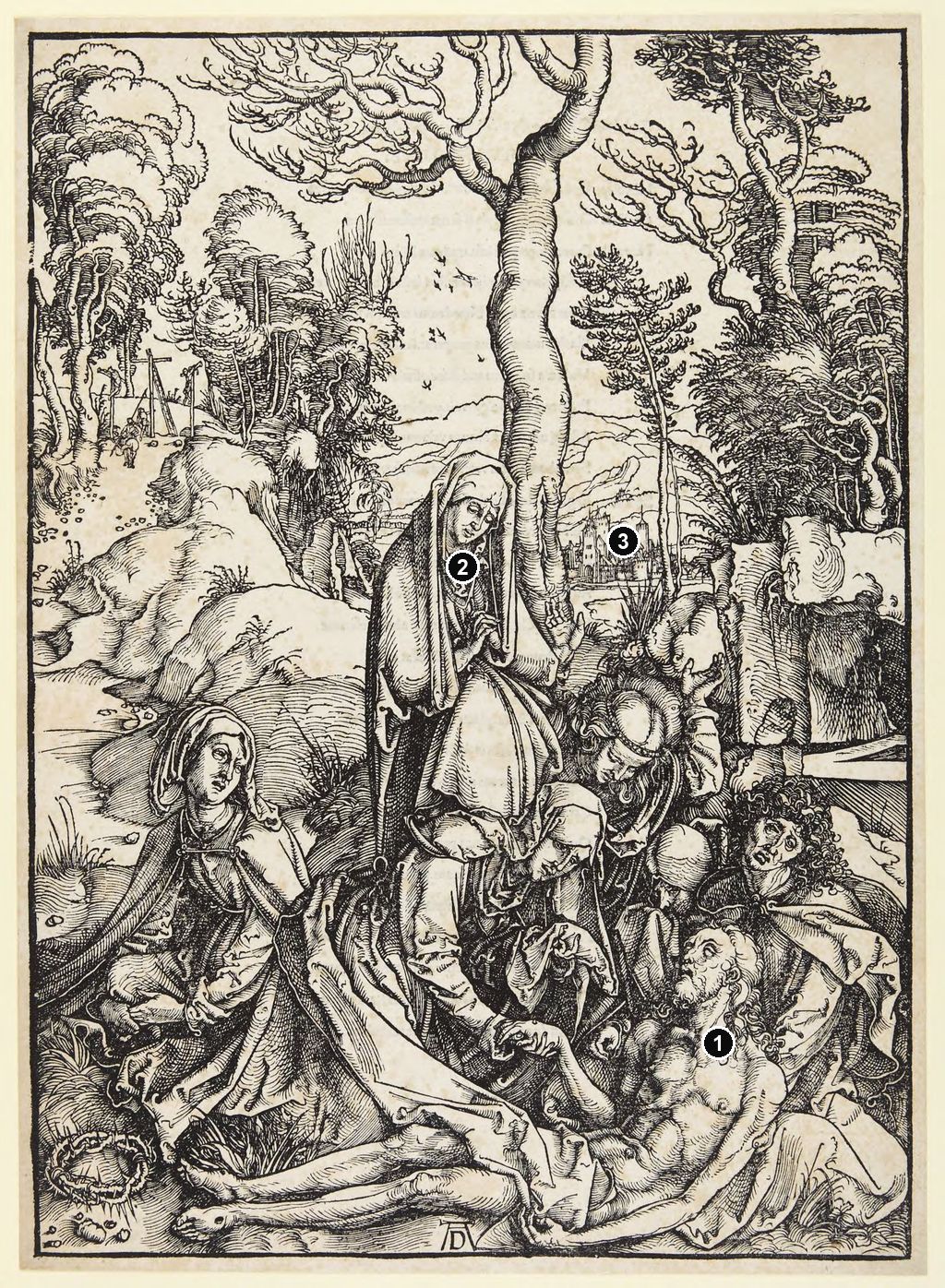
Details from THE LAMENTATION (LARGE PASSION WOODCUT)
Open the native-size details to compare the crowded figures with the finer lines of the distance.
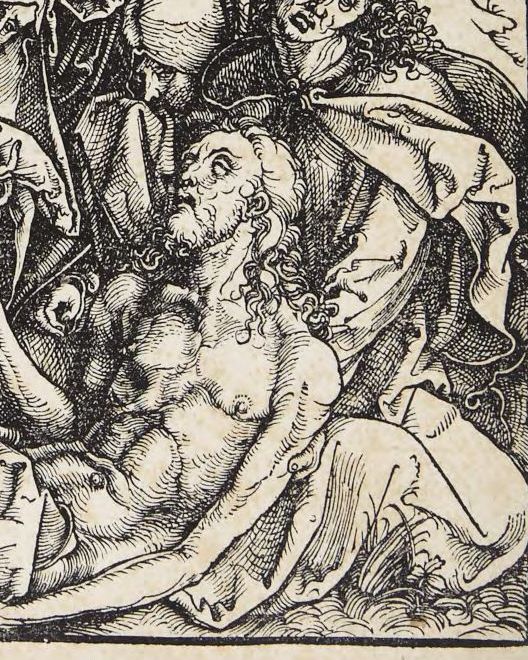
The tilted head and the supporting arm
Christ’s head tips backwards beside the arm supporting him. Curved lines describe the beard and hair, while longer strokes follow the exposed chest and shoulder.
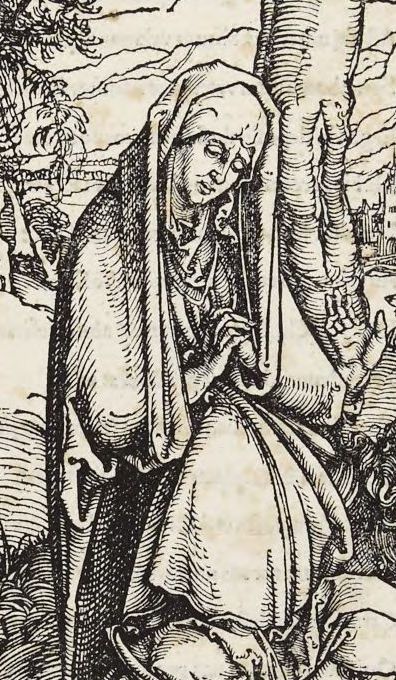
An upright figure beside the tree
The standing woman’s outline descends from the covered head into the long cloak. Close hatching darkens the cloth beside the much paler trunk.
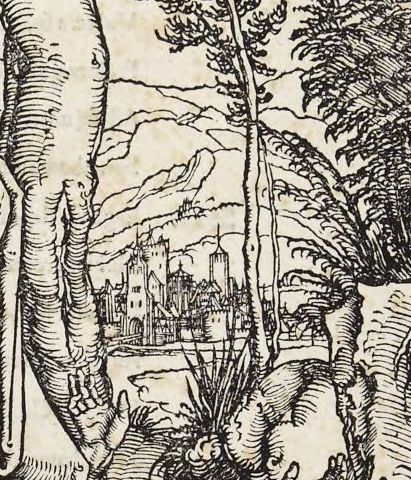
A small city between the trunks
Small pointed roofs and towers occupy a gap between the trunks. Their fine outlines contrast with the heavier curves and hatching of the nearer trees.
One design, different printed sheets
The image's long life can be followed through individual impressions. ALBERTINA in Vienna catalogues its sheet DG1934/199 as an impression before text, in Meder's category “vor Text b”. It records an ox-head watermark with a serpent staff, classified as Meder 81 and associated with early impressions of the Large Passion . These are characteristics of that particular sheet. They give the image a material history alongside its subject: paper, printing and the classification of an impression all help locate an object within the design's continuing use. [16]
A later example makes that continuing use strikingly visible. The Pushkin Museum dates its impression Г-2392 to 1570, decades after Dürer's death. It has no text and was printed from a block with a large crack running upwards through Christ's feet. The catalogue associates it with Meder 122, III, a. Here the date of the design, about 1498–99, and the date assigned to the surviving print describe different moments. The absence of text also occurs in this later impression, so a textless sheet needs further evidence before it can be called an early proof. [17]
The crack is a feature of the printing block, whose damage was transferred to paper. It should be distinguished from a tear in an individual sheet. In the Lamentation , such damage crosses an especially conspicuous area: the light, extended lower limbs at the front of the composition. A fault in the material used for printing can therefore interrupt the very forms that organise the scene. The history of the block becomes part of the viewer's encounter with Christ's body. [17]
The National Gallery of Art's impression, accession 1943.3.3622, entered the collection as Lessing J. Rosenwald's gift in 1943. The museum gives its image or block dimensions as 38.9 by 28.2 centimetres and its sheet dimensions as 41.5 by 29.4 centimetres. It also records an imperial-orb watermark, Meder 53. The larger paper size includes the space around the printed image. These measurements describe the Washington object; other impressions can have different surviving margins and their own marks, collecting histories and condition. [1]
Such differences reward attention because the design itself depends so heavily on the balance between fine lines and open paper. The broad light shapes of the body establish its visibility, while the closely spaced strokes in cloth, foliage and hair create surrounding depth. Looking at a particular impression means looking at how that balance survives there. Its paper and printed marks are the means through which Dürer's arrangement reaches the viewer. [1] [2]
From the printed gathering to a memorial painting
The composition also had a life beyond repeated printing. In the 2012 exhibition catalogue Der frühe Dürer , Daniel Hess connects the Holzschuher Lamentation with the woodcut, identifying the print's pyramidal arrangement as a model for the painted group. The catalogue dates the painting about 1499–1500 and describes its function as a memorial for the Nuremberg Holzschuher family. This is a specific relationship between the woodcut and a separate painted object. [18]
The comparison makes the print's compact organisation easier to appreciate. In the painting, the landscape extends into a broad view, while kneeling donors and heraldic shields occupy the bottom. The dead Christ and his mourners consequently belong to a larger commemorative setting. In the woodcut, the body comes much closer to the lower border, and the seated woman, bent mourner and supporting figures fill the available foreground. Its force comes partly from that economy: the body, the hands attending it and the faces above it remain within a single, tightly connected field. [2] [18]
Dürer's Lamentation sustains attention through these relationships. The distant crosses explain the loss; the cloth receives the body; the gestures show people responding to its weight and vulnerability. Across early and later impressions, those forms preserve a moment of care between the violence of death and the finality of burial. [2] [13]
Frequently Asked Questions
Artworks directory
These 187 records include individual works, reverse sides, detail views, paired panels and reconstructed arrangements. Three additional catalogue images repeat works already listed. Related views are not counted as separate originals; qualified attributions and published dating are retained.
Discussion
Look again at the images and ideas explored in Lamentation from the Large Passion. These editorial prompts invite your observations.
Reader Insights
Which detail or idea in Lamentation from the Large Passion most changed your reading, and why?
How does the discussion of “A pause between death and burial” affect your understanding?
What comparison would you bring to the discussion of “From the printed gathering to a memorial painting”?
Join the Conversation
Share a detail, comparison or question about Lamentation from the Large Passion below.
References
- National Gallery of Art , Washington, The Lamentation , c. 1498/1499, 1943.3.3622. Object metadata, dimensions, provenance, inscriptions and watermark. View source .
- Princeton University Art Museum , The Lamentation , ca. 1497–1500, x1957-144. Object record, curatorial interpretation and image. View source .
- ALBERTINA, Selbstbildnis als Dreizehnjähriger, inv. 4839 (German). View source.
- Metropolitan Museum, Four Horsemen from The Apocalypse, 19.73.209 (English). View source.
- Bayerische Staatsgemäldesammlungen, Selbstbildnis im Pelzrock, inv. 537 (German). View source.
- ALBERTINA, Feldhase, inv. 3073 (German). View source.
- ALBERTINA, Das große Rasenstück, inv. 3075 (German). View source.
- Metropolitan Museum, Adam and Eve, 19.73.1 (English). View source.
- ALBERTINA, Betende Hände, inv. 3113 (German). View source.
- Metropolitan Museum, Knight, Death, and the Devil, 43.106.2 (English). View source.
- Metropolitan Museum, Melencolia I, 43.106.1 (English). View source.
- Bayerische Staatsgemäldesammlungen, inventory 545: current collection record (German; descriptive citation). View source.
- John 19:16–42 , King James Version. View source .
- Todor Todorov , “In the Mirror of Christ's Passion: Prints, Drawings, and Illustrated Books by European Masters”, Princeton University Art Museum, exhibition essay for 2002, published online 10 January 2020. View source .
- Pushkin State Museum of Fine Arts , “The Large Passion”. Series introduction and sequence. View source .
- ALBERTINA , Vienna, Die Beweinung Christi (Große Passion, 9) , DG1934/199. German-language object record; edition and watermark information. View source .
- Pushkin State Museum of Fine Arts , The Lamentation , Г-2392. Design and impression dates; condition of the printing block. View source .
- Daniel Hess , “Die sakralen Gemälde,” in Daniel Hess and Thomas Eser, eds., Der frühe Dürer , Germanisches Nationalmuseum, 2012, pp. 415–17, especially p. 416; catalogue 107–108, pp. 420–21. German-language essay, object entries and illustrations. View source .
- Germanisches Nationalmuseum, Barbara Dürer (German and English). View source.
- Web Gallery of Art, Tucher–Rieter reverse (English). View source.
- National Gallery of Art, Portrait of a Clergyman (English). View source.
- Dürer Art, Portrait of a Man (English). View source.
- Hessen Kassel Heritage, Elsbeth Tucher (German). View source.
- Web Gallery of Art, Hans Tucher (English). View source.
- Germanisches Nationalmuseum, Emperor Maximilian I (German and English). View source.
- National Gallery of Art, Lot and His Daughters, reverse (English). View source.
- Bayerische Staatsgemäldesammlungen, Glim Lamentation (German). View source.
- Museo Nacional del Prado, Portrait of a Man (Spanish). View source.
- Bayerische Staatsgemäldesammlungen, Madonna of the Carnation (German). View source.
- Städel Museum, Job on the Dungheap (German). View source.
- Wallraf-Richartz-Museum, Piper and Drummer (German). View source.
- Italian Ministry of Culture / Uffizi, Head of Saint James (Italian). View source.
- Klassik Stiftung Weimar, Dresden Altarpiece (German). View source.
- Staatliche Museen zu Berlin, Girl with a Red Beret (German and English). View source.
- Dresden State Art Museums / Roland Enke, Bernhard von Reesen (German). View source.
- Royal Collection Trust, Burkhard von Speyer (English). View source.
- Dresden State Art Museums, Seven Sorrows of the Virgin (English). View source.
- Bayerische Staatsgemäldesammlungen, Mater Dolorosa (German). View source.
- Bayerische Staatsgemäldesammlungen, Lucretia (German). View source.
- Städel Museum, Young Woman with Her Hair Down (English). View source.
- ALBERTINA, Portrait of a Young Man (German). View source.





