


 by
Tom Gurney
Tom Gurney BSc (Hons) is an art history expert with over 20 years experience
Published on June 19, 2020 / Updated on October 22, 2026
Email:
tomgurney1@gmail.com
/ Phone:
+44 7429 011000
The Last Judgement from the Small Passion: Introduction
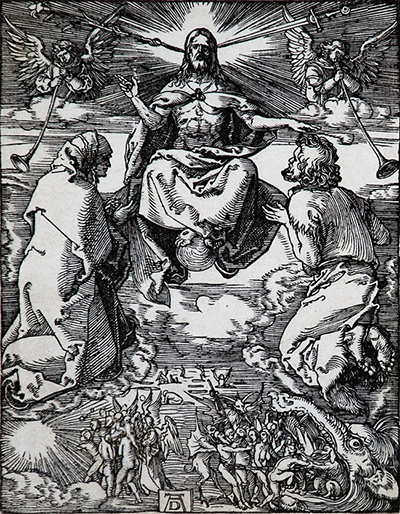
The world ends in a remarkably small space in Albrecht Dürer’s Last Judgement . Christ occupies the upper centre, framed by a burst of light, while below him the dead rise and separate into two streams. One moves towards a brilliant opening; the other is forced into a monster’s jaws. The Metropolitan Museum of Art dates the woodcut to about 1510. Its impression measures only 12.7 × 9.7 centimetres, yet the composition accommodates a heavenly court, a resurrected humanity and opposing eternal destinations. [1]
This is the final narrative image of the Small Passion , the woodcut cycle published as a book in 1511. Its sequence reaches from humanity’s Fall to the Last Judgement, placing Christ’s suffering and death within the broader history of sin and redemption. [2]
At a Glance
This work across Albrecht Dürer’s career
Young Hare
1502Praying Hands
1508Melencolia I
1514Four Apostles
1526Contents
- The heavenly court
- The dead rise and divide
- Scripture and the image
- An ending made for a book
- Black lines, white light and surviving impressions
- Frequently Asked Questions
The heavenly court
Christ faces us almost squarely. His cloak opens across a bare, strongly modelled chest, and its heavy folds gather over his knees. One hand rises; the other extends outward and down. His body is poised between these unequal gestures, giving the figure authority without making it rigid. The broad arrangement of shoulders, arms and drapery establishes a stable centre around which everything else is organised.
At either side kneel the Virgin Mary and John the Baptist, the intercessors identified in the Rijksmuseum’s catalogue. John’s shaggy garment and bearded profile face towards Christ. Mary, wrapped in a substantial mantle, occupies the opposite side. Their hands turn inward in prayer. Seen from behind and in profile, they give the viewer access to the court while directing attention towards its judge. [13]
The intercessors are large enough to have an almost bodily presence beside us. Mary’s cloak descends in broad planes, while John’s irregular clothing has a rougher, broken edge. These contrasting surfaces give the two flanking figures separate characters even within the near symmetry of their positions. Both are absorbed in the central encounter; neither turns outward to explain it.
Eckhard Leuschner uses this woodcut as an example of Last Judgement imagery before the Reformation. He identifies Christ’s rainbow seat and the globe beneath his feet, and explains the lily and sword beside his head as signs of gracious acceptance and condemnation. The globe is especially easy to overlook beneath the drapery. Its small, rounded form helps express the cosmic extent of the event: the world has become a footstool within a court whose authority exceeds it. [14]
The lily and sword stretch across the radiant field near Christ’s head. They offer a second, more emblematic expression of the division enacted below. Around them the rays spread in every direction, pressing against a dark background of closely worked lines. The white surrounding Christ’s face seems to expand because the neighbouring darkness is so dense.
Two angels sound long trumpets from the upper corners. Their wings fill the remaining space, while the instruments descend diagonally towards the human world. Those diagonals connect the court to the people beneath it. The angels’ cheeks, hands and angled heads make the act of sounding visible, giving this otherwise silent print an imagined noise that reaches across its separate zones.
The dead rise and divide
Between the great kneeling figures, distant bodies begin to emerge from the ground. They are so small that a raised arm or an upright torso can be described with only a few marks. The eye must slow down to find them. This interval is crucial: without it, the image might seem divided into two unrelated scenes. The newly awakened dead provide a passage from the expansive heavenly figures to the crowded foreground.
Clouds overlap the earthly landscape, leaving no continuous road by which ordinary perspective could lead from one realm to another. Instead Dürer uses changes of scale. The intercessors dwarf the people, and the space beneath Christ narrows towards the tiny figures at its centre. We understand the relationship as a hierarchy of worlds, even while reading the individual bodies as people in motion.
At the lower left, an angel accompanies naked figures towards a concentrated source of light. Their bodies remain separately legible, and the direction of travel is clear. The radiance spreads out from an opening whose interior is left largely to the imagination. Salvation has a destination, but Dürer gives it less physical substance than the bodies travelling towards it.
The opposite corner is more brutally explicit. A vast creature opens its mouth towards the foreground. Its round eye, curling muzzle and teeth turn the entrance to Hell into an active, threatening body. Demonic figures crowd the condemned towards its jaws. Legs, arms and torsos press against one another, and the movement becomes increasingly tangled as it approaches the mouth.
The two destinations thus differ in more than their positions. One offers an opening into light; the other consumes. The saved move towards a space beyond what can be pictured, while the damned encounter an exaggerated physical enclosure. This difference gives the judgement an immediate visual force before the viewer has identified every symbol.
Scripture and the image
Matthew 25:31–46 supplies a particularly clear framework for the separation. The Son of Man arrives with angels, sits in glory and gathers the nations before him. He places the blessed on his right and the condemned on his left. In the print those sides appear reversed to us because we face the judge: salvation lies at the viewer’s left. [15]
Matthew’s account also gives the judgement an ethical specificity that the massed bodies alone cannot convey. The king recalls feeding the hungry, welcoming strangers, clothing the naked and visiting the sick and imprisoned. Those judged ask when they encountered him in such circumstances; his answer identifies him with people in need. The woodcut compresses the outcome into a division of humanity, leaving these remembered actions outside the frame. [15]
Revelation 20:11–15 contributes another relevant vision: the dead, great and small, stand before the throne, books are opened, and judgement is made according to their works. Death and the sea surrender their dead, and the final punishment is figured as a lake of fire. Dürer’s monster mouth belongs to the visual language through which such events became imaginable. The picture combines scriptural ideas with established imagery; its details do not all reproduce the wording of one passage. [16]
Mary and John’s kneeling prayer adds another relationship to this scene of separation. Their great size makes intercession a major part of what the viewer sees. The image holds judgement and petition together: the decision below is presented beneath two figures still directing their appeals towards Christ. His exposed chest also keeps his embodied presence prominent, connecting the heavenly judge with the central human figure of the Passion.
An ending made for a book
The Small Passion appeared in small quarto format, with 38 leaves containing a title image, 36 narrative woodcuts and a concluding colophon. Benedictus Chelidonius supplied Latin verses. The Last Judgement is therefore the thirty-sixth narrative, or the thirty-seventh design when the title page is included. Its position explains why an image extending beyond Christ’s earthly life belongs at the close of a Passion book. [2]
The book’s opening Fall and its final judgement establish the reach of the story. The reader arrives here after the events of Christ’s life, suffering and return from death. What began with the first humans ends with humanity gathered collectively. At the same time, the tiny naked figures restore the vulnerability of individual bodies within that immense span. The final scene combines the scope of a universal history with the unsettling proximity of people being led, pushed and crowded towards their destinations. [2]
The print’s small dimensions encourage a changing rhythm of attention. At first the dominant figures and the two lower groups establish the whole arrangement. Looking closer reveals the distant resurrecting bodies and the congested details at Hell’s entrance. The composition remains readable at a glance, yet makes the consequences of its subject emerge through slower inspection.
Black lines, white light and surviving impressions
The effect depends on relief printing. In a woodcut, the lines that carry ink stand above the areas cut away from the block; the raised surface transfers the image to paper. Here closely grouped lines darken the sky and the folds of Christ’s cloak, while open paper supplies the brilliance around his head. Light becomes visible through the surrounding marks. No added white pigment is needed to produce that radiant contrast. [17]
Below, the close spacing of marks contributes to the press of bodies. Above, the radiating strokes spread outward. The same black ink creates both the congestion of the lower world and the apparent expansion of the heavenly light.
Surviving sheets carry separate histories. The Rijksmuseum’s impression, RP-P-OB-1356, is catalogued as before the text and measures 127 × 97 millimetres. It also bears the collector’s mark identified as Lugt 2228. The Met’s similarly sized sheet, 19.73.206, entered that museum as a gift from Junius Spencer Morgan in 1919. These almost identical measurements belong to separate sheets with different histories. [13] [1]
The ALBERTINA preserves a later example, DG1934/338, assigned to the 1612 text edition. Its catalogue separates the design’s date, about 1510, from the edition in which this particular impression was printed, and distinguishes a 12.9 × 10 centimetre sheet from a 12.6 × 9.7 centimetre printed area. That distinction allows an old design and a later sheet to retain their proper dates. The Last Judgement continued to reach viewers through repeated printing, carrying its tightly organised vision of resurrection, petition and separation into a new century. [18]
Frequently Asked Questions
Artworks directory
These 187 records include individual works, reverse sides, detail views, paired panels and reconstructed arrangements. Three additional catalogue images repeat works already listed. Related views are not counted as separate originals; qualified attributions and published dating are retained.
Discussion
Look again at the images and ideas explored in The Last Judgement from the Small Passion. These editorial prompts invite your observations.
Reader Insights
Which detail or idea in The Last Judgement from the Small Passion most changed your reading, and why?
How does the discussion of “The heavenly court” affect your understanding?
What comparison would you bring to the discussion of “Black lines, white light and surviving impressions”?
Join the Conversation
Share a detail, comparison or question about The Last Judgement from the Small Passion below.
References
- Metropolitan Museum of Art , The Last Judgment, from “The Small Passion” , 19.73.206. View source .
- Bridwell Library , Southern Methodist University, The Small Passion , with The Fall of Man and The Last Judgment , Books and Prints by Albrecht Dürer . View source 1 . View source 2 . View source 3 .
- ALBERTINA, Selbstbildnis als Dreizehnjähriger, inv. 4839 (German). View source.
- Metropolitan Museum, Four Horsemen from The Apocalypse, 19.73.209 (English). View source.
- Bayerische Staatsgemäldesammlungen, Selbstbildnis im Pelzrock, inv. 537 (German). View source.
- ALBERTINA, Feldhase, inv. 3073 (German). View source.
- ALBERTINA, Das große Rasenstück, inv. 3075 (German). View source.
- Metropolitan Museum, Adam and Eve, 19.73.1 (English). View source.
- ALBERTINA, Betende Hände, inv. 3113 (German). View source.
- Metropolitan Museum, Knight, Death, and the Devil, 43.106.2 (English). View source.
- Metropolitan Museum, Melencolia I, 43.106.1 (English). View source.
- Bayerische Staatsgemäldesammlungen, inventory 545: current collection record (German; descriptive citation). View source.
- Rijksmuseum , Laatste Oordeel , RP-P-OB-1356 (Dutch description; English catalogue fields). View source .
- Eckhard Leuschner , “Bilder des Jüngsten Gerichts: vor, während, nach der Reformation”, in Reformation und Katholische Reform: Zwischen Kontinuität und Innovation , 2019, pp. 361–384, especially p. 362 (German). View source .
- Matthew 25:31–46 , King James Version. View source .
- Revelation 20:11–15 , King James Version. View source .
- Suzanne Boorsch and Nadine M. Orenstein , The Print in the North: The Age of Albrecht Dürer and Lucas van Leyden , The Metropolitan Museum of Art Bulletin 54, no. 4, Spring 1997, pp. 3–4. View source .
- ALBERTINA , Das Jüngste Gericht (Kleine Passion, 37) , DG1934/338 (German). View source .
- Germanisches Nationalmuseum, Barbara Dürer (German and English). View source.
- Web Gallery of Art, Tucher–Rieter reverse (English). View source.
- National Gallery of Art, Portrait of a Clergyman (English). View source.
- Dürer Art, Portrait of a Man (English). View source.
- Hessen Kassel Heritage, Elsbeth Tucher (German). View source.
- Web Gallery of Art, Hans Tucher (English). View source.
- Germanisches Nationalmuseum, Emperor Maximilian I (German and English). View source.
- National Gallery of Art, Lot and His Daughters, reverse (English). View source.
- Bayerische Staatsgemäldesammlungen, Glim Lamentation (German). View source.
- Museo Nacional del Prado, Portrait of a Man (Spanish). View source.
- Bayerische Staatsgemäldesammlungen, Madonna of the Carnation (German). View source.
- Städel Museum, Job on the Dungheap (German). View source.
- Wallraf-Richartz-Museum, Piper and Drummer (German). View source.
- Italian Ministry of Culture / Uffizi, Head of Saint James (Italian). View source.
- Klassik Stiftung Weimar, Dresden Altarpiece (German). View source.
- Staatliche Museen zu Berlin, Girl with a Red Beret (German and English). View source.
- Dresden State Art Museums / Roland Enke, Bernhard von Reesen (German). View source.
- Royal Collection Trust, Burkhard von Speyer (English). View source.
- Dresden State Art Museums, Seven Sorrows of the Virgin (English). View source.
- Bayerische Staatsgemäldesammlungen, Mater Dolorosa (German). View source.
- Bayerische Staatsgemäldesammlungen, Lucretia (German). View source.
- Städel Museum, Young Woman with Her Hair Down (English). View source.
- ALBERTINA, Portrait of a Young Man (German). View source.







