


 by
Tom Gurney
Tom Gurney BSc (Hons) is an art history expert with over 20 years experience
Published on June 19, 2020 / Updated on October 22, 2026
Email:
tomgurney1@gmail.com
/ Phone:
+44 7429 011000
Laughing Peasant Woman: Introduction
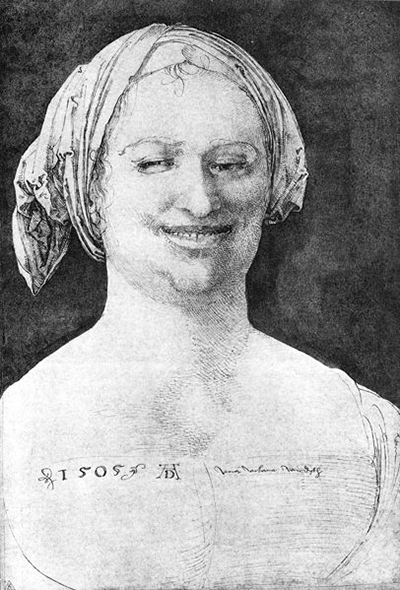
A woman smiles with her lips apart and her eyes almost closed. The movement spreads across her face: the cheeks lift, the corners of the mouth draw upwards, and shadows collect beneath the lower lip and around the eyes. Dürer gives this passing expression a remarkably substantial presence. The head rises above a broad expanse of neck, shoulders and bodice, while a knotted headcloth makes a pale arch against a dark background. The British Museum dates its drawing to 1505 and identifies the materials as pen and brown ink with brown wash on paper, measuring 41.6 × 28.1 centimetres. [1]
The familiar title, Laughing Peasant Woman , directs attention to the smile. Yet the sheet has several centres of interest: the intricate folds beside the head, the changing density of the penwork, and the inscription extending across the woman's chest. Looking from one to another reveals how carefully the drawing holds together. The sitter's name remains unknown; her expression is far more immediate than the surviving information about her life.
At a Glance
This work across Albrecht Dürer’s career
Young Hare
1502Praying Hands
1508Melencolia I
1514Four Apostles
1526Contents
- A smile built from marks
- What the inscription tells us
- Another woman of 1505
- An original and a disputed repetition
- From private collection to public museum
- Frequently Asked Questions
A smile built from marks
At the mouth, darkness opens into a narrow band broken by the pale shapes of teeth. The upper lip is relatively thin, while a shadow beneath the fuller lower lip makes it project. Small lines run outwards into the cheeks. These changes matter together: isolate the mouth and the expression becomes harder to read; follow it upwards into the narrowed eyelids and it gathers force. The eyes have different shapes and degrees of closure, preventing the face from settling into a perfectly symmetrical smile.
The turn of the head is similarly slight but consequential. We see more of one cheek than the other, and the nose interrupts the balance of the face. A deeper field of hatching gathers on the viewer's right, along the side of the nose, cheek and neck. Across the brighter forehead and opposite cheek, much more of the paper remains open. The face therefore has volume even before individual features are examined. Its modelling comes from the accumulation and spacing of marks, with light passing through the drawing between them.
Below the chin, short diagonal strokes make the neck turn and deepen the hollow above the chest. Farther down, the bodice is described with much lighter, more widely spaced lines. The change keeps the head visually dominant. It also allows the viewer to recognise the artist's decisions: some passages explain a surface thoroughly, while others supply only enough information to establish its shape. The shoulders give the portrait breadth without competing with the activity of the face.
The headcloth introduces another kind of movement. Long curves follow the fabric over the crown, then break into angular folds at the sides. On the viewer's left, the hanging knot forms a compact arrangement of ridges, pockets and pointed ends. Several dark interiors suggest fabric folded back upon itself. Near the forehead, small loose curls cross the boundary between skin and cloth. Those curls and the larger sweep of the covering make the head feel enclosed without hiding its irregular outline.
Art Fund's account suggests that Dürer recalled the fleeting grin from memory while working out the drawing's precise detail. This is a plausible explanation of a practical difficulty, rather than a surviving account of the sitting. The image itself shows the result: an unstable facial movement has been made legible through a sustained arrangement of lines. Its apparent spontaneity and its careful construction coexist on the same sheet. [12]
Francesca Alberti and Diane H. Bodart place the drawing within a history of laughter that included social distinctions. Their introduction to Rire en images à la Renaissance discusses the association of unrestrained laughter with lower social ranks, alongside conduct literature favouring a measured expression that concealed the teeth and open mouth. That context gives the small white intervals between this woman's lips historical significance. Her visible teeth help make the smile convincing, while also belonging to a kind of expression whose representation carried social meanings. [13]
What the inscription tells us
Across the bodice appear the date, Dürer's monogram and the words “Vna vilana Windisch”. The phrase combines Italian and German elements and identifies the subject as a Windisch peasant woman. In his 1937 catalogue, Friedrich Winkler drew attention to the deliberate presentation of the inscription, including the flourishes on either side of the year. He regarded this care as evidence of the importance Dürer attached to the drawing. [14]
The lettering has a visible compositional role as well. It runs along a level below the face, providing a horizontal counterweight to the curves of the neckline and shoulders. The date and monogram occupy one side; the smaller descriptive words extend across the other. Written identification is thus part of the encounter with the woman, even though it gives a social and regional description rather than her personal name. The inscription records how the artist classified his subject; it cannot supply her biography.
“Windisch” has also complicated attempts to locate the encounter. Winkler explained it through the Slovenes and the historic Windisch Mark in Carniola, describing a region between the Gurk, Kulpa and Save rivers. The British Museum and Art Fund instead explain the name through the area around Gurk in southern Austria. These accounts should not be compressed into a precise village or a documented stop on Dürer's journey. Nor does the Italian beginning of the inscription establish that the woman lived in Venice. [14] [1] [12]
Art historian Jeffrey Chipps Smith makes the geographical uncertainty explicit. In his study of Dürer and Eastern Europe, he discusses the proposal that the two Windisch women drawings indicate an easterly journey towards Venice through Carinthia or Slovenia. He also observes that Dürer could have encountered women from these regions selling goods in Venice. Smith treats the story of the artist falling ill near Ljubljana as uncorroborated and of doubtful authenticity. The useful distinction is between the woman's regional designation and the place where the drawing was made. The first survives in writing; the second remains open. [15]
Another woman of 1505
The related Head of a Young Woman (Windische Frau) in Museum Boijmans Van Beuningen offers a revealing comparison. Dated 1505, it is drawn in black chalk and measures 35 × 26.6 centimetres. The museum records the dark green wash behind the head as a later addition. It is a separate drawing, with a different pose, costume arrangement and expression. [16]
In Rotterdam's image the head turns farther towards the viewer's right. The eyes remain open, looking downwards, and the mouth is softly parted without the broad upward pull seen in the London portrait. A decorated band crosses the head, and long strands descend beside the face. Chalk makes the shadows read as broad, softly joined areas, especially below the cheek and around the jaw. In the laughing woman's portrait, individual ink strokes remain more insistent, particularly in the neck and tightly worked folds.
Placed beside one another, the drawings show how much expression depends on small changes in the eyes and mouth, but also on the surrounding structure. The stronger turn and lowered gaze of the Rotterdam head direct attention across the sheet; the London woman's more frontal presentation brings the smile towards the viewer. Their shared year and associated regional title invite comparison without establishing that they portray the same person or record the same sitting.
An original and a disputed repetition
The London portrait also survives in a close repetition on vellum. The British Museum's account traces the disagreement: Heinrich Theodor Musper promoted the vellum drawing as the original in 1971; Franz Winzinger defended the museum's sheet in 1975. A direct comparison by Giulia Bartrum and Fritz Koreny in 2005 supported the vellum work's status as a copy. They contrasted its hesitant, joined strokes with the fluid execution of long strands in the museum drawing. A later sixteenth-century date and a possible Wierix attribution remain proposals. [1]
In the museum image, the curls above the forehead are especially easy to follow because they cross a largely open area. Their looping outlines differ from the compact diagonal hatching below the jaw and the close parallel lines along the cloth. Following those changes in direction turns a general impression of delicacy into something more concrete: the pen repeatedly changes its course to describe different surfaces.
The museum also records damage to the paper from the removal of foxing before acquisition. Today's surface therefore carries a history beyond the act of drawing. Pale or interrupted areas should be approached with that material history in mind, rather than automatically treated as intentional effects. [1]
From private collection to public museum
The drawing's collecting history is distinct from the history of the vellum repetition. In the 1928 Nuremberg Dürer exhibition catalogue, number 243 belongs to ten Cate in Almelo and carries the reference Lippmann 408. Its title there is Südtiroler Bäuerin , or South Tyrolean peasant woman. Winkler's later catalogue identifies that same Lippmann number with the British Museum drawing, lists the earlier Lagoy and Seymour collections, and records its acquisition in 1930. Historical titles and measurements have varied; the catalogue trail connects the sheet across those changes. [17] [14]
The acquisition was news well beyond London. A June 1930 letter in Art in New Zealand , signed C. G. W., reported that Campbell Dodgson, the British Museum's Keeper of Prints and Drawings, had contributed £2,000 towards its purchase. The correspondent praised his generosity and expertise. The notice gives a contemporary glimpse of the effort to bring this intimate portrait into a public collection. [18]
The woman herself remains outside that collecting narrative. No identified sitter's history accompanies her smile. What survives is more particular than a general illustration of happiness: an uneven narrowing of the eyes, a lifted cheek, a mouth held open, and a headcloth whose folds frame the movement. Dürer's attention makes these features worth following slowly, even though the expression they describe seems to last only an instant.
Frequently Asked Questions
Artworks directory
These 187 records include individual works, reverse sides, detail views, paired panels and reconstructed arrangements. Three additional catalogue images repeat works already listed. Related views are not counted as separate originals; qualified attributions and published dating are retained.
Discussion
Look again at the images and ideas explored in Laughing Peasant Woman. These editorial prompts invite your observations.
Reader Insights
Which detail or idea in Laughing Peasant Woman most changed your reading, and why?
How does the discussion of “A smile built from marks” affect your understanding?
What comparison would you bring to the discussion of “From private collection to public museum”?
Join the Conversation
Share a detail, comparison or question about Laughing Peasant Woman below.
References
- British Museum. Portrait of a peasant woman , 1930,0324.1. Current collection record, inscription and expanded curatorial commentary. View source .
- ALBERTINA, Selbstbildnis als Dreizehnjähriger, inv. 4839 (German). View source.
- Metropolitan Museum, Four Horsemen from The Apocalypse, 19.73.209 (English). View source.
- Bayerische Staatsgemäldesammlungen, Selbstbildnis im Pelzrock, inv. 537 (German). View source.
- ALBERTINA, Feldhase, inv. 3073 (German). View source.
- ALBERTINA, Das große Rasenstück, inv. 3075 (German). View source.
- Metropolitan Museum, Adam and Eve, 19.73.1 (English). View source.
- ALBERTINA, Betende Hände, inv. 3113 (German). View source.
- Metropolitan Museum, Knight, Death, and the Devil, 43.106.2 (English). View source.
- Metropolitan Museum, Melencolia I, 43.106.1 (English). View source.
- Bayerische Staatsgemäldesammlungen, inventory 545: current collection record (German; descriptive citation). View source.
- Art Fund. Portrait of a Peasant Woman . Object and acquisition account. View source .
- Francesca Alberti and Diane H. Bodart. “Introduction,” Rire en images à la Renaissance (2019) , p. 34, fig. 10 and notes 77–81. French. View source .
- Friedrich Winkler. Die Zeichnungen Albrecht Dürers , vol. 2 (1937), p. 86, no. 375. German. View source .
- Jeffrey Chipps Smith. “Albrecht Dürer and Eastern Europe,” ARS 42 , no. 1 (2009), pp. 11–12 and notes 33–36. English. View source .
- Museum Boijmans Van Beuningen. Head of a Young Woman (Windische Frau) , MB 1947/T 17 (PK). Collection record and museum image. View source .
- Germanisches Nationalmuseum. Albrecht-Dürer-Ausstellung (1928) , p. 110, no. 243. German. View source .
- C. G. W. “A London Letter,” Art in New Zealand , vol. II, issue 8 (1 June 1930), p. 271. Contemporary acquisition report. View source .
- Germanisches Nationalmuseum, Barbara Dürer (German and English). View source.
- Web Gallery of Art, Tucher–Rieter reverse (English). View source.
- National Gallery of Art, Portrait of a Clergyman (English). View source.
- Dürer Art, Portrait of a Man (English). View source.
- Hessen Kassel Heritage, Elsbeth Tucher (German). View source.
- Web Gallery of Art, Hans Tucher (English). View source.
- Germanisches Nationalmuseum, Emperor Maximilian I (German and English). View source.
- National Gallery of Art, Lot and His Daughters, reverse (English). View source.
- Bayerische Staatsgemäldesammlungen, Glim Lamentation (German). View source.
- Museo Nacional del Prado, Portrait of a Man (Spanish). View source.
- Bayerische Staatsgemäldesammlungen, Madonna of the Carnation (German). View source.
- Städel Museum, Job on the Dungheap (German). View source.
- Wallraf-Richartz-Museum, Piper and Drummer (German). View source.
- Italian Ministry of Culture / Uffizi, Head of Saint James (Italian). View source.
- Klassik Stiftung Weimar, Dresden Altarpiece (German). View source.
- Staatliche Museen zu Berlin, Girl with a Red Beret (German and English). View source.
- Dresden State Art Museums / Roland Enke, Bernhard von Reesen (German). View source.
- Royal Collection Trust, Burkhard von Speyer (English). View source.
- Dresden State Art Museums, Seven Sorrows of the Virgin (English). View source.
- Bayerische Staatsgemäldesammlungen, Mater Dolorosa (German). View source.
- Bayerische Staatsgemäldesammlungen, Lucretia (German). View source.
- Städel Museum, Young Woman with Her Hair Down (English). View source.
- ALBERTINA, Portrait of a Young Man (German). View source.







