by
Tom Gurney
Tom Gurney BSc (Hons) is an art history expert with over 20 years experience
Published on June 19, 2020 / Updated on October 22, 2026
Email:
tomgurney1@gmail.com
/ Phone:
+44 7429 011000
Study of Christ’s Upper Body: Introduction
The outstretched arm gives this drawing its direction. A man turns to the right, looking along a reach that carries his hand almost to the edge of the paper. His chest, abdomen and shoulder are exposed; a cloth hangs behind him and passes over his left shoulder. Dürer’s monogram and the date 1508 occupy the open space above his back. Catalogued by Friedrich Winkler as a study for Christ’s upper body, the sheet belongs to the preparations for the Heller Altarpiece. The reach has a destination in the altarpiece’s composition, where Christ helps to hold a crown above the Virgin Mary. [1]
Dürer undertook the altarpiece for the Frankfurt merchant Jakob Heller in 1507. Its central panel represented the Assumption and Coronation of the Virgin, with apostles gathered below the heavenly assembly. The original centre was destroyed by fire in 1729. A replacement painted by Jobst Harrich in 1614 preserves the composition; that copy, now belonging to the Historisches Museum Frankfurt, allows the separate torso study to be understood within a larger action. Drawing and copy offer different kinds of evidence: the sheet brings us close to Dürer’s handling, while the later painting supplies the surrounding figures and the destination of the gesture. [2] [3]
At a Glance
- Inscribed date 1508 [1]
- Purpose Study of Christ’s upper body for the Heller Altarpiece [1]
- TypeDrawing [11]
This work across Albrecht Dürer’s career
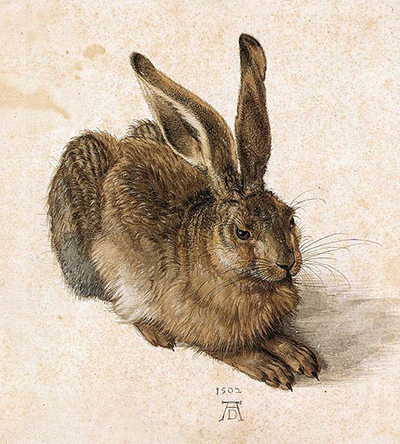
Young Hare
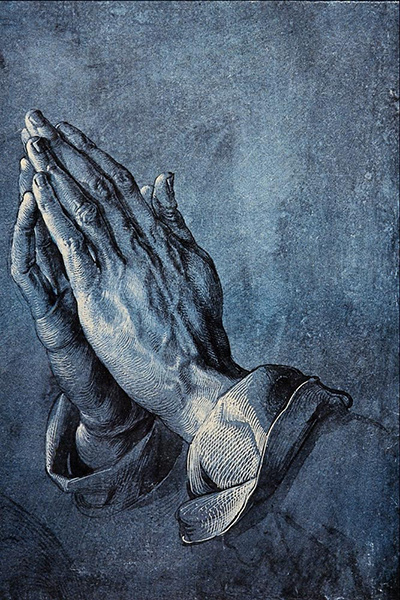
1502Praying Hands
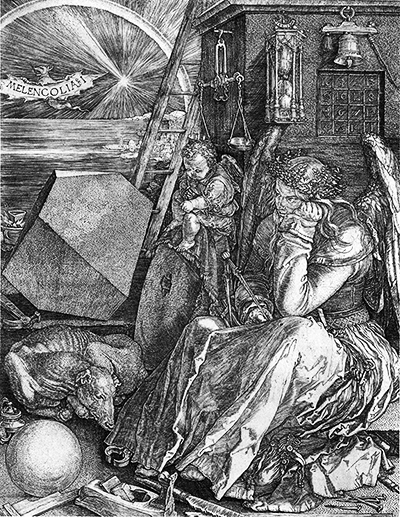
1508Melencolia I
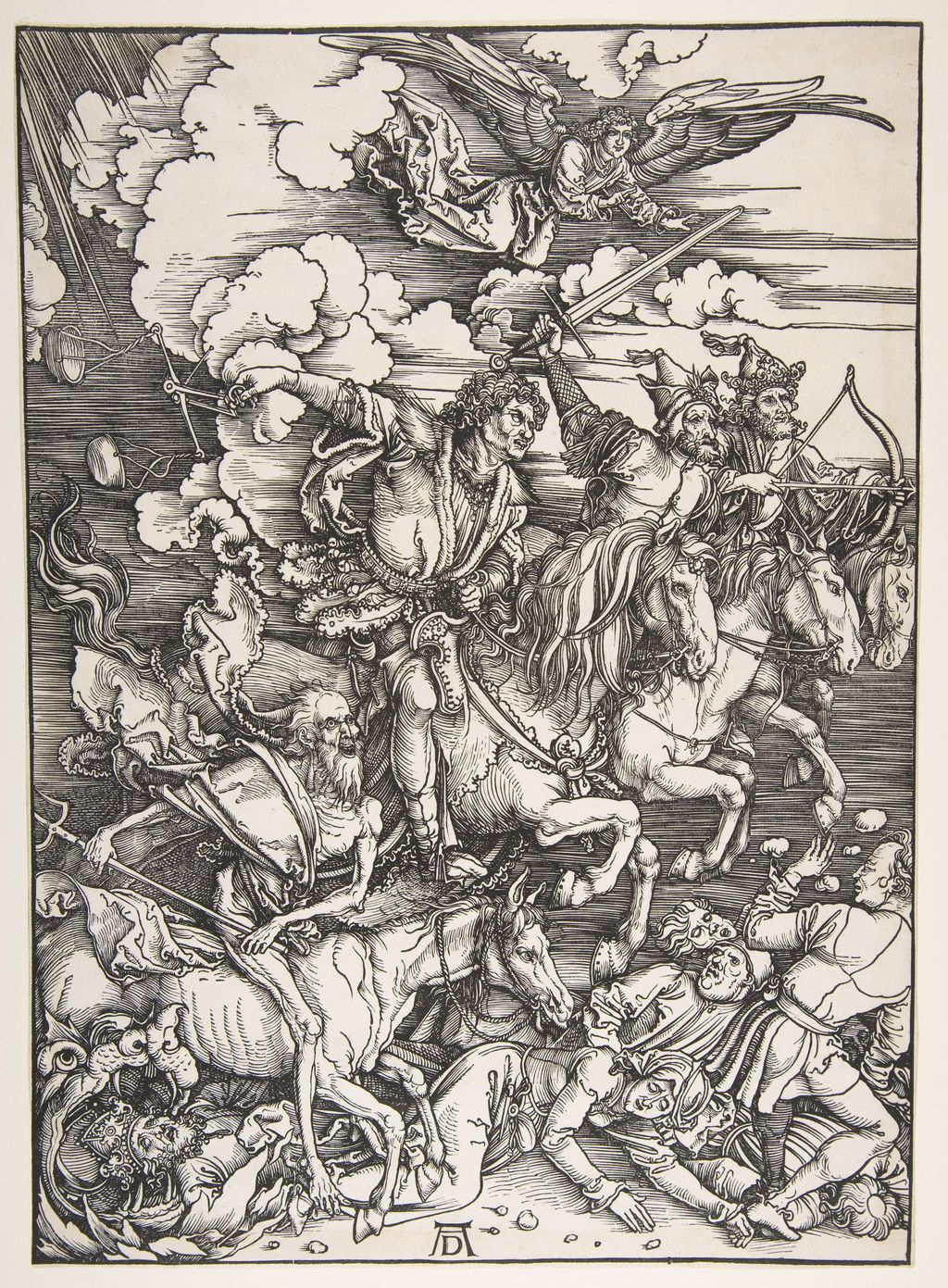
1514Four Apostles
1526Contents
- The reach of the body
- A model transformed
- The colour beneath the marks
- Care, time and the distant viewer
- Frequently Asked Questions
The reach of the body
The pose is more involved than an isolated pointing hand suggests. The right upper arm crosses the chest, its underside forming a strong shadowed diagonal. At the elbow the direction changes, and the forearm rises towards the wrist. The hand bends again, with the extended finger continuing the movement beyond the knuckles. This succession of adjustments makes the gesture feel sustained by the whole body. The shoulder has to carry the arm; the neck turns the head towards the same destination; the torso presents a broad surface beneath the moving limb.
Dürer gives each of these parts a different weight. The shoulder is round and bright at its summit, with close dark strokes gathering underneath and behind it. The elbow is angular, interrupting the smoother passage of the upper arm. Along the abdomen, short curving marks describe the swell and recession of the flesh around the navel. These marks follow changing surfaces instead of filling the body with a uniform mesh. The stomach consequently feels softer than the taut arm, although both are constructed from closely spaced strokes.
Light also distinguishes the front of the figure from the deep shadow beside his back. Small bright accents catch the nose, cheek, throat and collarbone. Under the arm, darkness gathers into a narrow band; further down, it spreads across the side of the body. The effect is especially convincing where a lit surface turns gradually into shade. Looking at the drawing closely means continually shifting between an apparently solid body and the small marks that produce it.
The cloth contributes to that experience. Its long edges descend behind the torso, and the pale fold beside the chest frames the exposed flesh. A comparatively broad dark passage within the hanging fabric contrasts with the finer modelling of the skin. At the bottom, the body is left incomplete, with looser indications around the boundary. There is no attempt to furnish a seat, legs or a surrounding room. Dürer concentrates the viewer’s attention on the junction of head, shoulder, chest and reaching arm.
A model transformed
In Harrich’s copy, Christ sits to the viewer’s left of Mary, opposite God the Father. His bare chest remains prominent above a mass of red drapery. Both divine figures reach towards the crown over Mary’s bowed head; below them, clouds and small angels separate the heavenly group from the apostles around the tomb. Restored to this arrangement, the study’s outward movement becomes an action shared with another figure. The reaching arm helps bridge the interval above Mary and gives the upper group a clear centre. [3]
The relationship does not require every feature to agree. The short-haired, unbearded head in the drawing is markedly different from Christ’s longer-haired, bearded appearance in the copy. Winkler explicitly identified the drawn head as the model’s and described its replacement by a conventional type of the Saviour in the painting. The comparison makes this transformation visible, although the identity of the man who posed remains unknown. [1]
The hand changes its role, too. On the paper, the projecting finger and the gathering of the other fingers can be inspected against the empty ground. In the copy, the hand participates in holding the crown. The gesture has acquired both an object and a relationship to God the Father’s corresponding movement. It would therefore be misleading to imagine that the finished figure needed only colour added to an otherwise complete design. The study offered a worked-out body and movement that could be adjusted to a sacred narrative.
A surviving companion study makes the division of labour between sheets particularly clear. The Louvre’s Drapery for a Christ in Glory , also dated 1508, concerns the cloth around Christ’s lower body in the same upper group. The museum identifies it specifically with Christ crowning the Virgin. The torso sheet and the drapery study address different problems within one figure: how an exposed body turns and reaches, and how cloth gives shape to the seated form below it. Neither sheet needs to contain the entire figure to contribute substantially to its construction. [15]
The colour beneath the marks
The paper’s preparation matters as much as the drawn lines. Winkler recorded a brush drawing heightened with white, measuring 198 by 214 millimetres, and listed it in the Kunsthalle Bremen, from the Grünling collection. His description specifies a grey ground over a red underlayer. He also disputed an earlier description of the ground as green and pink. This is a historical catalogue account of the object; the muted reproduction alone cannot establish its original colour or the precise materials of its preparation. [1]
The grey tone visible in the reproduction makes the basic procedure easy to follow. Dürer can darken it with shadow and lighten it with white. Much of the body inhabits the interval between those extremes, so that the ground contributes to the flesh instead of merely surrounding it. On the forehead and shoulder, pale lines describe rounded surfaces; near the back, dark strokes deepen the turn away from the light. White is an active drawing material, used to build form through many small decisions.
The ALBERTINA’s 2025 exhibition on drawings on coloured grounds places the Heller studies within Dürer’s continued exploration of techniques used during his Venetian stay. It distinguishes paper coloured during manufacture from the carefully prepared surfaces of his later studies. Its account emphasises the fine brushwork, washes and white accents possible on those smooth grounds. The exhibition also proposes a broader workshop role for highly finished studies, as examples of observation and skill that could be kept and shown. Such a role helps explain why a study connected with a painting can reward prolonged looking on its own. [16]
In this sheet, finish is selective. The chest and arm receive minute attention, while the surrounding space remains largely unoccupied. The contrast makes the studied body exceptionally legible. At roughly twenty centimetres across, the drawing invites a close encounter with details that would have been only one part of the much larger altarpiece. Its small scale and dense workmanship create an experience of looking distinct from following the whole scene.
Care, time and the distant viewer
Dürer’s letters to Heller show how demanding that painting became. Writing on 24 August 1508, the year inscribed on the drawing, he said that he had outlined the central panel with great care and spent considerable time on it. He proposed repeated layers of colour and promised to paint the centre himself. He also sought an increase from the original agreement of about 130 Rhenish florins to 200. In the same letter, his pleasure in the work sits beside concern about the approaching winter and its short working days. The correspondence dates the larger undertaking, although it does not identify the day on which this particular study was made. [17]
By 4 November, the discussion had become a disagreement about what exceptional care meant. Dürer resisted Heller’s apparent expectation of the greatest care imaginable. At that standard, he argued, a single face might occupy him for half a year, while the picture contained a great many faces as well as drapery, landscape and other elements. He also raised a practical question: who could see such labour in an altarpiece? His argument brings viewing distance into the discussion of artistic finish. The astonishing detail in the torso study can be inspected at arm’s length; the finished painting had to make its figures intelligible within an extensive composition. [17]
The letters nevertheless make clear that Dürer cared about recognition for this painstaking work. In March 1509 he linked his own honour and Heller’s with the judgement the painting would receive from other artists. In July, frustrated by the delay and their exchanges, he offered to keep the picture and return the money already received. The work was eventually dispatched in August, and his October letter expresses relief that Heller was pleased. These are the artist’s arguments during a negotiation, and their claims about losses or alternative buyers belong to that exchange. They do, however, reveal how closely labour, reputation and payment were connected in his account of making the altarpiece. [17]
Even the instructions sent with the finished panel concern looking. Dürer advised allowing it to lean forward slightly so that the light would fall favourably upon it. He discussed careful installation and a future application of varnish, and insisted that its surfaces should be protected. Those concerns give practical force to the delicacy visible in the study. The painter who shaped a shoulder with tiny light and dark strokes also thought about how the completed image would meet illumination, distance and an audience. [17]
The torso retains the intensity of that preparatory attention. Its unnamed man looks and reaches with a bodily particularity that the finished Christ transforms. The pale cloth, turning abdomen and firmly extended arm remain available for close examination even though the painting they helped to prepare has disappeared. Seen beside Harrich’s copy, the drawing reveals a specific passage between observing a person and giving a sacred figure an effective place within a crowded scene.
Frequently Asked Questions
Artworks directory
These 187 records include individual works, reverse sides, detail views, paired panels and reconstructed arrangements. Three additional catalogue images repeat works already listed. Related views are not counted as separate originals; qualified attributions and published dating are retained.
Discussion
Look again at the images and ideas explored in Study of Christ’s Upper Body. These editorial prompts invite your observations.
Reader Insights
Which detail or idea in Study of Christ’s Upper Body most changed your reading, and why?
How does the discussion of “The reach of the body” affect your understanding?
What comparison would you bring to the discussion of “Care, time and the distant viewer”?
Join the Conversation
Share a detail, comparison or question about Study of Christ’s Upper Body below.
References
- Friedrich Winkler , Die Zeichnungen Albrecht Dürers , vol. II: 1503–1510/11, Berlin, 1937, no. 456, p. 128; plate 456. German. View source 1 . View source 2 .
- Vanessa Tron , “Der ‘Heller-Altar’ von Albrecht Dürer”, Städel Museum, 18 November 2013. German. View source .
- Städel Museum , Jobst Harrich, Ascension and Coronation of the Virgin , B 265, Zeitreise , collection record for the copy belonging to the Historisches Museum Frankfurt. English title; German provenance. View source .
- ALBERTINA, Selbstbildnis als Dreizehnjähriger, inv. 4839 (German). View source.
- Metropolitan Museum, Four Horsemen from The Apocalypse, 19.73.209 (English). View source.
- Bayerische Staatsgemäldesammlungen, Selbstbildnis im Pelzrock, inv. 537 (German). View source.
- ALBERTINA, Feldhase, inv. 3073 (German). View source.
- ALBERTINA, Das große Rasenstück, inv. 3075 (German). View source.
- Metropolitan Museum, Adam and Eve, 19.73.1 (English). View source.
- ALBERTINA, Betende Hände, inv. 3113 (German). View source.
- Friedrich Winkler, Die Zeichnungen Albrecht Dürers, BandII:1503–1510/11 (1937) (German). View source.
- Metropolitan Museum, Knight, Death, and the Devil, 43.106.2 (English). View source.
- Metropolitan Museum, Melencolia I, 43.106.1 (English). View source.
- Bayerische Staatsgemäldesammlungen, inventory 545: current collection record (German; descriptive citation). View source.
- Musée du Louvre , Draperie pour un Christ en gloire , INV 18597, recto, collection record, updated 25 September 2024. French. View source .
- ALBERTINA , Leonardo–Dürer: Renaissance Master Drawings on Colored Ground , exhibition dossier, 2025, especially pp. 6–10. Curators Achim Gnann and Christof Metzger. View source .
- Albrecht Dürer , letters to Jakob Heller, 24 August 1508–11 October 1509, in William Martin Conway, Literary Remains of Albrecht Dürer , Cambridge University Press, 1889, pp. 65–71. English translation. View source .
- Germanisches Nationalmuseum, Barbara Dürer (German and English). View source.
- Web Gallery of Art, Tucher–Rieter reverse (English). View source.
- National Gallery of Art, Portrait of a Clergyman (English). View source.
- Dürer Art, Portrait of a Man (English). View source.
- Hessen Kassel Heritage, Elsbeth Tucher (German). View source.
- Web Gallery of Art, Hans Tucher (English). View source.
- Germanisches Nationalmuseum, Emperor Maximilian I (German and English). View source.
- National Gallery of Art, Lot and His Daughters, reverse (English). View source.
- Bayerische Staatsgemäldesammlungen, Glim Lamentation (German). View source.
- Museo Nacional del Prado, Portrait of a Man (Spanish). View source.
- Bayerische Staatsgemäldesammlungen, Madonna of the Carnation (German). View source.
- Städel Museum, Job on the Dungheap (German). View source.
- Wallraf-Richartz-Museum, Piper and Drummer (German). View source.
- Italian Ministry of Culture / Uffizi, Head of Saint James (Italian). View source.
- Klassik Stiftung Weimar, Dresden Altarpiece (German). View source.
- Staatliche Museen zu Berlin, Girl with a Red Beret (German and English). View source.
- Dresden State Art Museums / Roland Enke, Bernhard von Reesen (German). View source.
- Royal Collection Trust, Burkhard von Speyer (English). View source.
- Dresden State Art Museums, Seven Sorrows of the Virgin (English). View source.
- Bayerische Staatsgemäldesammlungen, Mater Dolorosa (German). View source.
- Bayerische Staatsgemäldesammlungen, Lucretia (German). View source.
- Städel Museum, Young Woman with Her Hair Down (English). View source.
- ALBERTINA, Portrait of a Young Man (German). View source.