by
Tom Gurney
Tom Gurney BSc (Hons) is an art history expert with over 20 years experience
Published on June 19, 2020 / Updated on October 22, 2026
Email:
tomgurney1@gmail.com
/ Phone:
+44 7429 011000
The Meeting of Joachim and Anne at the Golden Gate: Introduction
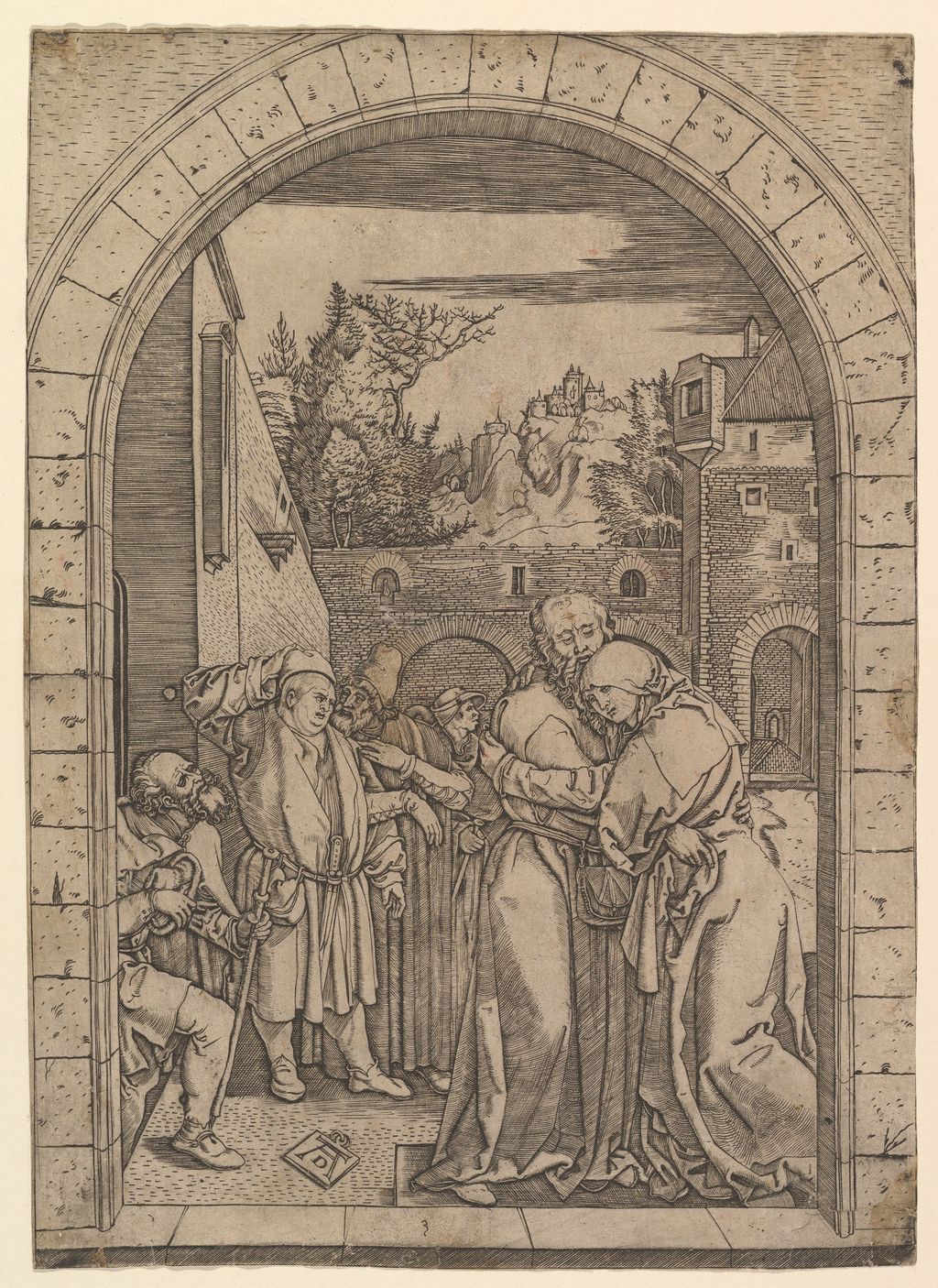
Joachim and Anne hold each other just inside an enormous decorated arch. Their bodies lean together, their arms cross and their heavy clothes settle into a single mass. Around them, a small gathering continues to talk, gesture and watch. Above their heads the view opens towards trees, birds and a distant hilltop settlement. In Albrecht Dürer’s The Meeting of Joachim and Anne at the Golden Gate , an intimate reunion occupies the threshold of a busy, elaborately imagined world. The woodcut is dated 1504 and belongs to his Life of the Virgin , published as a book in 1511. [1]
The embrace carries the story. Joachim’s bearded face rises above Anne’s covered head; she bends towards his shoulder while he gathers her against him. Their faces are close without becoming the sole centre of attention. The encircling arms make the reunion legible even at a distance. At their feet, long folds of cloth spread and overlap, giving weight and duration to a moment that a simpler image might have presented as a passing greeting.
At a Glance
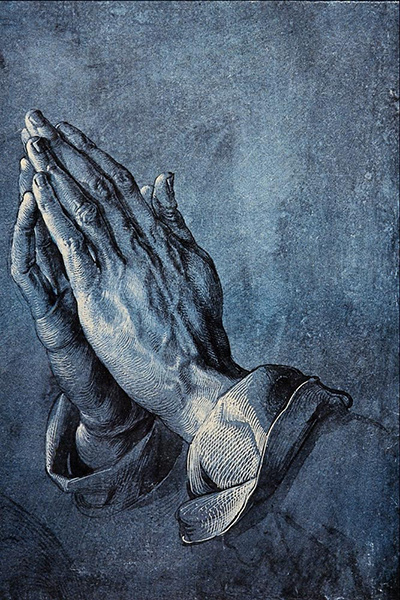
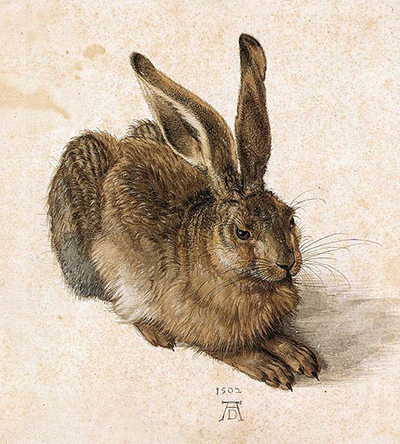
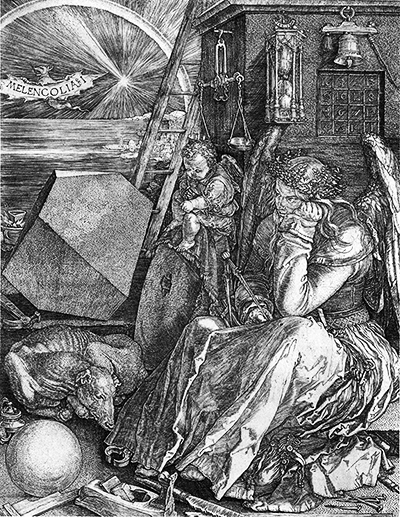
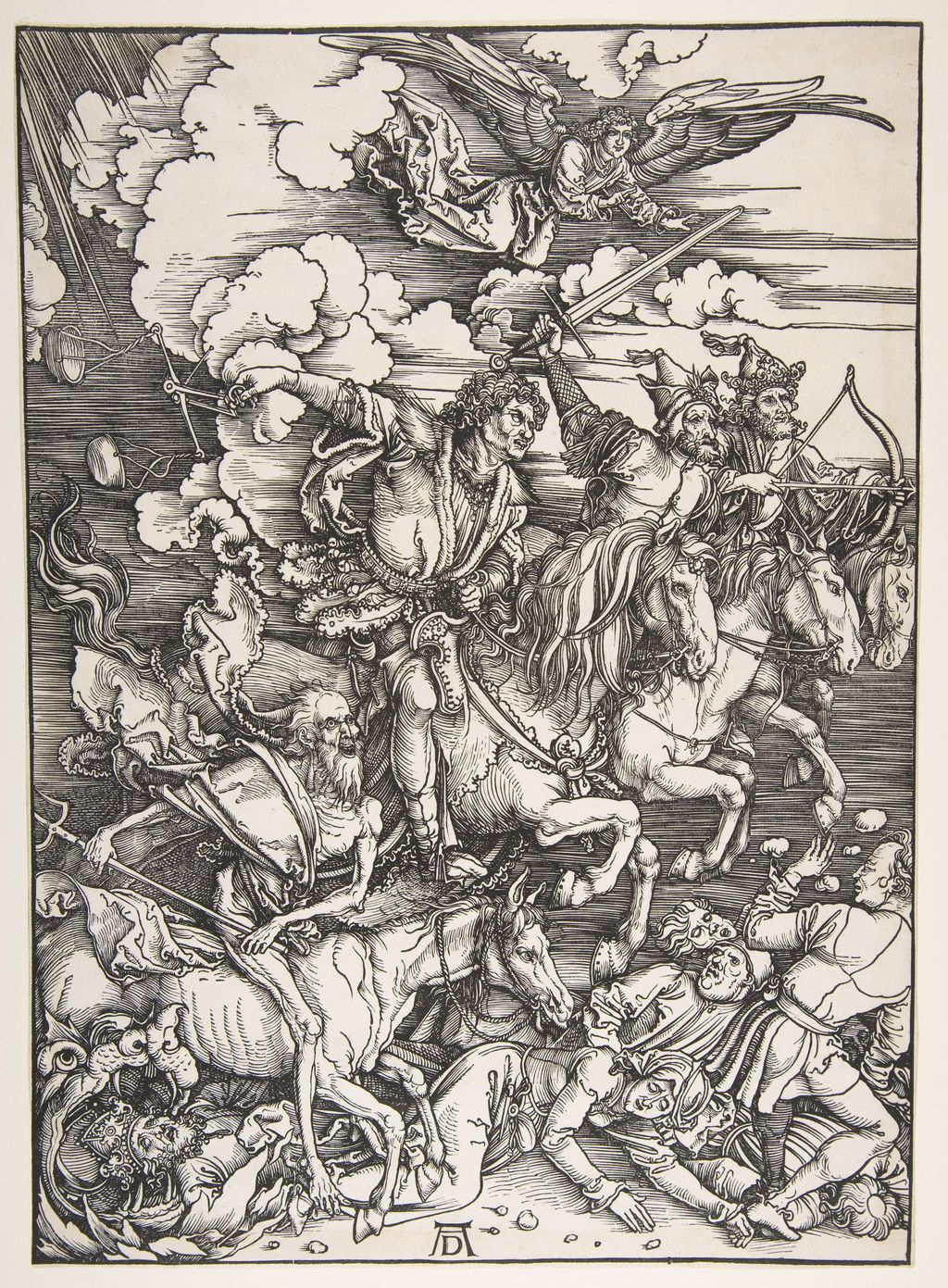
This work across Albrecht Dürer’s career
Young Hare
1502Praying Hands
1508Melencolia I
1514Four Apostles
1526Contents
- The promise behind the reunion
- A gate made for looking through
- Mary’s conception and the meaning of the embrace
- Black lines, light and the printed book
- Frequently Asked Questions
The promise behind the reunion
These are the Virgin Mary’s parents, whose early history belongs to apocryphal Christian storytelling. The Protoevangelium of James describes Joachim’s humiliation when his childlessness is used to challenge his standing among the people of Israel. He withdraws into the wilderness; Anne mourns both his absence and the fact that she has no child. Each receives an angelic assurance that their prayers have been heard. When Joachim returns with his flocks, Anne sees him at the gate, runs forward and embraces his neck. Their daughter is subsequently born and named Mary. [12]
That early account helps explain the emotional force of Dürer’s image. The meeting brings an absent husband home and gives the couple hope for a child. Anne’s joy answers two kinds of loss at once. Dürer’s joined figures make this reversal tangible: the separation required by the preceding story has become bodily closeness. The miracle is communicated through a gesture that needs very little explanation.
The medieval Golden Legend supplies a more specific setting. In its account of Mary’s Nativity, the angel directs Joachim to Jerusalem’s Golden Gate, promising that Anne will meet him there. Anne receives the same instruction independently. Their reunion becomes a sign confirming the promise, after which they return home in happiness. The text also gives the angel a pointed answer to the earlier humiliation: inability to have children should not itself be treated as evidence of sin. [13]
This narrative restores dignity as well as hope. Its public dimension matters in Dürer’s composition, where the couple are surrounded by other people. Yet the surrounding faces do not provide a dependable list of named characters or fixed emotional reactions. A man at the left raises a hand towards his cap; another leans into the group, and a woman’s head appears between the foreground figures. Their proximity brings the encounter into social life. To call them all disbelieving would flatten the varied activity Dürer has given them.
The book’s accompanying poetry preserves the same focus on Anne’s action. In the Cleveland Museum of Art’s 1959 portfolio, R. J. Schork’s English translation of Benedictus Chelidonius’s heading reads, “Anna embraces Joachim at the Golden Gate.” That short sentence is a useful guide to the picture’s centre of gravity. Dürer makes the woman’s movement towards her husband the decisive event, while the elaborate surroundings give that event a place to unfold. [14]
A gate made for looking through
The foreground arch works almost like a second frame inside the sheet. Its broad curve rises from two narrow, ornamented uprights and nearly fills the rectangular image. Vegetal scrolls thicken across the top, while small figures and tangled decorative forms occupy the vertical borders. The arch gathers everything beneath it into a coherent scene. At the same time, the depth of its inner surface makes it seem substantial enough to walk through.
The couple stand to the right of the centre, leaving room for the gathering on the left. This imbalance gives the embrace more presence: Joachim and Anne form the largest continuous shape in the lower half of the print, while the other people break into separate heads, hands, hats and sleeves. Anne’s broad back and descending mantle are especially important. They create a long outer contour that can be followed from her head down to the heavy turn of the fabric at the ground.
Look beyond the figures and the architecture becomes plainer. A low wall runs across the middle distance, punctuated by small openings and a larger arch. At the right, a further gateway cuts into a taller building. Repeated entrances establish a sequence of spaces inside the larger opening through which we look. The foreground threshold is therefore both a setting for the meeting and the beginning of a route into the city.
Above the wall, the landscape climbs sharply. Dark trees on the left give way to pale exposed rock and tiny buildings on the summit. Birds scatter across the open sky. This upper distance releases the pressure of the crowded foreground: after following the tightly interlocked arms and the dense ornament, the eye can move into relatively spacious light. The print’s Jerusalem belongs to the story, but its buildings and hillside do not establish an exact Nuremberg street or an eyewitness view of the historical Golden Gate.
The great arch also changes our relation to the figures. We stand outside its opening, close to the paving and just beyond the threshold. The scene is presented at an accessible human scale, despite the imposing decoration. Dürer’s monogram appears on a small, tilted tablet on the ground at the left, while the date 1504 is placed separately at the bottom left foot of the arch. Those marks belong to the constructed space of the image; they reward the downward glance after the eye has travelled through its deeper distances.
Mary’s conception and the meaning of the embrace
The scene acquired a particular importance in discussions of the Immaculate Conception. That doctrine concerns Mary’s freedom from Original Sin from the beginning of her life in Anne’s womb. It is distinct from the conception of Jesus, represented in the Annunciation. Some medieval images associated Mary’s miraculous conception with her parents’ embrace at the Golden Gate. As the National Gallery’s glossary explains, the idea that the embrace itself physically caused conception was not adopted by the Church. [15]
The distinction allows the print’s tenderness and its devotional significance to be understood together. Its visible subject is the reunion of Mary’s parents; its place within a Marian cycle invites the viewer to think ahead to their promised daughter. The image can carry meaning about beginnings and divine favour without supplying a literal account of reproductive events.
Anna Scherbaum gives the woodcut a stronger theological emphasis in her ALBERTINA catalogue essay. She connects the cycle’s three opening narratives about Mary’s parents with the growing veneration of Saint Anne, and interprets the Golden Gate scene as evidence of Dürer’s sympathy with supporters of the Immaculate Conception. She stresses the subject’s established association with that feast in devotional books. This is an art historian’s interpretation of the image within its religious culture. The devotional argument gives this domestic encounter a wider significance: an old couple find reassurance in each other while the viewer understands their reunion as the beginning of Mary’s story. [16]
Black lines, light and the printed book
Dürer gives this world substance through changes in the spacing and direction of lines. Close horizontal strokes darken the underside of the great arch; shorter marks describe masonry, faces and the roughness of distant rocks. Along the clothes, hatching follows curved bodies and bends into deep folds. Anne’s relatively light shoulder stands forward against Joachim’s darker sleeve and the shadowed gathering. The print offers a wide range of textures while keeping the embrace easy to read.
These effects depend on the particular logic of woodcut. The lines that receive ink stand above the areas cleared away from the block; the paper records those raised surfaces. Engraving uses incised lines in a metal plate, a different process even when the resulting image also consists of black marks on paper. In this woodcut, the apparently fluent drawing had to remain printable. The tiny ornamental details and the broad, clear silhouettes serve different needs within that shared material discipline. [17]
As a book illustration, the meeting is the third narrative scene and the fourth image when the title page is included. It follows Joachim’s rejected offering and the angel’s announcement, and precedes Mary’s birth. The complete Life of the Virgin contains eighteen narrative woodcuts framed by a title image and a concluding devotional image. In the 1511 book, Chelidonius’s Latin poems face the corresponding pictures across the opening, with text on the left and image on the right. The reunion consequently joins a sequence of anticipation, fulfilment and dedication. A viewer turning the pages encounters the embrace after the promise and before its visible result. [18]
The design also has a history beyond any single bound copy. The National Gallery of Victoria’s impression, acquired through the Felton Bequest in 1956, measures 29.7 × 20.9 centimetres and is catalogued as printed before the text edition. Its paper bears a complete High Crown watermark, with chain lines spaced 30.5 millimetres apart. These are features of that particular sheet. They help distinguish it from other impressions, without turning a watermark motif into an automatic printing date. [1]
The Pushkin Museum, for example, records an impression with Latin text on the back from the 1511 edition, alongside another without text that it dates to the middle of the sixteenth century. The same composition could thus reach viewers at different times and in different physical circumstances. Date, edition and individual sheet need to be considered together. [19]
Even the medium could change. Marcantonio Raimondi made an engraved version after Dürer; the Metropolitan Museum of Art holds a second-state impression. In that image the couple and their companions remain recognisable, but the rich foliage of the outer arch has become an exposed framework of masonry, and the birds have disappeared. The comparison makes the character of Dürer’s original particularly clear. His ornament, flickering sky and varied surfaces keep the still embrace connected to a world full of small movements. [20]
Frequently Asked Questions
Marcantonio Raimondi after Albrecht Dürer, Joachim embracing Saint Anne under the Golden Gate. Metropolitan Museum of Art, 29.52.9. Engraving.
Artworks directory
These 187 records include individual works, reverse sides, detail views, paired panels and reconstructed arrangements. Three additional catalogue images repeat works already listed. Related views are not counted as separate originals; qualified attributions and published dating are retained.
Discussion
Look again at the images and ideas explored in The Meeting of Joachim and Anne at the Golden Gate. These editorial prompts invite your observations.
Reader Insights
Which detail or idea in The Meeting of Joachim and Anne at the Golden Gate most changed your reading, and why?
How does the discussion of “The promise behind the reunion” affect your understanding?
What comparison would you bring to the discussion of “Black lines, light and the printed book”?
Join the Conversation
Share a detail, comparison or question about The Meeting of Joachim and Anne at the Golden Gate below.
References
- National Gallery of Victoria , Joachim and St Anne meet at the Golden Gate , accession 3544.4-4. Current collection record, accessed 19 October 2026. View source .
- ALBERTINA, Selbstbildnis als Dreizehnjähriger, inv. 4839 (German). View source.
- Metropolitan Museum, Four Horsemen from The Apocalypse, 19.73.209 (English). View source.
- Bayerische Staatsgemäldesammlungen, Selbstbildnis im Pelzrock, inv. 537 (German). View source.
- ALBERTINA, Feldhase, inv. 3073 (German). View source.
- ALBERTINA, Das große Rasenstück, inv. 3075 (German). View source.
- Metropolitan Museum, Adam and Eve, 19.73.1 (English). View source.
- ALBERTINA, Betende Hände, inv. 3113 (German). View source.
- Metropolitan Museum, Knight, Death, and the Devil, 43.106.2 (English). View source.
- Metropolitan Museum, Melencolia I, 43.106.1 (English). View source.
- Bayerische Staatsgemäldesammlungen, inventory 545: current collection record (German; descriptive citation). View source.
- The Protoevangelium of James , chapters 1–5, translated by Alexander Walker in Ante-Nicene Fathers , vol. 8, 1886; New Advent edition. View source .
- Jacobus de Voragine , “The Nativity of Our Blessed Lady,” The Golden Legend , volume 5, William Caxton’s English translation (1483), edited by F. S. Ellis, Temple Classics , 1900; Fordham Internet Medieval Sourcebook. View source .
- Cleveland Museum of Art , Albrecht Dürer: The Life of the Virgin , 1959, plate IV and introduction. English translations of Chelidonius’s headings by R. J. Schork. View source .
- National Gallery , London, “Immaculate Conception of the Virgin”, glossary, accessed 19 October 2026. View source .
- Anna Scherbaum , catalogue essay in Albrecht Dürer , edited by Klaus Albrecht Schröder and Maria Luise Sternath, ALBERTINA, Vienna, 2003, pp. 284–294, reproduced in Joachim und Anna unter der Goldenen Pforte (Marienleben, 4) , DG1934/389. German. View source .
- Suzanne Boorsch and Nadine M. Orenstein , The Print in the North: The Age of Albrecht Dürer and Lucas van Leyden , The Metropolitan Museum of Art Bulletin 54, no. 4, Spring 1997, pp. 3–4. View source .
- University Library Regensburg , “Die Buchgestaltung des Marienlebens”, virtual exhibition. German. View source .
- Pushkin State Museum of Fine Arts , Joachim and St. Anne Meet at the Golden Gate , inventory Г-2242, collection catalogue, English version, accessed 19 October 2026. View source .
- Metropolitan Museum of Art , Marcantonio Raimondi after Albrecht Dürer, Joachim embracing Saint Anne under the golden gate in Jerusalem , 29.52.9, collection record, accessed 19 October 2026. View source .
- Germanisches Nationalmuseum, Barbara Dürer (German and English). View source.
- Web Gallery of Art, Tucher–Rieter reverse (English). View source.
- National Gallery of Art, Portrait of a Clergyman (English). View source.
- Dürer Art, Portrait of a Man (English). View source.
- Hessen Kassel Heritage, Elsbeth Tucher (German). View source.
- Web Gallery of Art, Hans Tucher (English). View source.
- Germanisches Nationalmuseum, Emperor Maximilian I (German and English). View source.
- National Gallery of Art, Lot and His Daughters, reverse (English). View source.
- Bayerische Staatsgemäldesammlungen, Glim Lamentation (German). View source.
- Museo Nacional del Prado, Portrait of a Man (Spanish). View source.
- Bayerische Staatsgemäldesammlungen, Madonna of the Carnation (German). View source.
- Städel Museum, Job on the Dungheap (German). View source.
- Wallraf-Richartz-Museum, Piper and Drummer (German). View source.
- Italian Ministry of Culture / Uffizi, Head of Saint James (Italian). View source.
- Klassik Stiftung Weimar, Dresden Altarpiece (German). View source.
- Staatliche Museen zu Berlin, Girl with a Red Beret (German and English). View source.
- Dresden State Art Museums / Roland Enke, Bernhard von Reesen (German). View source.
- Royal Collection Trust, Burkhard von Speyer (English). View source.
- Dresden State Art Museums, Seven Sorrows of the Virgin (English). View source.
- Bayerische Staatsgemäldesammlungen, Mater Dolorosa (German). View source.
- Bayerische Staatsgemäldesammlungen, Lucretia (German). View source.
- Städel Museum, Young Woman with Her Hair Down (English). View source.
- ALBERTINA, Portrait of a Young Man (German). View source.