by
Tom Gurney
Tom Gurney BSc (Hons) is an art history expert with over 20 years experience
Published on June 19, 2020 / Updated on October 22, 2026
Email:
tomgurney1@gmail.com
/ Phone:
+44 7429 011000
An Eastern Ruler Seated on His Throne: Introduction
The ruler almost fills his throne. Crown, beard, pendant, knotted sash and falling robes gather into a single imposing figure, while a long sword steadies one side of the composition. Yet his eyes glance sideways, breaking the ceremonial frontality. Albrecht Dürer gives us a figure who seems firmly installed in power without telling us whose power this is. The National Gallery of Art in Washington dates the drawing to about 1495 and identifies its medium as pen and black ink on laid paper. The sheet measures 30.6 × 19.7 centimetres. [1]
Its familiar older title, An Oriental Ruler Seated on His Throne , describes the broad geographical character attributed to the costume. It supplies no sitter's name. That distinction matters in a drawing whose precise details can make an invented person seem almost recoverable from history. The dense ornaments invite us to examine each clasp and jewel as though they belonged to a particular royal wardrobe. Looking closely reveals how much of the image's authority comes from the way those details have been arranged.
At a Glance
- Date About 1495 [1]
- Materials Pen and black ink on laid paper [1]
- Collection National Gallery of Art, Washington [1]
This work across Albrecht Dürer’s career
Young Hare
1502Praying Hands
1508Melencolia I
1514Four Apostles
1526Contents
- A throne made of lines
- An imagined sovereign
- Turning the sheet over
- From sovereign to persecutor
- A recovered drawing
- Frequently Asked Questions
A throne made of lines
The tall back of the seat rises behind the head like an architectural frame. Its straight sides concentrate attention on the face; the diagonal hatching above and around the crown deepens the enclosure. Below, the clothes spread out beyond this narrow upright structure. Their expanding folds make the seated body seem substantial, while the throne remains a comparatively rigid skeleton around it. Dürer builds this contrast into the whole design: straight sword and seat, curling hair and fabric, hard jewels against soft cloth.
The crown is especially conspicuous because it grows out of a thick winding of material. Its pointed, decorated elements rise above the wrapped head covering, while small curls project sideways. The beard spreads across the upper chest and nearly touches the elaborate pendant below. Loops, beads and rounded settings continue down the front of the robe. These repeated small forms connect headgear, necklace and dress, making separate accessories read as a coordinated display of rank.
At the centre, the great knot of the sash interrupts that vertical procession of ornament. Fabric drawn across the lap collects here before turning and falling in several directions. The ruler's hands sit on either side of this complicated centre: one rests by the sword hilt, the other curves around the orb. The different shapes give each side its own weight. The sword establishes a long, narrow boundary; the globe and rounded sleeve create a compact mass. Their balance feels deliberate even though the figure is far from geometrically symmetrical.
Much of the drawing's richness depends on changes in the spacing of the pen strokes. Broad areas of the chest remain comparatively light, allowing the hanging jewellery to stand out. Elsewhere, closely packed lines darken a sleeve or turn under a fold. On the hanging cloth, curved hatching follows the bulge of a knee; lower down, shorter marks break across the fabric's uneven edges. Individual lines remain visible throughout. The drawing gives the eye both a convincing surface and the means by which that surface was constructed.
The feet are partly submerged in the folds. One ornamented shoe emerges near the sword, but the cloth continues beyond it, spilling across the foreground. This lower region loosens the formal pose established by the shoulders and throne, giving the figure a restless outline beneath its ceremonially composed upper body.
An imagined sovereign
Julian Raby's catalogue discussion explains the costume as a composite invention: the turban suggests an Ottoman setting, while the crown, sword, jewellery and throne draw heavily on European forms. He also traces earlier attempts to identify the figure as Charlemagne or Mehmed II. Neither identification is securely established, and the proposed pairing with a drawing of a richly dressed woman as Mehmed and Irene remains conjectural. [12]
The little orb provides a particularly economical sign. It has no crowning cross, a point Raby associates with the figure's separation from Christian imperial imagery. Visually, however, it still belongs to the drawing's larger vocabulary of possession and command. Its small size allows it to nestle under the hand; the sword extends almost the full length of the seated body. Power can be held compactly or displayed at formidable length. Both objects remain subordinate to the enormous spread of the robes. [12]
Larry Silver places the drawing within a more explicitly political reading. In his account of European images of the Ottoman world, he interprets this invented sovereign as an embodiment of the threat that Christian Europe perceived in Ottoman power. He connects the figure with the persecuting emperor Domitian in Dürer's Apocalypse . That interpretation describes a European construction of an adversary. It should not be mistaken for a reliable portrait of an Ottoman individual or a description of Ottoman character. [13]
Silver also places Dürer's early interest in Ottoman costume within a Venetian artistic network, where images by Gentile Bellini supplied models for some of the German artist's studies. The connection concerns the movement of images as well as people. A convincing costume detail could travel through another artist's work before entering a new invention. This route helps explain how familiarity with some Ottoman forms could coexist with the freely assembled magnificence of the enthroned ruler. [13]
Turning the sheet over
The reverse carries a tracing of the figure. Raby considers it probably Dürer's own work and connects it with an unfinished engraving of the same subject. Looking at the two sides makes the reversal immediately clear: the sword moves from the viewer's left to the right, while the orb moves in the opposite direction. The tracing includes shading and considerable ornament, carrying across far more than the outer silhouette. [12] [14]
The reverse is revealing because it allows attention to move from the finished effect to the figure's reusable structure. The winding headdress, pointed crown, necklace, sash and cascading cloth survive the change of direction. Together they form a coherent design that can be reconsidered on another surface. Their survival also makes the small asymmetries easier to notice. The robe sweeps differently across each knee, and each hand has its own relationship to the throne arm.
The related engraving is preserved in the Rijksmuseum as Enthroned Monarch in “Oriental” Attire , object RP-P-OB-1285. The museum dates the design to about 1496 and identifies the surviving sheet as a unique, late impression, around 1560, from the unfinished copperplate. Its account distinguishes this later printing from the moment when Dürer developed the image. The sheet therefore preserves evidence of an early project through a substantially later pull from the plate. [15]
The print's upper body consists largely of outlines. The lap and lower clothing, by contrast, contain closely worked passages of hatching. The crown is still mostly an empty shape; the heavy jewellery that fills the drawing's chest has not appeared. Below the sash, folds already swell and sink through alternating bands of light and dark. The contrast is striking: the ruler seems to acquire weight from the knees downward while his upper body remains suspended in a preliminary state.
This unequal development makes the engraving unusually useful for looking at process. The same image contains both an enclosing contour and passages where many further incisions have built up volume. The Rijksmuseum describes the figure's initial lines as cut with a burin and notes the subsequent elaboration of the cloth. One can follow that distinction across the actual impression without assuming that the unfinished areas record every step Dürer would have taken. The surviving evidence does not explain why he stopped. [15]
The print also changes the drawing's visual emphasis. With much of the ornament absent, the great knot and drapery become especially prominent. The empty chest exposes the broad architecture of the body, and the eyes stand out within a relatively sparse face. Seeing this provisional version brings the achievement of the ink drawing into sharper focus: its authority depends on both the figure's underlying structure and the extraordinary density laid over it.
From sovereign to persecutor
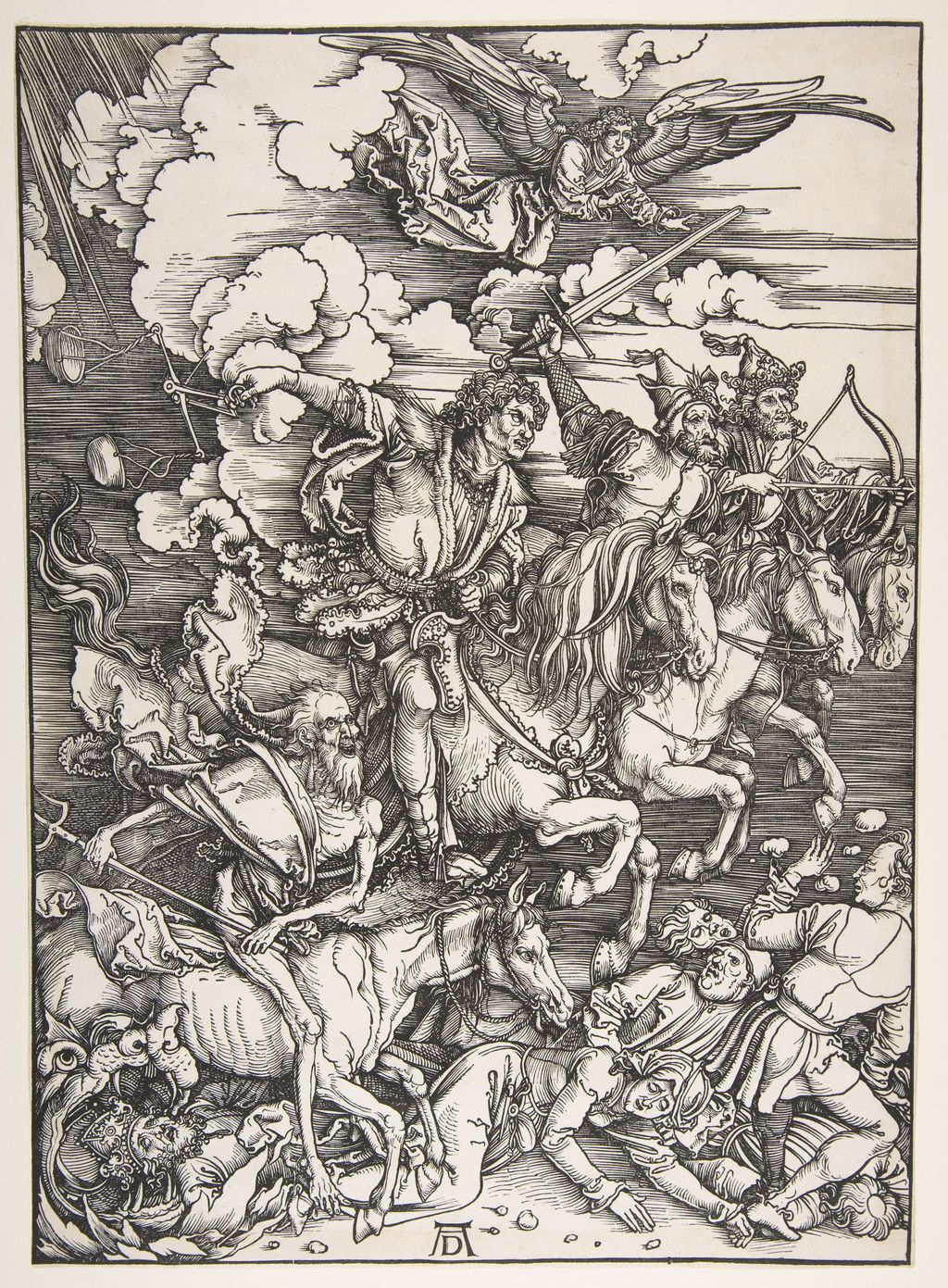
In the Martyrdom of Saint John , the first narrative woodcut of the Apocalypse , an enthroned ruler watches John being subjected to boiling oil. The Metropolitan Museum identifies him as Domitian, dressed as a Turkish sultan, and explains that the episode comes from the Golden Legend rather than the Book of Revelation itself. [16]
Raby points to the related necklace and pendant, including their flanking birds, and to a comparable sword held by an attendant. The visual relationship is more interesting than a simple repetition of the entire figure. In the woodcut, the seated emperor turns into the crowded scene, while the sword becomes part of the standing attendant's equipment. The commanding stillness of the independent drawing has been broken into elements that serve a narrative. Throne, rich clothing, jewellery and weapon now help organise the confrontation between a judge and a saint. [12]
A recovered drawing
The drawing returned to public attention in 1972. In that year's annual report, National Gallery director J. Carter Brown recorded its purchase in May and described it as long thought lost and previously known only through a copy. This contemporary account explains the acquisition's significance: a design already present in scholarship could again be studied through the recovered sheet. [17]
The Gallery's provenance lists William Young Ottley, Sir Thomas Lawrence, S. G. Liesching and Count Adolphe-Narcisse Thibaudeau, followed by an 1857 Paris sale and an American private collection. The purchase was made through Robert Light with the Ailsa Mellon Bruce Fund. The Gallery also owns an anonymous copy bearing the date 1523, given by Light in 1975. These are distinct objects with distinct histories; the copy is evidence of the composition's earlier circulation. [1] [18]
Even the familiar initials at the bottom need care. The current National Gallery inscription record describes the partly cut monogram as possibly the work of another early hand. The drawing's history includes marks of attribution as well as marks that construct the ruler. Its unresolved name, its reversed tracing and its unfinished engraved counterpart leave several questions open, but they also preserve an unusually tangible sequence of artistic decisions. A sovereign assembled from crown, cloth and jewels becomes a design that can be turned over, transferred, simplified and put to new narrative use. [1]
Frequently Asked Questions
Artworks directory
These 187 records include individual works, reverse sides, detail views, paired panels and reconstructed arrangements. Three additional catalogue images repeat works already listed. Related views are not counted as separate originals; qualified attributions and published dating are retained.
Discussion
Look again at the images and ideas explored in An Eastern Ruler Seated on His Throne. These editorial prompts invite your observations.
Reader Insights
Which detail or idea in An Eastern Ruler Seated on His Throne most changed your reading, and why?
How does the discussion of “A throne made of lines” affect your understanding?
What comparison would you bring to the discussion of “A recovered drawing”?
Join the Conversation
Share a detail, comparison or question about An Eastern Ruler Seated on His Throne below.
References
- National Gallery of Art , An Eastern Ruler Seated on His Throne , c. 1495, 1972.22.1.a, object details, provenance and inscriptions. View source .
- ALBERTINA, Selbstbildnis als Dreizehnjähriger, inv. 4839 (German). View source.
- Metropolitan Museum, Four Horsemen from The Apocalypse, 19.73.209 (English). View source.
- Bayerische Staatsgemäldesammlungen, Selbstbildnis im Pelzrock, inv. 537 (German). View source.
- ALBERTINA, Feldhase, inv. 3073 (German). View source.
- ALBERTINA, Das große Rasenstück, inv. 3075 (German). View source.
- Metropolitan Museum, Adam and Eve, 19.73.1 (English). View source.
- ALBERTINA, Betende Hände, inv. 3113 (German). View source.
- Metropolitan Museum, Knight, Death, and the Devil, 43.106.2 (English). View source.
- Metropolitan Museum, Melencolia I, 43.106.1 (English). View source.
- Bayerische Staatsgemäldesammlungen, inventory 545: current collection record (German; descriptive citation). View source.
- Julian Raby , “An Oriental Ruler Seated on His Throne,” catalogue 109, in Jay A. Levenson, ed., Circa 1492: Art in the Age of Exploration , National Gallery of Art, 1991, pp. 212–213. View source .
- Larry Silver , “Europe's Turkish Nemesis,” in Herbert Karner, Ingrid Ciulisová and Bernardo J. García García, eds., The Habsburgs and Their Courts in Europe, 1400–1700: Between Cosmopolitism and Regionalism , 2014, pp. 243–245. View source .
- National Gallery of Art , An Eastern Ruler Seated on His Throne , reverse, c. 1495, 1972.22.1.b, collection record and image. View source .
- Rijksmuseum , Tronende vorst in ‘oosterse’ kledij [Dutch], RP-P-OB-1285, collection record. View source .
- Metropolitan Museum of Art , The Martyrdom of Saint John , from The Apocalypse , 19.73.149, collection record and image. View source .
- J. Carter Brown , “Report of the Director,” National Gallery of Art Annual Report 1972 , pp. 21–22. View source .
- National Gallery of Art , An Oriental Ruler Seated on His Throne , anonymous artist after Albrecht Dürer, 1523, 1975.45.1, collection record. View source .
- Germanisches Nationalmuseum, Barbara Dürer (German and English). View source.
- Web Gallery of Art, Tucher–Rieter reverse (English). View source.
- National Gallery of Art, Portrait of a Clergyman (English). View source.
- Dürer Art, Portrait of a Man (English). View source.
- Hessen Kassel Heritage, Elsbeth Tucher (German). View source.
- Web Gallery of Art, Hans Tucher (English). View source.
- Germanisches Nationalmuseum, Emperor Maximilian I (German and English). View source.
- National Gallery of Art, Lot and His Daughters, reverse (English). View source.
- Bayerische Staatsgemäldesammlungen, Glim Lamentation (German). View source.
- Museo Nacional del Prado, Portrait of a Man (Spanish). View source.
- Bayerische Staatsgemäldesammlungen, Madonna of the Carnation (German). View source.
- Städel Museum, Job on the Dungheap (German). View source.
- Wallraf-Richartz-Museum, Piper and Drummer (German). View source.
- Italian Ministry of Culture / Uffizi, Head of Saint James (Italian). View source.
- Klassik Stiftung Weimar, Dresden Altarpiece (German). View source.
- Staatliche Museen zu Berlin, Girl with a Red Beret (German and English). View source.
- Dresden State Art Museums / Roland Enke, Bernhard von Reesen (German). View source.
- Royal Collection Trust, Burkhard von Speyer (English). View source.
- Dresden State Art Museums, Seven Sorrows of the Virgin (English). View source.
- Bayerische Staatsgemäldesammlungen, Mater Dolorosa (German). View source.
- Bayerische Staatsgemäldesammlungen, Lucretia (German). View source.
- Städel Museum, Young Woman with Her Hair Down (English). View source.
- ALBERTINA, Portrait of a Young Man (German). View source.