by
Tom Gurney
Tom Gurney BSc (Hons) is an art history expert with over 20 years experience
Published on June 19, 2020 / Updated on October 22, 2026
Email:
tomgurney1@gmail.com
/ Phone:
+44 7429 011000
Penance of Saint John Chrysostom: Introduction
The saint who gives this engraving its title is easy to overlook. A small, bearded man crawls at the far left, near the edge of a distant landscape. Most of the picture belongs to a naked woman nursing an infant beneath an enormous rock formation. Her lowered face, the baby's lifted head and the arms supporting its body form the intimate centre of an image whose story involves desire, violence and repentance. Made around 1497, Albrecht Dürer's Penance of Saint John Chrysostom turns a strange religious legend into a picture that asks us to look closely at the people its title leaves unnamed. [1]
The woman occupies the sheltered foreground, while the penitent appears beyond the rock's edge, almost lost among the details of the open country. A viewer can recognise the act of feeding a child before discovering the crawling figure that identifies the subject. Dürer makes understanding unfold in two stages: first an encounter with the mother, then a search for the story surrounding her.
At a Glance
This work across Albrecht Dürer’s career
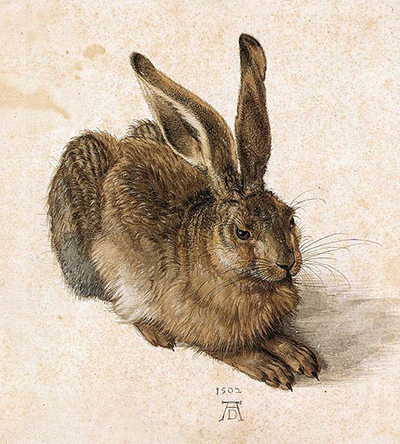
Young Hare
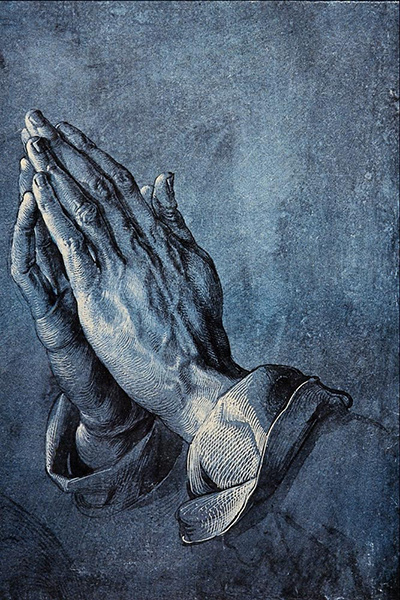
1502Praying Hands
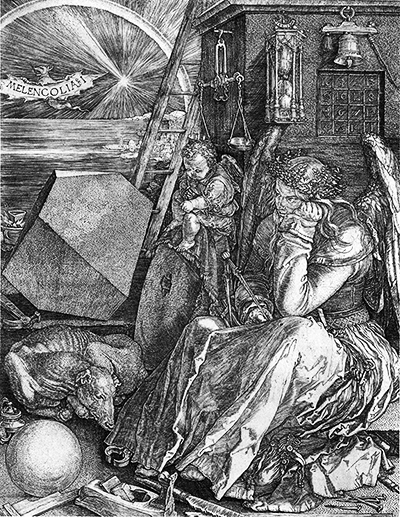
1508Melencolia I
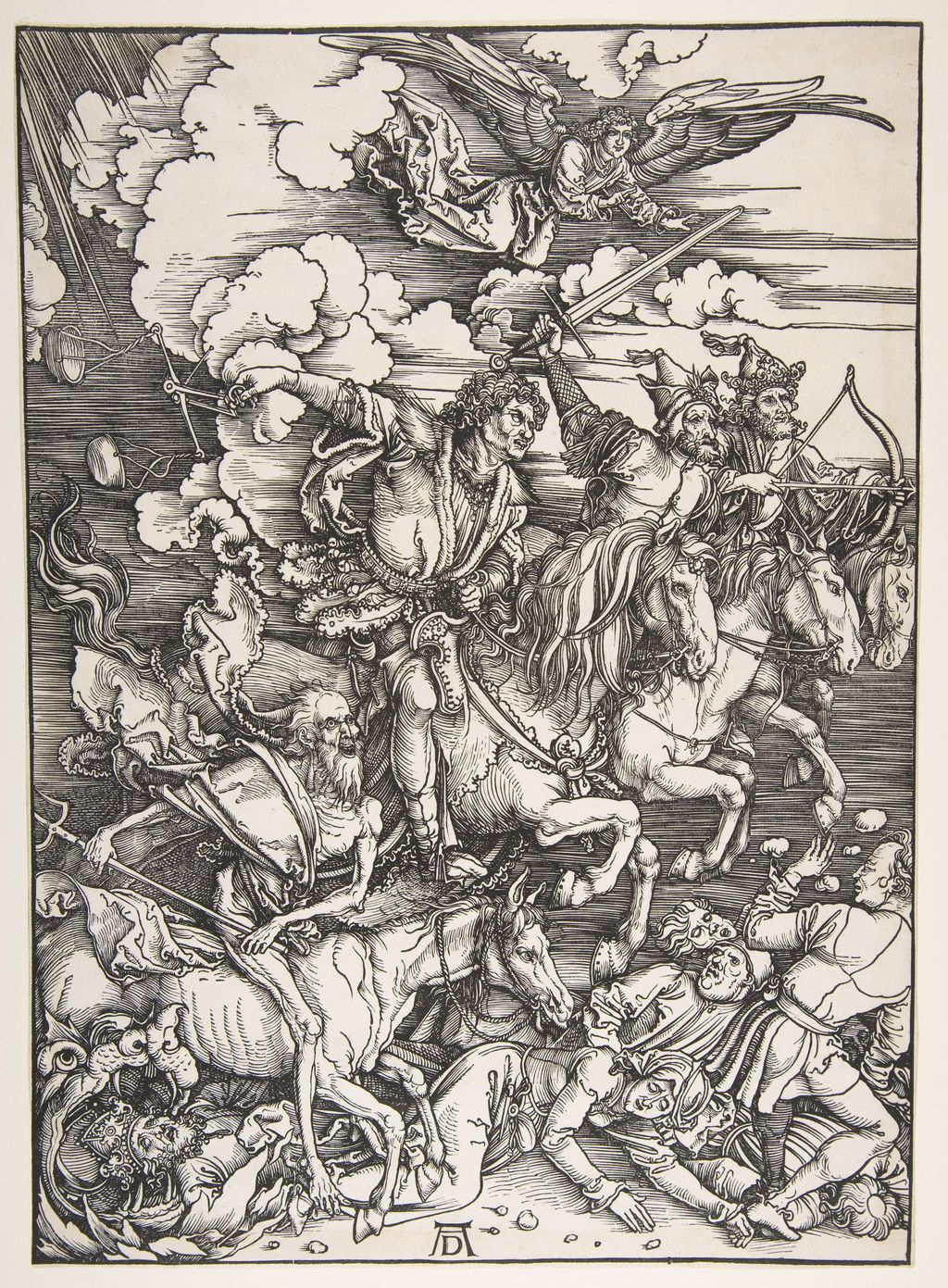
1514Four Apostles
1526Contents
- The story behind the crawling man
- A shelter made of rock and line
- An engraving on an intimate scale
- An image open to reinterpretation
- Frequently Asked Questions
The story behind the crawling man
In the late medieval tale, an emperor's daughter takes shelter with a hermit after becoming lost in a storm. John breaks his vow of chastity with her, then throws her from a cliff. Believing her dead, he undertakes a terrible penance, moving on all fours in the wilderness. The discovery that she has survived becomes part of the story of his forgiveness. This is a fictitious legend attached to John Chrysostom, the historical Church Father and patriarch of Constantinople who lived around the turn of the fifth century. It cannot be read as evidence of his actual conduct. [1] [12]
The child's identity needs particular care. Timothy Husband's account of the 1471 prose version distinguishes the emperor's newborn, who demands baptism by John, from the rescued princess. A separate German verse tradition, preserved in a manuscript of about 1516–18 but considered older, gives the princess a son who has reached adulthood when she is found. These versions do not supply one consistent, literal script for Dürer's nursing infant. The print brings mother and baby together with a clarity that the surviving literary alternatives complicate. [13]
The story itself later became an object of religious argument. As Sikorska notes, Martin Luther mocked it in his German-language pamphlet Die Lügend von S. Johanne Chrysostomo of 1537. Its fantastic incidents could serve opposing purposes: they offered an extraordinary narrative of forgiveness, but also furnished material for an attack on the credibility of saints' legends. [12]
Earlier illustrations help explain how unusual Dürer's emphasis was. A woodcut in Günther Zainer's 1471 Leben der Heiligen presents the naked, haloed penitent prominently between trees. Anton Koberger's 1488 Nuremberg edition places a crawling, hairy John at the right of a woodland scene, with a mounted hunter near the middle and a couple at the left. The figures share a broad strip of forest. Dürer's tall composition gives the woman and rock a scale that overwhelms the saint's small presence. [13]
His image also leaves much of the tale outside the frame. There is no visible fall, attack, encounter with hunters or public announcement of forgiveness. The mother tends her infant without acknowledging the man beyond her shelter. Consequently, the violence belongs to the viewer's knowledge of the legend, while the immediate action is the quiet work of sustaining a child. That separation gives the engraving an unsettling double character: tenderness is plainly visible, but its setting carries the memory of harm.
A shelter made of rock and line
The rocks are almost as commanding as the woman. Their upper edges break into shelves and points, sprouting grasses and fernlike leaves against the open sky. Below, rounded masses swell outwards, then split into sharp, pale fractures. The face nearest the woman is deeply shadowed, making a recess around her head and shoulders. Farther right, the stone opens into a large light surface before falling away into creases and projecting ledges. The shelter feels substantial because its different planes catch different amounts of light.
Against these broken forms, the woman's body has a continuous, rounded contour. Her legs extend down from the stone seat, one crossing in front of the other; her long hair spills in separate curls beside her shoulder. The infant's bent limbs make a smaller cluster of curves within her embrace. One hand supports the child while the other approaches the breast. The downward movement of her gaze answers the baby's upward turn. Almost everything within this small exchange directs attention back towards their physical contact.
There is no sumptuous bed, household interior or court costume to establish the princess's rank. Her nudity makes the exposure of her situation visible, yet the hollow in the rock encloses her. The setting offers protection without becoming comfortable. Jagged stone remains close to bare flesh, and the irregular ground makes the position of her feet conspicuous. The picture holds these different sensations together: bodily softness, a hard seat, the weight of the infant and the surrounding roughness.
Joanna Sikorska places Dürer's rock formations within a wider Franconian artistic tradition and his early interest in studying such motifs. Her discussion helps explain why the landscape demands attention in its own right. Here, the rocks perform several jobs at once. They create the foreground shelter, hide much of the world behind it and provide the abrupt edge beside which the distant saint comes into view. The division between the two human subjects is built into the terrain. [12]
At the left, the image opens into another kind of space. Small trees, buildings and distant hills recede beneath a much lighter sky. The crawling man's bent body belongs to this reduced scale. He is recognisably human, but his hands and knees bring him down towards the level of the ground. The woman sits upright and supports another person; the man supports himself on four limbs. These contrasting bodily arrangements make the meaning of his penance legible even before its narrative is known.
The subject offered Dürer an occasion to study the female nude, but the nursing gesture gives the figure a specific relationship and occupation. The Cleveland Museum of Art proposes that the engraving may express the triumph of maternal love over sin. That is a persuasive possibility, rather than a recorded explanation by the artist. The picture's distribution of attention supports it: the mother and child receive the sustained, close view, while the saint's self-punishment takes place at a distance. [1]
An engraving on an intimate scale
All these differences of texture are carried by printed marks. Engraving involves cutting into a metal plate with a sharp tool, the burin; it belongs to the intaglio family of printmaking. Woodcut works through a different arrangement, with the printable lines standing above the cut-away surface. This distinction matters when comparing Dürer's fine modelling with the older book illustrations. His image develops a broad rock face, a strand of hair and the soft turn of a limb through closely controlled changes in the lines. [14]
Across the stone, hatching follows the direction of a plane or gathers in a dark pocket. Along the hair, thin, curling strokes preserve individual locks. The woman's legs emerge through lighter modelling, surrounded by more densely worked ground and rock. Short marks and dots appear alongside the longer strokes, especially on the stone, but they form part of a varied engraved vocabulary. The picture's luminous areas depend on the spacing of black marks and the paper visible between them.
Its apparent monumentality can obscure how small the object is. The Birmingham Museum of Art's impression measures 18.1 by 11.9 centimetres at the sheet. The museum also notes the heavy inking often found in impressions of this engraving, including its own. Darkness therefore has a material history as well as a role in the design. Looking closely at one impression, or at a reproduction of it, means looking at a particular printing of the plate. [15]
The National Gallery of Art's sheet in Washington, trimmed to the plate, measures 18 by 11.9 centimetres. It entered the collection as Lessing J. Rosenwald's gift in 1943, after belonging to earlier collectors including the painter Sir Peter Lely and the Spencer family. Such histories belong to individual sheets. They help explain the engraving's survival as a collected object, while reminding us that the composition exists in multiple impressions, each with its own ownership and physical condition. [16]
An image open to reinterpretation
The date is approximate. Cleveland and Washington place the engraving around 1497, while the Metropolitan Museum of Art dates its impression to about 1496. The conspicuous AD monogram at the lower centre names the artist, but does not supply a year. A date around 1496–97 accommodates these institutional assessments without pretending that the work carries an exact chronological statement. [1] [16] [17]
Its subject has also proved less obvious than the familiar title suggests. Harvard Art Museums retains Saint Genevieve as an alternative title in its record. Looking at the print explains the possibility of uncertainty: the foreground contains a mother and child in a remote shelter, and the decisive identification depends on a much smaller figure at the margin. A title directs us towards John, while the composition keeps drawing the eye back to the woman. [18]
Dürer's arrangement had a conspicuous later response in Lucas Cranach the Elder's Penance of Saint John Chrysostom of 1509. Cranach likewise gives the foreground to a naked woman and child and relegates the crawling saint to the distance. His woman reclines in a fuller woodland setting, accompanied by animals. The British Museum identifies Dürer's engraving as an important model for the composition. The comparison reveals how transferable Dürer's central decision was: another artist could preserve the imbalance between foreground woman and distant penitent while changing the surrounding world. [19]
Sikorska interprets Cranach's response as an assertion of artistic ability within the competitive culture of the Wittenberg court. For Dürer's engraving, the comparison also sharpens what is distinctive in the earlier design. Its great wall of rock confines the mother and child to a narrow, upright space. The distant prospect appears through a side opening, and the crawling saint remains close to the edge. To find him is to recover the legend; to return to the foreground is to recognise how thoroughly Dürer has reorganised our attention around the woman's continued life and care. [12]
Frequently Asked Questions
Artworks directory
These 187 records include individual works, reverse sides, detail views, paired panels and reconstructed arrangements. Three additional catalogue images repeat works already listed. Related views are not counted as separate originals; qualified attributions and published dating are retained.
Discussion
Look again at the images and ideas explored in Penance of Saint John Chrysostom. These editorial prompts invite your observations.
Reader Insights
Which detail or idea in Penance of Saint John Chrysostom most changed your reading, and why?
How does the discussion of “The story behind the crawling man” affect your understanding?
What comparison would you bring to the discussion of “An image open to reinterpretation”?
Join the Conversation
Share a detail, comparison or question about Penance of Saint John Chrysostom below.
References
- Cleveland Museum of Art , The Penance of St. John Chrysostom , c. 1497, 1934.339. Object record and curatorial description. View source .
- ALBERTINA, Selbstbildnis als Dreizehnjähriger, inv. 4839 (German). View source.
- Metropolitan Museum, Four Horsemen from The Apocalypse, 19.73.209 (English). View source.
- Bayerische Staatsgemäldesammlungen, Selbstbildnis im Pelzrock, inv. 537 (German). View source.
- ALBERTINA, Feldhase, inv. 3073 (German). View source.
- ALBERTINA, Das große Rasenstück, inv. 3075 (German). View source.
- Metropolitan Museum, Adam and Eve, 19.73.1 (English). View source.
- ALBERTINA, Betende Hände, inv. 3113 (German). View source.
- Metropolitan Museum, Knight, Death, and the Devil, 43.106.2 (English). View source.
- Metropolitan Museum, Melencolia I, 43.106.1 (English). View source.
- Bayerische Staatsgemäldesammlungen, inventory 545: current collection record (German; descriptive citation). View source.
- Joanna Sikorska , “The Penance of St John Chrysostom: Lucas Cranach the Elder and Artistic Rivalry”, Journal of the National Museum in Warsaw. New Series 14 (50), 2025, pp. 123–142; especially pp. 126–130 and 136–139. Translated by Julita Mastalerz. View source .
- Timothy Husband , The Wild Man: Medieval Myth and Symbolism , Metropolitan Museum of Art, 1980, catalogue entries 22–24, pp. 102–109, especially figures 60–64. Includes reproductions of the German-language Zainer 1471 and Koberger 1488 illustrations. View source .
- Suzanne Boorsch and Nadine M. Orenstein , The Print in the North: The Age of Albrecht Dürer and Lucas van Leyden , The Metropolitan Museum of Art Bulletin 54, no. 4, Spring 1997, introduction, pp. 3–5. View source .
- Birmingham Museum of Art , The Penance of St. John Chrysostom , about 1497, 1952.2. Object record. View source .
- National Gallery of Art , Washington, The Penance of Saint John Chrysostom , c. 1497, 1943.3.3460. Object record, inscriptions and provenance. View source .
- Metropolitan Museum of Art , The Penance of Saint John Chrysostom , ca. 1496, 1984.1201.8. Object record. View source .
- Harvard Art Museums , Penance of Saint Chrysostom , c. 1496, G1094. Object record, including alternative title. View source .
- British Museum , Lucas Cranach the Elder, The Penance of St John Chrysostom , 1509, E,1.246. Curatorial commentary by Giulia Bartrum, from German Renaissance Prints 1490–1550 , 1995, no. 178. View source .
- Germanisches Nationalmuseum, Barbara Dürer (German and English). View source.
- Web Gallery of Art, Tucher–Rieter reverse (English). View source.
- National Gallery of Art, Portrait of a Clergyman (English). View source.
- Dürer Art, Portrait of a Man (English). View source.
- Hessen Kassel Heritage, Elsbeth Tucher (German). View source.
- Web Gallery of Art, Hans Tucher (English). View source.
- Germanisches Nationalmuseum, Emperor Maximilian I (German and English). View source.
- National Gallery of Art, Lot and His Daughters, reverse (English). View source.
- Bayerische Staatsgemäldesammlungen, Glim Lamentation (German). View source.
- Museo Nacional del Prado, Portrait of a Man (Spanish). View source.
- Bayerische Staatsgemäldesammlungen, Madonna of the Carnation (German). View source.
- Städel Museum, Job on the Dungheap (German). View source.
- Wallraf-Richartz-Museum, Piper and Drummer (German). View source.
- Italian Ministry of Culture / Uffizi, Head of Saint James (Italian). View source.
- Klassik Stiftung Weimar, Dresden Altarpiece (German). View source.
- Staatliche Museen zu Berlin, Girl with a Red Beret (German and English). View source.
- Dresden State Art Museums / Roland Enke, Bernhard von Reesen (German). View source.
- Royal Collection Trust, Burkhard von Speyer (English). View source.
- Dresden State Art Museums, Seven Sorrows of the Virgin (English). View source.
- Bayerische Staatsgemäldesammlungen, Mater Dolorosa (German). View source.
- Bayerische Staatsgemäldesammlungen, Lucretia (German). View source.
- Städel Museum, Young Woman with Her Hair Down (English). View source.
- ALBERTINA, Portrait of a Young Man (German). View source.