by
Tom Gurney
Tom Gurney BSc (Hons) is an art history expert with over 20 years experience
Published on June 19, 2020 / Updated on October 22, 2026
Email:
tomgurney1@gmail.com
/ Phone:
+44 7429 011000
Portrait of the Artist’s Father 1490: Introduction
Albrecht Dürer’s father looks beyond the left edge of the painting, his hands gathered around a string of beads. A broad black cap sets off the long, uneven outline of his face. Beneath it, fine strands of hair escape beside the temple, while the dark edging of his brown coat leads the eye towards his hands. The figure almost fills the picture. There is room for the turn of the head and the spread of the shoulders, but little space for anything to distract us from them. [1]
Painted in 1490, the portrait is an oil painting on panel, measuring 47.5 × 39.5 centimetres, now in the Uffizi in Florence. Its sitter, Albrecht Dürer the Elder, was a goldsmith and his son’s first teacher, as the artist later recorded in his family chronicle. [2] [3] [1] [4]
At a Glance
This work across Albrecht Dürer’s career
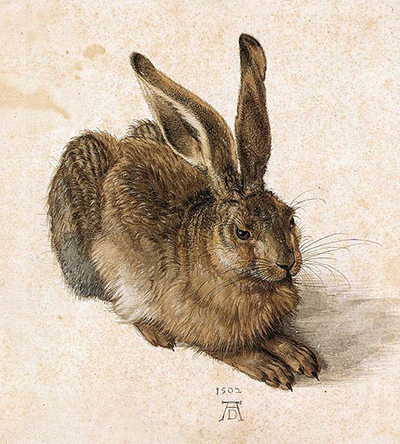
Young Hare
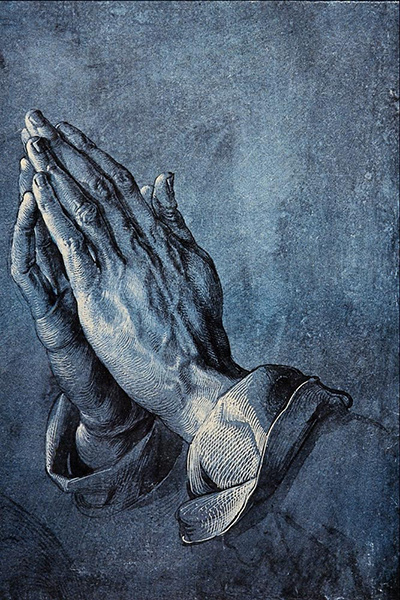
1502Praying Hands
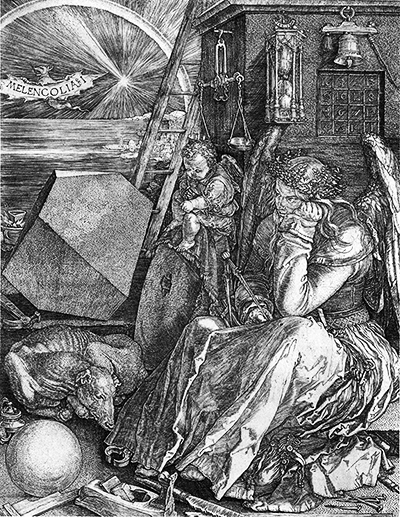
1508Melencolia I
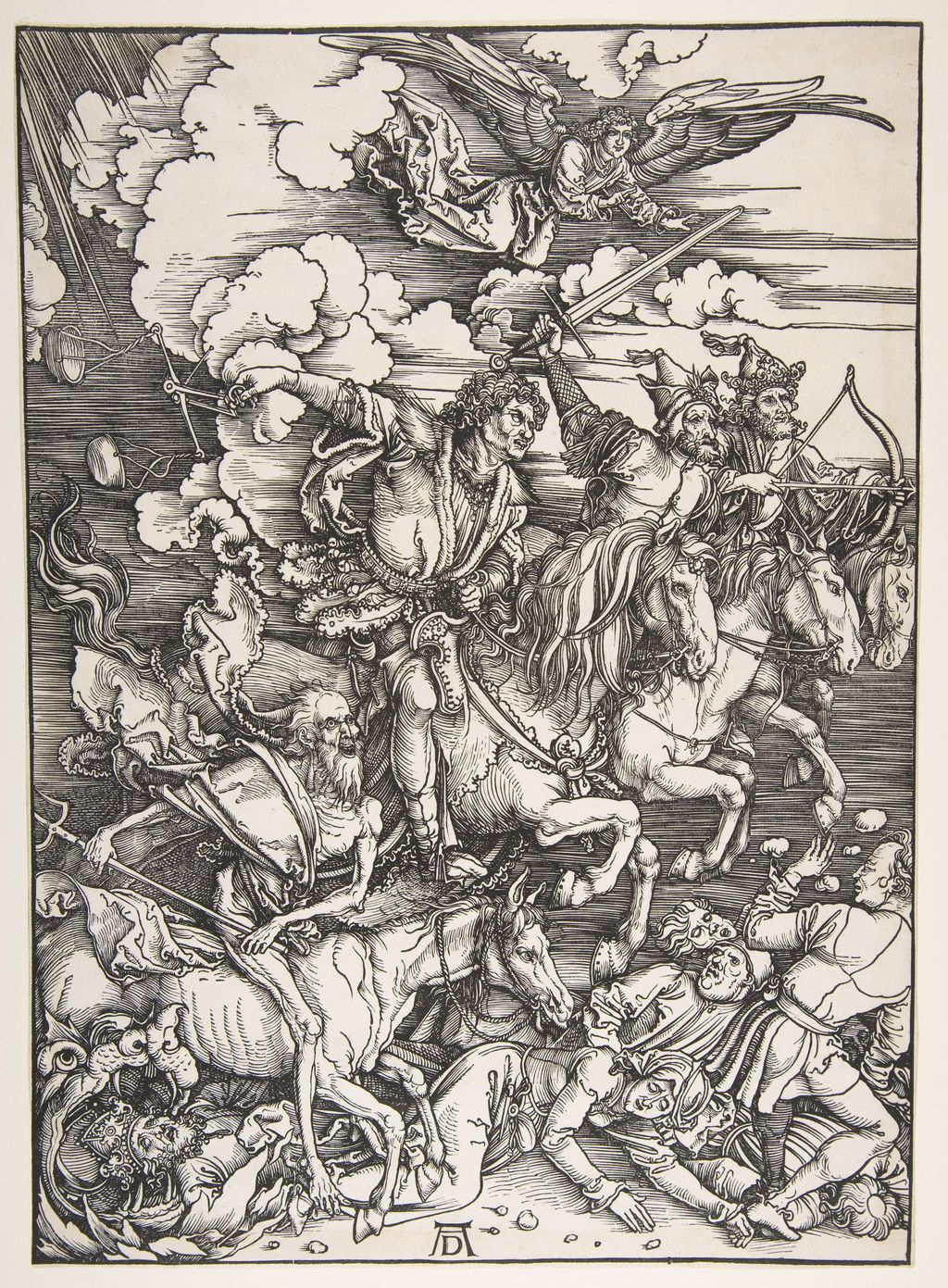
1514Four Apostles
1526Contents
- The face against the green
- Hands, beads and devotion
- A father’s record and a son’s apprenticeship
- Two parents and two painted surfaces
- A family image in later collections
- Frequently Asked Questions
The face against the green
The father’s body turns gently towards the left, bringing the nearer shoulder forward. His head follows the same direction, but the eyes seem to reach further out. Both eyes remain visible. The farther side of the face is compressed into a narrow succession of brow, cheek and mouth. On the nearer side, light travels across the forehead and cheekbone, then gives way to the long hollow beside the mouth.
Dürer makes the nose a firm projection without allowing it to dominate the head. Its illuminated bridge ends above a small shadow, while the lips form a narrow, almost horizontal interruption below. The jaw turns through a sharper angle towards the neck. Short creases beside the eye and beneath the cheek vary in direction and weight; they describe skin passing over bone, with soft and firm areas held together in the same face. The closed mouth and sideways gaze give the sitter a reserved presence, although the thoughts behind that expression remain inaccessible. [1]
The cap supplies a broad area of darkness above this intricate modelling. Its rounded crown and thick lower band are comparatively simple shapes. That simplicity helps the pale forehead emerge and makes the individual hairs at the temple more noticeable. Below, the dark garment at the neck answers the black cap. Between them, the face has a clear, luminous setting. The brown coat expands across the lower half of the picture in broad folds, giving weight to the figure without competing with his features.
The green ground has no horizon or described room. Its mottled appearance in reproduction gives the figure a shallow, enclosed setting. The strong outline of the shoulder secures the body against it, while small changes of colour within the skin turn the head in space. The cheek moves into shadow; the forehead catches a warmer light; the neck becomes paler where it meets the dark clothing. Close looking here depends as much on these gradual transitions as on the sharply drawn features.
There is also a striking difference between the two sides of the coat. On the right of the picture, a broad sleeve makes a nearly uninterrupted area of brown. Towards the left, the sleeve bends into a sequence of smaller folds around the wrist. Across the chest, the opening makes an irregular dark shape that narrows as it approaches the hands. These unequal shapes keep the substantial garment from becoming a rigid frame. They guide the eye towards the places where the body changes direction.
Hands, beads and devotion
At the lower edge, one thumb and a bent finger approach a bead while the other hand gathers the strand. The hands are close together but perform different actions. One is seen more from the back, the other with its fingers curling towards us. Their pale surfaces carry the light down from the face. Red beads punctuate the darker spaces around them, and the strand drops towards the bottom of the picture, where its curve is cut by the edge.
The Italian national catalogue identifies the beads as a rosary. With this object of devotion in his hands, the sitter’s religious life becomes part of the portrait. [22] [23]
The son’s later testimony gives this choice a personal context. He recalled the long labour by which his father had supported his wife and children, with little to spare. Writing in 1524, Dürer remembered a father who had taught his children to love God and deal honestly with their neighbours. In William Martin Conway’s 1889 English translation, he describes him as “a man patient of spirit, mild and peaceable to all”. He also recalls the father’s preference for few words and his gratitude towards God. [3]
The chronicle is affectionate remembrance, written more than three decades after the painting. It offers a particular son’s understanding of his father. Read beside the painted hands, its account of everyday religious instruction makes devotion part of the household’s remembered life. Yet the painting’s quietness leaves much unsaid. We can follow the fingers around the beads and the light across the face without turning their movements into a recovered thought or prayer.
A father’s record and a son’s apprenticeship
Dürer begins his chronicle by explaining that he has assembled it from his father’s papers. The elder man had kept a register of his children’s births, and the son copied entries from it into his own account. In the entry for 1471, the father records the arrival of the child who would become the painter, identifies Anton Koberger as godfather, and explains that the boy received his own name. The two Albrechts were already joined in the father’s written record long before the younger one painted this likeness. [3]
The same account traces a family history of skilled work. The father came from a village near Gyula in the kingdom of Hungary. His own father, Anton, had learned goldsmithing there, and Albrecht the Elder followed him into the craft. Another relative, Niklas, later trained with the elder Dürer in Nuremberg. Through these details, the sitter emerges as a teacher within an extended family, with connections that reached beyond a single workshop or city. [3]
According to the chronicle, he had spent time among artists in the Netherlands before arriving in Nuremberg in 1455. There he served Hieronymus Holper and, in 1467, married Holper’s daughter Barbara. The migration and the marriage belong to the son’s account of how his family took root in Nuremberg. They also explain why remembering this man involved remembering both an occupation and a household. [3]
The younger Dürer’s education began within that craft. After learning to read and write, he was taught goldsmithing by his father. He could already work competently when he expressed a preference for painting. His father regretted the time spent on a trade the boy now wished to leave, but agreed to the change. On 30 November 1486, he apprenticed his son to Michael Wolgemut for three years. [3]
The son’s wording preserves the difficulty of that decision as well as its outcome. An existing investment in training had to give way to a different ambition. For the reader looking back at the portrait, the relationship is unusually concrete: the painter was studying the face of someone who had taught him to work with his hands and had then allowed him to change direction. This context makes the careful rendering of hands especially absorbing, without explaining every painted outline as a consequence of goldsmithing. [3]
The father’s part in that education continued after the apprenticeship. Dürer says that his father sent him away when his learning was finished, and that he remained absent for four years until his father called him home. He dates his departure to 1490 and his return to 1494. The portrait’s year therefore falls at a transition that the son himself remembered through his father’s actions. His brief account supplies the broad setting; it gives no date for a sitting or description of a farewell. [3]
Two parents and two painted surfaces
The companion portrait is Barbara Dürer, née Holper, in the Germanisches Nationalmuseum, Nuremberg. Its current record identifies it as the left wing of the parents’ diptych and dates its recognition as Dürer’s mother to 1979. Painted in 1490 on fir, it measures 47.2 × 35.7 centimetres. The museum says both panels remained the artist’s personal property until his death. The father’s familiar solitary image thus belonged to a family pair whose two halves are now in different collections. [24]
This painted Barbara is distinct from the charcoal portrait Dürer made of his mother in 1514, now in Berlin. Keeping the two works separate restores the earlier painting’s place beside the father’s likeness. [25] [24]
The father’s reverse bears the Dürer and Holper arms. The Italian national catalogue locates the original date beneath them, distinguishing it from the front’s date and AD monogram, added later, probably by Dürer himself. The two faces therefore preserve different moments in the panel’s history. [22] [23]
On the back, pale wings spread to either side of a red-clad figure above a helmet. Below, two shields tilt away from one another, surrounded by curling red and yellow ornament. The display fills the surface with outward movement. Its bright forms stand against a much darker ground, with warmer, fiery-looking colour towards the top. The front concentrates attention on a head and a small action; the back sends the eye through an elaborate arrangement of curves, points and spreading feathers.
The emblems also carry names. The British Museum explains the open door through German Tür and the family’s connection with the Hungarian place-name Ajtós, meaning door. It identifies the wings and the bust of a Black man above the helmet as emblems used by Barbara Holper’s family. These signs place the two families together on the same panel. [26]
A family image in later collections
Susan Foister notes portraits of the father and mother in Willibald Imhoff’s inventories of 1573–74, 1580 and 1588, following his acquisition of Dürer’s workshop contents in 1560. She describes the father’s painting as usually identified with the Uffizi panel; that link retains a qualification, rather than establishing every transfer. [27]
The Uffizi’s account gives a secure later stage: Cardinal Leopoldo de’ Medici had acquired the portrait before its inventory in his collection in 1675. It entered the Gallery in 1773. [2]
Another composition of the father appears in the National Gallery, London. Its inscription gives his age as seventy in 1497, but the surviving panel is catalogued as After Albrecht Dürer , possibly later sixteenth century. The father-and-son portraits associated with Charles I concern this composition and the 1498 self-portrait now in Madrid, a separate pairing from the parents of 1490. [28]
The father himself lived until 1502. In his chronicle, Dürer recalled his father’s final illness, his religious counsel and his request that the son care for Barbara. A separate account of the death, also printed by Conway, says that the son was summoned from his chamber but arrived after his father had died. Dürer records his sorrow at missing that last moment. These memories give the relationship a later history, twelve years beyond the date of the painting. [3]
Dürer ended that account by asking friends to remember his father’s soul with an Our Father and an Ave Maria. His memorial invited prayer from its readers. Beside the portrait’s rosary, this request gives a moving instance of devotion passing between the father, his son and those who remembered him. [3] [23]
Returning to the picture, the father is still occupied with the beads. The eyes look beyond the frame while the hands remain close to the body, and the ample coat joins those two centres of attention. The son’s written recollections supply names, work, decisions and loss. The painted likeness holds another kind of detail: the turn of a cheek, the uneven line of a mouth, and the small interval between a finger and a bead. [3] [1]
Frequently Asked Questions
Artworks directory
These 187 records include individual works, reverse sides, detail views, paired panels and reconstructed arrangements. Three additional catalogue images repeat works already listed. Related views are not counted as separate originals; qualified attributions and published dating are retained.
Discussion
Look again at the images and ideas explored in Portrait of the Artist’s Father 1490. These editorial prompts invite your observations.
Reader Insights
Which detail or idea in Portrait of the Artist’s Father 1490 most changed your reading, and why?
How does the discussion of “The face against the green” affect your understanding?
What comparison would you bring to the discussion of “A family image in later collections”?
Join the Conversation
Share a detail, comparison or question about Portrait of the Artist’s Father 1490 below.
References
- Joseph Heller, Das Leben und die Werke Albrecht Dürer's, vol. II, part 1 (Bamberg: C. F. Kunz, 1827), p. 118, no. 138; pp. 160–162, Florence entry 13; pp. 196–197, Munich entry 17. Original German edition. View source.
- Uffizi Gallery , Portrait of the Artist’s Father , Google Arts & Culture. English. Object data and collection history. View source .
- Albrecht Dürer , family chronicle and father’s death accounts, in William Martin Conway, Literary Remains of Albrecht Dürer (Cambridge University Press, 1889), pp. 34–35, 37, 40–41. Historical English translation; manuscript transcripts and notes by Lina Eckenstein. View source .
- Maud Cruttwell, A Guide to the Paintings in the Florentine Galleries: The Uffizi, The Pitti, The Accademia (London:J.M.Dent; NewYork:E.P.Dutton,1907), p.119, no.766; abbreviationkey p.xiv. Original English edition. View source.
- Charles Ephrussi, Albert Dürer et ses dessins (Paris: A. Quantin, 1882), selected pp.2,14–16,20,78–80,107,109,120,153,178,188,298,302; index pp.399,403,405–406,409–410. Original French edition. View source.
- Campbell Dodgson, Catalogue of Early German and Flemish Woodcuts Preserved in the Department of Prints and Drawings in the British Museum, vol. 1 (London: British Museum, 1903). Original English edition Selected pp. 246, 260, 262, 272, 274, 288, 290, 294–296, 299–300, 302, 307. View source.
- Heinrich Wölfflin, Die Kunst Albrecht Dürers, second enlarged edition (Munich: F. Bruckmann, 1908), pp. 110, 298. Original German edition. View source.
- S. R. Koehler, A Chronological Catalogue of the Engravings, Dry-Points and Etchings of Albert Dürer (New York: Grolier Club, 1897). Original English edition Selected pp. 5, 14, 17–18, 32, 37, 42, 44, 51, 58, 60, 63, 81. View source.
- Moriz Thausing, Albert Dürer: His Life and Works, translated from German, edited by Fred. A. Eaton, vol. II (London: John Murray, 1882), pp. 16–18. Original English edition. View source.
- Johann Carl Sigmund Kiefhaber, ed., Nachrichten zur ältern und neuern Geschichte der freyen Reichsstadt Nürnberg: ein Beytrag zur Geschichte der Reichsstädte in Teutschland, vol.1 (Nuremberg: Lechner, 1803), first quarter, pp.6–9,14–16. Original German historical edition of correspondence and inventory. View source.
- T. Sturge Moore, Albert Dürer (London: Duckworth and Co.; New York: Charles Scribner’s Sons, 1905), part III, portrait discussion and caption of the 1500 Munich self-portrait. Original English edition. View source.
- ALBERTINA, Selbstbildnis als Dreizehnjähriger, inv. 4839 (German). Heinz Widauer, entry no.1, in Klaus Albrecht Schröder and Maria Luise Sternath, eds., Albrecht Dürer (Ostfildern-Ruit: Hatje Cantz, 2003), p.116.. View source.
- Metropolitan Museum, Four Horsemen from The Apocalypse, 19.73.209 (English). Associated publication: Suzanne Boorsch and Nadine M.Orenstein, The Print in the North: The Age of Albrecht Dürer and Lucas van Leyden, The Metropolitan Museum of Art Bulletin 54/4 (Spring1997).. View source.
- Bayerische Staatsgemäldesammlungen, Selbstbildnis im Pelzrock, inv. 537 (German). View source.
- ALBERTINA, Feldhase, inv. 3073 (German). View source.
- ALBERTINA, Das große Rasenstück, inv. 3075 (German). View source.
- Metropolitan Museum, Adam and Eve, 19.73.1 (English). View source.
- ALBERTINA, Betende Hände, inv. 3113 (German). Heinz Widauer, in Klaus Albrecht Schröder, ed., Die großen Meister der Albertina (Petersberg: Imhof, 2008), no.10.. View source.
- Metropolitan Museum, Knight, Death, and the Devil, 43.106.2 (English). View source.
- Metropolitan Museum, Melencolia I, 43.106.1 (English). View source.
- Bayerische Staatsgemäldesammlungen – Alte Pinakothek München, Vier Apostel: Hll. Johannes Ev. und Petrus, 1526, inv.545 (German).. View source.
- Italian Ministry of Culture , Ritratto del padre di Dürer , 0900286561. Italian. Uffizi inventory 1890, no. 1086; inscriptions and reverse. View source .
- Moriz Thausing, Albert Dürer: His Life and Works, translated from German, edited by Fred. A. Eaton, vol. I (London: John Murray, 1882), pp. 45–46. Original English edition. View source.
- Germanisches Nationalmuseum , Bildnis der Barbara Dürer, geb. Holper; Felslandschaft mit Drachen (Außenseite) , Gm1160. German and English. View source .
- Staatliche Museen zu Berlin, Barbara Dürer, geb. Holper, KdZ 22. German. Text: Michael Roth, in Dürers Mutter: Schönheit, Alter und Tod im Bild der Renaissance (Berlin,2006), p.24, cat.1.. View source.
- British Museum , Dürer’s Coat of Arms , 1523, 1895,0122.75, Google Arts & Culture. English. View source .
- Susan Foister , Dürer’s Nuremberg Legacy: The Case of the National Gallery Portrait of Dürer’s Father , p. 3. English. View source .
- National Gallery, After Albrecht Dürer, The Painter’s Father, NG1938. English. Current attribution and provenance. Provenance text: Susan Foister, National Gallery Catalogues: The German Paintings before 1800 (London,2024).. View source.
- Burlington Fine Arts Club, Exhibition of Early German Art (London: Burlington Fine Arts Club, 1906). Original English catalogue P.24, no.38. View source.
- Maud Cruttwell, Andrea Mantegna, London: George Bell and Sons, 1901, pp. 110–112. View source.
- Moriz Thausing, Dürer: Geschichte seines Lebens und seiner Kunst (Leipzig: E. A. Seemann, 1876). Original German edition Selected pp.303, 306, 308–309. View source.
- Hans W. Singer, Drawings of Albrecht Dürer (London: G. Newnes; New York: C. Scribner’s Sons, 1906), p. 8; Little Owl (Schönbrunner and Meder no. 829). Original English edition. View source.
- Germanisches Nationalmuseum, Katalog der im Germanischen Museum befindlichen Gemälde (Nürnberg: Verlag des Germanischen Museums, 1893), pp.34–35, nos.206–209. Original German catalogue. View source.
- Web Gallery of Art, Tucher–Rieter reverse (English). View source.
- National Gallery of Art, Portrait of a Clergyman (English). Associated catalogue: John Oliver Hand, with Sally E.Mansfield, German Paintings of the Fifteenth through Seventeenth Centuries (Washington: National Gallery of Art,1993).. View source.
- Dürer Art, Portrait of a Man (English). View source.
- Hessen Kassel Heritage, Elsbeth Tucher (German). View source.
- Web Gallery of Art, Hans Tucher (English). View source.
- Germanisches Nationalmuseum, Emperor Maximilian I (German and English). View source.
- National Gallery of Art, Lot and His Daughters, reverse (English). View source.
- Bayerische Staatsgemäldesammlungen, Glim Lamentation (German). View source.
- Museo Nacional del Prado, Portrait of a Man (Spanish). View source.
- Bayerische Staatsgemäldesammlungen, Madonna of the Carnation (German). View source.
- Städel Museum, Job on the Dungheap (German). View source.
- Wallraf-Richartz-Museum, Piper and Drummer (German). View source.
- Italian Ministry of Culture / Uffizi, Head of Saint James (Italian). View source.
- Klassik Stiftung Weimar, Dresden Altarpiece (German). View source.
- Staatliche Museen zu Berlin, Girl with a Red Beret (German and English). View source.
- Dresden State Art Museums / Roland Enke, Bernhard von Reesen (German). View source.
- Royal Collection Trust, Burkhard von Speyer (English). View source.
- Dresden State Art Museums, Seven Sorrows of the Virgin (English). View source.
- Bayerische Staatsgemäldesammlungen, Mater Dolorosa (German). View source.
- Bayerische Staatsgemäldesammlungen, Lucretia (German). View source.
- Städel Museum, Young Woman with Her Hair Down (English). View source.
- ALBERTINA, Portrait of a Young Man (German). View source.