by
Tom Gurney
Tom Gurney BSc (Hons) is an art history expert with over 20 years experience
Published on June 19, 2020 / Updated on October 22, 2026
Email:
tomgurney1@gmail.com
/ Phone:
+44 7429 011000
Portrait of Hieronymus Holzschuher: Introduction
Hieronymus Holzschuher meets the viewer’s eyes while his shoulders turn away. His silver beard spreads over a heavy brown fur collar, and loose curls occupy almost as much space as his face. Dürer gives this head extraordinary prominence: there are no hands, desk or landscape to divert attention. Painted in Nuremberg in 1526, the portrait belongs to Berlin’s Gemäldegalerie. The limewood panel measures 51 × 37.1 centimetres, a relatively intimate scale for such a commanding presence. [1]
The portrait also survives with a wooden sliding cover. Closing it concealed the face behind the combined arms of Holzschuher’s family and his wife’s family, the Münzers. That change from a particular man to a declaration of family identity is central to the picture’s history. Its unusually direct address was available to a viewer when someone chose to reveal it. [1]
At a Glance
This work across Albrecht Dürer’s career
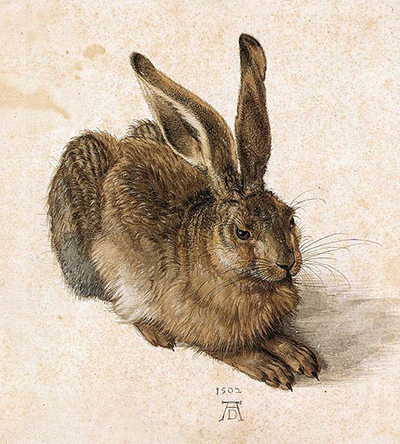
Young Hare
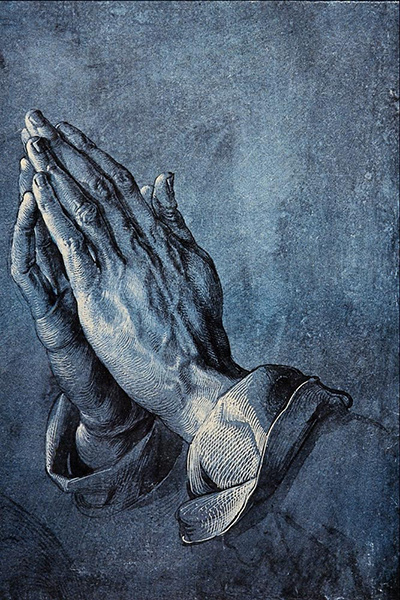
1502Praying Hands
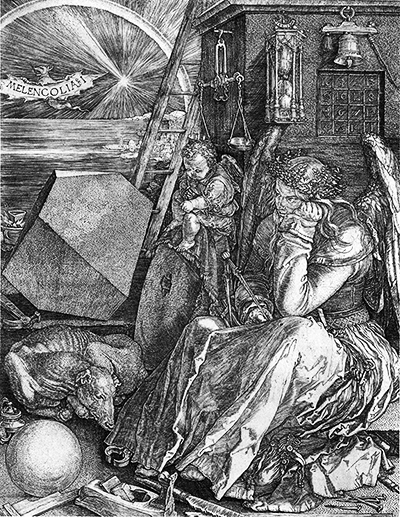
1508Melencolia I
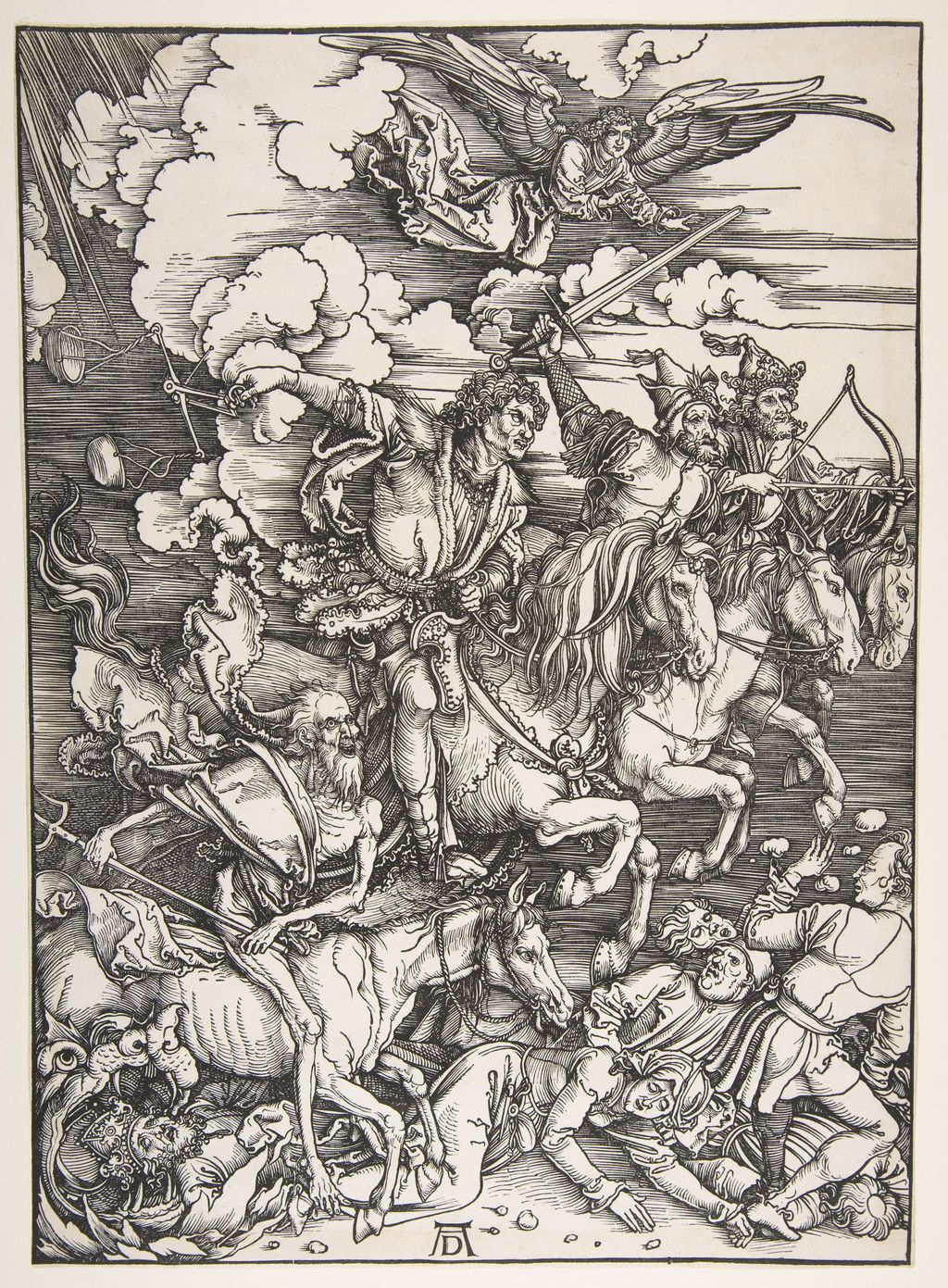
1514Four Apostles
1526Contents
- A face held close
- Holzschuher’s world
- The picture behind the arms
- Copies, restoration and rediscovery
- Frequently Asked Questions
A face held close
The pale, cool background sets off the warm forehead and cheeks. There is remarkably little empty space above the hair. At the lower edge the shoulders continue beyond the panel, making the figure seem larger than the available field. The broad diagonals of the collar steady the composition, while the hair makes smaller, irregular movements around the head. Looking from the eyes down to the beard, one passes from a very concentrated exchange of glances into an almost continuous field of fine marks.
The eyes do much of the work. The nearer one, on the right as we look, has a conspicuous area of white beside its iris. Its partner sits closer to the contour of the nose. This unequal framing prevents the gaze from becoming a diagram of two matching circles. Small lights animate the pupils; shadows under the brows give those lights added force. The furrow above the bridge of the nose tightens the centre of the face. Together these decisions make the encounter feel immediate, although they cannot tell us whether Holzschuher was habitually suspicious, friendly or forceful.
Dürer separates textures without making the picture fall into unrelated demonstrations of skill. The moustache bends around the upper lip, leaving the mouth visible. Below it, the beard opens into a much lighter mass, with individual curling strands breaking its edges. The head hair changes from thin, wandering locks over the forehead to denser curls beside the cheek. Warm brown and grey passages keep the white hair from looking cut out and pasted onto the background.
The fur has a different rhythm. Longer streaks run down the collar, with reddish brown depths and brighter yellow-brown tips. Its weight is established by broad areas of darkness as well as by individual hairs. A narrow strip of white shirt and a small opening of black clothing under the beard provide a moment of rest between the two richly worked surfaces. The combination makes one notice both the physical substance of the garments and the economy with which the body itself is suggested.
At the upper left, the small inscription supplies the sitter’s name, the year 1526 and his age, 57. The AD monogram appears separately on the right. The lettering is subordinate to the head, yet it anchors the encounter to an identifiable life. Silver hair alone could suggest any number of ages; the inscription gives the image its precise commemorative moment. [1]
Holzschuher’s world
Holzschuher belonged to Nuremberg’s governing patriciate, serving as junior mayor, elder mayor and one of its seven senior councillors. There is a fuller intellectual life behind that official outline. The Marburg repertory of early humanist translation literature records his studies at Ingolstadt and Padua and his 1498 marriage to Dorothea Münzer. Her father, Hieronymus Münzer, was a physician, geographer and humanist. Holzschuher inherited much of his substantial library from him. A book ownership inscription also records Holzschuher buying the German Boccaccio adaptation Florio und Bianceffora in 1499. [1] [12]
Those connections help explain why family arms mattered to the portrait’s presentation. The Münzer shield commemorated a marriage into an intellectually active household as well as a union between families. No book appears beside the painted sitter: the clothing and the face carry the visual argument. Learning belongs to the documented life around the image, and cannot be read directly from a brow or a pair of eyes.
Dürer’s Netherlands diary gives a smaller, more personal connection. Among the gifts listed for friends and acquaintances in Nuremberg in spring 1521, he records an exceptionally large horn for Hieronymus Holzschuher. Nearby entries distribute cloth, gloves, nuts and other objects among members of the same social world. This practical record brings painter and sitter into a network of exchange several years before the portrait. It does not establish the terms on which the painting was commissioned, but it gives their acquaintance a firmer basis than any imagined conversation suggested by the face. [13]
The picture behind the arms
The cover slides between a dark inner frame and an outer frame of pale ash. Berlin’s museum essay proposes that this protection helped preserve the painting. The construction invites a different idea of portrait viewing from an uninterrupted encounter with a picture on a wall. There was a closed state, an act of opening and a revealed likeness. Even without reconstructing exactly where the family kept it, those physical possibilities belong to the work. [1]
The cover has a visual character of its own. Against its dark field, two shields lean inward beneath a helmet. Red and gold ornament spreads sideways in curling ribbons. A wooden shoe on the left gives one shield an immediately recognisable motif. The surrounding forms are decorative and symmetrical in their overall arrangement, quite unlike the uneven curls and asymmetrical face inside. One surface names through heraldry; the other makes an individual recognisable through the particular arrangement of his features.
The date MDXXVI, 1526 in Roman numerals, ties this heraldic exterior to the year recorded beside the face. Its two shields keep the marriage visible while the likeness is hidden. Opening the panel changes the language of identification, from inherited emblems to a face with an age and a gaze.
That wish to retain the portrait is documented well before its arrival in Berlin. In the Teutsche Academie , published in 1675, Joachim von Sandrart recalls offering a large sum for it in 1651 on behalf of an unnamed powerful patron. The family would not name a price: they wanted to preserve it as a lasting memorial to their household. His account describes the picture as a Dürer admired in Nuremberg. It supplies early testimony both to its attribution and to the strength of its family ownership. [14]
Copies, restoration and rediscovery
The face circulated beyond that household. Hans Hoffmann painted a copy in 1578, now in the Germanisches Nationalmuseum. The museum interprets it as an expressive character study rather than a family document: Hoffmann omitted Dürer’s identifying name inscription and monogram. The copy was recorded in the Praun collection in 1616. [15]
Seeing the two pictures makes that shift particularly clear. Hoffmann retains the turned shoulders, direct gaze and great expanse of beard, but places the head against a darker grey field. A curled white label at the upper left announces the age in Roman numerals. The label stands out much more sharply than Dürer’s quiet lettering. Fine loops of hair remain a principal attraction, especially along the edge of the beard. The repeated likeness shows how readily the specific sitter could become a subject for another painter’s close examination of expression and surface.
Later attention did not always bring confidence in the original. Around 1812, the collector Sulpiz Boisserée suspected that it was a forgery. Berlin’s museum account explains his mistake as a response to the startling concentration of recognisably Dürerian qualities. The earlier testimony and surviving copy give that episode a useful perspective: a work can strike a new audience as almost implausibly accomplished while possessing a much longer documented life. [1]
Its appearance has also changed. Writing in 1885, Julius Meyer described Johann Lorenz Rotermundt’s restoration of 1816: the pale background had been covered with a dense violet-brown tone. Meyer reported that Berlin’s restorer A. Hauser removed this overpaint, recovering fine hair outlines and the fur’s edge. Meyer’s account makes the light ground and those delicate contours part of the painting’s history of restoration, as well as its visual effect. Meyer also records its public showing in Munich in 1869 and its placement in the Germanisches Nationalmuseum after 1871. [16]
Berlin acquired the portrait from the Holzschuher family in 1884. The move placed a long-preserved household memorial within a public collection. Yet its construction still asks us to imagine the moment before the familiar face appeared: a dark heraldic panel, then an opening, and suddenly those bright eyes. The painting’s force lies partly in the way such a compact object can make the act of looking feel reciprocal. [1]
Frequently Asked Questions
Artworks directory
These 187 records include individual works, reverse sides, detail views, paired panels and reconstructed arrangements. Three additional catalogue images repeat works already listed. Related views are not counted as separate originals; qualified attributions and published dating are retained.
Discussion
Look again at the images and ideas explored in Portrait of Hieronymus Holzschuher. These editorial prompts invite your observations.
Reader Insights
Which detail or idea in Portrait of Hieronymus Holzschuher most changed your reading, and why?
How does the discussion of “A face held close” affect your understanding?
What comparison would you bring to the discussion of “Copies, restoration and rediscovery”?
Join the Conversation
Share a detail, comparison or question about Portrait of Hieronymus Holzschuher below.
References
- Staatliche Museen zu Berlin , Gemäldegalerie, Hieronymus Holzschuher (1469–1529) mit Deckel , 557E, metadata and essay from 200 Meisterwerke der europäischen Malerei – Gemäldegalerie Berlin (2019); record updated 28 September 2026. German; English translation also available. View source .
- ALBERTINA, Selbstbildnis als Dreizehnjähriger, inv. 4839 (German). View source.
- Metropolitan Museum, Four Horsemen from The Apocalypse, 19.73.209 (English). View source.
- Bayerische Staatsgemäldesammlungen, Selbstbildnis im Pelzrock, inv. 537 (German). View source.
- ALBERTINA, Feldhase, inv. 3073 (German). View source.
- ALBERTINA, Das große Rasenstück, inv. 3075 (German). View source.
- Metropolitan Museum, Adam and Eve, 19.73.1 (English). View source.
- ALBERTINA, Betende Hände, inv. 3113 (German). View source.
- Metropolitan Museum, Knight, Death, and the Devil, 43.106.2 (English). View source.
- Metropolitan Museum, Melencolia I, 43.106.1 (English). View source.
- Bayerische Staatsgemäldesammlungen, inventory 545: current collection record (German; descriptive citation). View source.
- Marburger Repertorium zur Übersetzungsliteratur im deutschen Frühhumanismus , Hieronymus Holzschuher , MRFH 1090, version 29 May 2012. German. View source .
- Albrecht Dürer , Tagebuch der Reise in die Niederlande , “Frühjahr 1521 in Antwerpen”, gift list, electronic text in Bibliotheca Augustana. Early New High German with modern German annotations. View source .
- Joachim von Sandrart , Teutsche Academie (1675), II, book 3, p. 223, passage on the Holzschuher portrait, digital edition at Sandrart.net. German. View source .
- Germanisches Nationalmuseum , Bildnis des Nürnberger Patriziers Hieronymus Holzschuher (1469–1529), Kopie nach Dürer , Gm1417, Hans Hoffmann, 1578, collection record and display text. German; English display text also available. View source .
- Julius Meyer , “Des Hieronymus Holzschuher Bildnis von Albrecht Dürer”, Jahrbuch der Königlich-Preussischen Kunstsammlungen 6 (1885), pp. 101–106, especially pp. 105–106. German. View source .
- Germanisches Nationalmuseum, Barbara Dürer (German and English). View source.
- Web Gallery of Art, Tucher–Rieter reverse (English). View source.
- National Gallery of Art, Portrait of a Clergyman (English). View source.
- Dürer Art, Portrait of a Man (English). View source.
- Hessen Kassel Heritage, Elsbeth Tucher (German). View source.
- Web Gallery of Art, Hans Tucher (English). View source.
- Germanisches Nationalmuseum, Emperor Maximilian I (German and English). View source.
- National Gallery of Art, Lot and His Daughters, reverse (English). View source.
- Bayerische Staatsgemäldesammlungen, Glim Lamentation (German). View source.
- Museo Nacional del Prado, Portrait of a Man (Spanish). View source.
- Bayerische Staatsgemäldesammlungen, Madonna of the Carnation (German). View source.
- Städel Museum, Job on the Dungheap (German). View source.
- Wallraf-Richartz-Museum, Piper and Drummer (German). View source.
- Italian Ministry of Culture / Uffizi, Head of Saint James (Italian). View source.
- Klassik Stiftung Weimar, Dresden Altarpiece (German). View source.
- Staatliche Museen zu Berlin, Girl with a Red Beret (German and English). View source.
- Dresden State Art Museums / Roland Enke, Bernhard von Reesen (German). View source.
- Royal Collection Trust, Burkhard von Speyer (English). View source.
- Dresden State Art Museums, Seven Sorrows of the Virgin (English). View source.
- Bayerische Staatsgemäldesammlungen, Mater Dolorosa (German). View source.
- Bayerische Staatsgemäldesammlungen, Lucretia (German). View source.
- Städel Museum, Young Woman with Her Hair Down (English). View source.
- ALBERTINA, Portrait of a Young Man (German). View source.