by
Tom Gurney
Tom Gurney BSc (Hons) is an art history expert with over 20 years experience
Published on June 19, 2020 / Updated on October 22, 2026
Email:
tomgurney1@gmail.com
/ Phone:
+44 7429 011000
Portrait of the Artist’s Mother 1514: Introduction
Albrecht Dürer drew his mother Barbara in 1514. Berlin’s Kupferstichkabinett holds the charcoal portrait, KdZ 22: a sheet of paper measuring 42.2 × 30.6 centimetres. [1] [2]
Barbara died in May that year, about two months after the drawing was made. Her son’s account of her last illness makes the portrait unusually difficult to separate from family memory. Yet his writing also restores things a face cannot tell us: her repeated advice, her religious convictions, the circumstances of her care and his own grief. In William Martin Conway’s 1889 translation, he remembers her familiar farewell: “Go in the name of Christ.” The woman who looks away from us had spoken those words to him as he came and went. [3]
At a Glance
This work across Albrecht Dürer’s career
Young Hare
1502Praying Hands
1508Melencolia I
1514Four Apostles
1526Contents
- A face made of marks
- Barbara before 1514
- Charcoal, paper and survival
- Illness in the household
- A likeness kept after death
- Age and interpretation
- The surviving sheet
- Frequently Asked Questions
A face made of marks
Look first at the mouth. Two small, uneven curves bring the lips together, with a darker interruption near one corner. The upper lip projects beneath the nose; below the lower lip, a short shaded hollow separates it from the chin. These are modest differences, but they give the closed mouth a particular shape. Its firmness comes from the relation of several marks, rather than one continuous outline.
The ear, on the right as we look, is almost enclosed between face and cloth. A pair of pale, curved bands runs around its lower edge. Above them, the dark beside the cheek broadens into the shadow beneath the head covering. Following these curves makes the head feel round: we become aware of a side that turns away from the face presented to us.
Michael Roth notes the slightly elevated viewpoint and divergent gaze. He leaves the clothing partly uncertain: shirt or short shoulder covering, perhaps fur edging. Sparse outer marks intensify the detailed centre. He characterises its observation as sympathetic. [1]
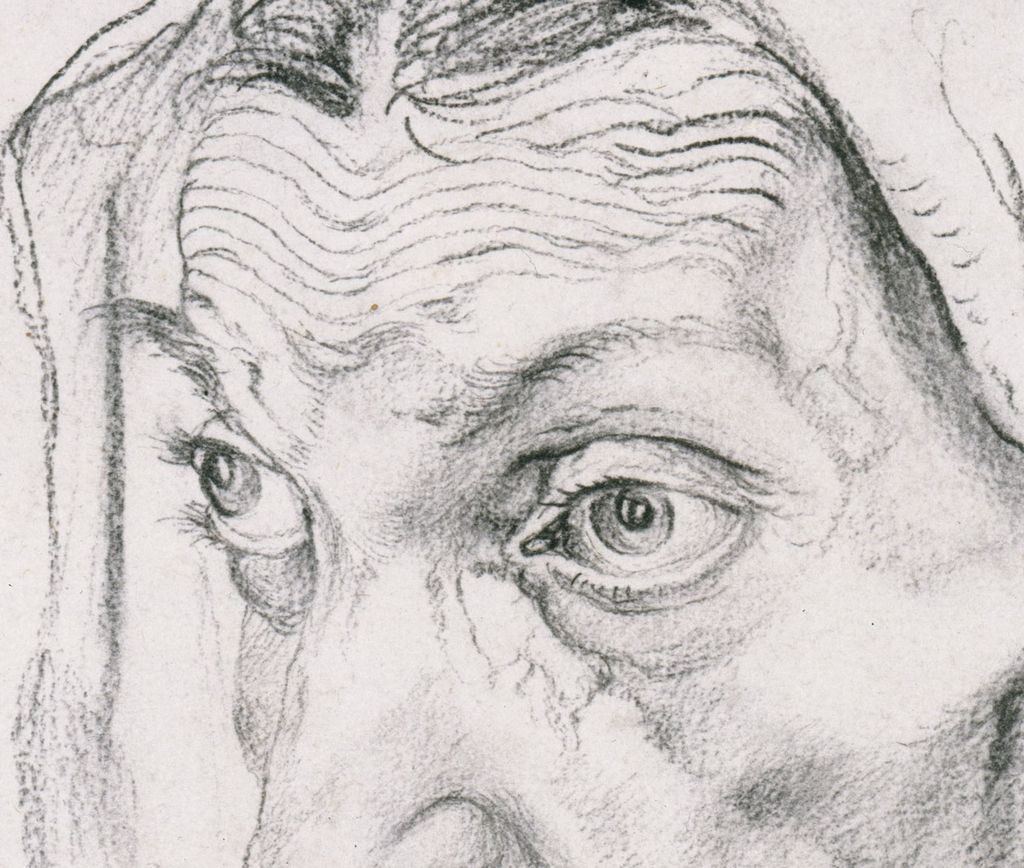
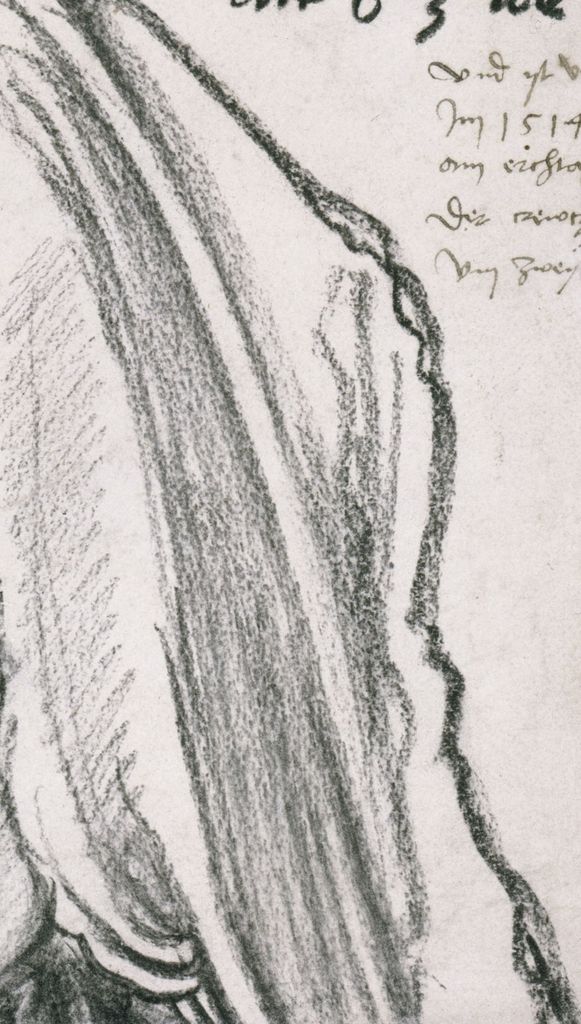
Across the forehead, long wavering lines bunch together near the brows and separate as they move sideways. Their repeated changes of direction make a very different pattern from the straighter strokes descending through the cloth at the right. The picture contains both kinds of movement within a few inches. One describes a surface gathered into small folds; the other lets a larger hanging surface run downwards.
Above the forehead, two dark patches sit beneath the covering, divided by a pale central wedge. Farther down, beside the nose, the hanging cloth is described so faintly that it can almost disappear into the background. These interruptions keep the surrounding fabric from forming a closed border. At different points, the eye meets a dark edge, a soft grey passage or paper left almost bare.
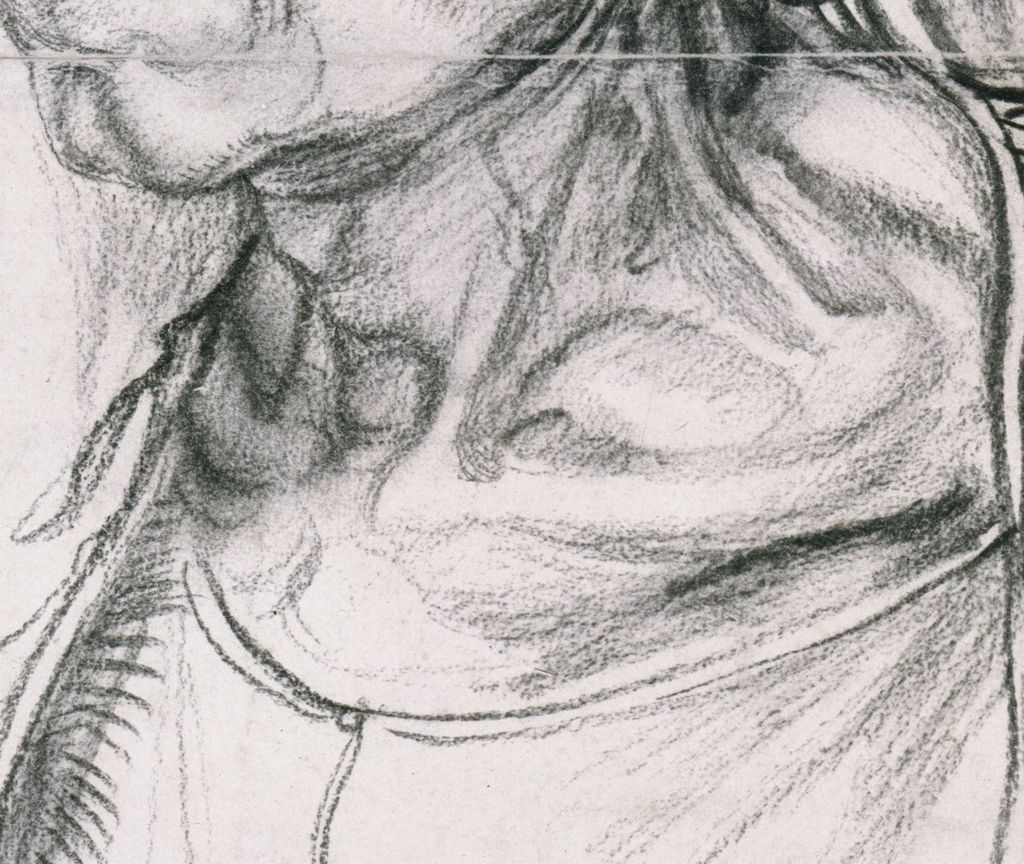
Under the chin, several short diagonal strokes cross a wider shadow. On the exposed chest, longer bands curve sideways. Their edges vary in sharpness: a dark line can become a pale patch before reaching the garment. The contrast with the small curves around the mouth is striking. Dürer has found different sizes of mark for neighbouring parts of the same person. [2]
Annotated Details from Portrait of Barbara Dürer
Follow the dark accents around the eyes, the long folds of the head covering and the changing marks beneath the chin.
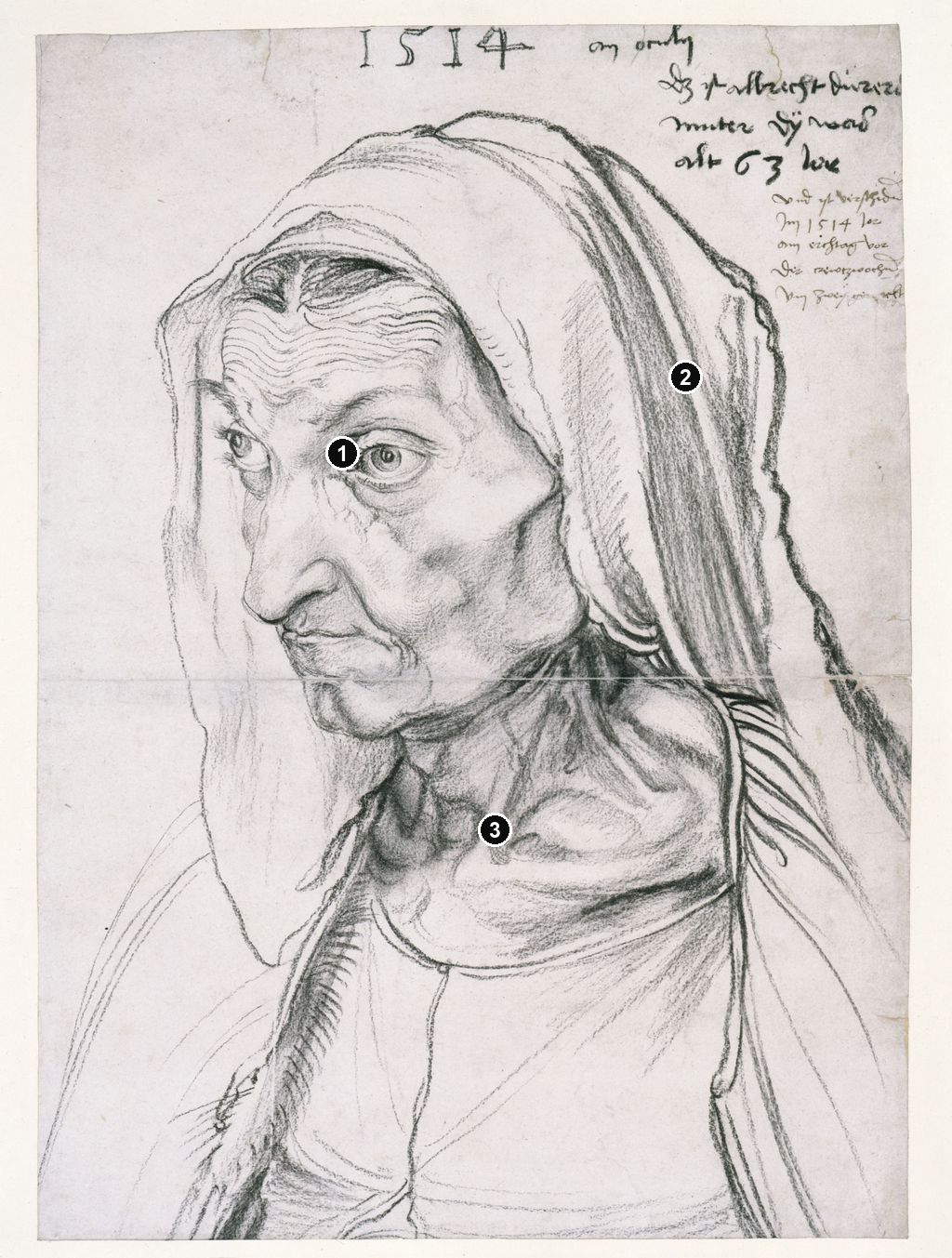
Details from PORTRAIT OF BARBARA DÜRER
Open the details to compare closely worked features with the more widely spaced lines of the clothing.
Forehead lines and open eyes
Curving lines run across the forehead beneath the edge of the cloth. Darker accents gather around the open eyes, with small pale intervals left within their outlines.
The long folds beside the face
Long descending strokes darken the outer fold. Lighter paper separates the shaded bands, while short broken marks follow the covering’s uneven outer edge.
The neck and the lightly drawn garment
Dark patches below the chin meet long slanting marks across the neck. Lower down, the garment is described with thinner, more widely spaced lines.
Barbara before 1514
In the family chronicle, Dürer reaches back to his parents’ marriage. His father, Albrecht the Elder, worked for the Nuremberg goldsmith Hieronymus Holper and married Holper’s daughter Barbara in 1467. Writing in 1524, the artist introduces this history as something assembled from his father’s papers. He then copies his father’s entries about the births of the children. Barbara’s identity consequently reaches us through a chain of family record keeping, as well as through the surviving likeness. [3]
The entry for 1471 names the future artist as the second son, with the publisher Anton Koberger as godfather. The chronicle also remembers brothers and sisters who had died, some in childhood and others while growing up. By 1524, Dürer says, only three brothers remained alive: himself, Andreas and Hans. These are the recollections of a surviving son looking back over a large family. They should not be converted into an explanation for every line of Barbara’s face. [3]
There is an earlier painted portrait of Barbara, dated 1490, in Nuremberg’s Germanisches Nationalmuseum. Painted on fir, it formed the left half of a parental diptych, with her husband as its companion. The museum records that both panels remained Dürer’s property during his lifetime. The mother’s panel was identified as Barbara only in 1979. That painting and the Berlin charcoal sheet are separate works, made twenty-four years apart. A title such as Portrait of the Artist’s Mother therefore needs its date: the 1514 drawing belongs to Barbara’s last year, while the 1490 panel belongs to her son’s early career. [21] [2]
Charcoal, paper and survival
Charcoal’s appearance can be deceptive. Conservators Georg Josef Dietz and Irene Brückle explain that the wood, its carbonisation and the paper’s texture all influence the line; wear and fixation can further alter its appearance. Broadness or softness alone cannot securely distinguish charcoal from natural black chalk. Their microscopic comparison found angular charcoal particles gathering within the paper’s fibrous surface, while chalk behaved differently. Their study concerns drawing materials and Grünewald’s sheets, rather than an examination of Barbara’s portrait. It helps explain why the museum’s material identification matters more than a guess from a reproduction, and why we cannot reconstruct this sheet’s entire making from its visible greys. [22]
The portrait itself lets us compare marks without recovering that lost sequence. A narrow dark curve defines the nostril, while the side of the nose is largely pale. Around the eye nearest the centre, a fine contour encloses the iris and a darker lid partly overlaps it. Elsewhere, closely spaced strokes remain visibly separate. The marks can be read both as fragments of a face and as black material resting on paper.
The shoulders reach the lower corners, where long outlines cross and return over one another. Some stop before meeting a neighbouring line. Looking there slows our recognition of the garment: it takes a moment to decide which edge to follow. This open handling is part of the image we possess. It supplies no record of a cancelled commission, and cannot by itself establish that a painting was planned.
Illness in the household
Dürer’s family chronicle says that he took his mother into his house in 1504, two years after his father’s death, because she had nothing left to live on. The more detailed remembrance describes a morning in 1513 when she was suddenly so ill that those attending her broke into her chamber. She could not open it herself. They carried her to a downstairs room and she received the sacraments because everyone thought she would die. She survived that crisis into the following year. [3]
In this account, illness sits beside activity and authority. Barbara went frequently to church and rebuked her son when he did wrong. He recalls her concern for his sins and those of his brothers, her charitable acts and her compassion towards others. He also says that she bore eighteen children and endured poverty, mockery and repeated serious illness without becoming malicious. The remembrance is openly affectionate and devout. It preserves a mother who instructed her children, as well as someone who eventually needed their care. [3]
Her son’s record establishes severe illness; it does not provide the clinical evidence for a diagnosis from the drawing. The portrait and the account answer different questions. One gives us a particular arrangement of visible features. The other recalls events, conduct and words. Keeping them together enriches our knowledge of Barbara, provided we do not make a hollow cheek or an eye position identify a disease, or claim to recover her thoughts from her appearance. [3]
A likeness kept after death
Conway translates the identification on the sheet as “That is Albrecht Dürer’s mother. She was 63 years old.” He then distinguishes the added note recording her death. The writing allows the image to hold two times together: the mother seen alive, and the son looking back after losing her. Nothing in those words establishes a deliberately staged final farewell. Nor does the inscription tell us how long the sitting lasted or what mother and son said while he worked. [3]
Roth calls the drawing a sheet of consolation and remembrance, an interpretation of its purpose rather than Dürer’s stated intention. [1] [2]
The account of her death is less still than the drawing. Barbara blesses her son, wishes him God’s peace and urges him to avoid sin. Dürer recalls her fear of dying, while distinguishing it from her willingness to come before God. He records her request for holy water and the pain of her last moments. He repeats the prayers and admits that his grief is beyond expression. His account closes with a prayer for his own end and for eternal life with his parents, relatives and friends. [3]
Historian Helmut Puff draws attention to the making of that written remembrance. The surviving memorial folio contains varied entries and later additions; it is not a seamless narrative. A final observation about Barbara looking sweeter after death was added with a different quill and ink. Puff reads the account within Christian expectations of dying well, and the difficulty of reconciling a virtuous life with a visibly painful death. That context gives the son’s prayers more weight: they belong to his attempt to understand what he witnessed. The peaceful final addition changes the ending of an account that had already described suffering. Such changes remind us that remembering involved work on the text, alongside preserving the likeness. [23]
A comparable addition appears on Dürer’s 1516 portrait of his teacher Michael Wolgemut. The Germanisches Nationalmuseum records that Dürer entered Wolgemut’s death date in the inscription in 1519. A portrait made during life could thus acquire a further memorial role through writing. The sequence is useful here because it places Barbara’s death note beside another documented act of updating a likeness. It does not establish that either portrait began with an identical purpose. [24]
Age and interpretation
An elderly face could also serve an allegory. On the reverse of Dürer’s young man’s portrait of 1507 in Vienna, an old woman grips a purse filled with money. The Kunsthistorisches Museum identifies the subject as Avarice and relates the reverse to the transience of earthly possessions. The bag gives the aged figure a specific moral setting. Barbara’s sheet has no equivalent money bag: its inscription identifies a relationship and an age. The comparison shows how much the objects and words accompanying a face can direct its interpretation. [25]
Earlier writers made that direction especially forceful. In his 1882 book on Dürer’s drawings, Charles Ephrussi described Barbara’s features as already transformed by the torments of dying. He regarded the drawing as simultaneously the artist’s most poignant and most brutal work. His description makes death seem almost present in the sitting, even while he dates the drawing two months before it. This is evidence of a nineteenth-century response, rather than an eyewitness account of Barbara’s condition as Dürer drew her. Ephrussi’s language invites us to experience the marks as an ordeal; recognising his language helps us notice how readily later knowledge can enter our first view of the face. [2]
Heinrich Wölfflin took a different route in Die Kunst Albrecht Dürers, published in 1905. He rejected a specific factual connection between the mother’s death and the engraving Melencolia I, while finding a relationship in their inwardness and expressive means. For him, the portrait marked a newly powerful capacity to make mental life speak through bodily form. He also insisted that reproductions failed to convey the original’s effect, praising the strength and apparent assurance of its charcoal strokes. These are judgments about artistic expression. They do not tell us what Barbara felt or prove that Dürer made every stroke without hesitation. Their value lies partly in the questions they raise: how does a physical mark become expressive, and how much does its scale contribute to that experience? [26]
The image later entered a very different public setting. Klaus Staeck used it in his 1971 poster Sozialfall, asking whether the viewer would rent this woman a room. Sabrina Streiter’s University of Hamburg study places the poster in Nuremberg’s Dürer anniversary celebrations and describes its display on 300 advertising columns. Her analysis follows its challenge to housing exclusion and social responsibility. Across the reproduced figure, large red lettering now demands a practical decision from the viewer. This twentieth-century reuse shifts the encounter from looking at a celebrated artist’s mother to considering how an elderly woman might be treated. It is a new political use of the likeness, rather than evidence for the drawing’s original function. [27]
The surviving sheet
Berlin records Imhoff, Andréossy and Firmin-Didot in the provenance. In 1877 it acquired the sheet through Gutekunst from Firmin-Didot’s collection; those names leave gaps in the earlier history. [1]
Return to the mouth, the pale rim of the ear and the cloth descending beside the face. They remain small, particular decisions after the larger stories of death, faith and later fame have been told. A line bends, a shadow widens, a narrow interval of paper separates one form from another. The portrait continues to offer those precise things to look at, each time we meet Barbara again. [2]
Frequently Asked Questions
Artworks directory
These 187 records include individual works, reverse sides, detail views, paired panels and reconstructed arrangements. Three additional catalogue images repeat works already listed. Related views are not counted as separate originals; qualified attributions and published dating are retained.
Discussion
Look again at the images and ideas explored in Portrait of the Artist’s Mother 1514. These editorial prompts invite your observations.
Reader Insights
Which detail or idea in Portrait of the Artist’s Mother 1514 most changed your reading, and why?
How does the discussion of “A face made of marks” affect your understanding?
What comparison would you bring to the discussion of “The surviving sheet”?
Join the Conversation
Share a detail, comparison or question about Portrait of the Artist’s Mother 1514 below.
References
- Staatliche Museen zu Berlin , Barbara Dürer , KdZ 22. German. Michael Roth, 2006, p. 24, cat. 1; object metadata. View source .
- Charles Ephrussi , Albert Dürer et ses dessins (Paris: A. Quantin, 1882), p. 178. French. View source .
- Albrecht Dürer , family writings, in William Martin Conway, Literary Remains of Albrecht Dürer (Cambridge, 1889), pp. 34–35, 77–79. Historical English translation. View source .
- Campbell Dodgson, Catalogue of Early German and Flemish Woodcuts Preserved in the Department of Prints and Drawings in the British Museum, vol. 1 (London: British Museum, 1903). Original English edition Selected pp. 260, 262, 272, 274, 288, 290, 294–296, 299–300, 302, 307. View source.
- Heinrich Wölfflin, Die Kunst Albrecht Dürers, second enlarged edition (Munich: F. Bruckmann, 1908), selected pp. 110, 178, 298, 321, 378–379 and the original plate following p. 178. Original German edition. View source.
- S. R. Koehler, A Chronological Catalogue of the Engravings, Dry-Points and Etchings of Albert Dürer (New York: Grolier Club, 1897). Original English edition Selected pp. 5, 14, 17–18, 32, 37, 42, 44, 51, 58, 60, 63, 81. View source.
- Moriz Thausing, Albert Dürer: His Life and Works, edited by F. A. Eaton, vol. II (London: John Murray, 1882), pp. 16–18. English edition. View source.
- Johann Carl Sigmund Kiefhaber, ed., Nachrichten zur ältern und neuern Geschichte der freyen Reichsstadt Nürnberg: ein Beytrag zur Geschichte der Reichsstädte in Teutschland, vol.1 (Nuremberg: Lechner, 1803), first quarter, pp.6–9,14–16. Original German historical edition of correspondence and inventory. View source.
- T. Sturge Moore, Albert Dürer (London: Duckworth and Co.; New York: Charles Scribner’s Sons, 1905), part III, portrait discussion and caption of the 1500 Munich self-portrait. Original English edition. View source.
- ALBERTINA, Das große Rasenstück, inv. 3075 (German). View source.
- Alice McEwan, Young Hare, NT 1274661, National Trust Collections, 2020; citing Colin Eisler, Dürer’s Animals (Washington and London: Smithsonian Institution Press, 1991), plate 13. View source.
- ALBERTINA, Selbstbildnis als Dreizehnjähriger, inv. 4839 (German). View source.
- Metropolitan Museum, Four Horsemen from The Apocalypse, 19.73.209 (English). View source.
- Bayerische Staatsgemäldesammlungen, Selbstbildnis im Pelzrock, inv. 537 (German). View source.
- ALBERTINA, Feldhase, inv. 3073 (German). View source.
- Metropolitan Museum, Adam and Eve, 19.73.1 (English). View source.
- ALBERTINA, Betende Hände, inv. 3113 (German). View source.
- Metropolitan Museum, Knight, Death, and the Devil, 43.106.2 (English). View source.
- Metropolitan Museum, Melencolia I, 43.106.1 (English). View source.
- Bayerische Staatsgemäldesammlungen – Alte Pinakothek München, Vier Apostel: Hll. Johannes Ev. und Petrus, 1526, inv. 545 (German).. View source.
- Germanisches Nationalmuseum , Barbara Dürer , Gm1160. German and English. Object record and gallery text. View source .
- Georg Josef Dietz and Irene Brückle , “Distinguishing between charcoal and natural black chalk in old master drawings,” Wege zur Konservierungswissenschaft , ed. Gerhard Banik (Munich: Anton Siegl, 2010), pp. 54–56. English. View source .
- Helmut Puff , “Memento mori, memento mei: Albrecht Dürer and the art of dying”, in Enduring Loss in Early Modern Germany , ed. Lynne Tatlock (Brill, 2010), pp. 103–104, 112–119. English. View source .
- Germanisches Nationalmuseum , Michael Wolgemut , Gm885. German and English. Object record and gallery text. View source .
- Kunsthistorisches Museum , Brustbild eines jungen Mannes , reverse: Allegorie des Geizes , GG849. German. Object record. View source .
- Heinrich Wölfflin , Die Kunst Albrecht Dürers (Munich: F. Bruckmann, 1905), “Die Meisterstiche und Verwandtes,” §4, pp. 208–209. German. View source .
- Sabrina Streiter , “Dürers Mutter als Sozialfall”, Bilder des Protests , University of Hamburg, 2025, panel 2. German. View source .
- Burlington Fine Arts Club, Exhibition of Early German Art (London: Burlington Fine Arts Club, 1906). Original English catalogue P. 24, no. 38. View source.
- Joseph Heller, Das Leben und die Werke Albrecht Dürers, volume II, part 1 (Bamberg: C. F. Kunz, 1827), p. 118, no. 138. German original. View source.
- Maud Cruttwell, Andrea Mantegna, London: George Bell and Sons, 1901, pp. 110–112. View source.
- Moriz Thausing, Dürer: Geschichte seines Lebens und seiner Kunst (Leipzig: E. A. Seemann, 1876). Original German edition Selected pp. 303, 306, 308–309. View source.
- ALBERTINA, Tote Blauracke, inv. 3133, around 1500. Current collection record (German and English). View source.
- ALBERTINA, Bildnisse eines Mädchens in kölnischer Tracht und Agnes Dürers (aus dem Silberstiftzeichenbuch der Niederländischen Reise), inv. 22385r, 1521; current object record and Matthias Mende, in Albrecht Dürer, exhibition catalogue, ed. Klaus Albrecht Schröder and Maria Luise Sternath (Vienna: ALBERTINA; Ostfildern-Ruit: Hatje Cantz, 2003), cat. 174, pp. 496–498. German and English. View source.
- ALBERTINA, Der Flügel einer Blauracke, inv. 4840, around 1500; current metadata and Heinz Widauer, Die großen Meister der Albertina (Vienna: ALBERTINA, 2008), no. 6. German and English. View source.
- Web Gallery of Art, Tucher–Rieter reverse (English). View source.
- National Gallery of Art, Portrait of a Clergyman (English). View source.
- Dürer Art, Portrait of a Man (English). View source.
- Hessen Kassel Heritage, Elsbeth Tucher (German). View source.
- Web Gallery of Art, Hans Tucher (English). View source.
- Germanisches Nationalmuseum, Emperor Maximilian I (German and English). View source.
- National Gallery of Art, Lot and His Daughters, reverse (English). View source.
- Bayerische Staatsgemäldesammlungen, Glim Lamentation (German). View source.
- Museo Nacional del Prado, Portrait of a Man (Spanish). View source.
- Bayerische Staatsgemäldesammlungen, Madonna of the Carnation (German). View source.
- Städel Museum, Job on the Dungheap (German). View source.
- Wallraf-Richartz-Museum, Piper and Drummer (German). View source.
- Italian Ministry of Culture / Uffizi, Head of Saint James (Italian). View source.
- Klassik Stiftung Weimar, Dresden Altarpiece (German). View source.
- Staatliche Museen zu Berlin, Girl with a Red Beret (German and English). View source.
- Dresden State Art Museums / Roland Enke, Bernhard von Reesen (German). View source.
- Royal Collection Trust, Burkhard von Speyer (English). View source.
- Dresden State Art Museums, Seven Sorrows of the Virgin (English). View source.
- Bayerische Staatsgemäldesammlungen, Mater Dolorosa (German). View source.
- Bayerische Staatsgemäldesammlungen, Lucretia (German). View source.
- Städel Museum, Young Woman with Her Hair Down (English). View source.
- ALBERTINA, Portrait of a Young Man (German). View source.