


 by
Tom Gurney
Tom Gurney BSc (Hons) is an art history expert with over 20 years experience
Published on June 19, 2020 / Updated on October 22, 2026
Email:
tomgurney1@gmail.com
/ Phone:
+44 7429 011000
Portrait of Lucas Cranach the Elder: Introduction
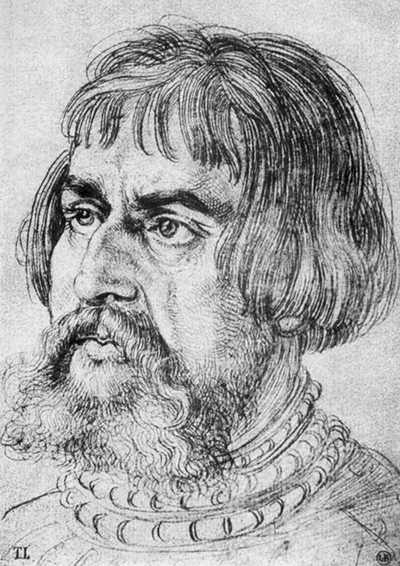
Lucas Cranach’s hair spreads almost to the edges of this small drawing. Long locks turn over his ears, a short fringe breaks across his forehead, and his beard curls outwards into two uneven points. Within that abundant frame, the eyes are particularly steady. Cranach looks past the viewer towards the left, his mouth closed and his head held upright. Dürer gives us very little of the body, yet the face feels substantial: a broad forehead, deep-set eyes, a projecting nose and cheeks whose rounded surfaces emerge from fine, patient shading.
The Portrait of Lucas Cranach the Elder , generally dated to 1524, is a silverpoint drawing on prepared paper in the Musée Bonnat-Helleu, Bayonne. The museum uses the approximate date “about 1524”; its inventory number, 1540, should not be mistaken for the year of execution. The sheet measures just 16.2 × 11 centimetres, only a little wider than a hand. That scale makes the density of the image especially striking. An enlarged reproduction lets us follow individual strokes, but the original asks for a close, concentrated encounter. [1] [2]
At a Glance
- Date About 1524 [1]
- Materials Silverpoint on prepared paper [1]
- Collection Musée Bonnat-Helleu, Bayonne; inventory 1540 [1]
This work across Albrecht Dürer’s career
Young Hare
1502Praying Hands
1508Melencolia I
1514Four Apostles
1526Contents
- A head built from lines
- Why silverpoint matters
- Dürer meets Cranach
- The sheet after the sitting
- Frequently Asked Questions
A head built from lines
The drawing contains several different kinds of movement. On the crown, loops of hair sweep away from an off-centre parting. At the sides, longer strokes descend and curve back towards the neck. The beard follows a less orderly course, opening into small rings and wiry strands around the chin. Dürer changes direction continually without losing the larger shape of the head. We can read the hair as a mass and then, at closer range, as a network of separate marks.
The face has a quieter rhythm. Short strokes bend around the cheek and gather beneath the eyes. Their changing density allows the paper to remain light on the brow and along the nose while shadow settles beside the nostril, under the lower lip and against the beard. The eyebrows bring two dark accents into this pale modelling. Beneath them, carefully drawn lids give the eyes weight and direction. The pupil of the nearer eye is surrounded by a small area of light that prevents the gaze from sinking into the shaded socket.
Dürer also preserves the asymmetry of the pose. One cheek opens towards us; the other is compressed by the turn. The nose interrupts the more distant side of the face, and the hair beside it occupies a comparatively narrow strip. On the right of the image, by contrast, the rounded fall of the bob fills a broad area. The head feels observed from a particular position, with its parts adjusting to that position, rather than assembled from a set of interchangeable features.
The beard partly hides the junction between chin and neck. Below it, a high collar and a substantial chain establish another kind of structure: curved bands and repeated links run around the throat. These orderly shapes give the lower part of the drawing a firm base. Only the shoulders and the uppermost part of the clothing appear. Light hatching indicates the garment, but its folds receive much less attention than the face. The difference directs our eye without requiring the whole figure to be worked to the same degree.
Why silverpoint matters
The precision belongs partly to the medium. A metalpoint drawing is made with a metal stylus on a suitably prepared surface. The abrasive ground allows the stylus to leave a fine trace; the British Museum describes silverpoint’s characteristic marks as precise lines that are difficult to erase. Paper is therefore only one part of this object. The preparation on its surface helped determine how the point moved and what kind of mark it could leave. [13]
As Stacey Sell explains in her introduction to Drawing in Silver and Gold , silverpoint responds less readily to pressure than pen or chalk. Its comparatively uniform line encourages the artist to build tone through hatching. The difficulty of erasure varies with the ground and the weight of the marks. It would be misleading to imagine that every line had to be infallible, but the medium rewards a controlled accumulation of strokes. In Cranach’s cheek, for example, the transition from light to shadow develops through many small decisions about spacing and direction. [14]
Looking between face and hair shows how much variety Dürer obtains within those conditions. The cheek’s mesh of fine marks describes a surface turning gradually from the light. The hair’s longer arcs describe strands travelling over and around that surface. Along the moustache, the strokes become short and closely packed; at the beard’s outer edge, they loosen into curls surrounded by untouched ground. The same drawing instrument can make the head seem firm, the hair flexible and the beard airy.
The museum’s colour photograph is especially useful here. It shows the portrait as a pale drawing on a warm, marked sheet, with open space above the hair and around the shoulders. In a darker, tightly cropped reproduction, the features can acquire the force of an engraving. In the colour view, the slenderness of the actual marks is easier to appreciate. The portrait’s authority survives without a solid black background or a heavily drawn outline. Much of its light comes from areas where relatively little has been added. [1]
Dürer meets Cranach
Cranach was already an established artist when Dürer drew him. Gunnar Heydenreich’s scholarly chronology records his appointment as Frederick the Wise’s court painter in Wittenberg in 1505, and his attendance with the elector at the imperial diet in Nuremberg in 1524. That visit provides the accepted setting for the portrait. Cranach, born around 1472, and Dürer, born in 1471, were near contemporaries: this is an encounter between experienced practitioners in their early fifties. [2]
The drawing gains interest from that professional relationship, although its expression cannot tell us exactly what the men thought of one another. Heydenreich distinguishes the controversial suggestion that the young Cranach worked in Dürer’s workshop from evidence of an artistic connection. His discussion brings together Cranach’s adaptation of Dürer’s motifs and technical parallels in their painting, including reddish preparations that would have been hidden beneath the finished surface. Such evidence makes workshop contact a serious scholarly question. It does not turn the later portrait into a record of an apprenticeship. [2]
Here the meeting takes the simple form of one artist studying another artist’s face. There is no easel, brush or inscription announcing Cranach’s occupation. The chain and collar give him a substantial public presence, while the close framing concentrates attention on his particular appearance. His gaze goes beyond the sheet, leaving the viewer close to the sitter without meeting his eyes. The resulting reserve is visible; any account of a private conversation, rivalry or affection would go beyond what the drawing itself preserves.
Silverpoint was an established means for Dürer to record people he encountered. In his Netherlands diary, he describes drawing the painter Jan Provoost in silverpoint before departing from Bruges in April 1521. The entry makes a portrait part of the practical sequence of a visit: lodging, meals, looking at pictures and taking leave. It helps explain the social usefulness of a small drawn likeness without supplying a missing history for Cranach’s sheet. We do not know from this evidence whether the portrait was commissioned, retained by Dürer or intended as a gift. [15]
Giulia Bartrum and An Van Camp place Cranach’s portrait within Dürer’s late silverpoint work alongside likenesses of powerful visitors, including Cardinal Albrecht of Brandenburg and Frederick the Wise. This is a helpful context for its concentrated finish. The modest size of a drawing did not restrict its sitter to the domestic circle. A prepared sheet and a stylus could preserve the appearance of someone whose presence in the city offered a limited opportunity for observation. [16]
The sheet after the sitting
The physical object has more to it than the familiar head. The Bayonne museum gives the full title as Portrait of Lucas Cranach the Elder; Reclining Man (verso) . The second subject is on the back of the same paper. That fact belongs to the history of a sheet used on both sides; it does not identify the reclining man as Cranach or establish that both drawings were made at the same sitting. The portrait reproduction, however complete it may appear as a composition, represents one face of an object that can be turned over. [1]
Two small marks at the bottom also lead beyond the sixteenth century. The TL at the left corresponds to Sir Thomas Lawrence’s collector’s mark, catalogued by Frits Lugt as L.2445. The circular LB at the right corresponds to Léon Bonnat’s L.1714. These are traces of collecting, not Dürer’s signature. In Lugt’s account, the Lawrence drawings were marked under the direction of his executors and the dealer Samuel Woodburn after the painter’s death. A mark can therefore document a collection without recording a gesture made by the collector himself. [17]
There is a fitting extension of the portrait’s subject in those later associations. Lawrence and Bonnat were themselves portrait painters who collected older drawings. Their marks bring two further artists into the paper’s history, although they tell us nothing about the intentions behind the original sitting. The museum now identifies the sheet as part of Bonnat’s 1922 bequest to the French national museums, held in Bayonne on permanent deposit from the Louvre. [1]
That collecting history helps explain how this small, vulnerable surface became a museum object. Its continuing attraction is easier to find in the head itself. Follow a strand over Cranach’s ear, then move back to the fine shading under the eye: Dürer repeatedly changes the scale and direction of his attention. The likeness holds together because those local observations belong to one coherent head. Its closeness comes from the amount of looking preserved in a very small space.
Frequently Asked Questions
Artworks directory
These 187 records include individual works, reverse sides, detail views, paired panels and reconstructed arrangements. Three additional catalogue images repeat works already listed. Related views are not counted as separate originals; qualified attributions and published dating are retained.
Discussion
Look again at the images and ideas explored in Portrait of Lucas Cranach the Elder. These editorial prompts invite your observations.
Reader Insights
Which detail or idea in Portrait of Lucas Cranach the Elder most changed your reading, and why?
How does the discussion of “A head built from lines” affect your understanding?
What comparison would you bring to the discussion of “The sheet after the sitting”?
Join the Conversation
Share a detail, comparison or question about Portrait of Lucas Cranach the Elder below.
References
- Musée Bonnat-Helleu , “Portrait de Lucas Cranach l’Ancien; Homme couché (verso),” inventory 1540, current collection entry and colour photograph. French . View source .
- Gunnar Heydenreich , Lucas Cranach the Elder: Painting Materials, Techniques and Workshop Practice (Amsterdam University Press, 2007), portrait caption p. 15, fig. 2 on p. 16; chronology p. 17; discussion of artistic exchange pp. 315–318. View source .
- ALBERTINA, Selbstbildnis als Dreizehnjähriger, inv. 4839 (German). View source.
- Metropolitan Museum, Four Horsemen from The Apocalypse, 19.73.209 (English). View source.
- Bayerische Staatsgemäldesammlungen, Selbstbildnis im Pelzrock, inv. 537 (German). View source.
- ALBERTINA, Feldhase, inv. 3073 (German). View source.
- ALBERTINA, Das große Rasenstück, inv. 3075 (German). View source.
- Metropolitan Museum, Adam and Eve, 19.73.1 (English). View source.
- ALBERTINA, Betende Hände, inv. 3113 (German). View source.
- Metropolitan Museum, Knight, Death, and the Devil, 43.106.2 (English). View source.
- Metropolitan Museum, Melencolia I, 43.106.1 (English). View source.
- Bayerische Staatsgemäldesammlungen, inventory 545: current collection record (German; descriptive citation). View source.
- British Museum , Early Netherlandish Drawings , exhibition guide, “Materials and Netherlandish drawings.” View source .
- Stacey Sell , “Introduction,” Drawing in Silver and Gold: Leonardo to Jasper Johns , edited by Stacey Sell and Hugo Chapman (Princeton University Press, 2015), opening discussion of metalpoint’s line and erasure. View source .
- Albrecht Dürer , Records of Journeys to Venice and the Low Countries , translated by Rudolph Tombo (1913), diary section “Visit to Bruges and Ghent (April 6–11, 1521).” View source .
- Giulia Bartrum and An Van Camp , “Masters of Metalpoint in Northern Europe,” Northern European Metalpoint Drawings: Technical Examination and Analysis , Joanna Russell, Judith Rayner and Jenny Bescoby (Archetype Publications in association with the British Museum, 2017; copyright 2016), pp. 8–9. View source .
- Frits Lugt , Les marques de collections de dessins & d’estampes (1921), L.2445, pp. 454–455; L.1714, p. 310. French . View source .
- Germanisches Nationalmuseum, Barbara Dürer (German and English). View source.
- Web Gallery of Art, Tucher–Rieter reverse (English). View source.
- National Gallery of Art, Portrait of a Clergyman (English). View source.
- Dürer Art, Portrait of a Man (English). View source.
- Hessen Kassel Heritage, Elsbeth Tucher (German). View source.
- Web Gallery of Art, Hans Tucher (English). View source.
- Germanisches Nationalmuseum, Emperor Maximilian I (German and English). View source.
- National Gallery of Art, Lot and His Daughters, reverse (English). View source.
- Bayerische Staatsgemäldesammlungen, Glim Lamentation (German). View source.
- Museo Nacional del Prado, Portrait of a Man (Spanish). View source.
- Bayerische Staatsgemäldesammlungen, Madonna of the Carnation (German). View source.
- Städel Museum, Job on the Dungheap (German). View source.
- Wallraf-Richartz-Museum, Piper and Drummer (German). View source.
- Italian Ministry of Culture / Uffizi, Head of Saint James (Italian). View source.
- Klassik Stiftung Weimar, Dresden Altarpiece (German). View source.
- Staatliche Museen zu Berlin, Girl with a Red Beret (German and English). View source.
- Dresden State Art Museums / Roland Enke, Bernhard von Reesen (German). View source.
- Royal Collection Trust, Burkhard von Speyer (English). View source.
- Dresden State Art Museums, Seven Sorrows of the Virgin (English). View source.
- Bayerische Staatsgemäldesammlungen, Mater Dolorosa (German). View source.
- Bayerische Staatsgemäldesammlungen, Lucretia (German). View source.
- Städel Museum, Young Woman with Her Hair Down (English). View source.
- ALBERTINA, Portrait of a Young Man (German). View source.







