


 by
Tom Gurney
Tom Gurney BSc (Hons) is an art history expert with over 20 years experience
Published on June 19, 2020 / Updated on October 22, 2026
Email:
tomgurney1@gmail.com
/ Phone:
+44 7429 011000
Portrait of Michael Wolgemut: Introduction
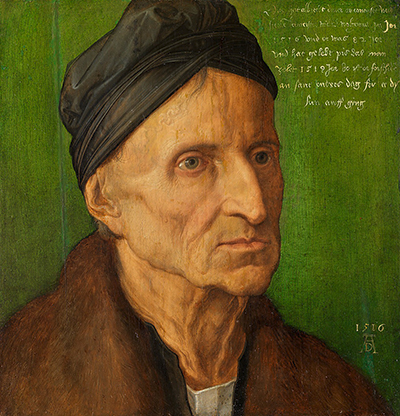
Michael Wolgemut’s face occupies the narrow interval between a black cap and a spreading brown fur collar. His head turns towards the right, but the eyes remain more open to us than the angle of the nose might suggest. Dürer makes the skin, cloth and fur distinct without separating them into isolated displays of skill. They belong to the same closely observed person. [1]
Painted in 1516 on limewood, the portrait measures 29.8 × 28.1 centimetres. The Germanisches Nationalmuseum holds it as Gm885, on loan from the Bavarian State Painting Collections. [2] [1]
At a Glance
- Portrait date 1516 [2]
- Later inscription Death notice added in 1519 [2] [3]
- Display collection Germanisches Nationalmuseum, Nuremberg; Bavarian State Painting Collections loan [2]
- TypePainting [2]
This work across Albrecht Dürer’s career
Young Hare
1502Praying Hands
1508Melencolia I
1514Four Apostles
1526Contents
- Looking closely
- Names and dates on the green ground
- Becoming Wolgemut’s apprentice
- Painter, designer and workshop leader
- A request from Venice
- The likeness survives
- Frequently Asked Questions
Looking closely
The cap rises in a loose bundle, its upper folds meeting the edge of the painted field. Lower down, several narrow bands sweep diagonally across the forehead and gather beside the ear. Light catches their ridges. Between those ridges the material becomes almost black, so that the cap has considerable volume despite its restricted colour.
Below it, the face is unevenly lit. The forehead, bridge of the nose and nearer cheek receive broad passages of light; the farther cheek narrows into shadow. A pale curl of hair at the temple interrupts the meeting of flesh and cloth. The ear projects from the head just enough to catch another small light. These changes make the turned head convincing without surrounding it with an elaborate setting.
The mouth receives much less light than the forehead. One corner folds into the cheek, and a deep crease runs down beside the nose. Under the lower lip a short dark band helps to bring the chin forward. The long neck is particularly exposed. Its vertical folds lead towards the white shirt opening, while the fur rises on either side like a second frame around the face.
Dürer changes his marks as he moves between surfaces. The cap has long, relatively clean divisions; the fur breaks into softer, crossing strands. Around the eyes, very small changes of colour distinguish lids, hollows and reflected light. The gaze is striking partly because those tiny bright accents remain visible within a much broader arrangement of brown, black and green. [1]
There is no hand, brush or palette. Nothing inside the picture presents a demonstration of Wolgemut’s occupation. The head carries almost the entire burden of the likeness. The cropping also limits our sense of his movement: we see neither a seated posture nor an action that might explain why he turns. His attention seems directed beyond the right edge, leaving us to look without becoming its definite object. [1]
The expression can feel severe. The closed lips, long nose and strongly marked cheek encourage that response, yet the painting gives no certain account of what Wolgemut was thinking. Its specificity lies in visible particulars. Following the contour from the cap to the temple, ear, jaw and neck reveals an individual shape that would be lost in a general description of an elderly man. [1]
Names and dates on the green ground
The writing names Dürer and his teacher and dates the likeness to 1516. The Haus der Bayerischen Geschichte places the age statement, eighty-two, within the later addition recording Wolgemut’s death in 1519, on St Andrew’s Day, 30 November, before sunrise. The GNM likewise identifies the death notice as a later addition. [2] [3] [1] [22]
Wolgemut’s birth is given as 1434 or 1437. Benno Baumbauer’s 2024 Neue Deutsche Biographie entry favours relating the eighty-two years to 1516 rather than 1519. The age at the sitting therefore needs qualification. [23]
The addition makes the living likeness a memorial. Wolgemut died on the same saint’s day that the apprenticeship began, thirty-three years earlier. [2] [3] [11] [1] [22]
Becoming Wolgemut’s apprentice
Dürer’s own account begins with another craft. His father taught him goldsmithing after taking him out of school. The boy learned to work neatly but found himself more strongly drawn to painting. His father regretted the time already spent on the first training, then agreed to his wish. On St Andrew’s Day, 30 November 1486, he bound Dürer to Michael Wolgemut for three years. [11]
This recollection forms part of the family history Dürer assembled in 1524, as presented in William Martin Conway’s 1889 English translation. It looks back across several decades. Dürer gives the decision a place within the story of his father’s care for him, his education and his own emerging preference. The change of craft required parental agreement and a formal commitment of time; it was more than a boy choosing a new subject to draw. [11]
He recalls learning diligently, then adds that he suffered much from Wolgemut’s lads. That brief complaint establishes difficulties among the workshop’s younger men, but supplies neither a sequence of incidents nor an account of the master’s response. The passage joins successful learning to an unhappy aspect of the experience. It leaves room for both within the same apprenticeship. [11]
The three-year term beginning late in 1486 leads to 1489. Dürer’s subsequent journeyman travels began in 1490, as the National Gallery of Art’s account explains. Its description of training across painting, drawing and printmaking also helps establish the breadth of the education, without supplying a timetable of individual lessons. [24]
The interval between apprenticeship and portrait matters. Dürer was no longer representing the master from the position of a newly arrived pupil. Thirty years separated his entry into the workshop from the date painted beside the monogram. The family chronicle’s account of goldsmithing and the decision to become a painter gives that long relationship a concrete beginning. [11]
Painter, designer and workshop leader
Johann Neudörffer’s account of Nuremberg artists, written in 1547, provides another early view of Wolgemut. He calls him a skilled painter and designer and explicitly connects that reputation with the elder Dürer’s choice of teacher for his son. He then directs readers to two kinds of work: the illustrations in the great Nuremberg chronicle and the Peringsdörffer altarpiece in the Augustinian church. [25]
This is a compact professional assessment. Neudörffer gives Wolgemut a standing among the city’s makers before identifying him through the famous pupil. He also remembers him through works that people could encounter, one in a book and another in a church. His notice allows the face in Dürer’s portrait to recover something of the working artist’s public life. [25]
Wolgemut succeeded to Hans Pleydenwurff’s workshop after Pleydenwurff’s death in 1472, marrying his widow. His business coordinated painted panels, altarpieces, sculptural polychromy, windows and prints. Surviving drawings in Erlangen preserve designs, copies and studies used across generations. Koberger’s Latin and German Nuremberg Chronicle of 1493 contained more than 1,800 woodcut illustrations. [26] [27] [28] [5]
Baumbauer stresses the division of labour in this enterprise. Neudörffer’s naming of an altarpiece under Wolgemut therefore cannot establish his exclusive execution of every part. [23]
The nineteenth-century editor Georg Wolfgang Karl Lochner adds a different kind of evidence beneath Neudörffer’s short notice. His documentary discussion records an agreement of 29 December 1491 for the chronicle enterprise and an accounting between the parties on 22 June 1509. Wolgemut appears both on his own behalf and as a guardian representing a member of the Pleydenwurff family. The enterprise involved families, obligations and continuing business arrangements as well as the production of pictures. [25]
Lochner reports that printing costs paid to Anton Koberger, the author’s payment to Hartmann Schedel, and expenses for bookbinders and illuminators had been settled before the final distribution he describes. This is useful evidence of the several kinds of labour sustained by an illustrated book. A completed image belonged within a larger chain of work and payment. His account supplies no basis for assigning a particular chronicle woodcut to the apprentice Dürer. [25]
These records bring the sitter into focus as someone accustomed to organising work. Neudörffer remembers his skill and reputation; Lochner’s documents expose the durable obligations around one major project. Neither text reconstructs the day when the portrait was painted. Together they help explain whose face Dürer was observing: a maker with an established professional history, not merely a name attached to Dürer’s youth. [25]
A request from Venice
A pair of letters offers a more everyday connection. Writing to Willibald Pirckheimer from Venice on 2 April 1506, Dürer asked him to tell his mother to speak to Wolgemut about his brother. Could Wolgemut give him work until Dürer returned, or arrange work with someone else? Dürer explained that he would willingly have brought the brother to Venice, where the journey could have helped them both and allowed the younger man to learn the language. [11]
The request appears among concerns about jewellery, money, painting and the difficulty of supporting several people. Dürer’s letter does not present it as a ceremonial reunion with his old teacher. It uses a continuing practical connection in Nuremberg while he himself is abroad. Wolgemut might provide employment directly or draw on his contacts to find another place. [11]
On 25 April Dürer returned to the matter, asking that his mother take his brother to Wolgemut so that he could work instead of remaining idle. Repetition gives the request some urgency. It also makes clear that we have a request, rather than confirmation that a placement had already been arranged. These letters show what Dürer hoped Wolgemut could do for his family, without establishing the eventual result. [11]
That modest evidence is valuable beside the later portrait. The remembered problems of apprenticeship had not prevented Dürer from approaching Wolgemut as a professional contact twenty years afterwards. The letters preserve the relationship through an ordinary need for work. They give it a firmer human scale than an imagined conversation about the younger painter’s success. [11]
The portrait’s commissioner remains unknown; a gift is only a possibility. [2]
The likeness survives
The Bavarian State Painting Collections identifies this same panel as inventory 700. Crown Prince Ludwig bought it in 1809 from the Nuremberg dealer Frauenholz; the record also names the former Praun collection. Gm885 and 700 therefore belong to one painting, recorded by its holding and owning institutions. [29]
The GNM calls Albertina 4838 a copy after the painting. Its late-sixteenth-century parchment repetition, formerly in the Schäfer collection, was once considered an earlier autograph version. Neither establishes a preparatory study. [2]
Looking back at the panel after reading the apprenticeship and letters, the face retains its independence. Those documents explain why Wolgemut mattered to Dürer, but they cannot translate a crease at the mouth into a particular memory. The fur still spreads towards the lower corners; the cap still presses against the upper edge. Between them, the eyes provide a small, concentrated area of light. Dürer’s close arrangement keeps that appearance available to anyone prepared to look slowly. [1]
Frequently Asked Questions
Artworks directory
These 187 records include individual works, reverse sides, detail views, paired panels and reconstructed arrangements. Three additional catalogue images repeat works already listed. Related views are not counted as separate originals; qualified attributions and published dating are retained.
Discussion
Look again at the images and ideas explored in Portrait of Michael Wolgemut. These editorial prompts invite your observations.
Reader Insights
Which detail or idea in Portrait of Michael Wolgemut most changed your reading, and why?
How does the discussion of “Looking closely” affect your understanding?
What comparison would you bring to the discussion of “The likeness survives”?
Join the Conversation
Share a detail, comparison or question about Portrait of Michael Wolgemut below.
References
- Joseph Heller, Das Leben und die Werke Albrecht Dürer's, vol.II, part1 (Bamberg: C.F.Kunz,1827), p.118, no.138, and pp.196–197, Munich entry17 (Michael Wolgemut). Original German edition. View source.
- Germanisches Nationalmuseum, Bildnis des Nürnberger Malers Michael Wolgemut, Gm885. German.. View source.
- Haus der Bayerischen Geschichte , Bildnis des Michael Wolgemut , inscription discussion. German. View source .
- Charles Ephrussi, Albert Dürer et ses dessins (Paris: A. Quantin, 1882), selected pp.2,14–16,20,78–80,107,109,120,153,178,188,298,302; index pp.399,403,405–406,409–410. Original French edition. View source.
- Campbell Dodgson, Catalogue of Early German and Flemish Woodcuts Preserved in the Department of Prints and Drawings in the British Museum, vol. 1 (London: British Museum, 1903). Original English edition Selected pp. 246, 260, 262, 272, 274, 288, 290, 294–296, 299–300, 302, 307. View source.
- Heinrich Wölfflin, Die Kunst Albrecht Dürers, second enlarged edition (Munich: F. Bruckmann, 1908), pp. 110, 298. Original German edition. View source.
- S. R. Koehler, A Chronological Catalogue of the Engravings, Dry-Points and Etchings of Albert Dürer (New York: Grolier Club, 1897). Original English edition Selected pp. 5, 14, 17–18, 32, 37, 42, 44, 51, 58, 60, 63, 81. View source.
- Moriz Thausing, Albert Dürer: His Life and Works, edited by F. A. Eaton, vol. II (London: John Murray, 1882), pp. 16–18. English edition. View source.
- Johann Carl Sigmund Kiefhaber, ed., Nachrichten zur ältern und neuern Geschichte der freyen Reichsstadt Nürnberg: ein Beytrag zur Geschichte der Reichsstädte in Teutschland, vol.1 (Nuremberg: Lechner, 1803), first quarter, pp.6–9,14–16. Original German historical edition of correspondence and inventory. View source.
- T. Sturge Moore, Albert Dürer (London: Duckworth and Co.; New York: Charles Scribner’s Sons, 1905), part III, portrait discussion and caption of the 1500 Munich self-portrait. Original English edition. View source.
- Albrecht Dürer , family chronicle and Venice letters, in William Martin Conway, Literary Remains of Albrecht Dürer (Cambridge, 1889), pp. 34–35, 51–52. Historical English translation; manuscript transcripts and notes by Lina Eckenstein. View source .
- ALBERTINA, Selbstbildnis als Dreizehnjähriger, inv. 4839 (German). View source.
- Metropolitan Museum, Four Horsemen from The Apocalypse, 19.73.209 (English). View source.
- Bayerische Staatsgemäldesammlungen, Selbstbildnis im Pelzrock, inv. 537 (German). View source.
- ALBERTINA, Feldhase, inv. 3073 (German). View source.
- ALBERTINA, Das große Rasenstück, inv. 3075 (German). View source.
- Metropolitan Museum, Adam and Eve, 19.73.1 (English). View source.
- ALBERTINA, Betende Hände, inv. 3113 (German). View source.
- Metropolitan Museum, Knight, Death, and the Devil, 43.106.2 (English). View source.
- Metropolitan Museum, Melencolia I, 43.106.1 (English). View source.
- Bayerische Staatsgemäldesammlungen – Alte Pinakothek München, Vier Apostel: Hll. Johannes Ev. und Petrus, 1526, inv. 545 (German).. View source.
- Katalog der Gemälde-Sammlung der Kgl. Älteren Pinakothek in München, fifth edition (Munich: Knorr & Hirth, 1893), p.52, no.243, Michael Wolgemut. Original German catalogue. View source.
- Benno Baumbauer , Wolgemut, Michael (Michel) , Neue Deutsche Biographie 28 (2024), pp. 478–480. German. View source .
- Margaret Doyle , National Gallery of Art, Albrecht Dürer: Master Drawings, Watercolors, and Prints from the Albertina (2013 brochure), PDF pp. 5–6. English. View source .
- Johann Neudörffer, Nachrichten von Künstlern und Werkleuten in Nürnberg aus dem Jahre 1547, edited by Georg Wolfgang Karl Lochner (Vienna: Wilhelm Braumüller, 1875), no.38, pp.128–130. Original German notice and separate nineteenth-century editorial discussion.. View source.
- Museen der Stadt Nürnberg , Michael Wolgemut – Mehr als Dürers Lehrer , press dossier, 19 December 2019, pp. 1–3. German. View source .
- Woldemar von Seidlitz, Wolgemut, Michel, Allgemeine Deutsche Biographie, vol.55 (Leipzig: Duncker & Humblot, 1910), pp.118–122; selected p.118. Original German article. View source.
- Franz von Reber, Ueber die Stilentwicklung der schwäbischen Tafel-Malerei im 14. und 15. Jahrhundert, Sitzungsberichte der philosophisch-philologischen und der historischen Classe der k.b. Akademie der Wissenschaften zu München, Jahrgang 1894 (Munich: Verlag der K. Akademie, 1895), pp.343–389; selected p.380. Original German article. View source.
- Bayerische Staatsgemäldesammlungen , Bildnis Michael Wolgemut , inventory 700. German. View source .
- Burlington Fine Arts Club, Exhibition of Early German Art (London: Burlington Fine Arts Club, 1906). Original English catalogue P.24, no.38. View source.
- Maud Cruttwell, Andrea Mantegna, London: George Bell and Sons, 1901, pp. 110–112. View source.
- Moriz Thausing, Dürer: Geschichte seines Lebens und seiner Kunst (Leipzig: E. A. Seemann, 1876). Original German edition Selected pp.303, 306, 308–309. View source.
- Hans W. Singer, Drawings of Albrecht Dürer (London: G. Newnes; New York: C. Scribner’s Sons, 1906), p. 8; Little Owl (Schönbrunner and Meder no. 829). Original English edition. View source.
- ALBERTINA, Innsbruck von Norden, inv.3056, current record; Christof Metzger, entry no.6, in Eva Michel and Maria Luise Sternath, eds., Kaiser Maximilian I. und die Kunst der Dürerzeit (Vienna, 2012), pp.140–141. Original German essay credited in the record. View source.
- Germanisches Nationalmuseum, Katalog der im Germanischen Museum befindlichen Gemälde (Nürnberg: Verlag des Germanischen Museums, 1893), pp.34–35, nos.206–209. Original German catalogue. View source.
- Germanisches Nationalmuseum, Barbara Dürer (German and English). View source.
- Web Gallery of Art, Tucher–Rieter reverse (English). View source.
- National Gallery of Art, Portrait of a Clergyman (English). View source.
- Dürer Art, Portrait of a Man (English). View source.
- Hessen Kassel Heritage, Elsbeth Tucher (German). View source.
- Web Gallery of Art, Hans Tucher (English). View source.
- Germanisches Nationalmuseum, Emperor Maximilian I (German and English). View source.
- National Gallery of Art, Lot and His Daughters, reverse (English). View source.
- Bayerische Staatsgemäldesammlungen, Glim Lamentation (German). View source.
- Museo Nacional del Prado, Portrait of a Man (Spanish). View source.
- Bayerische Staatsgemäldesammlungen, Madonna of the Carnation (German). View source.
- Städel Museum, Job on the Dungheap (German). View source.
- Wallraf-Richartz-Museum, Piper and Drummer (German). View source.
- Italian Ministry of Culture / Uffizi, Head of Saint James (Italian). View source.
- Klassik Stiftung Weimar, Dresden Altarpiece (German). View source.
- Staatliche Museen zu Berlin, Girl with a Red Beret (German and English). View source.
- Dresden State Art Museums / Roland Enke, Bernhard von Reesen (German). View source.
- Royal Collection Trust, Burkhard von Speyer (English). View source.
- Dresden State Art Museums, Seven Sorrows of the Virgin (English). View source.
- Bayerische Staatsgemäldesammlungen, Mater Dolorosa (German). View source.
- Bayerische Staatsgemäldesammlungen, Lucretia (German). View source.
- Städel Museum, Young Woman with Her Hair Down (English). View source.
- ALBERTINA, Portrait of a Young Man (German). View source.







