


 by
Tom Gurney
Tom Gurney BSc (Hons) is an art history expert with over 20 years experience
Published on June 19, 2020 / Updated on October 22, 2026
Email:
tomgurney1@gmail.com
/ Phone:
+44 7429 011000
Portrait of Oswolt Krel: Introduction
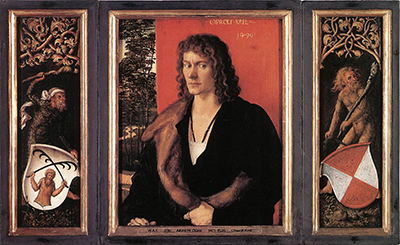
Albrecht Dürer's Portrait of Oswolt Krel makes a strong first impression through the meeting of a face, a field of red and a sweeping band of fur. Painted in 1499, the central panel belongs to a larger surviving ensemble in Munich's Alte Pinakothek. Two narrow heraldic paintings accompany it, each showing a shaggy figure with a club and a family shield. Looking at all three changes the portrait: the closely observed individual occupies the centre of a more elaborate statement about identity and marriage. [1]
The man looks towards us while his head turns slightly to our left. His eyes are widely open, his lips closed, and a small crease descends between his eyebrows. Those features create an impression of watchfulness. Dürer gives the viewer ample opportunity to inspect the sitter, while making the sitter appear to return that scrutiny. The tension belongs to the painted encounter; it gives us no reliable means of reconstructing Krel's everyday temperament.
At a Glance
- Date 1499 [1]
- Format Central portrait with two heraldic side panels [1]
- Collection Alte Pinakothek, Munich [1]
This work across Albrecht Dürer’s career
Young Hare
1502Praying Hands
1508Melencolia I
1514Four Apostles
1526Contents
- A merchant in Nuremberg
- Red ground and distant trees
- Two figures guarding family arms
- A portrait that could be covered
- A lasting likeness
- Frequently Asked Questions
A merchant in Nuremberg
Krel came from Lindau, on Lake Constance, and worked for the Great Ravensburg Trading Company. The Pinakothek records his presence in Nuremberg as its accounts clerk between January 1499 and August 1500, placing the portrait within a documented period of employment there. He was married to Agathe von Esendorf, whose family arms appear on the accompanying panel. The Haus der Bayerischen Geschichte dates their marriage to 1484, fifteen years before the portrait. This combination of a named man, professional circumstances and marital heraldry gives the painting a firmer social setting than its arresting expression alone could provide. [1] [12]
At the upper right, light lettering spells out “OSWOLT KREL”, with the year beneath. The lettering occupies a generous clear area of red, above the dark mass of curls. The inscription identifies the person whom the face brings before us; it also leaves the body free of a scroll or tablet that might interrupt the pose.
His clothes give Dürer several very different surfaces to paint. Black fabric spreads across the chest and expands into a rounded sleeve on our right. The outer garment lies over Krel's right shoulder, on our left, exposing a broad sweep of tawny fur. At the open neckline a finely gathered white shirt catches the light. A dark cord, carrying small gold-coloured rings, runs down against his bare chest. The Haus der Bayerischen Geschichte suggests that this cord fastened a pendant concealed by the shirt. [12]
The hands give the clothing weight and the pose a physical anchor. His left hand, on our right, closes around the garment near his waist; his other hand rests low at the opposite edge. A prominent ring stands out against the pale skin of the gripping hand; the Haus der Bayerischen Geschichte recognises an indication of Krel's family arms on it. The fur curves towards it in a broad diagonal, connecting shoulder, chest and fingers. That movement opens the figure to view without making the posture loose. The finely painted hairs at the fur's edge are especially effective where they project against the black cloth: tiny strokes describe a soft material while the surrounding silhouette remains decisive. [12]
Red ground and distant trees
Most of the background is occupied by a red hanging. Its nearly vertical left edge divides the panel very unevenly. A thin strip of landscape remains visible beside Krel's shoulder, where closely packed tree trunks rise through layers of foliage. Below them, a pale winding opening in the landscape brings small intervals of brightness between the darker trees. The landscape feels distant partly because so little of it is available. The sitter's clothing fills the foreground, leaving the eye to find its way into depth through a narrow passage.
The red serves a different purpose. It spreads continuously behind the head, making the outline of the curls unusually clear. The brown hair has internal movement, with individual locks turning back into one another, but it also forms a single dark boundary against the hanging. Red, black and warm flesh therefore organise the portrait before we begin following its smaller details. The trees introduce a finer, busier rhythm at the edge, where slender verticals and horizontal tiers of leaves relieve the broad shapes of the figure.
Dürer varies the scale of attention within this compact space. We can follow a tiny curl, the gathered edge of the shirt or a finger pressed against cloth, then step back mentally to see the head and shoulders as a single arrangement. The background never becomes a complete account of a room. It supplies the figure with a setting, while leaving his exact surroundings open.
Two figures guarding family arms
The centre is painted on limewood and measures 49.7 by 38.9 centimetres. The companion panels are almost the same height but much narrower: 49.4 by 15.7 centimetres on the viewer's left and 49.8 by 15.6 on the right. The museum catalogues them respectively as a wild man with Krel's arms and a wild man with those of Agathe von Esendorf. Their vertical proportions make the standing figures look compressed and energetic beside the ample half-length portrait. [1] [13] [14]
Both occupy dark spaces beneath elaborate golden-brown branches. These upper tangles are carefully ordered: stems cross, turn and produce curling leaves, with bright edges giving the ornament a carved appearance. At ground level, grasses and small plants surround the feet and shields. The two panels establish their own densely worked environments, quite distinct from the central hanging and distant landscape.
The left figure has greenish body hair, a white beard and a white cloth tied around his head. He lifts a knobbly club above his shoulder and places his other hand on the large pale shield. The figure on the right has warmer, reddish hair and carries his club diagonally across his body. A strap supports the shield in front of him. It is divided into alternating red and pale sections, whose surfaces contain delicate decorative patterns. Although the figures serve corresponding purposes, Dürer varies their colouring, gestures and equipment enough to make each worth examining separately.
There is a further wild man inside Krel's shield. Vincent Mayr's scholarly account identifies the two implements held above this smaller figure as crossed fire hooks. The repetition makes an intriguing visual structure: a hairy bearer presents a shield containing another hairy figure, whose raised arms echo the activity around him. Family identification and figural invention occupy the same surface. [15]
“Wild men” belonged to a broad European tradition of imaginary people living beyond settled society. Mayr distinguishes their human bodies and feet from the characteristics of devils and other fantastic beings, and documents their frequent employment as heraldic supporters. Their presence here brings the imagined strength of woodland figures into the service of recognisable families. The clubs look formidable as the figures attend to the orderly task of displaying shields. [15]
The Pinakothek also notes a historical belief that wild people descended from Cain. This myth concerns the imaginary beings represented beside the portrait; it supplies no evidence about Krel's actual ancestry. The specific visual connection is the wild man in his arms. Agathe's shield brings her family into the ensemble through a different emblem. The result places a marriage around the man's likeness even though his wife has no painted face within these three surviving images. [1]
A portrait that could be covered
The arrangement now described as a portrait triptych raises a practical question: how were the three paintings originally used? Their present position should be distinguished from certainty about their first construction. The Haus der Bayerischen Geschichte explains that the framing reconstructs them as a triptych, but also records the alternative that the heraldic panels belonged to a cover slid in front of the portrait. Mayr likewise describes them cautiously as panels currently mounted as triptych wings. [12] [15]
Either possibility asks us to imagine an encounter involving more than looking at a permanently exposed face. An enclosing arrangement could protect the portrait and allow its owner to reveal it. The original mechanism and the precise sequence of handling remain uncertain.
Judith Hentschel's study of portrait covers in Nuremberg explains the wider practice. Hinged lids, sliding covers and cases protected valuable likenesses, which could be kept in chests or cupboards and brought out for viewing. Family remembrance and social display could coexist: an object preserved privately might also be shown proudly to visitors. This offers a useful setting for Krel's ensemble without establishing the particular history of its handling. The arms would make sense as a public-facing declaration of family identity, while the portrait offered a more individual encounter when visible. [16]
Seen together today, the three paintings allow these forms of identification to operate at once. We read the name, meet the eyes and inspect the emblems. The centre concentrates attention on Dürer's account of a man's presence. The accompanying panels add the wider family and the possibility of a protected, selectively revealed object.
A lasting likeness
The current collection records date acquisition from the Oettingen-Wallerstein collection to 1828; they record the work as belonging to the Wittelsbacher Ausgleichsfonds from 1923. Its museum life has extended the audience far beyond any early domestic circle. [1] [13] [14]
That survival has also encouraged other artists to look closely. In her 2025 study of Krel, Christine Demele records that Heinrich Vogeler copied the painting in the Alte Pinakothek around 1900; the copy is held in the Heinrich Vogeler collection at Haus im Schluh, Worpswede. The portrait preserved a name and appearance sufficiently compelling for a later painter to spend time reproducing them. Its continuing interest lies in that concentration of attention: the eyes meeting ours, the fingers holding the fur, and the fantastic bearers presenting the family shields beside a recognisable human being. [17]
Frequently Asked Questions
Artworks directory
These 187 records include individual works, reverse sides, detail views, paired panels and reconstructed arrangements. Three additional catalogue images repeat works already listed. Related views are not counted as separate originals; qualified attributions and published dating are retained.
Discussion
Look again at the images and ideas explored in Portrait of Oswolt Krel. These editorial prompts invite your observations.
Reader Insights
Which detail or idea in Portrait of Oswolt Krel most changed your reading, and why?
How does the discussion of “A merchant in Nuremberg” affect your understanding?
What comparison would you bring to the discussion of “A lasting likeness”?
Join the Conversation
Share a detail, comparison or question about Portrait of Oswolt Krel below.
References
- Bayerische Staatsgemäldesammlungen , Bildnistriptychon des Oswolt Krel, Mittelteil: Oswolt Krel , WAF 230, current collection record, updated 27 October 2025. German. View source .
- ALBERTINA, Selbstbildnis als Dreizehnjähriger, inv. 4839 (German). View source.
- Metropolitan Museum, Four Horsemen from The Apocalypse, 19.73.209 (English). View source.
- Bayerische Staatsgemäldesammlungen, Selbstbildnis im Pelzrock, inv. 537 (German). View source.
- ALBERTINA, Feldhase, inv. 3073 (German). View source.
- ALBERTINA, Das große Rasenstück, inv. 3075 (German). View source.
- Metropolitan Museum, Adam and Eve, 19.73.1 (English). View source.
- ALBERTINA, Betende Hände, inv. 3113 (German). View source.
- Metropolitan Museum, Knight, Death, and the Devil, 43.106.2 (English). View source.
- Metropolitan Museum, Melencolia I, 43.106.1 (English). View source.
- Bayerische Staatsgemäldesammlungen, inventory 545: current collection record (German; descriptive citation). View source.
- Haus der Bayerischen Geschichte , Bildnistriptychon Oswolt Krel – Mittelteil: Bildnis des Oswolt Krel , Bayern Bilder portrait gallery. German. View source .
- Bayerische Staatsgemäldesammlungen , Bildnistriptychon des Oswolt Krel, linker Flügel: “Wilder Mann” mit dem Wappen des Oswolt Krel , WAF 230 A, current collection record, updated 27 October 2025. German. View source .
- Bayerische Staatsgemäldesammlungen , Bildnistriptychon des Oswolt Krel, rechter Flügel: “Wilder Mann” mit dem Wappen der Agathe von Esendorf , WAF 230 B, current collection record, updated 27 October 2025. German. View source .
- Vincent Mayr , “Wilde Leute”, Reallexikon zur Deutschen Kunstgeschichte / RDK Labor , 2019, sections I–III and IV.B.2.a, “15. Jh.” German. View source .
- Judith Hentschel , “Porträtdeckel mit Wildem Mann: Schiebedeckel zu einem verschollenen Porträt des Lazarus I. Holzschuher aus der Werkstatt Jakob Elsners”, Kulturgut , second quarter 2018, pp. 3–7, especially p. 4. German. View source .
- Christine Demele , “Plötzlich berühmt. Albrecht Dürer porträtiert Oswald Krell”, in Johannes Pommeranz and Anne Sowodniok, eds., Fastnacht. Tanz und Spiel in Nürnberg , 2025, pp. 110–113; cited here p. 110 and note 2. German. View source .
- Germanisches Nationalmuseum, Barbara Dürer (German and English). View source.
- Web Gallery of Art, Tucher–Rieter reverse (English). View source.
- National Gallery of Art, Portrait of a Clergyman (English). View source.
- Dürer Art, Portrait of a Man (English). View source.
- Hessen Kassel Heritage, Elsbeth Tucher (German). View source.
- Web Gallery of Art, Hans Tucher (English). View source.
- Germanisches Nationalmuseum, Emperor Maximilian I (German and English). View source.
- National Gallery of Art, Lot and His Daughters, reverse (English). View source.
- Bayerische Staatsgemäldesammlungen, Glim Lamentation (German). View source.
- Museo Nacional del Prado, Portrait of a Man (Spanish). View source.
- Bayerische Staatsgemäldesammlungen, Madonna of the Carnation (German). View source.
- Städel Museum, Job on the Dungheap (German). View source.
- Wallraf-Richartz-Museum, Piper and Drummer (German). View source.
- Italian Ministry of Culture / Uffizi, Head of Saint James (Italian). View source.
- Klassik Stiftung Weimar, Dresden Altarpiece (German). View source.
- Staatliche Museen zu Berlin, Girl with a Red Beret (German and English). View source.
- Dresden State Art Museums / Roland Enke, Bernhard von Reesen (German). View source.
- Royal Collection Trust, Burkhard von Speyer (English). View source.
- Dresden State Art Museums, Seven Sorrows of the Virgin (English). View source.
- Bayerische Staatsgemäldesammlungen, Mater Dolorosa (German). View source.
- Bayerische Staatsgemäldesammlungen, Lucretia (German). View source.
- Städel Museum, Young Woman with Her Hair Down (English). View source.
- ALBERTINA, Portrait of a Young Man (German). View source.







