


 by
Tom Gurney
Tom Gurney BSc (Hons) is an art history expert with over 20 years experience
Published on June 19, 2020 / Updated on October 22, 2026
Email:
tomgurney1@gmail.com
/ Phone:
+44 7429 011000
Sketch of a Table Fountain: Introduction
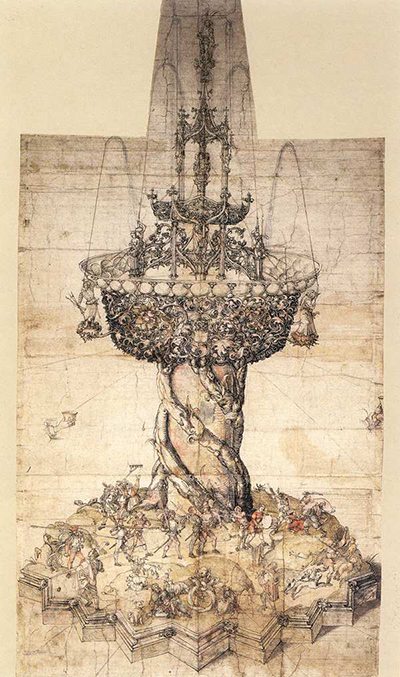
A small landscape supports an enormous vessel. People gather around a twisting trunk; above them, a deep bowl spreads out beneath a canopy of Gothic pinnacles, figures and flying streams. Albrecht Dürer's Sketch of a Table Fountain makes a piece of metalwork into a world with its own inhabitants and weather. The drawing in the British Museum dates from 1495–1500. Executed in pen and brown ink, watercolour and touches of red chalk on three joined sheets of paper, it measures 56 by 35.8 centimetres. Even before its proposed transformation into silver, this was a substantial object to handle and examine. [1]
The irregular paper outline helps establish its identity. A narrow extension rises above the broad rectangular lower portion to accommodate the spire and its uppermost jets. Within that tall silhouette, the composition repeatedly opens out and contracts: the spreading foot, the narrowing stem, the swelling basin, the little bowl above it, and finally the pointed canopy. The fountain looks precarious at first, with so much detail concentrated on slender supports. Follow its main supports, however, and the great horizontal bowl becomes the steady centre around which everything else is organised.
At a Glance
- Date 1495–1500 [1]
- Materials Pen, brown ink, watercolour and touches of red chalk on three joined paper sheets [1]
- Collection British Museum, London [1]
This work across Albrecht Dürer’s career
Young Hare
1502Praying Hands
1508Melencolia I
1514Four Apostles
1526Contents
- A landscape made for looking
- Instructions on the other side
- Hans Frey's moving water
- Versions and a religious transformation
- Frequently Asked Questions
A landscape made for looking
The foot is a raised platform with projecting angles and a stepped edge. Its hard architectural outline encloses irregular ground, scattered stones, animals and people. At the front, small figures cluster around a circular object; elsewhere, upright people and long implements interrupt the sloping terrain. There is no single commanding figure. Attention travels sideways across the platform before the central shaft draws it upward. The crowded base asks for the kind of sustained looking that a spectacular vessel could encourage during a gathering.
Differences of scale give this miniature world its character. The people seem able to walk beneath the bowl, while its supporting trunk rises like a huge tree among them. The broad basin consequently becomes both a vessel and an overhead structure. Dürer keeps the ordinary activities below close to the extraordinary apparatus above: the human figures offer an imagined measure for a piece of ornament whose true scale remains dependent on its eventual manufacture.
The trunk is particularly inventive. Branches wind around a smoother central body, cross one another and merge into the supporting structure. Its strong diagonal movements lead towards the bowl, whose underside thickens into a mass of curling leaves, projecting forms and small heads. At a distance these marks make a dark band. Close inspection breaks that band into individual turns and openings. The design depends on both effects: the bowl needs visual weight, but its surface also needs to keep offering discoveries.
Along the rim, a sequence of rounded lobes creates a comparatively legible border. Above it, delicate supports rise towards the smaller vessel and canopy. The change in density is striking. The lower bowl gathers ornament into a crowded skin; the upper structure separates it into thin shafts, arches and suspended figures. Empty paper becomes increasingly important as the fountain ascends. The canopy's openness allows the eye to pass through it, while the water arcs extend even farther into the surrounding space.
Those long curves matter as much as the solid ornament. They describe an event that the metal alone could never supply. On the sheet, the streams remain permanently airborne, crossing the blank ground in smooth trajectories. An operating fountain would repeatedly create and dissolve those lines. Dürer has drawn the vessel and its anticipated performance together.
Instructions on the other side
Contemporary German notes on the reverse specify the height of the silver mechanism above the basin. Ruled red lines accompany measurements for the silver figurines and for the streams from children, nude figures and the outer-rim figures. These annotations turn attention from the appearance of the object towards its operation. Different outlets were expected to produce different effects. [1]
The distinction between a figure's height and its jet's height is revealing. A little body serves as an outlet for a stream that can travel well beyond it. The drawn person and the moving liquid therefore need separate measurements. The reverse makes explicit what the front shows so engagingly: the fountain's form includes actions in the air around its structure. Its working dimensions extend beyond the boundary of its metal parts.
Friedrich Winkler recognised the practical significance of these notes in his 1936 catalogue. He argued that they showed an intention to execute the fountain. His entry also records a difficulty in studying the sheet: the reverse was then inaccessible because of its mounting, so he relied on a transcription associated with K. T. Parker in the British Museum's copy of Lippmann's publication. Winkler placed the drawing near 1500 through stylistic comparisons and noted the old parchment versions in Berlin and Vienna. His account preserves both an early assessment of the design and the circumstances under which its technical evidence could be consulted. [12]
Colour adds another layer of information. The British Museum reads blue upper jets as water or white wine and red lower jets as red wine; its rearward support suggests a wall or sideboard setting. The familiar title “table fountain” can thus conjure too simple a setting. This drawing offers a frontal spectacle whose relationship to surrounding furniture deserves attention. [1]
Hans Frey's moving water
A possible collaborator brings the apparently extravagant mechanism into a particularly concrete historical setting. Winkler supported the suggestion that Dürer made the design for his father-in-law, Hans Frey, while acknowledging it as a proposal. A much earlier account explains why Frey is such a persuasive connection. [12]
In his notices of Nuremberg artists and craftsmen, written in 1547, Johann Neudörffer described Frey's ability to raise water by means of air. The entry, printed in Georg Wolfgang Karl Lochner's 1875 edition, is unusually specific. Frey made hollow copper figures of men and women. Air acted within the apparatus so that water poured into it could emerge from a figure's head or other parts of its body. These fountains could be carried into a hall and set down there; Neudörffer reported that one could still be seen at the house of Hanns Ebner. [13]
This is valuable testimony to a local craft practice. Neudörffer describes things that could be transported, placed and used, with human bodies forming part of their hydraulic design. His account helps explain the combination of miniature sculpture and apparently spontaneous movement that Dürer's drawing anticipates. The surrounding company would encounter recognisable figures performing an unexpected action. A fountain could entertain through the moment when a familiar body became the source of a rising stream.
Neudörffer's passage concerns Frey's fountains generally. It supplies neither an order for this particular design nor a description detailed enough to identify it. Copper figures in his account also cannot establish the materials used in a lost object made from Dürer's drawing. Its importance lies in the practical knowledge it documents within Dürer's immediate family circle. The suggestion of collaboration rests on that relationship and that expertise; the exact division of work remains unknown.
The drawing itself leaves a similar boundary between visual invention and mechanical detail. We can follow the intended streams and read the specifications preserved on its reverse, but the front does not expose the hidden apparatus. Much of the pleasure depends on that concealment. The people and vegetation make an elaborate setting for the visible results of a system kept inside the vessel.
Versions and a religious transformation
The fountain design circulated in materially different forms. The ALBERTINA's version, inventory 14526, is a separate drawing on roughened parchment, 67 by 40.3 centimetres, dated around or after 1500. Its current record attributes it to Dürer and Hans Frey, with historical attributions also recorded. Its provenance includes Willibald Imhoff's collection, a transfer to Emperor Rudolf II in 1588, and acquisition by Duke Albert in 1796. That history belongs to the Vienna parchment, not to the joined paper sheet in London. [14]
The two sheets present the design differently. Vienna's drawing occupies a complete rectangular surface with an ornamental border and clipped inner corners. Its broad areas of yellow, pink and blue make the lower landscape and curling bowl ornament particularly easy to distinguish. London's irregular paper support and finer, more muted surviving appearance give a different experience of the same extraordinary structure. A comparison must allow for the different materials and reproductions, but the contrast also reveals how readily the composition can move between an exposed design sheet and a more enclosed display.
A further transformation takes the story beyond drawings. The British Museum follows Rasmussen's 1976 research in connecting the upper design with a lost silver-gilt tabernacle in Cardinal Albrecht of Brandenburg's Halle collection. It dates the illustrated manuscript to about 1526–1527 and identifies another record in Wolf Traut's 1520 Halle relic-book woodcut. The historical record of that reliquary can be examined in Philipp Maria Halm and Rudolf Berliner's 1931 edition of the Hallesche Heiltum . Their entry 83 identifies the illustration on folio 94 verso and its accompanying description on folio 95 recto; plate 41a reproduces the illustrated object. [1] [15]
The reproduction shows a broad lower framework carrying an open canopy, with a standing figure beneath it and an armoured banner-bearer above. Compared with Dürer's sheet, the great landscape foot, twisting trunk and encompassing main bowl have disappeared. The upper architectural idea is recognisable in a new arrangement. Halm and Berliner identify the central figure as the Man of Sorrows, the crowning figure as Saint Maurice, and surrounding angels as bearers of the instruments of the Passion. The transcribed inventory calls it a large silver-gilt tabernacle with figures and records twenty relic particles. [15]
The comparison changes how the drawing's profusion can be understood. An elaborate structure made to frame animated bodies and falling liquid could also frame a devotional figure and sacred contents. The canopy offered a powerful way of directing attention, adaptable to another purpose. The surviving images support this relationship, although the circumstances of the alteration remain unrecorded. [1]
The London drawing eventually entered the British Museum through Sir Hans Sloane's bequest; the museum also lists Pieter Spiering van Silvercroon as a previous owner. What survives is especially compelling because its material remains so visible. The paper has joins and an unusual outline; the fountain has countless small inhabitants; the streams hang in empty space. Each belongs to a different stage of making and imagining. Together they preserve the ambition of a design whose ornament was intended to become an experience unfolding before its viewers. [1]
Frequently Asked Questions
Artworks directory
These 187 records include individual works, reverse sides, detail views, paired panels and reconstructed arrangements. Three additional catalogue images repeat works already listed. Related views are not counted as separate originals; qualified attributions and published dating are retained.
Discussion
Look again at the images and ideas explored in Sketch of a Table Fountain. These editorial prompts invite your observations.
Reader Insights
Which detail or idea in Sketch of a Table Fountain most changed your reading, and why?
How does the discussion of “A landscape made for looking” affect your understanding?
What comparison would you bring to the discussion of “Versions and a religious transformation”?
Join the Conversation
Share a detail, comparison or question about Sketch of a Table Fountain below.
References
- British Museum , Gothic table fountain , SL,5218.83. Collection record, including contemporary German verso inscriptions, English translations and curatorial commentary. English; German inscriptions. View source .
- ALBERTINA, Selbstbildnis als Dreizehnjähriger, inv. 4839 (German). View source.
- Metropolitan Museum, Four Horsemen from The Apocalypse, 19.73.209 (English). View source.
- Bayerische Staatsgemäldesammlungen, Selbstbildnis im Pelzrock, inv. 537 (German). View source.
- ALBERTINA, Feldhase, inv. 3073 (German). View source.
- ALBERTINA, Das große Rasenstück, inv. 3075 (German). View source.
- Metropolitan Museum, Adam and Eve, 19.73.1 (English). View source.
- ALBERTINA, Betende Hände, inv. 3113 (German). View source.
- Metropolitan Museum, Knight, Death, and the Devil, 43.106.2 (English). View source.
- Metropolitan Museum, Melencolia I, 43.106.1 (English). View source.
- Bayerische Staatsgemäldesammlungen, inventory 545: current collection record (German; descriptive citation). View source.
- Friedrich Winkler , Die Zeichnungen Albrecht Dürers , vol. I: 1484–1502 (Berlin, 1936), no. 233, pp. 163–164. German. View source .
- Johann Neudörffer , Nachrichten von Künstlern und Werkleuten (1547), in Georg Wolfgang Karl Lochner, ed., Des Johann Neudörfer Schreib- und Rechenmeisters zu Nürnberg Nachrichten von Künstlern und Werkleuten daselbst aus dem Jahre 1547 (Vienna, 1875), no. 30, “Hanns Frey,” p. 117. German. View source .
- ALBERTINA , Entwurf für einen Tafelaufsatz oder Tischbrunnen , inventory 14526. German and English. View source .
- Philipp Maria Halm and Rudolf Berliner , Das Hallesche Heiltum: Man. Aschaffenb. 14 (Berlin, 1931), p. 33, no. 83, and plate 41a, reproducing fol. 94v. German; historical German inventory transcription. View source 1 . View source 2 .
- Germanisches Nationalmuseum, Barbara Dürer (German and English). View source.
- Web Gallery of Art, Tucher–Rieter reverse (English). View source.
- National Gallery of Art, Portrait of a Clergyman (English). View source.
- Dürer Art, Portrait of a Man (English). View source.
- Hessen Kassel Heritage, Elsbeth Tucher (German). View source.
- Web Gallery of Art, Hans Tucher (English). View source.
- Germanisches Nationalmuseum, Emperor Maximilian I (German and English). View source.
- National Gallery of Art, Lot and His Daughters, reverse (English). View source.
- Bayerische Staatsgemäldesammlungen, Glim Lamentation (German). View source.
- Museo Nacional del Prado, Portrait of a Man (Spanish). View source.
- Bayerische Staatsgemäldesammlungen, Madonna of the Carnation (German). View source.
- Städel Museum, Job on the Dungheap (German). View source.
- Wallraf-Richartz-Museum, Piper and Drummer (German). View source.
- Italian Ministry of Culture / Uffizi, Head of Saint James (Italian). View source.
- Klassik Stiftung Weimar, Dresden Altarpiece (German). View source.
- Staatliche Museen zu Berlin, Girl with a Red Beret (German and English). View source.
- Dresden State Art Museums / Roland Enke, Bernhard von Reesen (German). View source.
- Royal Collection Trust, Burkhard von Speyer (English). View source.
- Dresden State Art Museums, Seven Sorrows of the Virgin (English). View source.
- Bayerische Staatsgemäldesammlungen, Mater Dolorosa (German). View source.
- Bayerische Staatsgemäldesammlungen, Lucretia (German). View source.
- Städel Museum, Young Woman with Her Hair Down (English). View source.
- ALBERTINA, Portrait of a Young Man (German). View source.







