


 by
Tom Gurney
Tom Gurney BSc (Hons) is an art history expert with over 20 years experience
Published on June 19, 2020 / Updated on October 22, 2026
Email:
tomgurney1@gmail.com
/ Phone:
+44 7429 011000
Saint Anthony: Introduction
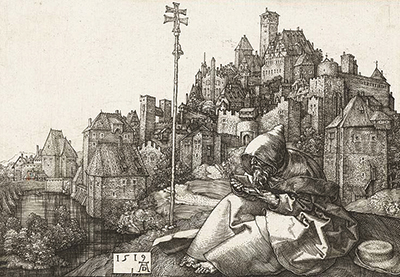
An old man sits outside a fortified town, holding a small book close to his face. Behind him, buildings climb so steeply that their roofs seem almost to rest upon his shoulders. Albrecht Dürer's Saint Anthony , dated 1519, brings these two kinds of concentration together: the reader gathered into his hood and cloak, and the city gathered into a dense mass of stone. It is a copperplate engraving, catalogued as Bartsch 58, Meder 51 and Schoch–Mende–Scherbaum 87. The Städel Museum's impression measures only 10.5 × 14.8 centimetres, including its paper margins. Within that small rectangle, Dürer gives both a solitary figure and an astonishingly expansive world. [1]
Anthony occupies the lower right of the image. His beard descends towards the book, his hands hold its open leaves, and his hood shades the upper part of his face. The cloak spreads across his knees in broad, angular folds. Bare toes emerge at its lower edge, unevenly bent and overlapping. A broad-brimmed hat lies beside him at the right edge of the print, on the saint's own left. The tall staff stands on the opposite side of his body. Its summit carries a crucifix against a double cross, with a little bell hanging below—a more elaborate form than the simple T-shaped staff often associated with Anthony. [2]
The staff passes through the open sky, rising above the highest tower. It creates a narrow vertical interval between the loosely descending town on the left and the great accumulation of buildings behind the saint. Anthony himself looks down, his attention directed away from both. The book is too small to yield a readable passage. What Dürer makes unmistakable is the act of attending to it: the lowered head, the close-held pages and the sheltered space enclosed by hood, beard and hands.
At a Glance
- Date 1519 [1]
- Process Copperplate engraving [1]
- Catalogue Bartsch 58, Meder 51, Schoch–Mende–Scherbaum 87 [1]
This work across Albrecht Dürer’s career
Young Hare
1502Praying Hands
1508Melencolia I
1514Four Apostles
1526Contents
- The hermit and his book
- A city assembled across time
- Engraved lines and travelling impressions
- Frequently Asked Questions
The hermit and his book
This is Anthony Abbot, also called Anthony the Great, the Egyptian ascetic of early Christianity. His withdrawal from ordinary society became an influential example of monastic life. In Athanasius's Life of Antony , the young man responds to hearing the Gospel by distributing his possessions and taking up religious discipline. His first places of retreat are outside his village; later he occupies tombs and an abandoned fort. The same narrative describes violent assaults by demons, including apparitions in animal forms. [13]
That account gives the engraving's peacefulness a particular weight. A reader familiar with Anthony's story could supply dangers that Dürer leaves outside the scene. Here no creature tears at the saint's clothing, no persecutor breaks his absorption, and no sudden apparition competes with the book. Solitude takes the form of an ordinary sustained action. Even the exposed bare feet belong to a body at rest. The saint's enclosure is made by his posture and clothing, without the walls of a cell.
The book also introduces an interesting distance from the early biography. Athanasius portrays Anthony as having avoided learning letters and describes his exceptional memory for the Scriptures he heard read aloud. Dürer's visible reader therefore belongs to the saint's later pictorial life, rather than serving as a literal illustration of that account. The image makes inward religious attention legible through a familiar activity. Athanasius's Anthony also advises visitors and returns reluctantly to solitude after helping others: withdrawal and service coexist in his story. [13]
The bell carries a later history into the scene. The Royal Collection connects this attribute with the Order of St Anthony's use of bells when seeking alms. His cult offered hope of relief from illnesses called St Anthony's fire. The small object brings a culture of charity and intercession into the solitary scene. [14]
A city assembled across time
The town offers enough detail to draw the eye away from the reader for a considerable time. Round towers interrupt the walls; a stair climbs along the right-hand defences; steep roofs, chimneys and windows crowd the upper slopes. At the summit, a square tower rises beside a large, sharply roofed building. Lower down, houses reach the water's edge. Their dark reflections extend beneath them, while vegetation softens the meeting of masonry, river and bank. The viewer can wander through this architecture although Anthony never looks up.
Its density depends on an accumulation of separate forms. A wall blocks a building's lower storeys; a roof appears behind another roof; narrow passages of shadow suggest spaces that remain inaccessible. The scene feels inhabited because so much has been built, yet human bustle scarcely registers. Dürer supplies the structures of communal life while keeping its noise and movement remote. The solitary reader remains close enough for us to inspect the folds of his clothing, and the town seems at once substantial and curiously hushed.
The town's earlier form appears in Pupila Augusta , a pen-and-ink drawing of about 1498 in the Royal Collection. Elderly and younger women, putti and a large fish belong to an enigmatic, debated subject. Reversed lettering and monogram indicate a projected print, apparently never executed. The architecture survived that unrealised project to become Anthony's setting more than twenty years later. [15]
Looking at the drawing makes the transformation clear. There the town occupies the upper distance, framed by two large trees and separated from a foreground crowded with figures. Its high central tower and descending roofs are already recognisable. In the engraving, the city changes sides, the trees disappear, and the foreground opens around a single seated figure. A landscape that once supported an elaborate gathering now fills much of a horizontal composition. The buildings gain prominence as the human action becomes quieter.
The Royal Collection relates adjustments in browner ink on the drawing to this reuse: a changed roof angle and buildings completed behind the omitted tree trunk. Removing the tree created gaps to be solved. Reuse meant reshaping the view for a new image. [14] [15]
The city itself also combines different places. The Virtual Museum of Nuremberg Art identifies elements drawn from Innsbruck and Trent together with Nuremberg's pentagonal castle tower and Walburgis Chapel. Its account traces the mixture through Pupila Augusta into Saint Anthony . The result is a constructed town with recognisable architectural memories. Its crowded hill gives Anthony a setting that would have looked far closer to Dürer's European world than to ancient Egypt. [16]
The folds of the cloak and the clustered buildings share a taste for abrupt changes of plane. Light catches the broad surface across Anthony's knees, then breaks against a deep fold; above him, a pale wall meets a darker roof or a tower's shadow. His bent silhouette also finds an answering rise in the town behind him. These repetitions bind the figure to his surroundings even as his downward gaze keeps him apart. The town's complexity and the reader's absorption can occupy the same small field without either becoming incidental.
Engraved lines and travelling impressions
Copperplate engraving builds this tonal world from incised marks. Ink remains in the cut lines after the plate's surface has been wiped, and pressure transfers it to dampened paper. In Saint Anthony , changes in spacing and direction make the marks serve very different surfaces. Short strokes articulate masonry; longer curves follow the cloak; dense lines darken the water. Much of the sky is left open. That reserve of pale paper gives the miniature towers and the slender cross room to remain distinct. [17]
The print soon travelled with Dürer. His journal of the Netherlands journey records gifts of Saint Anthony in 1520. One went with other engravings to the sculptor Konrad Meit, delivered through an intermediary. Anthony also appeared in substantial gifts to two Portuguese recipients. Later entries name Wilhelm Hauenhut, Jacob Bannisis and Bannisis's secretary Erasmus among its recipients: six specified distributions in these passages. The contemplative image moved through a busy network of introductions, hospitality and artistic exchange. [18]
The diary also places Anthony beside other works, including Melencolia and the seated Saint Jerome. Those lists give a concrete sense of prints handled in groups. They do not establish that these images were conceived as a single series. They show Dürer selecting and distributing his work, with a recent small engraving taking its place among larger and already familiar compositions. His gifts allow us to follow the image's circulation while leaving the subsequent fate of those particular sheets unknown. [18]
Surviving impressions have individual histories. The Pushkin Museum's sheet, inventory Г-5220, measures 9.6 × 14 centimetres. The museum identifies it as an early, clear impression, dates its printing to the first quarter of the sixteenth century and records no watermark. It came from N. Basnin's collection to the Rumyantsev Museum in 1918 and entered the Pushkin in 1924. Those details belong to this impression. They distinguish the surviving piece of paper from the design shared by all impressions and from the differently sized Städel and Royal Collection sheets. [19]
Later viewers found several uses for the image's compact abundance. An impression formed part of John Ruskin's educational collection at Oxford, where it appeared with other Dürer saints in his nineteenth-century catalogues. At Greenwich, a graphite-and-grey-wash drawing by William Lionel Wyllie, tentatively dated 1895, studies the hilltop fortress after the engraving. In that later sheet the architecture became the subject in its own right. The city that Dürer had rescued from an earlier design could still invite another artist to stop, look closely and draw. [2] [20]
Frequently Asked Questions
Artworks directory
These 187 records include individual works, reverse sides, detail views, paired panels and reconstructed arrangements. Three additional catalogue images repeat works already listed. Related views are not counted as separate originals; qualified attributions and published dating are retained.
Discussion
Look again at the images and ideas explored in Saint Anthony. These editorial prompts invite your observations.
Reader Insights
Which detail or idea in Saint Anthony most changed your reading, and why?
How does the discussion of “The hermit and his book” affect your understanding?
What comparison would you bring to the discussion of “Engraved lines and travelling impressions”?
Join the Conversation
Share a detail, comparison or question about Saint Anthony below.
References
- Städel Museum , Saint Anthony , 1519, object 31368 D. Object metadata and collection image. English; inscription field in German. View source .
- Ashmolean Museum , The Elements of Drawing: John Ruskin's Teaching Collection , Saint Anthony before the City , WA.RS.ED.075.b. Curator's description, object details, provenance and reproduced Ruskin catalogue entries. English. View source .
- ALBERTINA, Selbstbildnis als Dreizehnjähriger, inv. 4839 (German). View source.
- Metropolitan Museum, Four Horsemen from The Apocalypse, 19.73.209 (English). View source.
- Bayerische Staatsgemäldesammlungen, Selbstbildnis im Pelzrock, inv. 537 (German). View source.
- ALBERTINA, Feldhase, inv. 3073 (German). View source.
- ALBERTINA, Das große Rasenstück, inv. 3075 (German). View source.
- Metropolitan Museum, Adam and Eve, 19.73.1 (English). View source.
- ALBERTINA, Betende Hände, inv. 3113 (German). View source.
- Metropolitan Museum, Knight, Death, and the Devil, 43.106.2 (English). View source.
- Metropolitan Museum, Melencolia I, 43.106.1 (English). View source.
- Bayerische Staatsgemäldesammlungen, inventory 545: current collection record (German; descriptive citation). View source.
- Athanasius , Life of St. Anthony , especially §§1–3, 8–14 and 84–88; translated by H. Ellershaw, in Nicene and Post-Nicene Fathers , second series, vol. 4, edited by Philip Schaff and Henry Wace (1892), revised for New Advent by Kevin Knight. English translation of Greek primary text. View source .
- Royal Collection Trust , St Anthony , 1519, RCIN 800068. Catalogue entry adapted from The Northern Renaissance: Dürer to Holbein (London, 2011). English. View source .
- Royal Collection Trust , Pupila Augusta , c.1498, RCIN 912175. Catalogue entry adapted from The Northern Renaissance: Dürer to Holbein (London, 2011). English. View source .
- Virtual Museum of Nuremberg Art , Innsbruck , around 1495. Entry on Dürer's watercolour and the subsequent recombination of its architectural motifs. English. View source .
- Pushkin State Museum of Fine Arts , “Copperplate Engraving”, German Prints . English. View source .
- Albrecht Dürer , Netherlands journal, in William Martin Conway, Literary Remains of Albrecht Dürer (Cambridge, 1889), pp. 100 and 103. English translation of German primary text. View source .
- Pushkin State Museum of Fine Arts , St. Anthony , 1519, inventory Г-5220, German Prints . English. View source .
- Royal Museums Greenwich , Albrecht Durer B.146 1895.1.22.730 , PAE2184, William Lionel Wyllie, 1895?. English. View source .
- Germanisches Nationalmuseum, Barbara Dürer (German and English). View source.
- Web Gallery of Art, Tucher–Rieter reverse (English). View source.
- National Gallery of Art, Portrait of a Clergyman (English). View source.
- Dürer Art, Portrait of a Man (English). View source.
- Hessen Kassel Heritage, Elsbeth Tucher (German). View source.
- Web Gallery of Art, Hans Tucher (English). View source.
- Germanisches Nationalmuseum, Emperor Maximilian I (German and English). View source.
- National Gallery of Art, Lot and His Daughters, reverse (English). View source.
- Bayerische Staatsgemäldesammlungen, Glim Lamentation (German). View source.
- Museo Nacional del Prado, Portrait of a Man (Spanish). View source.
- Bayerische Staatsgemäldesammlungen, Madonna of the Carnation (German). View source.
- Städel Museum, Job on the Dungheap (German). View source.
- Wallraf-Richartz-Museum, Piper and Drummer (German). View source.
- Italian Ministry of Culture / Uffizi, Head of Saint James (Italian). View source.
- Klassik Stiftung Weimar, Dresden Altarpiece (German). View source.
- Staatliche Museen zu Berlin, Girl with a Red Beret (German and English). View source.
- Dresden State Art Museums / Roland Enke, Bernhard von Reesen (German). View source.
- Royal Collection Trust, Burkhard von Speyer (English). View source.
- Dresden State Art Museums, Seven Sorrows of the Virgin (English). View source.
- Bayerische Staatsgemäldesammlungen, Mater Dolorosa (German). View source.
- Bayerische Staatsgemäldesammlungen, Lucretia (German). View source.
- Städel Museum, Young Woman with Her Hair Down (English). View source.
- ALBERTINA, Portrait of a Young Man (German). View source.







