by
Tom Gurney
Tom Gurney BSc (Hons) is an art history expert with over 20 years experience
Published on June 19, 2020 / Updated on October 22, 2026
Email:
tomgurney1@gmail.com
/ Phone:
+44 7429 011000
Study of Drapery for Christ in the Heller Altarpiece: Introduction
A bare foot emerges from an immense cascade of cloth. Above it, a sharply lit fold turns outward like the rim of a vessel; across the lap, smaller creases gather around a broad, rounded knee. Albrecht Dürer's Study of Drapery for Christ in the Heller Altarpiece gives this clothing enough weight and presence to suggest a seated body even though most of that body is absent. Dated 1508, the Louvre drawing measures 25.7 × 19.2 centimetres and combines brush, pen, black ink, wash and white heightening on green-prepared paper. It studies the garment of Christ crowning the Virgin in the altarpiece's upper register. [1]
The missing head and arms direct attention towards a different kind of description. We follow the cloth as it stretches, hangs, doubles back and collects near the feet. The broad sweep across the lap gives the figure a stable seat. Below it, the hanging material forms a deep central valley, its lower point marked by a thin, bright edge. On the right, the cloth descends in a longer, almost continuous strip beside the exposed shin. This asymmetry matters: a garment disposed evenly over two legs would be much less informative about the body's position.
Dürer varies the scale of his marks as carefully as the size of the folds. Long strokes carry the eye down an extended surface. Closely packed, shorter lines turn around the bulge of the knee. Where the fabric buckles at the middle, the drawing becomes angular and compact. The shadows are deepest in narrow recesses, so that even a small triangular opening can seem to lead far behind the illuminated surface. Following one fold through its changes of direction is a good way to see how much spatial information these fine marks carry.
The foot provides a second measure of the drapery's mass. Its toes are small beside the descending garment, but their recognisable shape gives the whole arrangement a human scale. The flesh receives a concentrated passage of light, while a dark interval separates it from the cloth curling behind it. At the other side, fabric lies in crumpled pockets near the lower edge of the study. The contrast between the relatively smooth expanse over the thigh and these collapsed edges makes the imagined weight particularly convincing. The sheet records several behaviours of cloth within a single pose.
At a Glance
- Date 1508 [1]
- Materials Brush, pen, black ink, wash and white heightening on green-prepared paper [1]
- Collection Louvre, Paris [1]
This work across Albrecht Dürer’s career
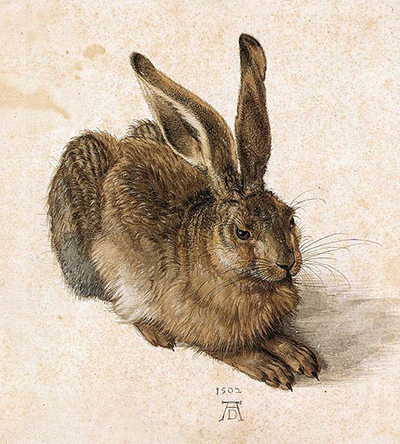
Young Hare
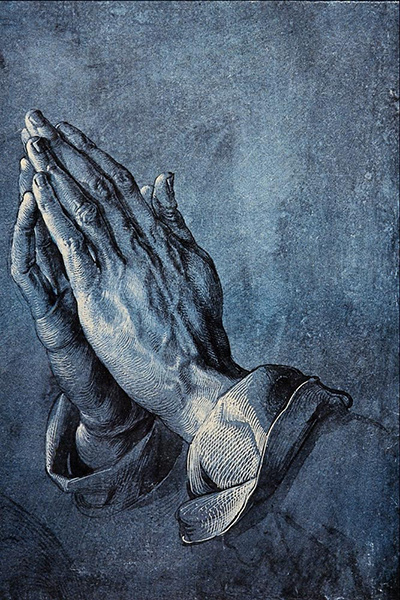
1502Praying Hands
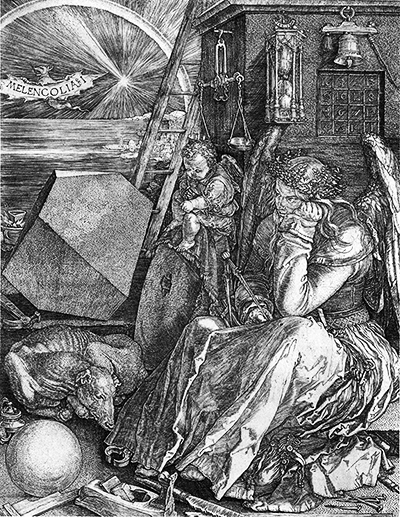
1508Melencolia I
1514Four Apostles
1526Contents
- Working from a middle tone
- Cloth in a heavenly setting
- A study worth keeping
- From imperial album to Louvre drawing
- Frequently Asked Questions
Working from a middle tone
The colour of the paper belongs to the drawing's construction. Green provides a middle value between the dark wash and the applied white, allowing Dürer to develop illuminated and shaded surfaces in opposite directions. The ALBERTINA's 2025 exhibition on drawings on coloured grounds distinguishes papers coloured during manufacture from sheets subsequently given a coloured preparation. It places the carefully prepared blue and green papers of the Heller studies after Dürer's work on Venetian blue paper in 1506, emphasising the finer surfaces he could obtain in Nuremberg. [12]
Here the green remains visible across extensive areas of the garment. White does more than trace an outside edge: it spreads across the raised knee in delicate bands, then contracts into bright threads along narrower crests. In the dark inner folds, wash and hatching absorb the ground into shadow. Between these extremes, comparatively quiet surfaces give the eye room to understand the larger form. An enlarged monochrome reproduction can make the drawing seem predominantly black and white. The colour image reveals how much the restrained green participates in every transition.
The upper part also shows that finish was selective. A few fine outlines suggest the larger arrangement, while the principal cloth receives sustained attention. The contrast allows us to distinguish what Dürer needed to describe closely from what he could leave implicit. Economical indications and elaborate modelling perform different jobs within the same sheet. The Louvre reports Philippe Lorentz's proposal that Dürer worked from a nude model; the sheet does not identify that model. [1]
Cloth in a heavenly setting
The completed Heller centre brought together the apostles around Mary's tomb below and her coronation above. The original was destroyed in the Munich Residenz fire of 1729. Jobst Harrich's replacement, commissioned in 1614 when the original panel was acquired for Bavaria, preserves the arrangement; the copy now belongs to the Historisches Museum Frankfurt. In it, Christ sits to the viewer's left of Mary and reaches towards her crown, opposite God the Father. His red garment spreads over bent legs, with a bare lower leg projecting at the right side of his seated figure. [1] [13]
Seen against that crowded composition, the drawing's concentration becomes especially striking. The robe must help establish a seated figure suspended above the earth, surrounded by angels and cloud. Its solid folds give Christ's body a firm presence in a setting without an ordinary chair or floor. Faint indications beneath the clothing belong to this larger conception: Friedrich Winkler identified the lightly sketched angel heads as supports beneath Christ's feet in his catalogue of the drawings. The slight marks at the bottom therefore connect the intensely observed cloth with the intended celestial scene. [14]
Harrich's panel is valuable for locating the study, but a comparison has limits. Its red robe can show how the broad arrangement participates in the coronation. It cannot recover the lost original's every stroke, colour transition or degree of finish. The drawing lets us examine Dürer's own handling at close range; the copy makes the overall relationship legible. Together they answer different questions about a painting that can no longer be inspected directly.
The surviving correspondence with Jacob Heller supplies another perspective on this care. On 24 August 1508, Dürer describes his painstaking preparation of the centre panel, proposes repeated applications of colour and insists that he will paint it himself. Asking for an increase over the original agreement of about 130 Rhenish florins, he joins artistic ambition to the expense of materials and time. The letter does not name this particular drawing. [15]
On 4 November 1508, Dürer argues that absolute meticulousness would make the work practically endless. He includes drapery and landscape among its many demands, pointing out that exceptionally fine work on an altarpiece could scarcely be seen. Following a tiny white stroke across a fold here differs from reading an elevated painted figure across a church. [15]
When he dispatched the picture in August 1509, Dürer explained how it should be protected, handled and lit, recommending that it lean forward slightly for viewing. Illumination concerned him beyond modelling an individual form. These instructions also preserve the artist's forceful presentation of his labour; his promises of extraordinary durability belong to his negotiations with a patron. [15]
A study worth keeping
The extraordinary detail of the Heller drawings has encouraged a broader account of their purpose. The ALBERTINA's 2025 exhibition interprets such highly finished sheets as resources retained in the workshop and demonstrations of artistic skill, beyond their immediate relationship to paintings. That interpretation suits the pleasure this sheet offers when viewed on its own. The date and monogram occupy the lower margin, while the carefully differentiated folds reward an attention much closer than an altarpiece usually permits. [12]
The drawing's finish cannot establish who first viewed it or the order in which the surviving studies were made. Dürer gave the cloth an internal coherence that sustains attention independently of the missing upper body: the heavy, closed shapes below are balanced by the open space above, and the foot extends the long outer fold towards the lower corner.
Two other Heller drapery studies, now in the ALBERTINA as inventories 3116 and 3117, concern God the Father. Their shared catalogue essay by Heinz Widauer treats them as alternative solutions, identifying 3116 as a design not adopted in that form for the panel and subsequently used for Mary's garment in the 1518 engraving The Virgin Crowned by Two Angels . The Louvre's seated Christ has a different later connection. Keeping the individual studies distinct reveals how particular arrangements of fabric could remain useful after their first commission. [16]
Winkler explicitly connects the Louvre drapery with Dürer's Virgin Nursing the Child of 1519, Bartsch 36, specifying that the motif was reused with changes. An impression in the Metropolitan Museum of Art makes the comparison possible. In the print, Mary's lap again carries a broad stretch of material across a raised knee, followed by a long falling fold. The disposition is reversed, and the prominent hanging edge appears on the viewer's left. Dürer integrates it into a much more fully described figure holding an infant. [14] [17]
The transformation is easier to appreciate by following the garment than by comparing the subjects. Christ's exposed foot no longer supplies the same endpoint. Mary's folds gather along the ground beneath her, and additional creases adapt the earlier arrangement to the new figure. Engraved black lines now create the transitions that white strokes, dark wash and a coloured surface produced in the drawing. An observed configuration could thus survive as a usable idea without being repeated mechanically. The distance between the two works also gives substance to the idea of a study kept for future reference.
From imperial album to Louvre drawing
The sheet's later history belongs to the collecting of drawings. The Louvre traces it through Rudolf II's collection, the imperial treasury in Vienna, the Court Library in 1783 and the transfer to Duke Albert of Saxe-Teschen in 1796. Its departure in 1809 remains uncertain: the museum records sale or theft. Later owners included Dominique Vivant Denon, J. A. de Silvestre and Pierre Defer. The Louvre purchased it in January 1852. [1]
An album, a collector's mount and a museum presentation each give an isolated study a different setting. In the present colour photograph, the green rectangle sits within a broad pale mount. That surrounding space makes the descending garment feel self-contained. Within the drawing, however, unfinished contours and the faint heads beneath the cloth continue to point outward towards a larger figure and scene. The sheet holds both experiences together: a fragment of a lost altarpiece and a sustained, absorbing account of how light makes folded material visible.
Frequently Asked Questions
Artworks directory
These 187 records include individual works, reverse sides, detail views, paired panels and reconstructed arrangements. Three additional catalogue images repeat works already listed. Related views are not counted as separate originals; qualified attributions and published dating are retained.
Discussion
Look again at the images and ideas explored in Study of Drapery for Christ in the Heller Altarpiece. These editorial prompts invite your observations.
Reader Insights
Which detail or idea in Study of Drapery for Christ in the Heller Altarpiece most changed your reading, and why?
How does the discussion of “Working from a middle tone” affect your understanding?
What comparison would you bring to the discussion of “From imperial album to Louvre drawing”?
Join the Conversation
Share a detail, comparison or question about Study of Drapery for Christ in the Heller Altarpiece below.
References
- Musée du Louvre , Draperie pour un Christ en gloire: Étude pour le retable Heller , INV 18597, Recto. French. Current collection record, technical description and provenance. View source .
- ALBERTINA, Selbstbildnis als Dreizehnjähriger, inv. 4839 (German). View source.
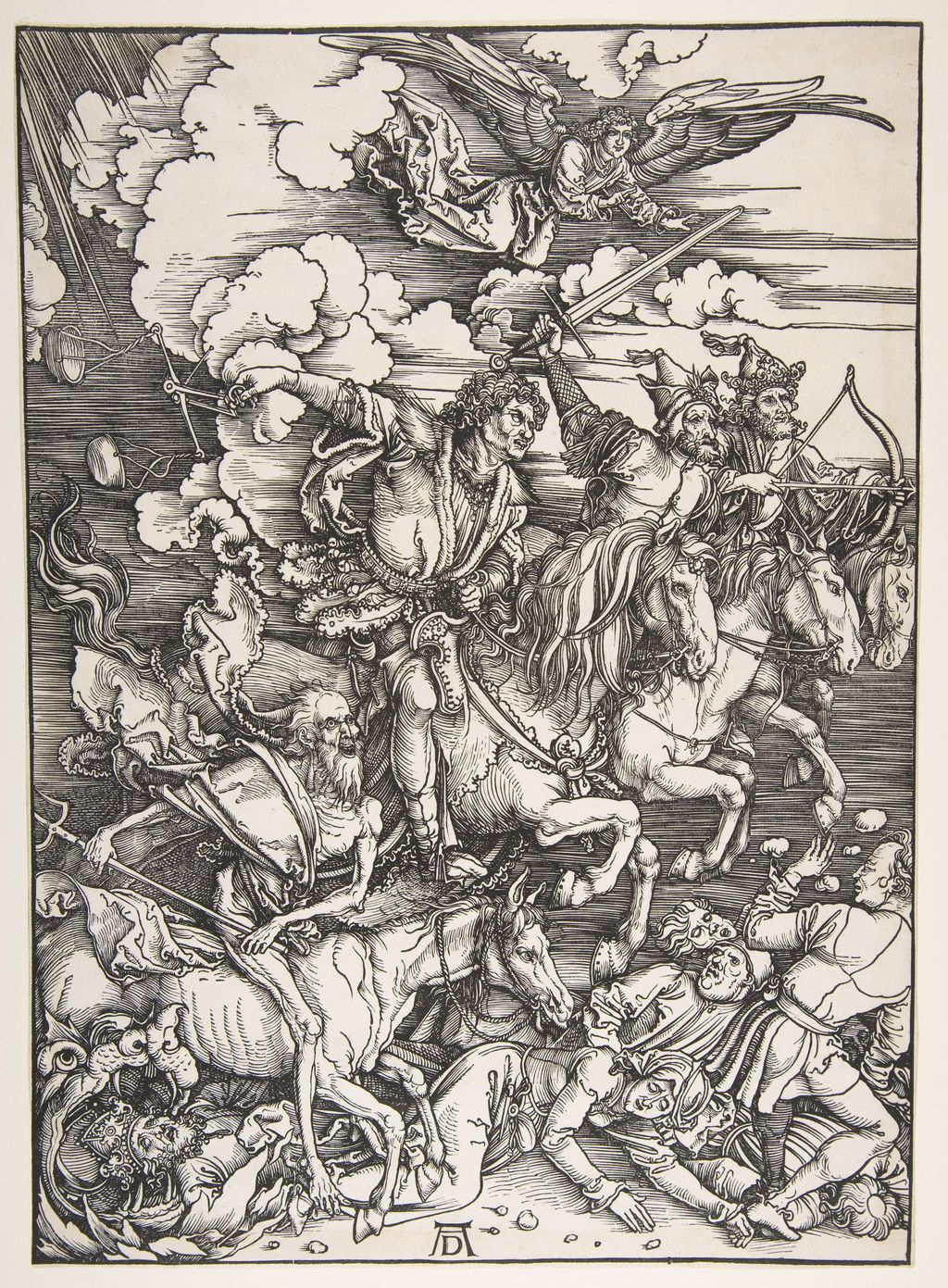
- Metropolitan Museum, Four Horsemen from The Apocalypse, 19.73.209 (English). View source.
- Bayerische Staatsgemäldesammlungen, Selbstbildnis im Pelzrock, inv. 537 (German). View source.
- ALBERTINA, Feldhase, inv. 3073 (German). View source.
- ALBERTINA, Das große Rasenstück, inv. 3075 (German). View source.
- Metropolitan Museum, Adam and Eve, 19.73.1 (English). View source.
- ALBERTINA, Betende Hände, inv. 3113 (German). View source.
- Metropolitan Museum, Knight, Death, and the Devil, 43.106.2 (English). View source.
- Metropolitan Museum, Melencolia I, 43.106.1 (English). View source.
- Bayerische Staatsgemäldesammlungen, inventory 545: current collection record (German; descriptive citation). View source.
- ALBERTINA , Leonardo–Dürer: Renaissance Master Drawings on Colored Ground , 2025, exhibition texts, especially pp. 6, 9–10. Exhibition curated by Achim Gnann and Christof Metzger. View source .
- Städel Museum , Zeitreise, Jobst Harrich, Ascension and Coronation of the Virgin , B 265, Historisches Museum Frankfurt. English title with German provenance and historical records. View source .
- Friedrich Winkler , Die Zeichnungen Albrecht Dürers , vol. II: 1503–1510/11 (Berlin, 1937), no. 455, pp. 127–128. German. View source 1 . View source 2 .
- Albrecht Dürer , letters to Jacob Heller, 1508–1509, in William Martin Conway, Literary Remains of Albrecht Dürer (Cambridge, 1889), pp. 65–71. English translation. View source .
- ALBERTINA , Studie zum Gewand Gottvaters , inv. 3116 and inv. 3117, with Heinz Widauer's 2003 catalogue essay. German. View source 1 . View source 2 .
- Metropolitan Museum of Art , The Virgin Nursing the Child , 1519, 68.793.42. View source .
- Germanisches Nationalmuseum, Barbara Dürer (German and English). View source.
- Web Gallery of Art, Tucher–Rieter reverse (English). View source.
- National Gallery of Art, Portrait of a Clergyman (English). View source.
- Dürer Art, Portrait of a Man (English). View source.
- Hessen Kassel Heritage, Elsbeth Tucher (German). View source.
- Web Gallery of Art, Hans Tucher (English). View source.
- Germanisches Nationalmuseum, Emperor Maximilian I (German and English). View source.
- National Gallery of Art, Lot and His Daughters, reverse (English). View source.
- Bayerische Staatsgemäldesammlungen, Glim Lamentation (German). View source.
- Museo Nacional del Prado, Portrait of a Man (Spanish). View source.
- Bayerische Staatsgemäldesammlungen, Madonna of the Carnation (German). View source.
- Städel Museum, Job on the Dungheap (German). View source.
- Wallraf-Richartz-Museum, Piper and Drummer (German). View source.
- Italian Ministry of Culture / Uffizi, Head of Saint James (Italian). View source.
- Klassik Stiftung Weimar, Dresden Altarpiece (German). View source.
- Staatliche Museen zu Berlin, Girl with a Red Beret (German and English). View source.
- Dresden State Art Museums / Roland Enke, Bernhard von Reesen (German). View source.
- Royal Collection Trust, Burkhard von Speyer (English). View source.
- Dresden State Art Museums, Seven Sorrows of the Virgin (English). View source.
- Bayerische Staatsgemäldesammlungen, Mater Dolorosa (German). View source.
- Bayerische Staatsgemäldesammlungen, Lucretia (German). View source.
- Städel Museum, Young Woman with Her Hair Down (English). View source.
- ALBERTINA, Portrait of a Young Man (German). View source.