by
Tom Gurney
Tom Gurney BSc (Hons) is an art history expert with over 20 years experience
Published on June 19, 2020 / Updated on October 22, 2026
Email:
tomgurney1@gmail.com
/ Phone:
+44 7429 011000
Standing Apostle (Study of a Man in Drapery): Introduction
The figure in Albrecht Dürer's Standing Apostle looks above and beyond the edge of the sheet. His face occupies little space beside the great hanging cloak, yet that lifted head gives the whole body its direction. A bright ridge descends from his shoulder; darker folds gather beneath his arm and sweep towards his knees. Known also as Study of a Man in Drapery , this drawing of 1508 belongs to Berlin's Kupferstichkabinett, where its fuller title leaves the apostle's identity open between Paul and James the Greater. The current collection record describes black brushwork with white heightening on green prepared paper, measuring 40.7 × 24 centimetres. [1]
At a Glance
- Date 1508 [1]
- Materials Black brushwork and white heightening on green prepared paper [1]
- Collection Kupferstichkabinett, Berlin [1]
This work across Albrecht Dürer’s career
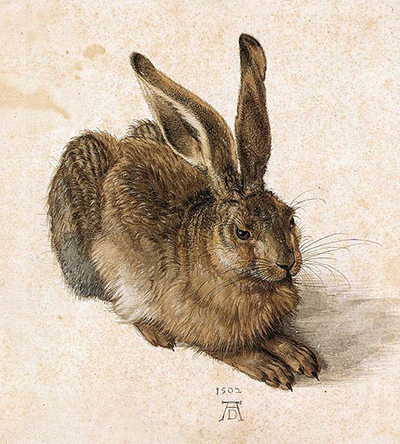
Young Hare
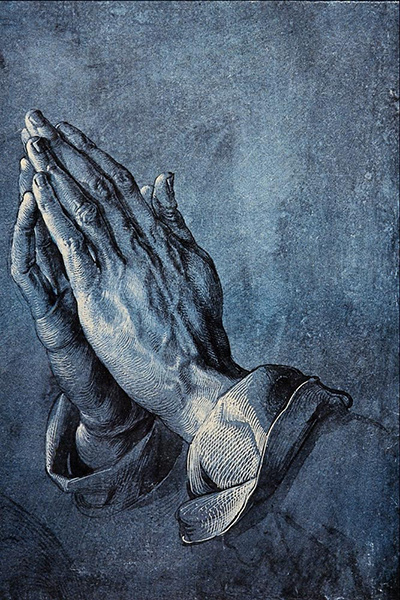
1502Praying Hands
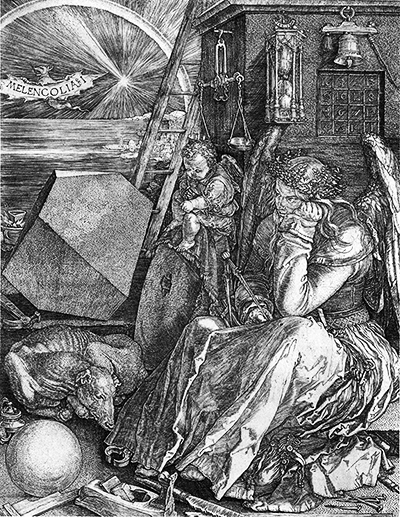
1508Melencolia I
1514Four Apostles
1526Contents
- A body carried by its clothing
- Green paper, black marks and white light
- An apostle for the Heller commission
- The face and the question of identity
- From workshop sheet to collected drawing
- Frequently Asked Questions
A body carried by its clothing
Dürer shows the man obliquely from behind. We see the back of his head and shoulders, one side of his face, and a hand projecting at the right. Most of the body disappears inside clothing. The narrow strip of lower leg at the bottom is almost an afterthought beside the broad garment above it. This disproportion directs attention towards what cloth can reveal: the height of a shoulder, the bend of an arm, the turn of a torso and the downward pull of suspended weight.
The cloak's outline changes character as the eye travels around it. At the left, a short overhanging flap projects away from the body. Below that, the edge falls almost straight before curling out again. Across the shoulder, the fabric becomes a continuous sloping plane, interrupted by sharply illuminated creases. At the right, it hangs in a long loop beneath the extended arm. These changes prevent the figure from becoming a simple column. Each interruption in the silhouette suggests a different relationship between the body and the material covering it.
Inside that outline, Dürer develops several kinds of fold. Broad, relatively smooth areas alternate with narrow ridges and deep pockets of darkness. Near the centre, angular turns form a descending chain. Lower down, a great rounded fold curves across the legs, its underside thickened with dark strokes. The result is surprisingly weighty for something made from such fine marks. The fabric appears to bunch, double back and hang freely, while the hand and face remain exposed beyond its edges.
The little staff follows the right side of the sheet. It gives the projecting hand something to grasp and supplies a slender upright beside the cloak's curved boundary. The raised chin and firmly held pose give the man an attentive presence. His age and physical condition remain unspecified; the gesture clearly carries his attention beyond his immediate surroundings.
Green paper, black marks and white light
The coloured ground participates throughout the figure. Where Dürer leaves it relatively open, it becomes the half-lit surface of the garment. Dark brushstrokes deepen the shadow; white strokes bring the cloth forward into light. The ALBERTINA's 2025 exhibition on Renaissance drawings on coloured grounds explains this use of a middle tone and distinguishes paper prepared with a coloured coating from paper coloured during manufacture. Its account places the Heller drawings among Dürer's particularly fine studies on carefully prepared blue and green grounds after his Venetian work. [12]
Here, a bright contour alone seldom carries the modelling. Along the shoulder and hanging sleeve, tiny white strokes gather into meshes. They spread across a rounded surface and thin towards its edges. Elsewhere, parallel dark strokes bend around a fold before meeting a denser patch of shadow. Looking closely, one can move between the illusion of heavy cloth and the separate marks that produce it. The drawing rewards both distances: from farther away the figure stands solidly; nearby, its surface opens into patient brushwork.
The light also joins areas that are physically separated. A few bright curls lift the hair from the green background, while the cloak catches a much larger field of white below. Across the lower half, the brightest edges repeatedly emerge from deep shadow. This distribution gives the drawing its movement even though the man stands still. The eye follows illumination from the small head down through the shoulder and into the folds.
The date and Dürer's interlocking initials appear above the figure. Their pale, open lines occupy the same empty field towards which the head turns. Around the body, the green surface remains largely unfilled. There is no room, landscape or crowd to explain the action. That isolation makes the stance exceptionally clear, while leaving its full purpose dependent on the painting with which the sheet is associated.
An apostle for the Heller commission
The drawing belongs with Dürer's work for the Frankfurt merchant Jakob Heller. The altarpiece was completed in 1509; nearly twenty related drawings of heads, hands and drapery survive. Dürer's surviving letters to Heller make the pressures surrounding that commission unusually vivid. In his letter of 4 November 1508, he defended the labour and expense involved and argued over what degree of finish he had promised. He pointed out how long a single face could take if treated with the utmost care, then reminded his patron of the many faces, draperies and landscape passages involved. The exchange is available in William Martin Conway's 1889 English translation of Dürer's literary remains. [12] [13]
Those remarks give particular resonance to a sheet in which the brush appears to have followed so many individual turns of cloth. They also show Dürer thinking about the conditions under which minute work would be seen. In the same letter he questioned the usefulness of carrying extreme detail into an altarpiece whose viewers could scarcely appreciate it. His complaint arose within a disagreement over cost and promises; it should be heard as the painter defending his work to a demanding patron. Even so, it raises a useful question when looking at this drawing: how much of its closely worked surface could have survived visually within a much larger composition? [13]
The altarpiece was made for Frankfurt's Dominican church. Its composition is preserved in Jobst Harrich's replacement centre, commissioned in 1614. The Städel's collection-history record identifies that work as a copy after Dürer and places it in the Historisches Museum Frankfurt. Mary appears above the apostles, receiving her crown from Christ and God the Father; below, the men gather around her tomb. The standing figure seen from behind helps connect those two levels through his upward gaze. [14]
The 1999 catalogue From Schongauer to Holbein notes that Harrich's figure looks stockier, with the drapery extending to the feet. Its authors, Fedja Anzelewsky and Stefan Moret, also emphasise how much more fully the clothes are worked out here than the head. They discuss Annette Pfaff's proposal that Dürer studied cloth arranged on a dummy. That remains a scholarly reconstruction of his working method. [15]
The proposal is useful because the cloak holds such an elaborate arrangement of ridges, hollows and suspended lengths. A stable support could help explain the sustained attention those forms received. The drawing itself, however, does not disclose everything that stood before the artist. We can recognise his concentration on fabric without turning a plausible studio procedure into a witnessed event.
The face and the question of identity
Berlin also preserves a separate Head of an Apostle Looking Upwards , inventory KdZ 13, dated 1508. It uses black brushwork and white heightening on green prepared paper and measures 18.9 × 24.2 centimetres. In that larger study, the tilt of the head becomes an entire subject. Fine strokes surround the eye, model the cheek and gather beneath the jaw. Long curls sweep out from the beard. The face in the standing figure carries the same emphatic upward direction with far fewer marks. [16]
Placing the sheets together reveals a division of attention. One allows the face to expand across a horizontal rectangle; the other sets a small head above an extensive structure of clothing. Their different degrees of detail make sense as different investigations within a larger enterprise. They do not supply a documented identity for the person who may have posed, or establish that every part of the standing figure was drawn during one sitting.
The apostle's name has also divided scholars. Anzelewsky and Moret report Winkler's and Strauss's suggestions of Paul or James the Greater, but argue for Peter through the distinctive forehead locks in Harrich's copy. Berlin's current title continues to offer Paul or James. The disagreement deserves to remain visible. The drawing can establish the direction of a gaze and the shape of a garment much more securely than it can settle a name without an identifying attribute. [1] [15]
From workshop sheet to collected drawing
The high finish of such studies has prompted a broader discussion of their purpose. In the ALBERTINA's 2025 account, detailed drawings could serve as demonstrations preserved in a workshop archive, displaying powers of observation beyond their immediate use for a painting. The Standing Apostle makes that possibility easy to understand: its fabric offers enough visual interest to sustain attention independently of the lost altarpiece. Association with a commission and a later life as an admired drawing can both matter to the same sheet. [12]
A later engraving offers a more specific afterlife for the figure. In his catalogue of Dürer's drawings, Friedrich Winkler identified a modified reuse in the 1513 Healing of the Lame , Bartsch 18. The print shows Peter and John healing a man at the Temple gate. Its large foreground apostle faces left, lowers his gaze and reaches towards the seated man. The shoulder covering and deeply hanging mantle recall the drawing's arrangement, while the gesture has become an encounter at ground level. The familiar mass of cloth serves a new action within a crowded architectural setting. [17] [18]
Its collecting history is distinct from that of the painting. Berlin's record names Antoine-François Andréossy among its previous owners and records its purchase in 1877 from the Posonyi-Hulot collection. The 1999 catalogue also records a high-crown watermark in the paper. Dürer's original centre panel had already been destroyed by fire in 1729. The drawing consequently preserves original brushwork for a project whose central painted image must now be approached through a copy. [1] [15]
That survival changes the balance of attention. Removed from the surrounding apostles, the standing man fills almost the entire height of the page. We can follow a single illuminated fold much farther than a viewer considering a crowded altarpiece might do. The raised face directs us towards an event outside the drawing, while the dense, turning cloth continually draws us back to the surface in front of us.
Frequently Asked Questions
Artworks directory
These 187 records include individual works, reverse sides, detail views, paired panels and reconstructed arrangements. Three additional catalogue images repeat works already listed. Related views are not counted as separate originals; qualified attributions and published dating are retained.
Discussion
Look again at the images and ideas explored in Standing Apostle (Study of a Man in Drapery). These editorial prompts invite your observations.
Reader Insights
Which detail or idea in Standing Apostle (Study of a Man in Drapery) most changed your reading, and why?
How does the discussion of “A body carried by its clothing” affect your understanding?
What comparison would you bring to the discussion of “From workshop sheet to collected drawing”?
Join the Conversation
Share a detail, comparison or question about Standing Apostle (Study of a Man in Drapery) below.
References
- Staatliche Museen zu Berlin , Kupferstichkabinett, Stehender Apostel (Paulus oder Jakobus major) , KdZ 12. Collection record, updated 9 October 2026. German. View source .
- ALBERTINA, Selbstbildnis als Dreizehnjähriger, inv. 4839 (German). View source.
- Metropolitan Museum, Four Horsemen from The Apocalypse, 19.73.209 (English). View source.
- Bayerische Staatsgemäldesammlungen, Selbstbildnis im Pelzrock, inv. 537 (German). View source.
- ALBERTINA, Feldhase, inv. 3073 (German). View source.
- ALBERTINA, Das große Rasenstück, inv. 3075 (German). View source.
- Metropolitan Museum, Adam and Eve, 19.73.1 (English). View source.
- ALBERTINA, Betende Hände, inv. 3113 (German). View source.
- Metropolitan Museum, Knight, Death, and the Devil, 43.106.2 (English). View source.
- Metropolitan Museum, Melencolia I, 43.106.1 (English). View source.
- Bayerische Staatsgemäldesammlungen, inventory 545: current collection record (German; descriptive citation). View source.
- ALBERTINA Museum , Leonardo–Dürer: Renaissance Master Drawings on Colored Ground , 2025 exhibition dossier, curators Achim Gnann and Christof Metzger, especially exhibition texts pp. 6–10. English. View source .
- Albrecht Dürer , letters to Jakob Heller, especially 4 November 1508, in William Martin Conway, trans. and ed., Literary Remains of Albrecht Dürer (Cambridge University Press, 1889), pp. 65–71. English translation from German. View source .
- Städel Museum , Jobst Harrich, Ascension and Coronation of the Virgin , B 265, Zeitreise . English interface with German provenance and historical catalogue texts. View source .
- Fedja Anzelewsky , adapted by Stefan Moret, “Standing Apostle,” no. 65, in From Schongauer to Holbein: Master Drawings from Basel and Berlin (National Gallery of Art, Washington, 1999), pp. 156–158. English translation from German. View source .
- Staatliche Museen zu Berlin , Kupferstichkabinett, Kopf eines emporblickenden Apostels , KdZ 13. Collection record, updated 9 October 2026. German. View source .
- Friedrich Winkler , Die Zeichnungen Albrecht Dürers , vol. II (Berlin, 1937), p. 127, no. 453. German. View source .
- Los Angeles County Museum of Art , Saints Peter and John Healing a Cripple at the Gate of the Temple , M.70.68.16, 1513, engraving. English. View source .
- Germanisches Nationalmuseum, Barbara Dürer (German and English). View source.
- Web Gallery of Art, Tucher–Rieter reverse (English). View source.
- National Gallery of Art, Portrait of a Clergyman (English). View source.
- Dürer Art, Portrait of a Man (English). View source.
- Hessen Kassel Heritage, Elsbeth Tucher (German). View source.
- Web Gallery of Art, Hans Tucher (English). View source.
- Germanisches Nationalmuseum, Emperor Maximilian I (German and English). View source.
- National Gallery of Art, Lot and His Daughters, reverse (English). View source.
- Bayerische Staatsgemäldesammlungen, Glim Lamentation (German). View source.
- Museo Nacional del Prado, Portrait of a Man (Spanish). View source.
- Bayerische Staatsgemäldesammlungen, Madonna of the Carnation (German). View source.
- Städel Museum, Job on the Dungheap (German). View source.
- Wallraf-Richartz-Museum, Piper and Drummer (German). View source.
- Italian Ministry of Culture / Uffizi, Head of Saint James (Italian). View source.
- Klassik Stiftung Weimar, Dresden Altarpiece (German). View source.
- Staatliche Museen zu Berlin, Girl with a Red Beret (German and English). View source.
- Dresden State Art Museums / Roland Enke, Bernhard von Reesen (German). View source.
- Royal Collection Trust, Burkhard von Speyer (English). View source.
- Dresden State Art Museums, Seven Sorrows of the Virgin (English). View source.
- Bayerische Staatsgemäldesammlungen, Mater Dolorosa (German). View source.
- Bayerische Staatsgemäldesammlungen, Lucretia (German). View source.
- Städel Museum, Young Woman with Her Hair Down (English). View source.
- ALBERTINA, Portrait of a Young Man (German). View source.