


 by
Tom Gurney
Tom Gurney BSc (Hons) is an art history expert with over 20 years experience
Published on June 19, 2020 / Updated on October 22, 2026
Email:
tomgurney1@gmail.com
/ Phone:
+44 7429 011000
Study of a Man with a Drill: Introduction
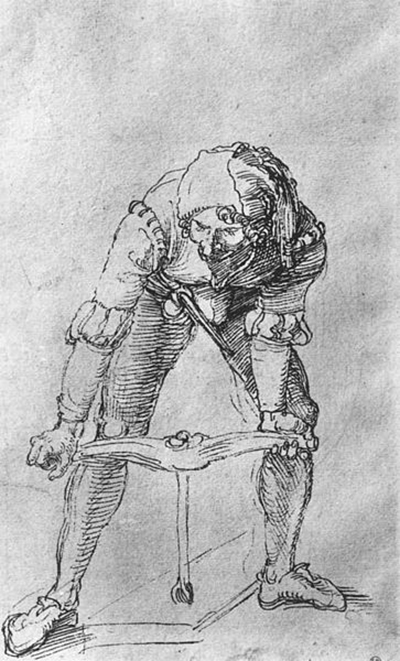
A man bends over a large hand drill, spreading his feet until his whole body seems built around the effort of turning it. His head drops between his shoulders; both hands close around the ends of the broad handle. Below them, a thin shaft descends through the otherwise open space between his legs. Albrecht Dürer has given us very little of the workplace, yet the action is immediately understandable. The figure belongs to the Musée Bonnat-Helleu in Bayonne, where the pen drawing is known in German as Mann mit Bohrer . [1]
The small sheet measures approximately 25.1 by 15.1 centimetres and is placed in the middle of the 1490s. Leonhard Sladeczek dated it around 1495; Friedrich Winkler's catalogue records a proposed date of 1496 or 1497. Its familiar English title, Study of a Man with a Drill , describes the practical subject without specifying the religious scenes in which the pose would reappear. That separation is part of its interest. On this sheet, the worker commands our attention through his own bodily activity; elsewhere, the same concentrated action acquires a disturbing narrative purpose. [2] [3]
At a Glance
- Proposed dates About 1495, or 1496–1497 [2] [3]
- Material Pen drawing [1]
- Collection Musée Bonnat-Helleu, Bayonne [1]
This work across Albrecht Dürer’s career
Study of a Man with a Drill (current article)
c. 1495–1497Young Hare
1502Praying Hands
1508Melencolia I
1514Four Apostles
1526Contents
- A body organised around a tool
- Clothing, shadow and decisions in pen
- From a workman to an executioner
- How the drawing changed the discussion
- Frequently Asked Questions
A body organised around a tool
Start with the feet. One shoe points towards the lower left corner, while the other extends to the right. Their broad separation gives the figure a stable base. Above them, the legs form two supports of unequal appearance: the leg on our left makes a relatively long, clear sweep, while the other bends outwards beneath the crowded upper body. The stance opens a large space in the lower half of the drawing. Within that space the drill's narrow upright becomes unusually conspicuous.
The handle runs almost across the width of the man's stance. Its curving edges and thickened centre distinguish it from a simple straight stick. The hands grip near its ends, with individual fingers curling over the upper edge. Each arm leads down to one of these grips, so the eye can follow a continuous chain from shoulder to elbow, wrist, hand and tool. The long handle suggests the leverage needed to turn the shaft. This is an action that involves balance as much as muscular force: the spread feet steady a torso folded forward over the work.
The head is the most compressed part of the pose. We see the top of the cap, then a small, sharply angled face emerging beneath it. A few dark curls and the projecting nose help us distinguish the face from the dense clothing around it. Because the man is looking down, his face gives little invitation to an exchange with the viewer. Our attention follows his attention towards the implement. His absorption makes the figure convincing even though the surroundings remain almost empty.
Dürer changes the level of description according to what matters locally. The gripping hands, irregular cuffs and shoes have clear, assertive outlines. The surface beneath the bit is indicated by a few oblique lines, leaving its size and construction largely undescribed. There is no bench, wall or room to locate the work. The slanting lines give the tool something to meet, while the scattered strokes under the shoes provide just enough ground to prevent the man from floating. The drawing's concentration depends on this economy: nearly everything visible contributes to the relationship between the body and the drill.
Clothing, shadow and decisions in pen
The man's clothes make his movement more legible. His short upper garment gathers and bunches around the bent torso. Sleeves swell above the wrists and then narrow at the cuffs, allowing the forearms to read as strong descending shapes. Around the waist, overlapping edges and the diagonal accessory at his side interrupt the otherwise continuous folds. The fitted leg coverings expose the changing direction of the limbs, whereas the more voluminous upper clothing compresses head, shoulders and chest into a compact mass.
These differences are carried by the pen. Closely spaced strokes wrap around the legs and accumulate beneath the torso. Across the upper body, darker bands of hatching run into one another; on the sleeves, the marks become more widely separated. Small loops and hooked strokes describe the fingers and the broken edges of cloth. The shoes are treated as angular, spreading forms with distinct outlines. The alternation between open paper and dense ink lets us read the body without a continuous, carefully graded wash.
At a distance, the drawing appears brisk and unified. Looking more closely reveals uneven densities and repeated boundaries. The cap and the shadowed chest are especially busy, while part of the upper sleeve is scarcely enclosed. This variety gives different passages different kinds of energy. A few lines establish the outer reach of an arm; many more investigate the difficult area where the lowered head meets the chest. The drawing records concentrated attention moving around a figure, with its greatest pressure falling on the compressed upper body.
Winkler identified earlier contours beneath the final figure, including feet initially placed higher. He regarded the foreshortening of the torso as a central problem and described the sheet as a study from nature. He also recorded the monogram and the date 1518 as additions by another hand. [3]
Its selective finish is well suited to a working figure study. The bare background and economical tool do not tell us how much time Dürer spent on the sheet. They do show where its descriptive resources are concentrated. The hands, stance and lowered head already establish a complete and forceful action, while the surrounding space remains available for a different setting.
From a workman to an executioner
The pose has a close counterpart in the Nailing to the Cross , one of the Dresden panels of The Seven Sorrows of the Virgin . The Gemäldegalerie Alte Meister's museum guide dates the series to 1495/96. Its seven scenes concern episodes of Christ's life and Passion understood through Mary's suffering; the central figure of the sorrowing Virgin is now in Munich. In the Nailing , the bent man works over the cross lying on the ground, preparing a hole beside Christ's extended hand. [14] [15]
The setting alters the effect of his concentration. The drawing allows us to attend to a piece of manual work without a victim. In the panel, the worker's practical competence contributes to the infliction of suffering. Around him, other figures undertake different parts of the execution, and the grieving group beyond supplies an emotional response absent from the isolated study. The same downward absorption that gives the drawing its convincing physical focus becomes unsettling within the Passion scene.
Comparison also shows adaptation. The painted worker's face turns more clearly to the side, and a basket adds another object to the crowded shoulder area. His body belongs among other bodies, tools and the diagonal cross. The drawing's empty interval between the feet becomes part of an occupied foreground. Winkler explicitly discussed the changes between drawing and painting, including the shifted head and hand; his argument concerns a revised use of the figure, rather than a literal repetition of every contour. [3]
A second counterpart appears in the woodcut The Martyrdom of the Ten Thousand , generally dated around 1496–97. An impression in the Metropolitan Museum of Art makes the figure's new role particularly clear. At the lower right, the drilling man bends over a prostrate bishop. The broad handle remains easy to recognise, but the shaft now leads towards the victim's eye. The Weisman Art Museum identifies the scene with the torture of Saint Acacius within the medieval legend of Christian soldiers executed for their faith. [16] [17]
Here the man's stance has become more aggressive. One foot presses on the victim, so the support that steadied the independent workman also restrains another body. The arrangement is reversed from the drawing, and the arms and legs have been adjusted to the new task. The small working study has entered the very front of a large, crowded image. Richly dressed spectators surround the torment, while other executions spread uphill through the landscape. The drilling figure helps bring that distant multitude of suffering into immediate physical proximity. [16]
A pose can retain its bodily logic while changing its moral meaning. The grip still communicates leverage, and the bent back still concentrates the action downwards. What changes is the thing on which the force is exerted. The drawing's sparsely described working surface leaves the gesture available for both carpentry within a Crucifixion and direct violence against a human victim.
How the drawing changed the discussion
The sheet attracted attention well beyond its modest size. In February 1912 the Darmstädter Tagblatt reported Gustav Pauli's identification of a Dürer drawing in Léon Bonnat's Paris collection. Its account singled out the bent carpenter and connected him with both the woodcut and the Dresden painting. The report presented the discovery as evidence bearing on the disputed authorship of the Dresden series. A single working figure could thus become an argument about the relationship between drawings, prints and paintings. [18]
Later scholarship continued to use it as a clear example of a figure surviving across works. In his 1965 study of Dürer and the Nuremberg Chronicle , Sladeczek reproduced the drilling man beside The Martyrdom of the Ten Thousand . The accompanying argument used them to illustrate Dürer's economy in returning to forms he had already developed. [2]
The drawing rewards a return from those larger questions to its small physical particulars. The hands still close hard around the handle, the feet still spread against the ground, and the face still disappears into the action. Seen alongside the two narrative counterparts, these details explain why the study was useful: it gives a difficult posture enough internal coherence to withstand changes of setting, scale and meaning. Seen alone, it preserves the close attention to effort on which those later effects depend.
Frequently Asked Questions
Artworks directory
These 187 records include individual works, reverse sides, detail views, paired panels and reconstructed arrangements. Three additional catalogue images repeat works already listed. Related views are not counted as separate originals; qualified attributions and published dating are retained.
Discussion
Look again at the images and ideas explored in Study of a Man with a Drill. These editorial prompts invite your observations.
Reader Insights
Which detail or idea in Study of a Man with a Drill most changed your reading, and why?
How does the discussion of “A body organised around a tool” affect your understanding?
What comparison would you bring to the discussion of “How the drawing changed the discussion”?
Join the Conversation
Share a detail, comparison or question about Study of a Man with a Drill below.
References
- Klassik Stiftung Weimar , Mann mit Bohrer , institutional authority record, GND 1198959177. German. View source .
- Leonhard Sladeczek , Albrecht Duerer und die Illustrationen zur Schedelchronik: neue Fragen um den jungen Dürer , Baden-Baden, 1965, p. 34; illustrations 11–12, pp. 36–37; illustration list, p. 101. German. View source 1 . View source 2 .
- Friedrich Winkler , Die Zeichnungen Albrecht Dürers , I: 1484–1502, no. 167, pp. 113–114, Berlin, 1936; continuation, p. 114. German. View source 1 . View source 2 .
- ALBERTINA, Selbstbildnis als Dreizehnjähriger, inv. 4839 (German). View source.
- Metropolitan Museum, Four Horsemen from The Apocalypse, 19.73.209 (English). View source.
- Bayerische Staatsgemäldesammlungen, Selbstbildnis im Pelzrock, inv. 537 (German). View source.
- ALBERTINA, Feldhase, inv. 3073 (German). View source.
- ALBERTINA, Das große Rasenstück, inv. 3075 (German). View source.
- Metropolitan Museum, Adam and Eve, 19.73.1 (English). View source.
- ALBERTINA, Betende Hände, inv. 3113 (German). View source.
- Metropolitan Museum, Knight, Death, and the Devil, 43.106.2 (English). View source.
- Metropolitan Museum, Melencolia I, 43.106.1 (English). View source.
- Bayerische Staatsgemäldesammlungen, inventory 545: current collection record (German; descriptive citation). View source.
- Staatliche Kunstsammlungen Dresden and Stephan Koja , eds., Gemäldegalerie Alte Meister: Museumsführer , p. 128, Dresden: Sandstein, 2020, Die Sieben Schmerzen der Maria , Gal.-Nrn. 1875–1881. German. View source .
- Web Gallery of Art , The Seven Sorrows of the Virgin , reproduction of the panels in Dresden and the central Virgin in Munich. View source .
- Metropolitan Museum of Art , Martyrdom of the Ten Thousand , woodcut, object 19.73.152, with collection image. View source .
- Ben Weil , “Focus on the Collection: ‘The Martyrdom of the Ten Thousand’”, Weisman Art Museum, 2 May 2019. View source .
- “Ein neuer Dürerfund” , Darmstädter Tagblatt , 17 February 1912. German. View source .
- Germanisches Nationalmuseum, Barbara Dürer (German and English). View source.
- Web Gallery of Art, Tucher–Rieter reverse (English). View source.
- National Gallery of Art, Portrait of a Clergyman (English). View source.
- Dürer Art, Portrait of a Man (English). View source.
- Hessen Kassel Heritage, Elsbeth Tucher (German). View source.
- Web Gallery of Art, Hans Tucher (English). View source.
- Germanisches Nationalmuseum, Emperor Maximilian I (German and English). View source.
- National Gallery of Art, Lot and His Daughters, reverse (English). View source.
- Bayerische Staatsgemäldesammlungen, Glim Lamentation (German). View source.
- Museo Nacional del Prado, Portrait of a Man (Spanish). View source.
- Bayerische Staatsgemäldesammlungen, Madonna of the Carnation (German). View source.
- Städel Museum, Job on the Dungheap (German). View source.
- Wallraf-Richartz-Museum, Piper and Drummer (German). View source.
- Italian Ministry of Culture / Uffizi, Head of Saint James (Italian). View source.
- Klassik Stiftung Weimar, Dresden Altarpiece (German). View source.
- Staatliche Museen zu Berlin, Girl with a Red Beret (German and English). View source.
- Dresden State Art Museums / Roland Enke, Bernhard von Reesen (German). View source.
- Royal Collection Trust, Burkhard von Speyer (English). View source.
- Dresden State Art Museums, Seven Sorrows of the Virgin (English). View source.
- Bayerische Staatsgemäldesammlungen, Mater Dolorosa (German). View source.
- Bayerische Staatsgemäldesammlungen, Lucretia (German). View source.
- Städel Museum, Young Woman with Her Hair Down (English). View source.
- ALBERTINA, Portrait of a Young Man (German). View source.







