


 by
Tom Gurney
Tom Gurney BSc (Hons) is an art history expert with over 20 years experience
Published on June 19, 2020 / Updated on October 22, 2026
Email:
tomgurney1@gmail.com
/ Phone:
+44 7429 011000
Title Page of Small Passion: Introduction
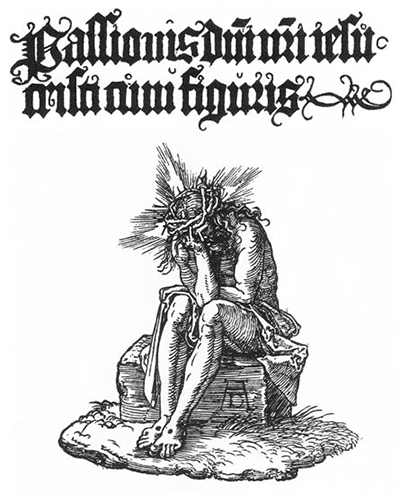
Albrecht Dürer opens the Small Passion with a figure who seems to have reached the end of his strength. Christ sits alone, his head lowered into his hand, his bare feet planted on a small patch of rough ground. The crown of thorns and the wounds identify his suffering, while rays spread from his bowed head. Known as The Man of Sorrows Seated , this woodcut was made around 1511 for the title page of a book published that year. The Metropolitan Museum of Art holds an impression under that title, numbered 19.73.170. [1]
The image gathers the reader's attention before the story begins. There is no companion to comfort Christ, no persecutor to explain his distress and no architecture to locate the encounter. His body, the stone seat and the uneven earth form a compact island in the surrounding paper. A whole history of suffering has been concentrated into one seated person.
At a Glance
- Date About 1511 [1]
- Process Woodcut [1]
- Example impression Metropolitan Museum of Art, 19.73.170 [1]
This work across Albrecht Dürer’s career
Young Hare
1502Praying Hands
1508Melencolia I
1514Four Apostles
1526Contents
- A body folded into sorrow
- The image and the book
- A silent figure given a voice
- Circulation and a changed beginning
- Frequently Asked Questions
A body folded into sorrow
The posture carries much of the image's feeling. Christ's back bends forward and his head sinks towards the supporting hand. The forearm makes an almost vertical connection between the face and the raised knee, so that the body seems to fold back upon itself. The long lower legs descend from this tightly gathered centre. They give the small figure weight: his exhaustion is expressed through the effort of remaining upright.
The head is particularly difficult to separate into its parts. Hair, thorns, fingers and shadow collect around the lowered face. The hand that might ordinarily gesture or bless is occupied in supporting the head. Little of the face is available to meet the viewer. This makes the encounter unusually intimate. We look at someone absorbed in pain, whose attention has withdrawn from the world around him.
Yet the radiance prevents that withdrawal from becoming complete disappearance. Its straight, projecting strokes push outwards from the dark knot of the head. Across the rest of the body, curved lines follow the rounded shoulder, thigh and calf. The distinction is immediately legible: flesh bends and sags, while the rays break across the surrounding emptiness. The same narrow vocabulary of black strokes describes both bodily frailty and sacred presence.
Cloth lies across Christ's lap and falls beside him. Its irregular edges interrupt the smoother contours of the limbs. Beneath it, the seat has a comparatively level upper surface and a broad, hatched front bearing Dürer's AD monogram. The signature is quiet but conspicuous once noticed. It belongs within the little structure supporting the figure, close to the bare feet, rather than occupying a separate ornamental panel.
The ground has its own rhythm of short tufts and curved marks. It supplies enough unevenness to make the feet feel exposed without expanding into a landscape. There is nowhere for the eye to wander towards a distant city or horizon. Every movement away from the body reaches the edge of the little patch of earth and then the unprinted paper.
The image and the book
The scale suits this concentrated encounter. The ALBERTINA's impression from the 1511 text edition has a sheet measuring 13.8 by 10.3 centimetres; the figure composition measures only 8.7 by 7.8 centimetres. Its catalogue distinguishes woodcut from the accompanying type printing. These are useful distinctions when looking at reproductions: the size of the seated figure, the extent of the paper and the complete printed page are different measurements. [12]
In the Bayerische Staatsbibliothek's 1511 copy, the title names Dürer as the maker of the images and Benedictus Chelidonius as the author of the poems. Beneath Christ stand four Latin lines, followed by Cum privilegio , indicating a privilege. The page identifies a collaboration as well as offering an image for contemplation. [13]
Bridwell Library describes the Small Passion as a portable devotional book and catalogues its 1511 edition as a small quarto. Its thirty-eight leaves comprise a title page, thirty-six narrative woodcuts and a final colophon. Thus there are thirty-seven woodcut designs, counting the title image. Chelidonius, a monk, supplied Latin verses for the publication; some individual designs bear the earlier dates 1509 and 1510. The title leaf brings that sequence together as a book with an opening, an order and a named poetic voice. [14]
The frontispiece does something different from the narrative pictures. Its wounded Christ sits outside a specific episode, available to be contemplated before the reader encounters the chain of events. The first narrative is the Fall of Man; the last is the Last Judgment. Placing this suffering body before such an extensive history makes the human cost of redemption visible at the outset. Before the reader sees the first act of disobedience, the title image has already shown its consequence within the book's Christian account of salvation. [14]
Turning the first leaf makes that relation tangible. In the Munich copy, the poem about the first parents' transgression is printed on the back of the title leaf and faces the image of Adam and Eve. The solitary, wounded body gives way to a crowded garden containing two unwounded bodies. Looking between the opening pages brings innocence, transgression and suffering into close succession. [13]
A silent figure given a voice
The four lines below Christ make the encounter more demanding. In their address to the reader, Christ's suffering becomes a reason to cease sinning. Sabine Siemer discusses this conjunction of image and poem under the heading of an enduring Passion: the reader is implicated in pain that human wrongdoing continues to renew. She also interprets Christ's leftward orientation, together with the arrangement of the verse, as holding the reader within contemplation of the image. [15]
That reading helps explain the frontispiece's stillness. Christ has already suffered, yet the poem brings his pain into the reader's present. With no crowd or narrative action to absorb attention, the encounter has an uncomfortable directness. The words address the person looking; the image supplies the body that suffers.
The distinction between visible gesture and verbal address is especially effective. Christ does not raise his face to speak. His downcast head makes the printed words seem to emerge from the depth of an inward condition. Reading them and looking back at the figure are different acts, each altering the other. The sorrow gives weight to the admonition, while the admonition makes the sorrow concern the reader's own conduct.
Shira Brisman places the Small Passion within a broader relationship between touch, religious experience and the printed medium. She argues that the cycle's recurring contacts and bodily traces offer a way of thinking about how Christ's presence is transmitted, and how a print reaches its beholder. Her discussion also recognises the limits of an image as a substitute for a body. On this title leaf, her argument brings into focus the distance between Christ's self-contained figure and the reader holding his image. [16]
The woodcut's material process contributes to this intimacy. In relief printing, the lines that receive ink stand above the areas cut away from the block. Here those printable lines create the curved volume of a leg, the roughness of the seat and the dark enclosure around the face. Open paper does much of the work of light. The broad areas left clear beside Christ make the thin marks describing his body seem particularly exposed. [17]
The effect changes with viewing distance. Seen at once, the figure is a compact silhouette, readily grasped beneath the heading. Seen closely, that silhouette becomes a multitude of decisions about the spacing and direction of lines. The viewer can move from recognition to prolonged inspection without leaving the small page. Its modest scale concentrates attention instead of requiring a large setting for devotional seriousness.
Circulation and a changed beginning
This was a book that could travel. Dürer's Netherlandish diary records a transaction in Antwerp in 1520 in which Sebald Fischer bought sixteen Small Passions for four florins. William Martin Conway's 1889 English edition prints that entry on page 97. The quantity matters as much as the sum: Dürer was distributing copies of a reproducible work. That particular sale does not establish a universal retail price or the circumstances of every buyer. [18]
The 1511 colophon names Dürer as painter, gives Nuremberg and the year, and warns against unauthorised printing and sale under the imperial privilege. Image and notice address the reader differently. One asks for consideration of suffering and conduct; the other asserts the maker's claim over the circulating work. Devotion and the business of publishing occupy the same volume. [13]
The frontispiece's own material history is less continuous than that of many images inside. The British Museum holds thirty-five of the thirty-seven original blocks. Its catalogue notes that the title block is absent from later sixteenth-century impressions, suggesting damage or separation after the 1511 edition. By 1612 the remaining blocks were in Venice, where Daniel Bissuccio published an Italian edition with a portrait of Dürer on the title page, based on a medal by Matthes Gebel. [19]
The ALBERTINA's surviving 1612 title leaf makes the change visible. Large Italian lettering announces the Passion and names Dürer; below it, an oval portrait shows the artist in profile. Christ's bowed head has given way to the upright head of his maker. The narrative can still concern Christ's suffering, but the first encounter now also commemorates the famous artist responsible for its images. The altered opening changes the reader's introduction to the sequence. [20]
Later reproduction brought the seated Christ back through a different material route. In his introduction to the 1894 Little Passion , Austin Dobson explains that Henry Cole's 1844 publication used stereotype copies of the surviving blocks, with repairs, while Charles Thurston Thompson recut the two missing subjects, including the title vignette. The 1894 book reused that material. A recognisable Dürer composition can therefore reach a later reader through a replacement block and a new arrangement of text. [21]
Lettering likewise varies between surviving presentations. Thorvaldsens Museum's separate impression carries the short Latin heading Passionis Domini nostri Iesu Christi , instead of the longer title naming Dürer and Chelidonius in the 1511 Munich book. Such differences reward looking at the whole leaf. The enduring centre is the solitary seated figure, but words, paper and publication determine how that figure first meets its reader. [22]
The power of Dürer's design rests in how little intervenes in that meeting. The bare feet anchor the body; the stone holds it; the hand bears the head. Radiance breaks out from a figure otherwise closing in upon itself. Before the many actions of the Small Passion unfold, this small image offers a sustained pause in which the reader can attend to one person's suffering.
Frequently Asked Questions
Artworks directory
These 187 records include individual works, reverse sides, detail views, paired panels and reconstructed arrangements. Three additional catalogue images repeat works already listed. Related views are not counted as separate originals; qualified attributions and published dating are retained.
Discussion
Look again at the images and ideas explored in Title Page of Small Passion. These editorial prompts invite your observations.
Reader Insights
Which detail or idea in Title Page of Small Passion most changed your reading, and why?
How does the discussion of “A body folded into sorrow” affect your understanding?
What comparison would you bring to the discussion of “Circulation and a changed beginning”?
Join the Conversation
Share a detail, comparison or question about Title Page of Small Passion below.
References
- The Metropolitan Museum of Art , The Man of Sorrows Seated, title page of “The Small Passion” , ca. 1511, woodcut, 19.73.170. View source .
- ALBERTINA, Selbstbildnis als Dreizehnjähriger, inv. 4839 (German). View source.
- Metropolitan Museum, Four Horsemen from The Apocalypse, 19.73.209 (English). View source.
- Bayerische Staatsgemäldesammlungen, Selbstbildnis im Pelzrock, inv. 537 (German). View source.
- ALBERTINA, Feldhase, inv. 3073 (German). View source.
- ALBERTINA, Das große Rasenstück, inv. 3075 (German). View source.
- Metropolitan Museum, Adam and Eve, 19.73.1 (English). View source.
- ALBERTINA, Betende Hände, inv. 3113 (German). View source.
- Metropolitan Museum, Knight, Death, and the Devil, 43.106.2 (English). View source.
- Metropolitan Museum, Melencolia I, 43.106.1 (English). View source.
- Bayerische Staatsgemäldesammlungen, inventory 545: current collection record (German; descriptive citation). View source.
- ALBERTINA , Der Schmerzensmann (Kleine Passion, Titelblatt) , DG1934/235, 1511 text edition. German catalogue. View source .
- Albrecht Dürer and Benedictus Chelidonius , Passio Christi ab Alberto Durer Nurenbergensi effigiata , Nuremberg, 1511; Bayerische Staatsbibliothek, Rar. 113, title leaf, first opening and colophon, digitised scans 5–7 and 79. Latin primary text. View source .
- Bridwell Library , Southern Methodist University, The Small Passion , Books and Prints by Albrecht Dürer . View source .
- Sabine Siemer , Die Passionsdarstellungen von Albrecht Dürer: Theologie und Rezeptionsästhetik , section 4.2.1, pp. 113–114, Heidelberg: arthistoricum.net, 2023. German. View source .
- Shira Brisman , “A Touching Compassion: Dürer's Haptic Theology”, Open Arts Journal 4 (Winter 2014–15), pp. 9–27. View source .
- Suzanne Boorsch and Nadine M. Orenstein , The Print in the North: The Age of Albrecht Dürer and Lucas van Leyden , The Metropolitan Museum of Art Bulletin 54, no. 4 (Spring 1997), pp. 3–4. View source .
- Albrecht Dürer , Netherlandish diary, in William Martin Conway, Literary Remains of Albrecht Dürer , Cambridge University Press, 1889, p. 97. Historical English translation. View source .
- British Museum , The Entombment of Christ , printing block from the Small Passion , 1839,0608.3.44, curator's comments and entry from Dürer and his Legacy (2002), no. 115. View source .
- ALBERTINA , Kleine Passion (Titelblatt der Ausgabe 1612) , DG1934/301. German catalogue; Italian primary title page. View source .
- Austin Dobson , introduction to The Little Passion of Albert Dürer , London: George Bell & Sons, 1894, pp. 9–12. View source .
- Thorvaldsens Museum , Den lidende Kristus , E126, catalogue and image. Danish catalogue; Latin inscription. View source .
- Germanisches Nationalmuseum, Barbara Dürer (German and English). View source.
- Web Gallery of Art, Tucher–Rieter reverse (English). View source.
- National Gallery of Art, Portrait of a Clergyman (English). View source.
- Dürer Art, Portrait of a Man (English). View source.
- Hessen Kassel Heritage, Elsbeth Tucher (German). View source.
- Web Gallery of Art, Hans Tucher (English). View source.
- Germanisches Nationalmuseum, Emperor Maximilian I (German and English). View source.
- National Gallery of Art, Lot and His Daughters, reverse (English). View source.
- Bayerische Staatsgemäldesammlungen, Glim Lamentation (German). View source.
- Museo Nacional del Prado, Portrait of a Man (Spanish). View source.
- Bayerische Staatsgemäldesammlungen, Madonna of the Carnation (German). View source.
- Städel Museum, Job on the Dungheap (German). View source.
- Wallraf-Richartz-Museum, Piper and Drummer (German). View source.
- Italian Ministry of Culture / Uffizi, Head of Saint James (Italian). View source.
- Klassik Stiftung Weimar, Dresden Altarpiece (German). View source.
- Staatliche Museen zu Berlin, Girl with a Red Beret (German and English). View source.
- Dresden State Art Museums / Roland Enke, Bernhard von Reesen (German). View source.
- Royal Collection Trust, Burkhard von Speyer (English). View source.
- Dresden State Art Museums, Seven Sorrows of the Virgin (English). View source.
- Bayerische Staatsgemäldesammlungen, Mater Dolorosa (German). View source.
- Bayerische Staatsgemäldesammlungen, Lucretia (German). View source.
- Städel Museum, Young Woman with Her Hair Down (English). View source.
- ALBERTINA, Portrait of a Young Man (German). View source.







