


 by
Tom Gurney
Tom Gurney BSc (Hons) is an art history expert with over 20 years experience
Published on June 19, 2020 / Updated on October 22, 2026
Email:
tomgurney1@gmail.com
/ Phone:
+44 7429 011000
The Wire-Drawing Mill: Mill Buildings (Detail): Introduction
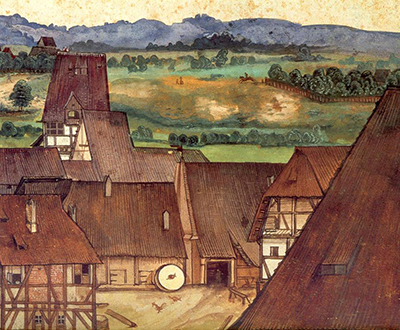
A white millstone rests beside a dark doorway, surrounded by steep roofs and timber-framed walls. These are the buildings brought into close view by the detail sometimes called The Trefileria on Peignitz II . It is a crop of Albrecht Dürer's The Wire-Drawing Mill , the watercolour in Berlin's Kupferstichkabinett, inventory KdZ 4. The repeated roofs, projecting chimney and pale circular stone locate it precisely within that larger sheet. The name does not identify a second painting or a later version made after Italy. Berlin dates the original to 1489–1494; Hans Mielke's museum essay discusses both an early date around 1489–90 and the more usual proposal of summer 1494, before the first Italian journey. [1]
The close view changes the balance of the scene. In the complete sheet, the river spreads across the left and the buildings belong to a wider inhabited valley. Here, brown roof planes occupy most of the image. A high, nearly vertical-looking roof rises towards the upper left, while another, much closer slope enters from the right and runs beyond the lower edge. Between them, a succession of smaller roofs encloses a light patch of courtyard. The countryside remains visible above, but the eye must first negotiate this dense assembly of buildings.
At a Glance
- Object Mill-buildings detail of The Wire-Drawing Mill [1]
- Whole-sheet museum date 1489–1494 [1]
- Collection Kupferstichkabinett, Berlin; KdZ 4 [1]
- TypeDrawing [1]
This work across Albrecht Dürer’s career
The Wire-Drawing Mill: Mill Buildings (Detail) (current article)
1489–1494; detailYoung Hare
1502Praying Hands
1508Melencolia I
1514Four Apostles
1526Contents
- Roofs and timber walls
- A courtyard with industry out of sight
- How much can a painted view explain?
- Frequently Asked Questions
Roofs and timber walls
Follow the long roof across the centre. Its surface is drawn with many narrow strokes running down the slope. Small pale projections interrupt the brown, and the tall chimney near its right end provides a firm vertical against the descending lines. The roofs overlap so closely that one can easily mistake the whole group for a single complicated structure. Looking for ridges, changes of angle and the ends of walls helps separate the individual volumes. Dürer makes this act of looking rewarding: a building hidden almost entirely by its neighbour can still announce itself through a small triangle of roof.
Roof texture has also mattered to the historical interpretation of the sheet. In his 1928 study, Justus Bier argued that Dürer's repeated downward lines signified roofs covered with curved tiles. He used this detail to distinguish a distant stretch of roof from land whose colour had been reproduced inconsistently. His argument is a useful reminder that a brown or green wash alone does not identify a material. The direction and repetition of the marks help make the building legible. [12]
The exposed wall at the lower left offers a different kind of information. Dark uprights and crosspieces divide it into pale panels, with sloping timbers cutting across some of the rectangles. A related pattern appears on the white gable towards the right. These walls are easiest to understand by following the larger beams first, then noticing the smaller subdivisions. The dark framework holds its shape across the changes of colour within the panels. Beside it, the broad roofs are comparatively continuous surfaces, so the picture alternates between open grids and closely hatched slopes.
The panels themselves are varied. Some look almost white; others have a warmer, bricklike pattern. Windows introduce dark recesses within this network, while the roof edges cast deeper bands above the walls. Dürer distinguishes enough to prevent the buildings from becoming interchangeable brown boxes. Yet the image cannot tell us the species of every timber or the exact materials behind each pale surface. Those questions would require evidence from the buildings themselves. What the detail gives us directly is the visible arrangement of frame, openings and infill, with some parts hidden behind nearer roofs.
G. Ulrich Großmann relates Dürer's rural buildings to modern building research. He explains that investigation and reconstruction of surviving late medieval buildings at Bad Windsheim helped establish the basic credibility of the houses in Dürer's Nuremberg-area watercolours. That is a reason to take these structures seriously as observations. It does not turn every painted line into a measured construction drawing, or supply a floor plan for this particular mill. [13]
Notice, too, the absence of a single grand façade. The buildings present themselves at different angles, some largely roof, some a wall and gable, others little more than a dark opening between neighbours. The high roof near the left acquires prominence through its height and isolation against the field. The great slope at the right has the opposite effect: it blocks our view of part of the yard. Looking across the group means repeatedly adjusting between what stands exposed and what can only be inferred from an edge.
A courtyard with industry out of sight
The open yard is small in area but important to the view. Its pale ground lets the eye escape from the patterned roofs. The doorway behind it becomes a strong dark rectangle, and the millstone stands out sharply beside it. A few tiny animal shapes animate the ground. At this scale they are brief marks within the spaces left by the buildings, with none of the descriptive detail given to the surrounding architecture. They offer a sense of occupancy without explaining what work is taking place inside.
Lothar Schmitt identifies the large white disc as a millstone in his discussion of the work for the Deutsches Museum's Kultur & Technik . He also explains the apparent absence of the machinery: Dürer looks towards the buildings from the courtyard side, leaving the waterwheels out of sight. The site, the Großweidenmühle on the north bank of the Pegnitz, was used for water-powered wire production. [14]
That distinction gives the circle a more interesting role. It is a piece of mill equipment standing outside, its bright face turned towards us, rather than a diagram of power being transmitted from the river. Its dark centre and narrow rim are unusually easy to pick out among the crowded straight lines. Beside the doorway, it supplies a clear point around which to orient the rest of the yard. The crop strengthens its visual importance by placing it close to the centre of the lower part of the image.
Much of the industrial process remains behind walls and roofs. We see no sequence of workers drawing wire and no exposed mechanism that would allow us to reconstruct the operation. Even the river, so conspicuous in the whole sheet, has effectively disappeared from this close view. The connection between water and production therefore has to be understood through the identity of the mill and the larger image. The architecture is rendered with considerable attention, while the activity that gave the place its name is largely concealed.
Daniel Hess suggests that Dürer's choice of courtyard view may relate to its proximity to the Hallerwiese, where townspeople gathered for recreation. On this reading, the setting's social associations help explain the emphasis on the mill yard. [15]
How much can a painted view explain?
The elevated angle makes the roofs unusually accessible to the eye. Bier proposed an upper-storey viewpoint in a garden house on the raised northern bank. Großmann, discussing Hermann Leber's different proposal for the distant hills, allows that the background may have been seen from the Kaiserburg terrace and added to the mill view. He stresses that modern buildings obstruct a conclusive check. Even if Leber's proposal is correct, Großmann argues, the mill itself retains a single perspective; the altered element would be its background. [12] [13]
The close study of a roof or wall and the arrangement of the wider landscape need not have the same documentary precision. We can follow the relationships between overlapping roofs without assuming that the hills supply a reliable survey of everything beyond them. The surviving strip of countryside gives the buildings room to stand out, but it provides little help in understanding their internal arrangement.
Dürer's original sheet combines watercolour and opaque colour on paper; Berlin's 2023 exhibition checklist also records a charcoal underdrawing. Its dimensions, 29 × 42.6 centimetres, belong to the complete work, which entered the Berlin collection in 1877. Within that sheet, this cluster repays concentrated attention. Roof coverings, framed walls, windows and the millstone make the place tangible, while the tight succession of buildings limits what we can see. The detail allows us to examine the mill's exterior closely and to recognise how much of its working life lay beyond the painter's chosen view. [1] [16]
Frequently Asked Questions
Artworks directory
These 187 records include individual works, reverse sides, detail views, paired panels and reconstructed arrangements. Three additional catalogue images repeat works already listed. Related views are not counted as separate originals; qualified attributions and published dating are retained.
Discussion
Look again at the images and ideas explored in The Wire-Drawing Mill: Mill Buildings (Detail). These editorial prompts invite your observations.
Reader Insights
Which detail or idea in The Wire-Drawing Mill: Mill Buildings (Detail) most changed your reading, and why?
How does the discussion of “Roofs and timber walls” affect your understanding?
What comparison would you bring to the discussion of “How much can a painted view explain?”?
Join the Conversation
Share a detail, comparison or question about The Wire-Drawing Mill: Mill Buildings (Detail) below.
References
- Staatliche Museen zu Berlin , Kupferstichkabinett, Die Drahtziehmühle , KdZ 4, current collection record, updated 9 October 2026; object essay by Hans Mielke, from Das Berliner Kupferstichkabinett. Ein Handbuch zur Sammlung , 2nd ed. (1994), pp. 107–108, cat. III.27. German. View source .
- ALBERTINA, Selbstbildnis als Dreizehnjähriger, inv. 4839 (German). View source.
- Metropolitan Museum, Four Horsemen from The Apocalypse, 19.73.209 (English). View source.
- Bayerische Staatsgemäldesammlungen, Selbstbildnis im Pelzrock, inv. 537 (German). View source.
- ALBERTINA, Feldhase, inv. 3073 (German). View source.
- ALBERTINA, Das große Rasenstück, inv. 3075 (German). View source.
- Metropolitan Museum, Adam and Eve, 19.73.1 (English). View source.
- ALBERTINA, Betende Hände, inv. 3113 (German). View source.
- Metropolitan Museum, Knight, Death, and the Devil, 43.106.2 (English). View source.
- Metropolitan Museum, Melencolia I, 43.106.1 (English). View source.
- Bayerische Staatsgemäldesammlungen, inventory 545: current collection record (German; descriptive citation). View source.
- Justus Bier , “Die Örtlichkeit von Dürers ‘Drahtziehmühle’”, Mitteilungen des Vereins für Geschichte der Stadt Nürnberg 28 (1928), pp. 334–339 and four plates, especially pp. 336–337. German. View source .
- G. Ulrich Großmann , “Die Architektur im Werk des jungen Dürer”, in Daniel Hess and Thomas Eser, eds., Der frühe Dürer (2012), pp. 221–235, especially pp. 228–229. German. View source .
- Lothar Schmitt , “Es muss nicht immer Leonardo sein: Albrecht Dürer, die Kunst und die Technik”, Kultur & Technik 4/2012, pp. 50–53, mill discussion pp. 50–51. German. View source .
- Daniel Hess , “Nature as Art's Supreme Guide: Dürer's Nature and Landscape Studies”, translated by Catherine Framm, in The Early Dürer (2012), pp. 117–131. English translation. View source .
- Staatliche Museen zu Berlin , Kupferstichkabinett, Dürer für Berlin : exhibition worklist (2023), p. 12, cat. 65. German. View source .
- Germanisches Nationalmuseum, Barbara Dürer (German and English). View source.
- Web Gallery of Art, Tucher–Rieter reverse (English). View source.
- National Gallery of Art, Portrait of a Clergyman (English). View source.
- Dürer Art, Portrait of a Man (English). View source.
- Hessen Kassel Heritage, Elsbeth Tucher (German). View source.
- Web Gallery of Art, Hans Tucher (English). View source.
- Germanisches Nationalmuseum, Emperor Maximilian I (German and English). View source.
- National Gallery of Art, Lot and His Daughters, reverse (English). View source.
- Bayerische Staatsgemäldesammlungen, Glim Lamentation (German). View source.
- Museo Nacional del Prado, Portrait of a Man (Spanish). View source.
- Bayerische Staatsgemäldesammlungen, Madonna of the Carnation (German). View source.
- Städel Museum, Job on the Dungheap (German). View source.
- Wallraf-Richartz-Museum, Piper and Drummer (German). View source.
- Italian Ministry of Culture / Uffizi, Head of Saint James (Italian). View source.
- Klassik Stiftung Weimar, Dresden Altarpiece (German). View source.
- Staatliche Museen zu Berlin, Girl with a Red Beret (German and English). View source.
- Dresden State Art Museums / Roland Enke, Bernhard von Reesen (German). View source.
- Royal Collection Trust, Burkhard von Speyer (English). View source.
- Dresden State Art Museums, Seven Sorrows of the Virgin (English). View source.
- Bayerische Staatsgemäldesammlungen, Mater Dolorosa (German). View source.
- Bayerische Staatsgemäldesammlungen, Lucretia (German). View source.
- Städel Museum, Young Woman with Her Hair Down (English). View source.
- ALBERTINA, Portrait of a Young Man (German). View source.







