


 by
Tom Gurney
Tom Gurney BSc (Hons) is an art history expert with over 20 years experience
Published on June 19, 2020 / Updated on October 22, 2026
Email:
tomgurney1@gmail.com
/ Phone:
+44 7429 011000
View of Kalchreuth: Introduction
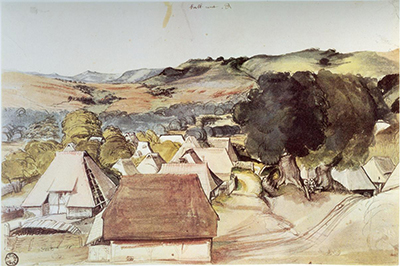
A wide brown roof blocks the nearest part of Albrecht Dürer’s View of Kalchreuth . Beyond it, pale roofs descend among trees, following ground that falls away towards a broad valley. On the right, two massive trunks support a dark canopy beside the road. The village fills much of the sheet, yet the eye keeps travelling: through the narrow opening between the buildings and trees, across the fields, and towards the long ridge on the horizon. Dürer makes a small settlement the threshold of a much larger landscape.
This is the village view historically catalogued as Winkler 118, measuring 21.6 by 31.4 centimetres. Joseph Maria Ritz reproduced it in his 1955 study of village form, identifying it as formerly in the Kunsthalle Bremen. Its subject is Kalchreuth, near Nuremberg, rather than an Italian settlement encountered on Dürer’s travels. A separate, much narrower watercolour in Berlin depicts the surrounding valley. The two sheets belong together in discussions of Dürer’s landscape art, but their different shapes and emphases matter: here, the foreground is an inhabited place. [1] [2]
At a Glance
- Historic catalogue Winkler 118 [1]
- Recorded dimensions 21.6 × 31.4 cm [1]
- Subject Village of Kalchreuth near Nuremberg [1]
- TypeDrawing [1]
This work across Albrecht Dürer’s career
View of Kalchreuth (current article)
Date discussed in articleYoung Hare
1502Praying Hands
1508Melencolia I
1514Four Apostles
1526Contents
- The village seen through its roofs
- Roads, trees and distance
- Colour and the open sheet
- An uncertain date, a documented later history
- Frequently Asked Questions
The village seen through its roofs
The large roof at the bottom establishes the scale of everything behind it. Its ridge runs almost horizontally, while the sloping ends and dark lower edge make it a solid obstruction. The wall beneath appears only as a shallow band before the sheet ends. We are looking over the building from above, without seeing enough of its surroundings to walk around it. This abrupt cropping brings the viewer close to the village and gives the more distant roofs a convincing sequence of diminishing sizes.
Behind the first roof, each building turns slightly differently. Some show a broad pale slope, others a narrow side or a triangular opening. Their upper edges rise and fall across the sheet rather than settling into a regular terrace. Small wedges of yellow ground and green foliage separate them. The roofs make the settlement legible before any complete house can be reconstructed. A viewer can follow its density, changes of level and winding spaces while knowing very little about individual interiors.
These shapes have also attracted architectural historians. Ritz paired Dürer’s image with a twentieth-century photograph of Kalchreuth’s village street. He used the comparison to illustrate substantial changes in Franconian village appearance and noted that hipped roofs had formerly been much more widespread. A hipped roof slopes down at its ends as well as along its sides; the broad coverings in the watercolour consequently give the buildings a low, enveloping outline. His photograph records a different street rhythm, with prominent upright gables and more exposed house fronts. [1]
The building on the left rewards a closer look. Its light roof opens along a dark, ladder-like strip, and a horizontal structure projects near its base. These details can look like evidence of a roof awaiting repair. In a 2018 study of historical timber construction, however, the building researcher Anita Springer identified this structure as a barn. Her caption describes an outer screen, or Schild , interrupted at the entrance to the threshing floor. She uses the illustration in a discussion of walls placed outside the principal timber frame, beneath projecting eaves. The detail offers evidence about the organisation of a working building. It supplies no reliable measure of the household’s wealth. [13]
Dürer gives this complex structure only a few dark divisions. They are enough to differentiate it from the great brown roof alongside, whose surface is built from broad colour. The shift between architectural shorthand and full, weighty masses makes looking unusually active. A detail that seems incidental at first can suddenly make its construction the centre of attention.
Roads, trees and distance
The route into the view begins low on the right. Several curving lines describe the road as it swings around the base of the trees and approaches the open space beside the houses. Higher up, a bright passage narrows between foliage and roofs. Its bend delays the movement into depth: the village does not lie open along one straight axis. The foreground road, the smaller passage and the distant valley provide successive invitations to look further.
The two trees are the chief counterweight to the architecture. Their crowns overlap into a nearly continuous dark mass, but their trunks remain distinct. Deep creases and sweeping curves make the wood seem twisted and heavy. Around the roots, a few thin marks retain the openness of drawing. Above them, the densely coloured foliage makes a powerful silhouette against the lighter land. The group joins the bare foreground to the ridge behind, occupying several levels of the picture at once.
Across the valley, Dürer changes his vocabulary. The nearest trees have individual trunks; more distant vegetation becomes clustered loops and patches. On the hills, short dark strokes punctuate longer bands of ochre, green and grey. A ridge can be followed across the paper even where its surface is barely described. The open country is therefore spacious without being empty. Its repeated interruptions suggest routes, planted ground and folds in the terrain without requiring a separate inventory of every feature.
A modern geological excursion published by the Naturhistorische Gesellschaft Nürnberg in 2019 provides a particularly useful comparison. Its annotated photograph sets this village watercolour against the actual northern outlook from the Kalchreuth ridge, identifying the Hetzleser Berg, Lange Meile and Friesener Warte. The photograph had to be compressed sideways to align the landforms. The accompanying explanation suggests that Dürer strengthened a break in the Hetzles slope and rearranged the apparent spacing to direct attention into the distance. [14]
The comparison also explains why the view can feel both expansive and close. Large roofs occupy the foreground while substantial hills remain visually assertive behind them. The NHG account records the proposal that Dürer worked from a north-facing window of the Hallerschloss; it also identifies a nearby outdoor viewpoint with a comparable outlook. The suggested window helps explain the elevated view, although it does not establish the exact circumstances of painting. [14]
Looking at the watercolour itself, the distant ridge is much less imposing on the left. There the land opens into a pale interval between rising ground. Towards the right, the hills gather height and dark accents, answering the heavier tree canopy below. The landscape has a pronounced sideways movement as well as a recession towards the horizon. Following it is rather like turning the head after first looking down at the village.
Colour and the open sheet
Warm and cool passages divide the landscape without forming rigid zones. The brown foreground roof gives weight to the lower edge. Cream and pale yellow spread across the smaller roofs; green gathers among the houses and deepens into the great trees. Grey-blue washes stretch through the middle distance. Small reddish marks on the slopes keep the distant land connected to the warmth of the buildings.
Much of the sky is left pale. It has little of the internal incident found in the village, so the irregular horizon becomes especially clear. Below, the unfinished-looking ground on the right allows the road’s curving lines to remain visible. These open passages change the pace of the picture. Dense foliage, broad washes and lightly indicated spaces can be taken in together, without every part receiving the same degree of finish.
The effect is easiest to appreciate by following the edges. A roof meets a wall in a decisive dark line; a tree crown meets the sky in a broken, swelling contour; a distant slope dissolves into a thin band. Each boundary has a different pressure and clarity. The picture’s freedom comes partly from this adjustment of attention. Dürer can insist on one connection and leave the next for the viewer to complete.
Friedrich Winkler catalogued the medium as watercolour and opaque colour. Writing in 1936, he admired the breadth of handling in the two Kalchreuth watercolours, comparing their apparent modernity with Menzel and Cézanne. He also cautioned that the colour reproduction of the village view failed to convey the luminous white of its paper. His comparison belongs to the work’s later reception, but the warning remains helpful: reproductions can make the pale areas seem like a uniform coloured ground and diminish their interaction with the painted passages. [15]
An uncertain date, a documented later history
The date has been debated because the picture’s broad handling is difficult to place within a simple progression from youthful detail to mature freedom. Winkler favoured the dating around 1500 proposed by Emil Waldmann, rather than the later placement then often given to the two sheets. In the 1999 Washington exhibition catalogue, Fedja Anzelewsky’s entry, adapted by Stefan Moret, described proposals extending from 1499–1500 to 1518–1520. The entry favoured the earlier period, using the watermark of the Berlin valley sheet as a chronological reference. [15] [2]
That paper evidence concerns the Berlin drawing. Applying its implications to the village view depends on accepting a close relationship between the works; the manufacture of paper also does not by itself supply the day or year it was painted. Springer’s architectural illustration uses a date around 1511. This is one placement within a disputed chronology. The fluent brushwork can be appreciated while that chronology remains open. [13]
The sheet’s later history is more firmly documented at particular moments. Winkler listed it in Bremen and recorded its earlier presence in the Grünling collection. By December 2002 it formed part of the Baldin Collection held at the Hermitage in St Petersburg. In a written parliamentary answer published in January 2003, Germany’s culture minister Christina Weiss specifically named the Kalchreuth watercolour as a subject of discussions about returning works displaced during the war. A second answer stated that no precise return timetable had been fixed. [15] [16]
This record establishes the painting’s place in those negotiations and its reported location at that time. It records a prospective return, leaving the subsequent outcome open. The familiar association with Bremen consequently needs to be distinguished from an assertion that the sheet can currently be seen there.
The watercolour continues to reward the kind of attention its subject invites: looking across roofs, following a road past old trees, and noticing how a distant hillside emerges between nearer things. The village buildings give the view its texture and scale. Beyond them, the country opens gradually, through a few broad bands of colour that carry the eye far beyond the small sheet.
Frequently Asked Questions
Artworks directory
These 187 records include individual works, reverse sides, detail views, paired panels and reconstructed arrangements. Three additional catalogue images repeat works already listed. Related views are not counted as separate originals; qualified attributions and published dating are retained.
Discussion
Look again at the images and ideas explored in View of Kalchreuth. These editorial prompts invite your observations.
Reader Insights
Which detail or idea in View of Kalchreuth most changed your reading, and why?
How does the discussion of “The village seen through its roofs” affect your understanding?
What comparison would you bring to the discussion of “An uncertain date, a documented later history”?
Join the Conversation
Share a detail, comparison or question about View of Kalchreuth below.
References
- Joseph Maria Ritz , “Dorf”, Reallexikon zur Deutschen Kunstgeschichte , IV (1955), cols. 224–245, especially section IV, “Siedlungsbild,” subsection B, and figures 6–7. German. View source .
- Fedja Anzelewsky , adapted by Stefan Moret, “Valley near Kalchreuth,” cat. 53, in From Schongauer to Holbein: Master Drawings from Basel and Berlin (Washington: National Gallery of Art, 1999), p. 135 and notes. English edition translated from German. View source .
- ALBERTINA, Selbstbildnis als Dreizehnjähriger, inv. 4839 (German). View source.
- Metropolitan Museum, Four Horsemen from The Apocalypse, 19.73.209 (English). View source.
- Bayerische Staatsgemäldesammlungen, Selbstbildnis im Pelzrock, inv. 537 (German). View source.
- ALBERTINA, Feldhase, inv. 3073 (German). View source.
- ALBERTINA, Das große Rasenstück, inv. 3075 (German). View source.
- Metropolitan Museum, Adam and Eve, 19.73.1 (English). View source.
- ALBERTINA, Betende Hände, inv. 3113 (German). View source.
- Metropolitan Museum, Knight, Death, and the Devil, 43.106.2 (English). View source.
- Metropolitan Museum, Melencolia I, 43.106.1 (English). View source.
- Bayerische Staatsgemäldesammlungen, inventory 545: current collection record (German; descriptive citation). View source.
- Anita Springer , “Das Gebäude – Einordnung und weitere Entwicklung,” in Jakob Steinmann, Zimmermannshandwerk vor 460 Jahren: Der Abbund eines Mehrreihen-Ständerbaus in Ramlinsburg , Schriften der Archäologie Baselland 53 (Basel: Schwabe, 2018), especially pp. 83–84 and figure 116. German. View source .
- Naturhistorische Gesellschaft Nürnberg , Geowissenschaften course contributors, direction and editing by Gottfried Hofbauer, “Mit Albrecht Dürer auf der Kalchreuther Höhe”, Georegion: Digitale Exkursionen , no. 1, conceived August 2019, section 1 and annotated photographic comparison. German. View source .
- Friedrich Winkler , Die Zeichnungen Albrecht Dürers , vol. I (Berlin: Deutscher Verein für Kunstwissenschaft, 1936), no. 118, pp. 88–89, and plate 118. German. View source .
- Deutscher Bundestag , Drucksache 15/288 , 10 January 2003, questions 2–3 and answers by Christina Weiss dated 20 December 2002, printed pp. 2–3. German. View source .
- Germanisches Nationalmuseum, Barbara Dürer (German and English). View source.
- Web Gallery of Art, Tucher–Rieter reverse (English). View source.
- National Gallery of Art, Portrait of a Clergyman (English). View source.
- Dürer Art, Portrait of a Man (English). View source.
- Hessen Kassel Heritage, Elsbeth Tucher (German). View source.
- Web Gallery of Art, Hans Tucher (English). View source.
- Germanisches Nationalmuseum, Emperor Maximilian I (German and English). View source.
- National Gallery of Art, Lot and His Daughters, reverse (English). View source.
- Bayerische Staatsgemäldesammlungen, Glim Lamentation (German). View source.
- Museo Nacional del Prado, Portrait of a Man (Spanish). View source.
- Bayerische Staatsgemäldesammlungen, Madonna of the Carnation (German). View source.
- Städel Museum, Job on the Dungheap (German). View source.
- Wallraf-Richartz-Museum, Piper and Drummer (German). View source.
- Italian Ministry of Culture / Uffizi, Head of Saint James (Italian). View source.
- Klassik Stiftung Weimar, Dresden Altarpiece (German). View source.
- Staatliche Museen zu Berlin, Girl with a Red Beret (German and English). View source.
- Dresden State Art Museums / Roland Enke, Bernhard von Reesen (German). View source.
- Royal Collection Trust, Burkhard von Speyer (English). View source.
- Dresden State Art Museums, Seven Sorrows of the Virgin (English). View source.
- Bayerische Staatsgemäldesammlungen, Mater Dolorosa (German). View source.
- Bayerische Staatsgemäldesammlungen, Lucretia (German). View source.
- Städel Museum, Young Woman with Her Hair Down (English). View source.
- ALBERTINA, Portrait of a Young Man (German). View source.







