by
Tom Gurney
Tom Gurney BSc (Hons) is an art history expert with over 20 years experience
Published on June 19, 2020 / Updated on October 22, 2026
Email:
tomgurney1@gmail.com
/ Phone:
+44 7429 011000
View of Nuremberg: Introduction
A pale road curls through dark grass towards Nuremberg, passing between a wooden fence and the city's defences. The towers are unmistakable, yet the foreground takes up much of our attention: irregular ground, leaning boards, a thick cluster of trees and a route which seems to divide before reaching the buildings. Dürer gives the approach to the city its own weight. His View of Nuremberg makes an inhabited place appear through the landscape around it, with sharp nearby forms giving way to a skyline softened by distance.
This is a small, exceptionally wide work in watercolour and opaque colour. Friedrich Winkler's catalogue of Dürer's drawings records it as 163 by 344 millimetres, or 16.3 by 34.4 centimetres, and identifies it as a view from the west. He identifies the place-name inscription, “nörnperg,” as Dürer's own writing, while the monogram beside it was added by another hand. The sheet's identity is much firmer than its date. Current records range from the mid-1490s to a proposal around 1519, a difference large enough to change where the picture belongs within Dürer's career. [1]
At a Glance
- Dating Proposals range from the mid-1490s to about 1519 [2] [3] [4]
- Materials Watercolour and opaque colour [1]
- View From the west [1]
This work across Albrecht Dürer’s career
View of Nuremberg (current article)
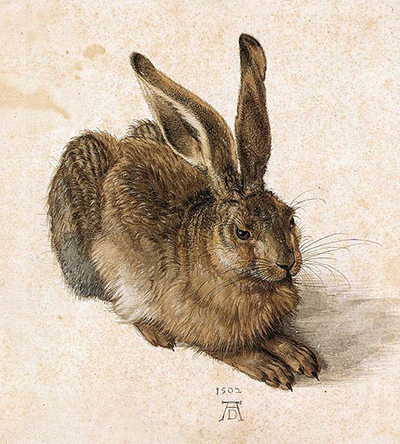
Mid-1490s or c. 1519; disputedYoung Hare
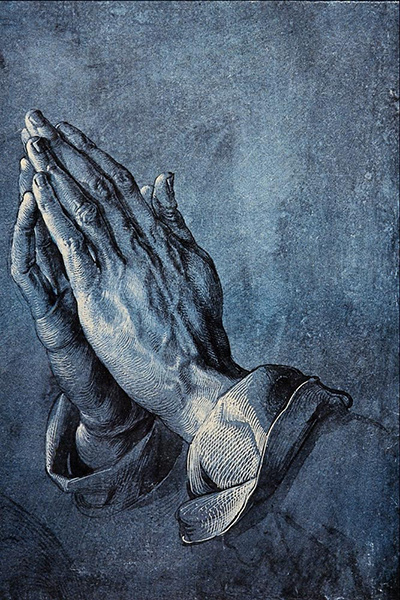
1502Praying Hands
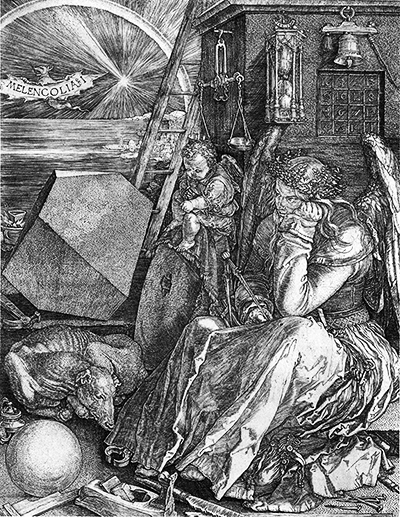
1508Melencolia I
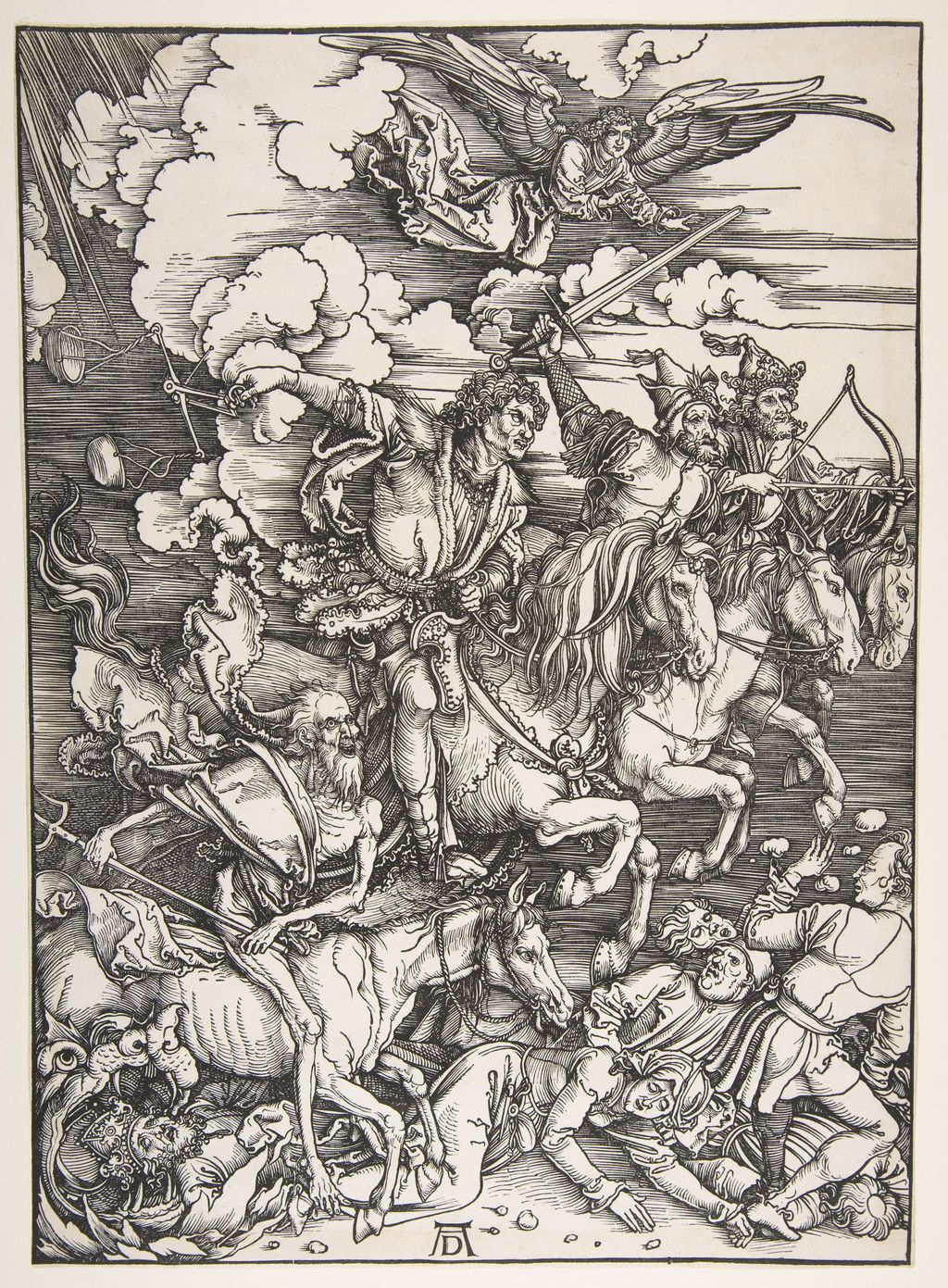
1514Four Apostles
1526Contents
- Following the road
- Where Dürer stood
- Colour, distance and the wide sheet
- An early landscape or a later return?
- A city without a central event
- Frequently Asked Questions
Following the road
The road is the most inviting shape in the painting. Entering the scene from the right, its light surface turns inward and opens into a broader patch below the centre. A narrower route continues uphill towards the skyline. This change in width makes the ground feel traversable: the eye follows a movement that a person could make. Yet there is no prominent traveller to fix the scale or carry a story. The approaching viewer supplies the sense of movement.
The wooden fence on the left helps to measure that journey. Its nearest end is dark, tall and uneven; farther away, the boards shrink into a thin reddish line beneath the trees. The right-hand barrier answers it with longer, flatter horizontal bands. Together the two sides form a loosely enclosed passage, but their different heights prevent the composition from becoming a symmetrical corridor. The way forward curves between them, and small changes of angle keep the eye moving.
Beyond the fence, houses sit across a lower, greener stretch of land. Their light walls and warm roofs are plainly visible, although the rounded foliage nearby makes a much denser mass. The outskirts contain buildings, open ground and vegetation in the same continuous view. The city begins gradually before its fortified edge asserts itself on the right.
Above that edge, steep roofs interrupt the sky at different heights. The nearest pointed tower has a solid reddish presence; the paler buildings towards the centre seem to stand in another layer of air. Dürer does not distribute emphasis evenly across the panorama. He concentrates weight at the sides and leaves an opening near the middle, allowing the route, the distant buildings and the sky to meet there.
Where Dürer stood
The picture concerns the western edge of Nuremberg, especially the relationship between its defences and the land outside. In the 2020 exhibition catalogue Der weite Blick , Ursula Timann places the viewpoint in the Spittlertorgraben, approximately level with the later Fürther Tor. She identifies the ditch wall, outer defensive wall and city-wall towers, including the Schlayerturm and Neutorturm, with the imperial castle appearing in the background. The castle belongs within a broader urban prospect, its distant position subordinate to the buildings and barriers nearer the viewer. [2]
The Virtual Museum of Nuremberg Art gives a further useful correction. The view was formerly described as taken from the Hallerwiese, but its record places the artist outside the Pegnitz outflow. It also draws attention to the embankment on the left, subsequently built over. These details bring the painting down to the level of a particular position beside the city's perimeter. A low viewpoint makes nearby fences and defences rise strongly against the more distant town. [3]
That position shapes what the city can look like. From here, Nuremberg is an uneven succession of roofs and towers behind barriers, with an expanse of sky above it. We encounter its edge before its interior. The road draws us towards the built-up area while the defences cut across our path of vision. The resulting tension is gentle but persistent: the picture offers an approach and, at the same time, makes us aware of enclosure.
Colour, distance and the wide sheet
The work is more than twice as wide as it is high. Its proportions permit a long lateral sweep, but the road repeatedly pulls that sweep into depth. Looking along the skyline and looking towards the city are different movements, and the painting holds them together. The nearest ground acts almost as a shallow platform from which the more distant forms rise.
Colour makes the changes of distance especially legible. In the foreground, dark green and brown areas meet in comparatively abrupt patches. The fence has a strong reddish warmth, while the path remains a pale interruption. Farther away, the range becomes quieter. Greys, muted pinks and bluish tones allow buildings to merge into the surrounding atmosphere without losing their silhouettes. The city is recognisable through a few accents, although much of its fabric is indistinct.
A broad cloud stretches over the left side, balancing the darker concentration of land beneath it. Towards the right, the sky becomes lighter and more open. These passages make the air feel variable across the width of the sheet. They need not be assigned a particular hour or weather event to have an effect: the sky gives the architecture room and connects distant objects which the foreground separates.
The combination of watercolour and opaque colour allows different degrees of coverage within a single work. Here the visual contrast between airy distance and dense foreground is fundamental. Some areas invite us to look through a thin veil of colour; others insist on the surfaces of earth, foliage or timber. A reproduction can convey that broad organisation, though its colour balance should not be treated as a precise record of every original tint. [1]
An early landscape or a later return?
The Bildarchiv Foto Marburg record, updated in March 2026, gives approximately 1494–95. Timann's 2020 catalogue discussion reports Matthias Mende's dating around 1495, while its illustration caption uses 1495–96. These place the watercolour within Dürer's early development. The Virtual Museum of Nuremberg Art, however, now labels it around 1519 and directs readers to Helge Weingärtner's 2022 study. [4] [2] [3]
The study's title makes the question explicit: Dürers Ansicht Nürnbergs mit dem westlichen Vorgelände – ein Spätwerk? , or “Dürer's View of Nuremberg with the Western Foreground—a Late Work?” It is listed in volume 109 of the Mitteilungen des Vereins für Geschichte der Stadt Nürnberg . The regional museum's adoption of the later date is evidence of a changed interpretation; the continuing early date in another current catalogue shows that the change has not produced uniform labelling. [15]
The alternatives affect the story told about the picture. An early date makes its flowing arrangement part of the rapid expansion of Dürer's landscape practice as a young artist. A date around 1519 would make it a mature return to familiar surroundings. Neither reading can be established merely by calling the brushwork free or the atmosphere convincing. Such qualities are visible; their position in a sequence of works requires further evidence.
Winkler's 1936 entry offers a clear example of an earlier approach. He compared the watercolour's colouring and handling with other landscapes, especially the view of Trent and the quarry studies, to propose a relative order within the group. That is an argument about relationships between pictures, rather than an inscribed year on this sheet. Topographical identification and stylistic comparison ask different questions, even when both contribute to dating. The unresolved chronology leaves room for both kinds of inquiry. [1]
A city without a central event
Timann situates the view within a longer history of images of Nuremberg. Her discussion begins with the city appearing behind sacred figures on the Krell altarpiece in St Lorenz and includes the southern view made for the 1493 Nuremberg Chronicle . Dürer's western prospect offers a different kind of encounter. Its foreground is already full of visual incident, although no large religious or ceremonial action occupies it. [2]
This gives ordinary things unusual importance. A broken rhythm of fence boards, a bend in the road and the silhouette of a roof are sufficient to sustain attention. Movement comes from the way shapes overlap and from the changes between exposed light ground and shaded vegetation. Nuremberg remains the named place, but the experience of approaching it is the picture's most immediate subject.
There is also a collecting history behind the familiar image. Winkler records the sheet as formerly in the Grünling collection and then in the Kunsthalle Bremen. The regional museum now describes it as a Bremen war loss in Russia. That wording should be distinguished from a collection attribution in a catalogue: a Bremen collection label does not establish that the original is presently on view there. The image's circulation in reproductions can make it seem more readily accessible than the history of the physical sheet warrants. [1] [3]
The small inscription at the top helps to hold these different experiences together. A name identifies the place, while the broad painted view gives it distance, air and an approach through the outskirts. We can recognise Nuremberg without being supplied with every building in equal detail. The painting asks us to look across the city and to imagine moving towards it, following the pale road until its clear foreground shapes dissolve into the quieter world beyond.
Frequently Asked Questions
Artworks directory
These 187 records include individual works, reverse sides, detail views, paired panels and reconstructed arrangements. Three additional catalogue images repeat works already listed. Related views are not counted as separate originals; qualified attributions and published dating are retained.
Discussion
Look again at the images and ideas explored in View of Nuremberg. These editorial prompts invite your observations.
Reader Insights
Which detail or idea in View of Nuremberg most changed your reading, and why?
How does the discussion of “Following the road” affect your understanding?
What comparison would you bring to the discussion of “A city without a central event”?
Join the Conversation
Share a detail, comparison or question about View of Nuremberg below.
References
- Friedrich Winkler , Die Zeichnungen Albrecht Dürers , vol. I (Berlin, 1936), no. 116, pp. 87–88 and plate 116. German. View source .
- Ursula Timann , “Frühe Ansichten und Panoramen der Stadt Nürnberg,” in Ludwig Sichelstiel, ed., Der weite Blick: Nürnberger Panoramen aus sieben Jahrhunderten (Petersberg: Michael Imhof Verlag, 2020), pp. 13–14. German. View source .
- Förderverein Kulturhistorisches Museum Nürnberg , “Nordwestlicher Altstadtrand,” Virtual Museum of Nuremberg Art, object 960. German. View source .
- Bildarchiv Foto Marburg , “Ansicht Nürnbergs von Westen,” Bildindex, object 20501398, updated 7 March 2026. German. View source .
- ALBERTINA, Selbstbildnis als Dreizehnjähriger, inv. 4839 (German). View source.
- Metropolitan Museum, Four Horsemen from The Apocalypse, 19.73.209 (English). View source.
- Bayerische Staatsgemäldesammlungen, Selbstbildnis im Pelzrock, inv. 537 (German). View source.
- ALBERTINA, Feldhase, inv. 3073 (German). View source.
- ALBERTINA, Das große Rasenstück, inv. 3075 (German). View source.
- Metropolitan Museum, Adam and Eve, 19.73.1 (English). View source.
- ALBERTINA, Betende Hände, inv. 3113 (German). View source.
- Metropolitan Museum, Knight, Death, and the Devil, 43.106.2 (English). View source.
- Metropolitan Museum, Melencolia I, 43.106.1 (English). View source.
- Bayerische Staatsgemäldesammlungen, inventory 545: current collection record (German; descriptive citation). View source.
- Nuremberg City Archive , Mitteilungen des Vereins für Geschichte der Stadt Nürnberg , vol. 109 (2022), contents. German. View source .
- Germanisches Nationalmuseum, Barbara Dürer (German and English). View source.
- Web Gallery of Art, Tucher–Rieter reverse (English). View source.
- National Gallery of Art, Portrait of a Clergyman (English). View source.
- Dürer Art, Portrait of a Man (English). View source.
- Hessen Kassel Heritage, Elsbeth Tucher (German). View source.
- Web Gallery of Art, Hans Tucher (English). View source.
- Germanisches Nationalmuseum, Emperor Maximilian I (German and English). View source.
- National Gallery of Art, Lot and His Daughters, reverse (English). View source.
- Bayerische Staatsgemäldesammlungen, Glim Lamentation (German). View source.
- Museo Nacional del Prado, Portrait of a Man (Spanish). View source.
- Bayerische Staatsgemäldesammlungen, Madonna of the Carnation (German). View source.
- Städel Museum, Job on the Dungheap (German). View source.
- Wallraf-Richartz-Museum, Piper and Drummer (German). View source.
- Italian Ministry of Culture / Uffizi, Head of Saint James (Italian). View source.
- Klassik Stiftung Weimar, Dresden Altarpiece (German). View source.
- Staatliche Museen zu Berlin, Girl with a Red Beret (German and English). View source.
- Dresden State Art Museums / Roland Enke, Bernhard von Reesen (German). View source.
- Royal Collection Trust, Burkhard von Speyer (English). View source.
- Dresden State Art Museums, Seven Sorrows of the Virgin (English). View source.
- Bayerische Staatsgemäldesammlungen, Mater Dolorosa (German). View source.
- Bayerische Staatsgemäldesammlungen, Lucretia (German). View source.
- Städel Museum, Young Woman with Her Hair Down (English). View source.
- ALBERTINA, Portrait of a Young Man (German). View source.