by
Tom Gurney
Tom Gurney BSc (Hons) is an art history expert with over 20 years experience
Published on June 19, 2020 / Updated on October 22, 2026
Email:
tomgurney1@gmail.com
/ Phone:
+44 7429 011000
The Virgin and Child with Saint Anne: Introduction
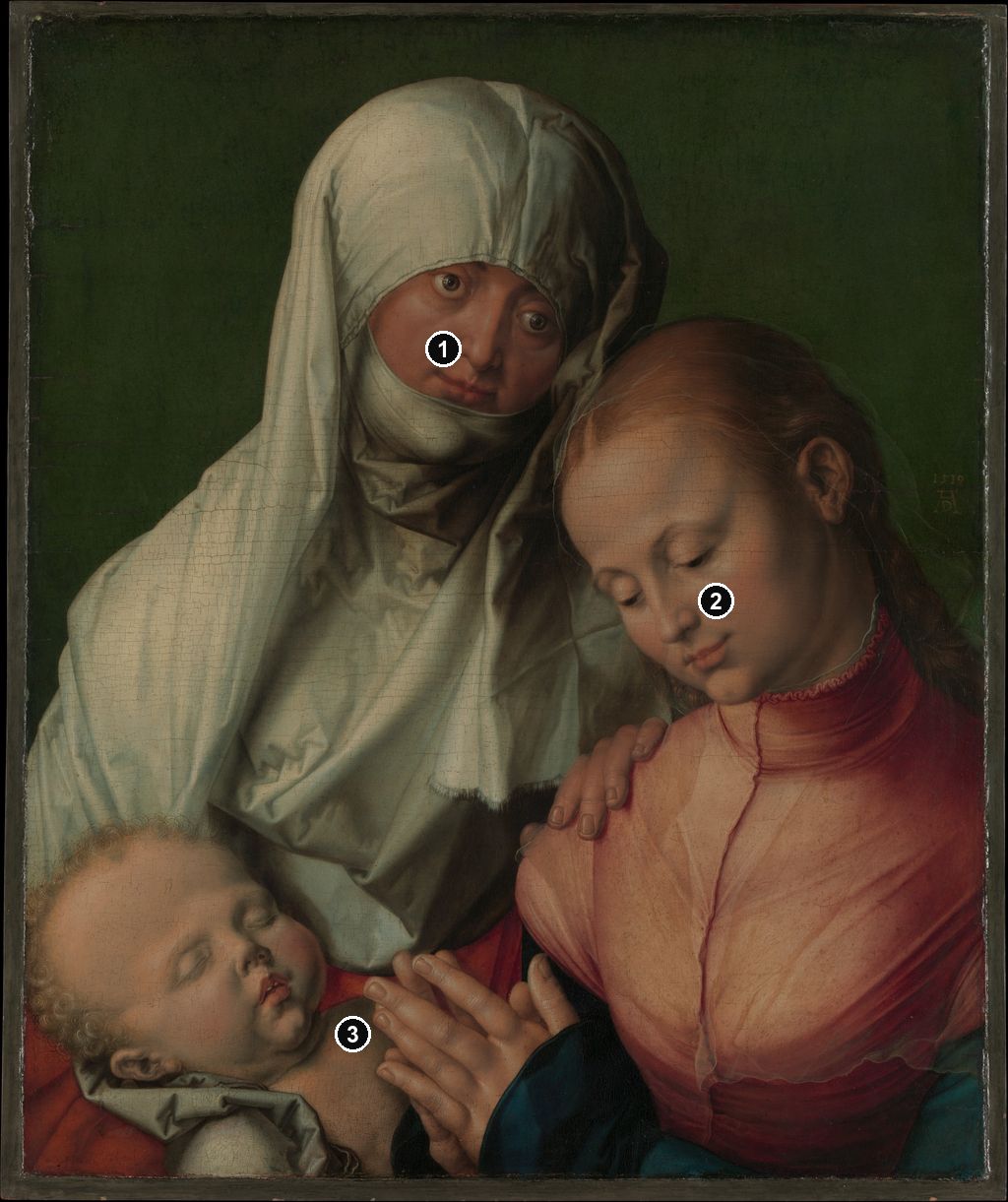
A hand rests on a shoulder, a mother joins her hands, and a baby sleeps. These small actions hold together Albrecht Dürer’s Virgin and Child with Saint Anne . Anne rises behind her daughter Mary, her white headcloth filling much of the upper picture. Mary bends towards Christ at the lower left. The three figures come so close to the edges that their encounter seems to continue just beyond the frame. There is scarcely room for anything except the people and the attention passing between them.
The painting belongs to the Metropolitan Museum of Art in New York. Its current identification is probably 1519, oil on linden, measuring 60 × 49.8 centimetres. It entered the museum through Benjamin Altman’s bequest of 1913. Its small differences of expression and touch reward a slow encounter. [1]
At a Glance
- Current date Probably 1519 [1]
- Medium Oil on linden [1]
- Collection Metropolitan Museum of Art, New York [1]
This work across Albrecht Dürer’s career
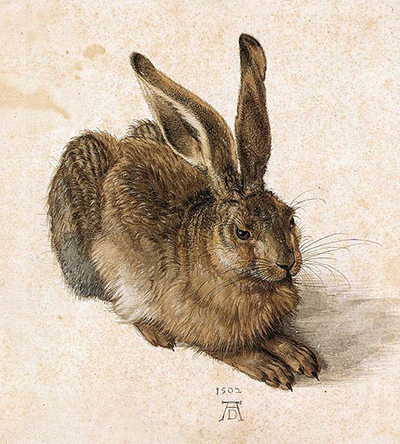
Young Hare
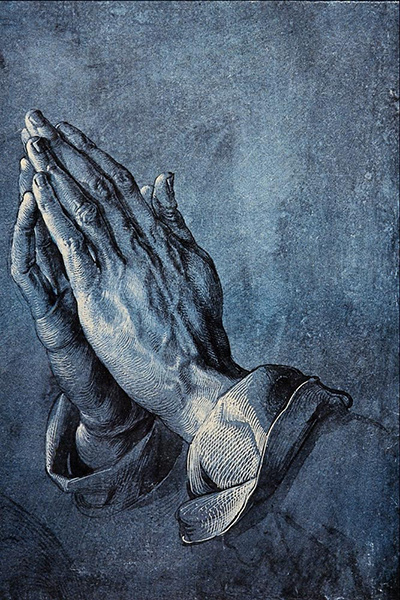
1502Praying Hands
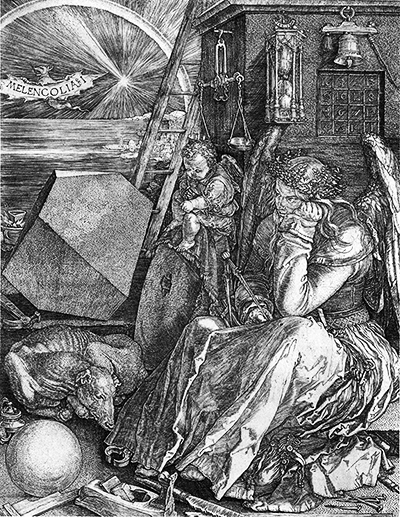
1508Melencolia I
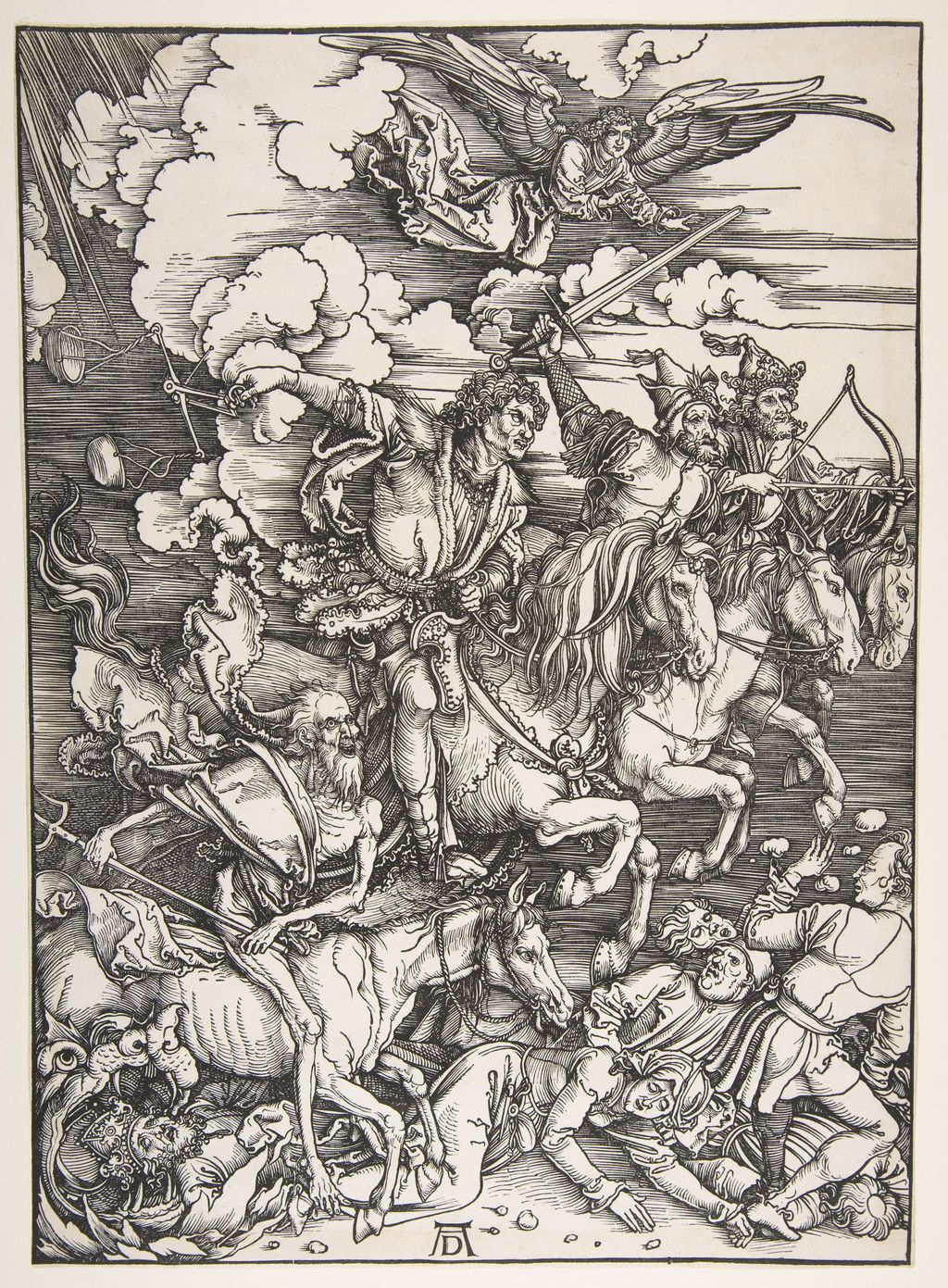
1514Four Apostles
1526Contents
- Three generations brought close
- Anne, Mary and the sleeping Child
- Agnes Dürer and the making of Saint Anne
- A panel with a complicated history
- Frequently Asked Questions
Three generations brought close
Anne’s head occupies the highest point of an uneven triangle. Mary’s head falls below and to the right, while Christ’s tilted face completes the descent at the left. This arrangement establishes the family relationship without separating the figures into three compartments. Anne’s enveloping cloth extends behind both younger figures; her hand crosses onto Mary’s shoulder. Mary’s joined hands approach the Child, drawing the eye across the bottom of the painting. The group is stable, but its stability comes from these interlocking forms and gestures.
The green background offers little sense of a room. It supplies a dark field against which faces and fabrics become exceptionally clear. Anne’s white covering spreads broadly through the left side; Mary’s rose-coloured garment fills the right. Blue at the lower edge introduces a deeper, cooler note beside the warm flesh and red fabric. The colours give each figure a distinct place while remaining part of one compact arrangement. A narrow interval of green above Mary’s hair is enough to make her bowed head stand forward.
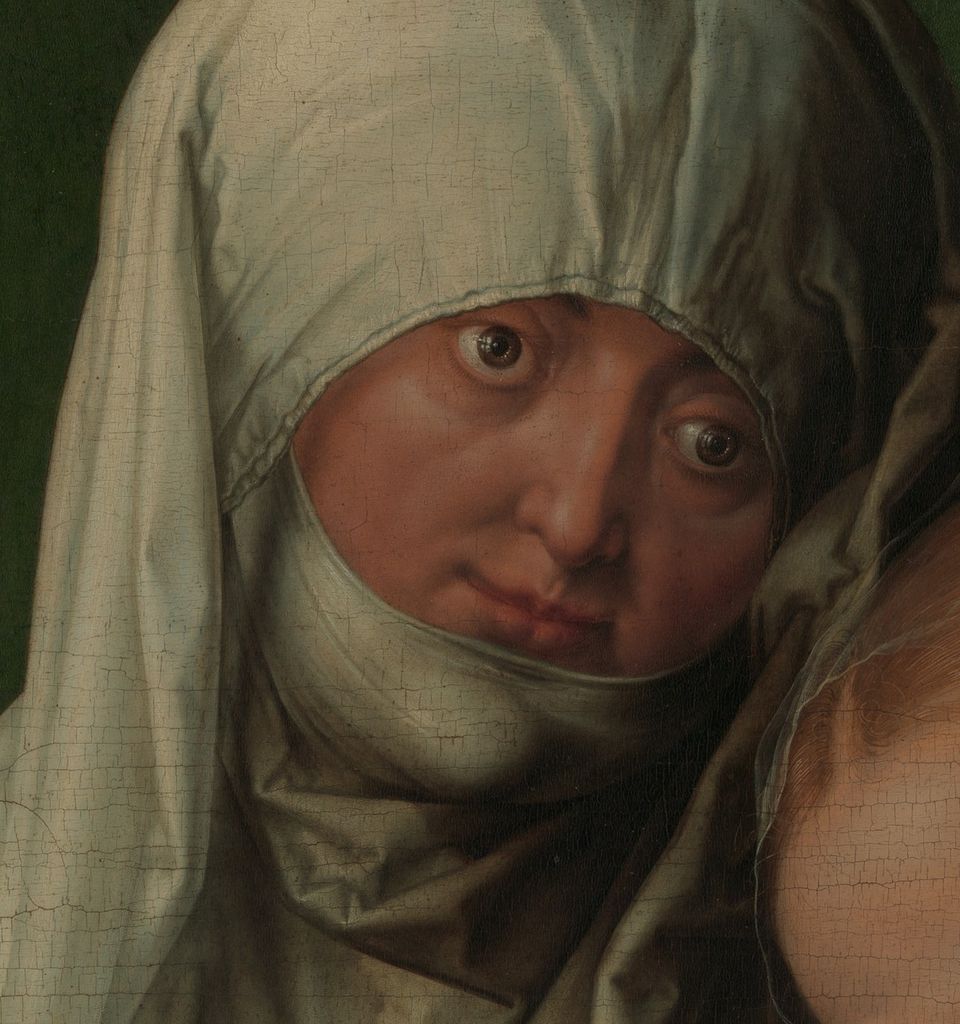
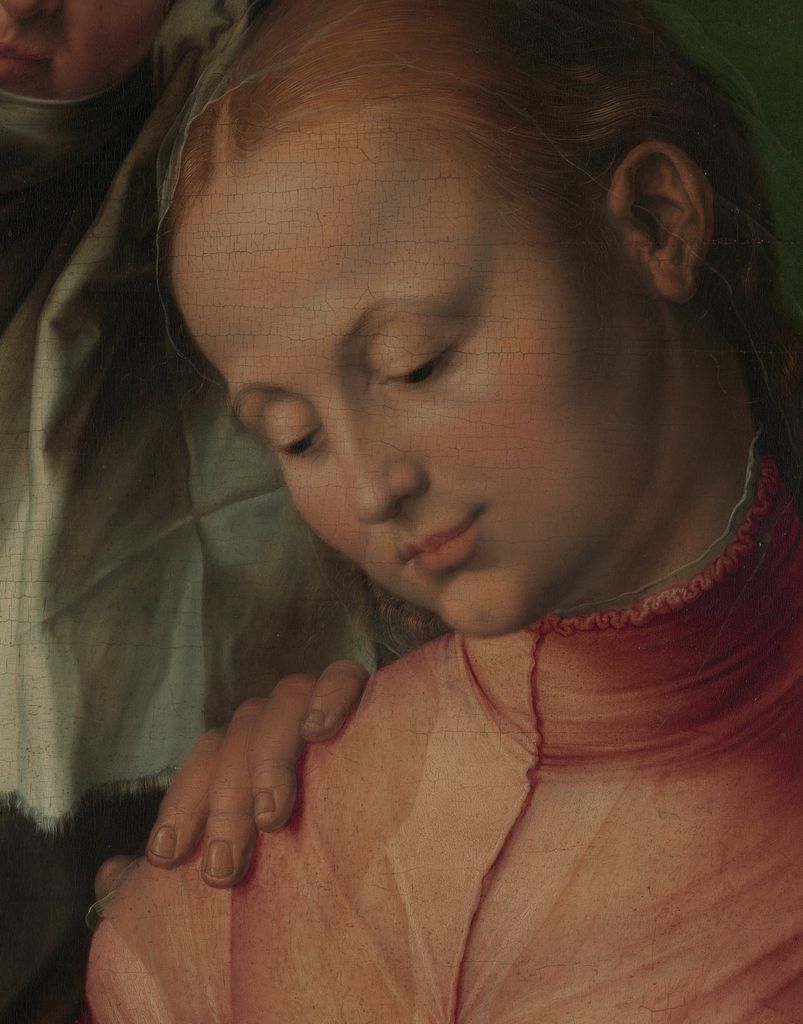
The two women’s clothing also shapes the difference between them. Anne’s face is enclosed: cloth passes across her forehead, along her cheeks and beneath her chin. The folds widen around her shoulders, giving her the largest silhouette. Mary’s reddish hair remains exposed around the ear and at the back of her head. A fine, translucent veil lies across her upper body, through which the stronger colour beneath is visible. One woman appears sheltered within heavy folds; the other is revealed through a delicate surface that catches the light.
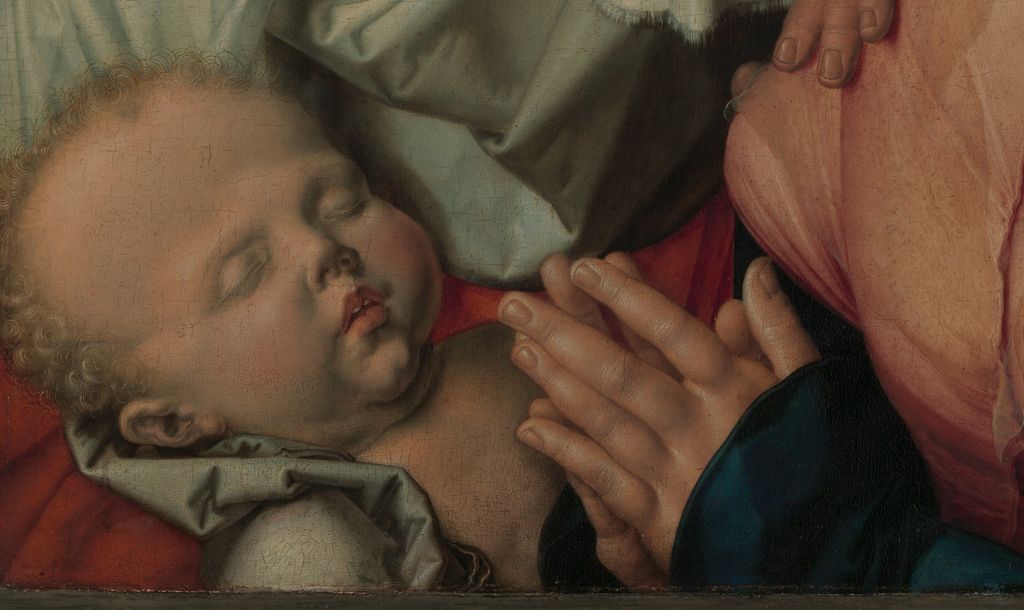
Small details prevent these broad colour areas from becoming flat. Anne’s head covering has seams, shallow creases and deeper angular folds. Light catches her fingertips where they rest on the shoulder. Mary’s hands overlap without becoming a simple symmetrical emblem: individual fingers turn at slightly different angles. Christ’s curls, parted lips and rounded cheek bring an equally particular presence to the lowest corner. The painting allows us to recognise a family group immediately, then keeps drawing us back to the physical particulars of each person.
The eyes establish three different kinds of stillness. Christ’s are closed. Mary looks down, her eyelids lowering the direction of her attention towards him. Anne’s eyes remain open and look outward, away from the intimate exchange below. She therefore connects the enclosed group with a space beyond it, even though her gaze does not directly meet ours. Her hand gives her an immediate physical connection with Mary while her eyes suggest a more distant train of thought.
The Met interprets that gaze as anticipation of Christ’s Passion and the hand on Mary’s shoulder as consolation. This reading makes the gesture unusually tender: Anne steadies the daughter whose sleeping child will suffer. The baby’s slack mouth and backward-tilted head can then carry two meanings at once, ordinary sleep and an intimation of death. The mother’s prayer remains quiet, with no visible crisis to interrupt it. [1]
Anne, Mary and the sleeping Child
The family relationship reaches back into Christian stories about Mary’s own childhood. In the apocryphal Protoevangelium of James , Anna and Joachim grieve because they have no child. An angel announces that Anna will conceive; she promises to dedicate the child to God. The girl is born and named Mary. Later Anna prepares a protected space for her at home, and the parents eventually bring her to the Temple. These episodes supply a narrative identity for Mary’s mother, placing Christ’s birth within an earlier history of prayer, parenthood and dedication. [12]
That text is an ancient Christian work outside the New Testament canon. As the biblical scholar Ursula Ulrike Kaiser explains, its actual author is unknown, despite its presentation of James as narrator. Dürer’s picture does not illustrate one episode from its opening chapters. It gathers the successive generations into a shared devotional presence. The adult Mary can be both a daughter receiving her mother’s touch and a mother praying before her own child. That double relationship gives the picture much of its emotional density. [13]
The German name is Anna Selbdritt : Anne in a group of three. Earlier versions could reduce Mary to a child-sized figure; here she has adult proportions. Dürer had addressed it in a small engraving around 1500, a separate work represented by impressions in both New York and Nuremberg. In the engraving, the women stand facing one another, with the Child held between them; God the Father and a dove appear above. The figures’ full lengths and the open interval between their bodies let us follow the encounter as an exchange across space. In the later painting, faces, cloth and hands nearly fill the field. The older woman’s presence spreads behind the younger, and bodily closeness carries the subject. [14] [15] [16]
The Met connects the later picture’s Venetian character with Dürer’s experience in Italy during 1505–07. Its German-language commentary proposes Giovanni Bellini as a likely stimulus for Mary contemplating the sleeping Christ. The suggestion helps explain the concentration on a few large, quietly modelled forms. Sleep slows the whole composition: every movement seems adjusted to the vulnerable body below. [1] [17]
Annotated Details from The Virgin and Child with Saint Anne
Follow the folds around Anne’s face, the hand resting on Mary’s shoulder and the sleeping Child below.
Details from THE VIRGIN AND CHILD WITH SAINT ANNE
Open the details to compare the closely gathered faces, fingers and fabrics.
Anne’s face within the white folds
The white head covering surrounds the exposed face with several layers of cloth. Narrow folds gather beside the cheek and turn beneath the chin, setting pale edges against softer shadows.
A lowered face and a hand on the shoulder
Mary lowers her eyes towards the Child. Behind her neck, a hand rests across the shoulder; its separate fingers stand against the broad pink area of the dress.
The sleeping Child and the joined hands
The Child’s head leans back on the folded cloth, with closed eyes and slightly parted lips. Beside him, Mary’s joined hands form a rising diagonal above the dark blue cuff.
Agnes Dürer and the making of Saint Anne
A surviving study makes the painting’s development unusually tangible. The ALBERTINA in Vienna owns Agnes Dürer as Saint Anne , dated 1519, a brush drawing in grey, black and white on stone-grey prepared paper, 39.5 × 29.2 centimetres. The museum identifies Agnes, Dürer’s wife, as the model and explains that spaces were left for Mary and Jesus from the outset. The sheet already anticipates a group, although it concentrates on one figure. [18]
Looking between drawing and painting reveals how much the headcloth contributes. In both, it rises above the skull and broadens over the shoulders; the opening frames a small face within a much larger pale form. The drawing’s folds cascade through the torso, giving the fabric an independent structure even where the remaining figures have yet to appear. With colour absent, the contrast of light cloth and dark ground becomes especially emphatic. The face seems to emerge from within that structure.
The painted Anne has a smoother, more rounded face than the drawn sitter. The nose is less irregular and the mouth more softly contained. Her eyes also have a less direct address. Those changes make the comparison more revealing than a simple identification of Agnes’s likeness. A person studied in the workshop has become a figure within a carefully coordinated religious encounter. The painting preserves the convincing weight of an observed head and its covering while changing the way that face participates in the scene. [18]
Agnes’s contribution as model brings everyday observation into contact with sacred imagery. The supporting hand then supplies a connection between Anne and Mary that the isolated study cannot show.
A panel with a complicated history
Examination records horizontal wood grain, thinning, reinforcement and added edges; the original painted surface measures 58.2 × 48.4 centimetres. The catalogue separates that painted area from the larger overall panel. The paint is generally well preserved. Infrared examination found slight changes to hand contours. Glazes bear marks of the painter’s hand, while the copper-green background has probably browned. [14]
The visible date and monogram contain industrially manufactured pigments indicating addition after 1850. Nevertheless, 1519 was recorded in 1630 and agrees with the preparatory study. An inscription’s age and a painting’s date can therefore require separate judgments. [14]
Probably commissioned by Leonhard I Tucher, the picture passed through Tucher descendants to Hans von Furtenbach in settlement of a debt, then to Maximilian of Bavaria in 1630. Sold from the Bavarian collection in 1852, it resurfaced with Entres, later passing through Kuris and Duveen to Altman. [14]
Maximilian initially rejected it; Entres’s 1854 display revived dispute. Waterman reports Claus Grimm’s 2002 workshop proposal but defends Dürer’s authorship using contemporary comparisons and technique. The Met currently attributes it to Dürer. [14] [1]
Frequently Asked Questions
Artworks directory
These 187 records include individual works, reverse sides, detail views, paired panels and reconstructed arrangements. Three additional catalogue images repeat works already listed. Related views are not counted as separate originals; qualified attributions and published dating are retained.
Discussion
Look again at the images and ideas explored in The Virgin and Child with Saint Anne. These editorial prompts invite your observations.
Reader Insights
Which detail or idea in The Virgin and Child with Saint Anne most changed your reading, and why?
How does the discussion of “Three generations brought close” affect your understanding?
What comparison would you bring to the discussion of “A panel with a complicated history”?
Join the Conversation
Share a detail, comparison or question about The Virgin and Child with Saint Anne below.
References
- Metropolitan Museum of Art , Virgin and Child with Saint Anne , 14.40.633, current collection record and commentary. View source .
- ALBERTINA, Selbstbildnis als Dreizehnjähriger, inv. 4839 (German). View source.
- Metropolitan Museum, Four Horsemen from The Apocalypse, 19.73.209 (English). View source.
- Bayerische Staatsgemäldesammlungen, Selbstbildnis im Pelzrock, inv. 537 (German). View source.
- ALBERTINA, Feldhase, inv. 3073 (German). View source.
- ALBERTINA, Das große Rasenstück, inv. 3075 (German). View source.
- Metropolitan Museum, Adam and Eve, 19.73.1 (English). View source.
- ALBERTINA, Betende Hände, inv. 3113 (German). View source.
- Metropolitan Museum, Knight, Death, and the Devil, 43.106.2 (English). View source.
- Metropolitan Museum, Melencolia I, 43.106.1 (English). View source.
- Bayerische Staatsgemäldesammlungen, inventory 545: current collection record (German; descriptive citation). View source.
- Protoevangelium of James , chapters 1–7, translated by Alexander Walker in Ante-Nicene Fathers , vol. 8 (1886), text at New Advent. View source .
- Ursula Ulrike Kaiser , “Protevangelium des Jakobus”, WiBiLex , October 2020, sections 1–2 and 4.1–4.2. German. View source .
- Joshua P. Waterman , “Virgin and Child with Saint Anne,” cat. 25, in Maryan W. Ainsworth and Joshua P. Waterman, German Paintings in The Metropolitan Museum of Art, 1350–1600 (2013), pp. 113–117, technical notes and endnotes 1–46, pp. 297–298. View source .
- Metropolitan Museum of Art , The Virgin and Child with the Infant Christ and Saint Anne , 19.73.36, engraving, about 1500. View source .
- Germanisches Nationalmuseum , Die heilige Anna und Maria mit dem Kinde, stehend (Die Heilige Anna Selbdritt) , StN2092, collection record and image. German. View source .
- Metropolitan Museum of Art , Jungfrau und Kind mit der Heiligen Anna , collection commentary. German. View source .
- ALBERTINA , Agnes Dürer als heilige Anna (Vorzeichnung für die “Hl. Anna Selbdritt”) , 3160, collection record, catalogue text and image; record edited 24 January 2025. German and English. View source .
- Germanisches Nationalmuseum, Barbara Dürer (German and English). View source.
- Web Gallery of Art, Tucher–Rieter reverse (English). View source.
- National Gallery of Art, Portrait of a Clergyman (English). View source.
- Dürer Art, Portrait of a Man (English). View source.
- Hessen Kassel Heritage, Elsbeth Tucher (German). View source.
- Web Gallery of Art, Hans Tucher (English). View source.
- Germanisches Nationalmuseum, Emperor Maximilian I (German and English). View source.
- National Gallery of Art, Lot and His Daughters, reverse (English). View source.
- Bayerische Staatsgemäldesammlungen, Glim Lamentation (German). View source.
- Museo Nacional del Prado, Portrait of a Man (Spanish). View source.
- Bayerische Staatsgemäldesammlungen, Madonna of the Carnation (German). View source.
- Städel Museum, Job on the Dungheap (German). View source.
- Wallraf-Richartz-Museum, Piper and Drummer (German). View source.
- Italian Ministry of Culture / Uffizi, Head of Saint James (Italian). View source.
- Klassik Stiftung Weimar, Dresden Altarpiece (German). View source.
- Staatliche Museen zu Berlin, Girl with a Red Beret (German and English). View source.
- Dresden State Art Museums / Roland Enke, Bernhard von Reesen (German). View source.
- Royal Collection Trust, Burkhard von Speyer (English). View source.
- Dresden State Art Museums, Seven Sorrows of the Virgin (English). View source.
- Bayerische Staatsgemäldesammlungen, Mater Dolorosa (German). View source.
- Bayerische Staatsgemäldesammlungen, Lucretia (German). View source.
- Städel Museum, Young Woman with Her Hair Down (English). View source.
- ALBERTINA, Portrait of a Young Man (German). View source.
- Splash image , Albrecht Dürer, The Virgin and Child with Saint Anne, probably 1519. Metropolitan Museum of Art, 14.40.633. Bequest of Benjamin Altman, 1913. Public domain. Image source . Public domain .