 by Tom Gurney
Tom Gurney BSc (Hons) is an art history expert with over 20 years experience
Published on June 19, 2020 / Updated on October 14, 2023
Email: tomgurney1@gmail.com / Phone: +44 7429 011000
Philip IV in Armour: Introduction
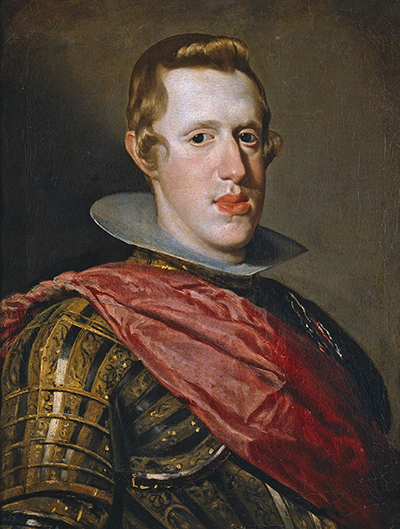
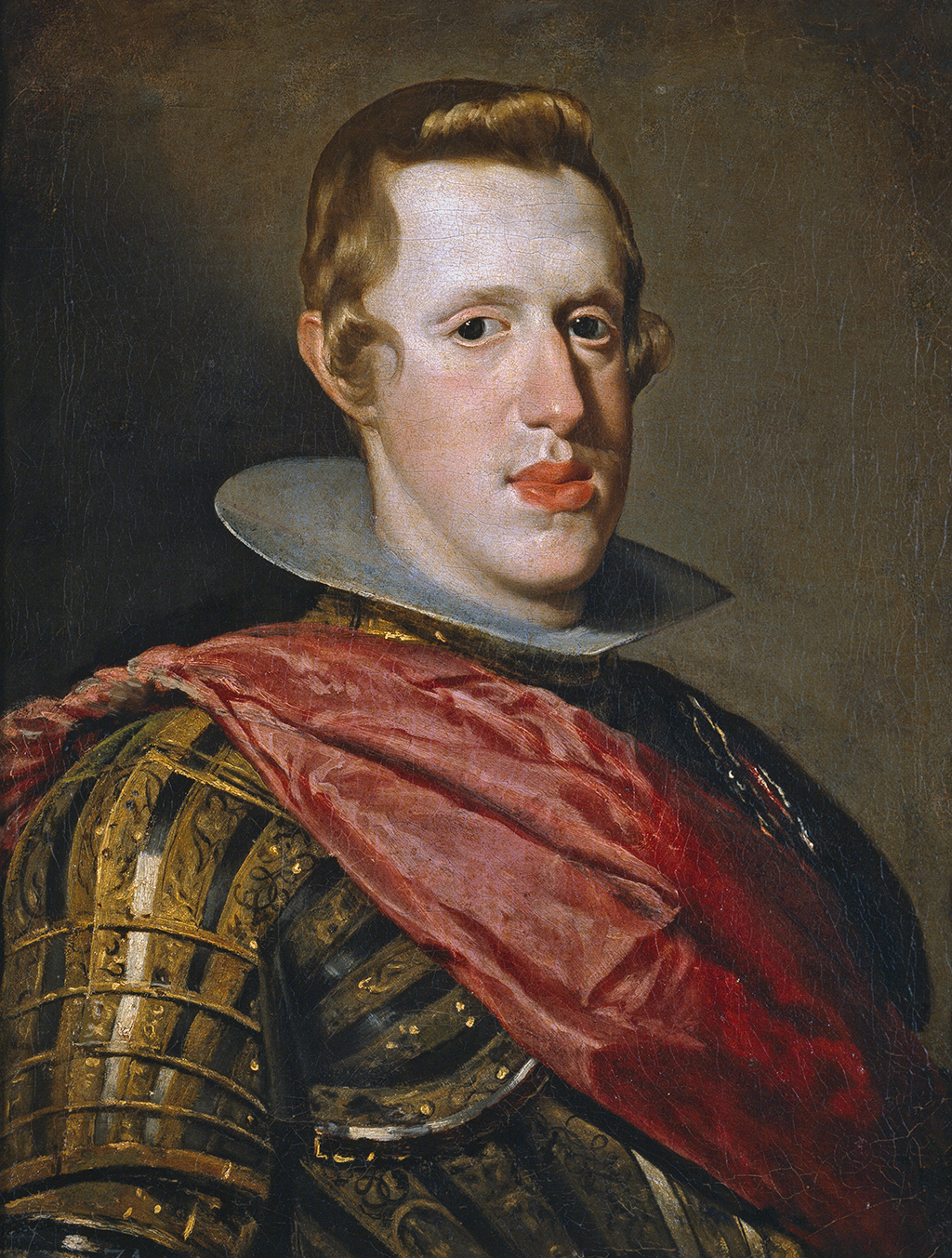
A narrow light runs down Philip IV’s armoured shoulder before the red sash crosses it. It picks out several overlapping plates in succession, then breaks up into specks along the lower curves of the breastplate. Higher up, a pale line on the edge of the collar makes a much longer, quieter curve. It runs under the king’s chin and sets his face apart from the cloth and metal below. The nearer shoulder fills the bottom left of the picture, but the head has room on either side. In a canvas little more than half a metre high, the king’s gaze can hold its own against the richest things he is wearing. [1]
This is the young Philip IV in the Museo Nacional del Prado’s Felipe IV, P001183, commonly called Philip IV in Armour. The Prado’s 1990 exhibition catalogue gives the oil on canvas as 57 × 44 cm, and the museum’s report on its 2017 exhibition dates this armoured bust to around 1628 and names Diego Velázquez as its painter. The small canvas that we see today survives from a larger painting. Its dimensions describe what reached the museum, while the proportions of the original figure remain a question. [1] [2]
At a Glance
- CollectionMuseo Nacional del Prado, P001183 [1]
- PaintedAround 1628 [2]
- Surviving formatOil on canvas, 57 × 44 cm [1]
The armoured bust and related likenesses
The early full-length likeness
From about 1623 [3]Portús connects the bust’s face to the Prado portrait P001182.
Philip IV with a lion
Around 1652 [8] [9]The separate full-length portrait was later revised for El Escorial.
Contents
- The face above the armour
- When did Velázquez paint it?
- Three later likenesses of Philip
- The bust in the royal collection
The face above the armour
The body presents its nearer shoulder on the left as we see it. The face turns far enough towards us to bring both eyes into view. Light spreads across the forehead, warms as it descends through the lit cheek and turns quickly to shadow beside the nose. The eye on the darker side still has a pale rim and a catchlight. Let your gaze follow the nose down to the mouth and the face seems to turn again. One end of the lips disappears into the shadow, while small red and pink changes across their surface suggest how the lower lip curves forward. These changes of tone give the relatively still face a sense of volume that can be read from across the room. [1] [3]
The collar, a flat golilla, reaches well beyond the cheek on the left and comes to a point against the far shoulder. Its lit side opens like a shallow oval, while the other side takes the shadow of the head. That shadow helps fix the chin a little in front of the collar’s plane. The lower rim forms a clear line where it passes above the sash, then loses its brightness as it travels into the background. Above it, little glints pick out the swept hair at the forehead and the curl beside the near ear. Velázquez gives the head some firm edges, such as the boundary along the lit cheek, and lets others soften. The far side of the cheek remains legible through the eye, the mouth and the narrow passage of light at the tip of the nose. [1] [3]
Javier Portús sets Velázquez’s flat collars in the context of the dress reforms at the start of Philip’s reign. Regulations issued in 1623 prescribed a simpler, cheaper form of collar in place of the ruff. In the bust, that restrained form sits above richly decorated armour. This gives the eye two quite different surfaces to reckon with. The broad grey of the collar receives soft shadow, while the shoulder plate catches much smaller lights. The gold-coloured ornament follows the shape of the metal. Its upright strokes bend with the shoulder, and the lines between its horizontal plates divide a single glint into several steps. On the sash, ridges broaden and fade into the surrounding red. The fabric falls across the metal with enough slack to fold over itself, even as its diagonal keeps the torso turned across the picture. [1] [3]
In a Prado technical study, Jaime García-Máiquez and María Dolores Gayo draw a comparison between the grey-blue paint of the collar in Velázquez’s likeness of Philip III and similar pigment blends in the armoured portrait of Philip IV. In the father’s collar a microsample combined lead white, a black thought to be lamp black and a few grains of a blue pigment. The authors compare that mixture with the armoured portrait and observe that a similar visible grey in a painting by Juan Bautista Maíno was obtained with different materials. The comparison gives some purchase on a surface easily overlooked between the red sash and the face. Paint that reads as grey can carry enough colour to hold its own beside the shadow of the jaw. [4]
When did Velázquez paint it?
The 1990 catalogue records that when the canvas was lined in 1923, it was found to be a fragment of a larger support. It also distinguishes between the careful modelling of the face and the more freely painted sash and gold decoration. The catalogue discusses a sequence in which the head preceded the cuirass and sash, and reports radiographic evidence cited by the scholar Pier Maria Bardi for an earlier appearance of the face. It records earlier proposals around 1625 alongside a Prado catalogue’s suggestion that the work was being painted in September 1628. The Prado’s 2017 exhibition catalogue illustrates the exact bust as about 1627–28. The earlier estimates and the later dating belong to a discussion of how the canvas was made and revised, with the museum’s 2017 activity report giving the finished likeness an approximate date around 1628. [1] [2] [3]
Portús identifies a particular source for the face. In his account, the likeness in the armoured bust was traced from Velázquez’s full-length standing Philip IV, Prado P001182, first painted about 1623–24 and reworked several years later. That painting and its revisions have their own dates. A court painter could reuse the proportions of the face and still change how the king was presented. In the standing portrait, dark civilian dress gives the pale areas of the face and collar particular force. Here the sash introduces a large area of warmth immediately under the chin, and the highlights on the plate give the turned torso a presence of its own. The connection between the canvases lets us look at what survives a change of clothing and what the painter has to establish afresh. [3]
The fact that the canvas was cut also explains an older line of inquiry. Pedro de Madrazo suggested that the fragment might come from the lost early portrait of Philip on horseback. The 1990 catalogue weighs the turn of the body and the line of the breastplate against details it would have expected in an equestrian likeness, including a hat. The early equestrian portrait was exhibited in Madrid in 1625, according to the records studied by Héctor Ruiz Soto. The youthful face and painted armour are compatible with the period. The surviving rectangle gives us no horse, reins or setting to establish its original format. The Prado’s familiar later Equestrian Portrait of Philip IV survives as its own canvas, P001178. There, the figure’s profile, the movement of the sash and the raised forelegs of the horse make the exercise of command visible across the full width of a landscape. In P001183 we see the metal and sash close enough to follow their surfaces. The particular occasion and first setting remain open. [1] [5]
Three later likenesses of Philip
The Frick Collection’s King Philip IV of Spain was painted in 1644 in Fraga, during the campaign that included the siege of Lérida. The portrait reaches low enough to show Philip handling a baton and a hat. The red and silver of his campaign dress spread across the torso, where the smaller Prado bust gives the red a single heavy diagonal over the rigid outline of the shoulder. The Frick’s historical account traces the picture to a thanksgiving service in Madrid that August. That display has documentary support specific to the 1644 portrait. In the early bust, the sash and armour convey military rank through what the king wears. [1] [6]
In London’s Philip IV of Spain, NG745, which the National Gallery dates to about 1656, the head again takes up much of the canvas. The levels of light are differently distributed. The dark clothes almost join the background and the chain of the Golden Fleece appears as a few flashes. Light on the eyelids, cheeks and greying hair can keep the eye near the face for a long time. The armoured bust has more interruptions. The pale collar redirects the eye along the broad slash of red and the lit ridges of plate bring it round to the shoulder. London’s gallery documents copies used as gifts and the likeness’s translation into an engraving by Pedro de Villafranca for a book on El Escorial in 1657. [1] [7]
The Prado’s full-length Philip IV in Armour, with a Lion at His Feet, P001219, gives the breastplate, baton, boots and lion room to articulate a royal presence from head to foot. The Prado credits Velázquez and his workshop. Portús links the face visible today to a separate late Prado bust, P001185, which he dates around 1654, and identifies a revision in 1665 when the full-length picture was destined for El Escorial. The late Prado prototype and the London portrait thus illuminate two ways a royal face could circulate. One informed a revision to a large painted figure in armour. The other provided a likeness that could be engraved and repeated. The young king in P001183 belongs to the earlier episode discussed by Portús, when a face established for a standing portrait in dark clothes could be carried over into armour. [1] [3] [7] [8] [9]
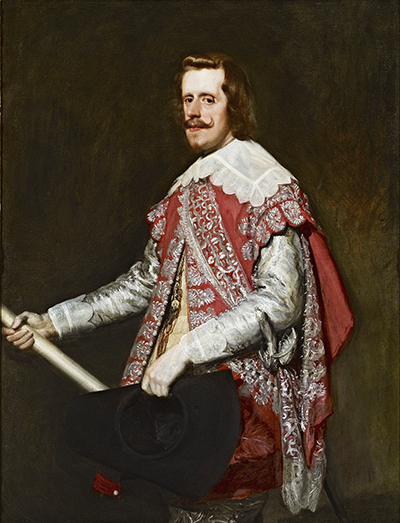
King Philip IV of Spain. The Fraga likeness makes a separate comparison for the king’s head and the treatment of his campaign clothes. View King Philip IV of Spain (1644).
The bust in the royal collection
The 1990 catalogue records the bust in the royal collection at the Quinta del Duque del Arco in 1794. In 2017 the Prado hung it on the same wall as Pedro Antonio Vidal’s portrait of Philip III, Velázquez’s likeness of that king and Velázquez’s Infante Don Carlos, P001188. The grouping gave a viewer the chance to see how painters working for successive reigns handled the shape and light of a face. The profile of Philip IV’s shoulder and the width of his sash can give the present fragment the immediate weight of a much larger figure. Beside portraits of his father and brother, the turn of the cheek above that sharp-edged collar offers a smaller and more particular measure of the painter’s work. [1] [2] [3]
Artworks directory
Frequently Asked Questions
Museo Nacional del Prado, P001183 [1]
Around 1628 [2]
Oil on canvas, 57 × 44 cm [1]
Discussion
Look again at the images and ideas explored in Philip IV in Armour. These editorial prompts invite your observations.
Reader Insights
Where does the collar draw your eye away from the armour?
How would the fragment’s composition read differently if the original canvas extended below it?
Join the Conversation
Share a detail, comparison or question about Philip IV in Armour below.
References
- Museo Nacional del Prado, Velázquez (Madrid, 1990), cat. 15, Felipe IV, pp. 122–123, accession P001183. See also cat. 38, P001178, and cat. 72, P001219. Spanish. View catalogue. View source.
- Museo Nacional del Prado, Memoria de Actividades 2017, ‘Velázquez. Retrato de Felipe III. Donación de William B. Jordan a American Friends of the Prado Museum’. Spanish. View report. View source.
- Javier Portús, ‘The Portrait of Philip III. Velázquez at a Crossroads’, in Velázquez’s Philip III. Donated by William B. Jordan (Museo Nacional del Prado, Madrid, 2017), pp. 27–35, especially p. 33 and fig. 28, P001183. View catalogue. View source.
- Jaime García-Máiquez and María Dolores Gayo, ‘Notes on a Sketch. Philip III and Technical Data on Velázquez’, in Velázquez’s Philip III. Donated by William B. Jordan (Museo Nacional del Prado, Madrid, 2017), pp. 53–54 and p. 59 n. 18. View technical study. View source.
- Héctor Ruiz Soto, ‘“Yo, a quien cabe tanta parte de su felicidad”. Pacheco, Velázquez y el retrato ecuestre perdido de Felipe IV’, Atlante 20 (2024). Spanish. View article. View source.
- The Frick Collection, The King at War: Velázquez’s Portrait of Philip IV, ‘History and Function’, collection accession 1911.1.123. View exhibition account. View source.
- The National Gallery, London, Philip IV of Spain, NG745. View collection record. View source.
- Museo Nacional del Prado, Charles II in armour, collection essay discussing Philip IV in armour, a lion at his feet, P001219, as a precedent. View collection essay. View source.
- Javier Portús, Velázquez y el último retrato de Felipe IV (Museo de Bellas Artes de Bilbao), pp. 7–10, especially p. 9, on Prado P001185 and P001219. Spanish. View essay. View source.