 by
Tom Gurney
Tom Gurney BSc (Hons) is an art history expert with over 20 years experience
Published on June 19, 2020 / Updated on October 30, 2026
Email:
tomgurney1@gmail.com
/ Phone:
+44 7429 011000
The Bromley Children by Ford Madox Brown: Introduction
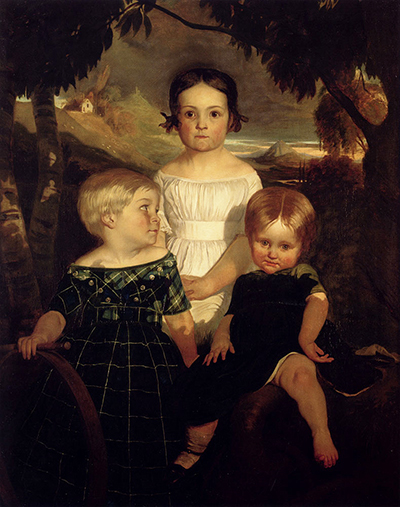
Three children occupy a sheltered opening beneath dark trees. The tallest stands at the centre in a white dress, facing out with an unusually steady gaze. One smaller child turns towards this central figure; the other sits at the right, looking towards us with a bare foot hanging into the foreground. Their closeness makes the group feel intimate, yet the carefully arranged landscape gives this family portrait something of the gravity of a larger ceremonial picture.
In The Bromley Children , Ford Madox Brown combines individual faces with a composition that holds them firmly together. Looking at the painting means noticing both: the shared enclosure of the three figures and the different ways each child inhabits it.
At a Glance
- Artist Ford Madox Brown.
- Date Probably 1844; the inscribed date is uncertain. [1]
- Medium and size Oil on canvas, 127 × 101 cm. [1]
- Subject Three children of Brown’s Bromley relatives. [1]
This work across Ford Madox Brown’s career
Manfred on the Jungfrau
1841; retouched 1861The Bromley Children by Ford Madox Brown (current article)
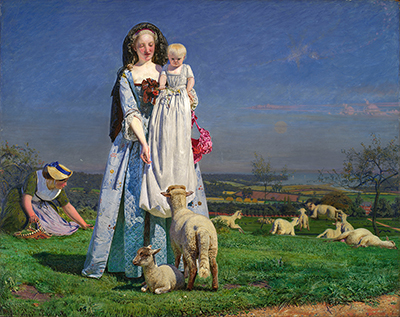
Probably 1844; catalogue discusses an older 1843 attributionPretty Baa-Lambs
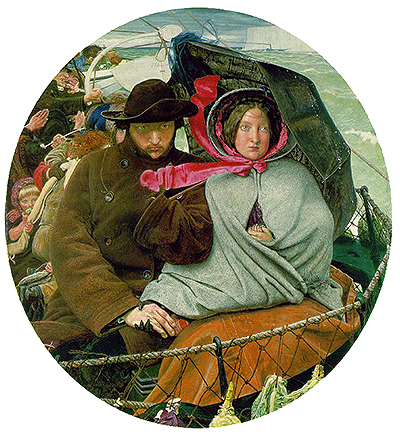
1851–1859The Last of England
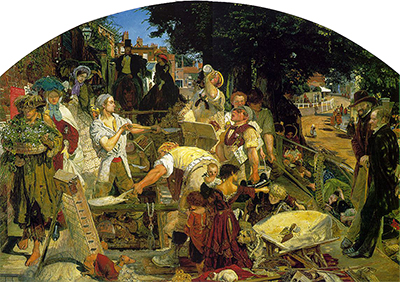
1852–1855Work
1852–1865King René’s Honeymoon
Tate watercolour, 1864Manchester Murals
1878–1893Contents
- Three children, three different presences
- Trees, light and a distant world
- An early portrait with an uncertain date
- Brown’s continental education
- Beside The Bromley Family
- A portrait preserved within the family
Three children, three different presences
The central child gives the picture its upright axis. The face is almost frontal, the shoulders level and the white dress broadly symmetrical. Its gathered neckline, wide waistband and soft folds introduce variations within that simple shape. Against the surrounding brown and green, the dress becomes the brightest large area in the composition. The eye returns to it even after wandering towards the smaller faces or the distant landscape.
The child at the left is more mobile in appearance. The head turns inward, while one hand rests on the hoop at the edge of the picture. A dark dress patterned with a yellow-green grid spreads across much of the lower left. Its intersecting lines make that part of the painting visually busy, contrasting with the central figure’s plain white clothing. The turn of the face also supplies a direction for our own looking: from the outer edge back towards the middle.
At the right, the seated child answers the central figure’s outward gaze, but with a very different posture. The head is slightly lowered; the dark clothing blends into the shadows around the seat. The pale legs become especially conspicuous against this darkness. A bare foot extends downwards, breaking the more formal arrangement above.
Brown has not made three interchangeable examples of childhood. The central stillness, the sideways attention on the left and the compact, uneven pose on the right give the portrait its variety. Nor does the connection between the figures depend on their all looking at the same thing. Their bodies overlap, their hands occupy the narrow spaces between them, and the central white dress supplies a shared visual anchor.
The result can be read as a balance between posing and restlessness. The children have been arranged for a portrait, but their unequal heights, directions of attention and positions of the feet keep the arrangement from becoming rigid. Their expressions remain open to interpretation. A lowered head need not mean shyness, just as a direct gaze cannot tell us what a child was thinking during a sitting.
Trees, light and a distant world
The trees do more than indicate an outdoor setting. Their trunks rise along the sides, and a branch crosses overhead, making a dark frame within the painted rectangle. Foliage hangs over the children without obscuring the central face. Below it, the three heads form a much smaller, uneven arch.
Through this enclosure appears a landscape of hills, buildings and distant water. A small pale building stands on the slope at the left; towards the centre-right the land opens into a brighter horizontal distance. The landscape gives the group room to breathe, but it does not compete equally with the figures. Most of its detail is smaller, softer and less immediately legible than the faces and clothes.
This contrast is especially effective around the central child. The dark hair stands against a lighter patch of distance, while the white dress lies against shadow. Brown changes the surrounding tones to keep different parts of the figure clear. Several carefully managed contrasts give the group its clarity.
The children’s faces receive enough light to separate them from their surroundings, while the trees and lower foreground remain sombre. That lighting produces a sense of presentation: the figures seem to have been brought forward for us to see. It would be a further claim to identify this background as a precise view of a particular place. The portrait itself offers no secure basis for doing so.
An early portrait with an uncertain date
The last numeral of Brown’s inscription has been read tentatively as 1843. Christie’s preferred a connection with his 1844 English visit, while recording earlier catalogue dates that disagree. The children’s individual identifications also depend on contradictory family records. Their names and ages remain uncertain. [1]
The uncertainty should not obscure the picture’s place in Brown’s early career. His grandson Ford Madox Hueffer describes a visit to the Bromley household at Meopham, Kent, in the summer of 1844. He records portraits of Augustus Bromley, Helen Bromley and their horse among Brown’s work during that stay. These are evidence of the artist’s activity within the household, rather than a precise date for this particular canvas. [2]
Hueffer also describes earlier portraits of Brown’s relations at Meopham. Family portraiture was thus part of the young artist’s practice alongside the ambitious subjects he hoped to exhibit. His account helps explain the setting in which a group such as this could emerge, although its chronology needs care. The broader biography provides the context for Brown’s family relationships. [2]
Watch: Ford Madox Brown
Choose a film exploring the people, stories and visual details in two of Brown’s best-known paintings.
Pre-Raphaelites: Ford Madox Brown – Work
Curator Tim Barringer explores the figures and stories within Work.
Watch on YouTubeBrown’s continental education
Brown’s training had taken him through academies in Bruges, Ghent and Antwerp before his years in Paris. Hueffer names Gregorius, Van Hanselaer and Baron Wappers as his teachers, and describes his subsequent study of paintings in the Louvre. This was a substantial continental education, already behind him when he painted his early Bromley portraits. [2]
An especially useful qualification comes from Brown himself. Writing retrospectively in his 1865 exhibition catalogue about Parisina’s Sleep , an early Paris painting, he resisted treating his style as merely the product of either Belgian teaching or Parisian studios. He located its origins instead in “the Spanish pictures and in Rembrandt.” Hueffer reproduces the passage in his biography. Brown was discussing that painting, rather than The Bromley Children , but his words complicate any account of his early work as a simple exercise in an academy’s manner. [2]
Here, the deep shadows and selective brightness provide a useful way into that early visual world. They give the family portrait a dramatic presence through the arrangement of dark masses, illuminated faces and contrasting fabrics.
Beside The Bromley Family
The separate Bromley Family in Manchester Art Gallery is dated 1844 and depicts an adult group. [1]
Placed beside one another, the paintings reveal a useful compositional relationship. In both, foliage surrounds a group of closely assembled figures, while pale clothing draws attention towards the centre. In the adult portrait, raised hands, turned heads and conversations make the space more crowded and animated. In the children’s portrait, the smaller number of figures gives each face and each change of posture greater weight.
In both pictures the trees help Brown organise the group and separate its immediate space from a more distant landscape. The adult portrait extends this device across a more elaborate gathering; the children’s picture concentrates it around three close figures.
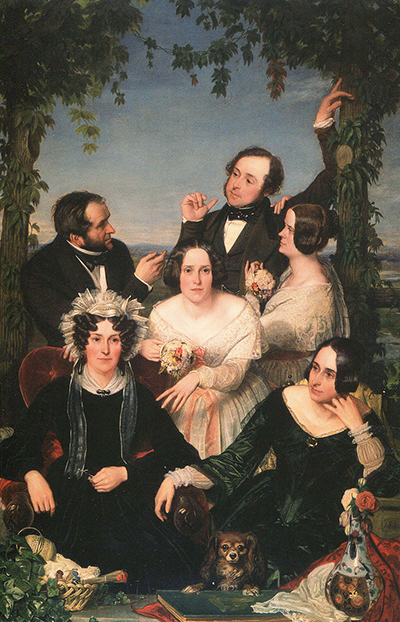
Ford Madox Brown, The Bromley Family, 1844. Oil on canvas. Manchester Art Gallery, 1947.142; the distinct adult group.
A portrait preserved within the family
Christie’s gives the early ownership by Helen Bromley and transfer to Brown as probable. Its subsequent provenance runs through his daughter Lucy and her husband, William Michael Rossetti. The catalogue records exhibitions at the Grafton Galleries in 1897 and Abingdon in 1961; it does not establish the painting’s present owner. [1]
Artworks directory
Explore paintings, drawings, cartoons, illustrations and decorative designs documented in museum collections and specialist research. Distinct versions are listed separately; repeated print impressions are grouped. The coverage includes studies and works without a dedicated article and remains open to further research.
| Name | Date | Medium |
|---|---|---|
| Work (Manchester) | 1852–1865 | Oil on canvas |
| The Last of England (Birmingham) | 1852–1855 | Oil on panel |
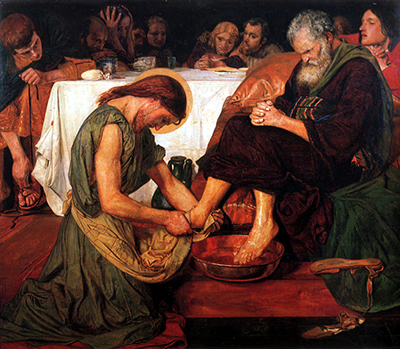
| Jesus Washing Peter’s Feet | 1852–1856 | Oil on canvas |
| Pretty Baa-Lambs | 1851–1859 | Oil on panel |
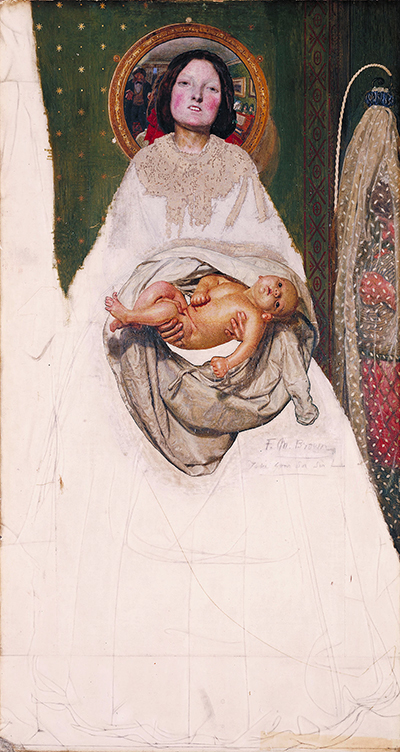
| Take Your Son, Sir | ?1851–1892 | Oil on canvas |
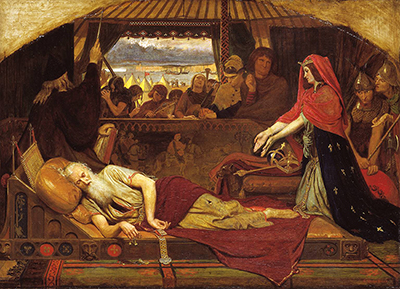
| Lear and Cordelia | 1849–1854 | Oil on canvas |
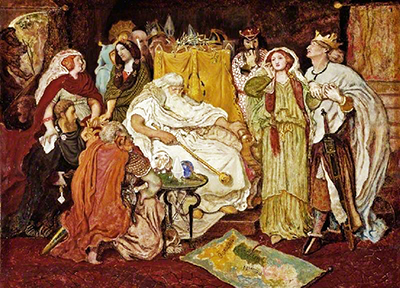
| Cordelia’s Portion | 1867–1875 | Oil on canvas |
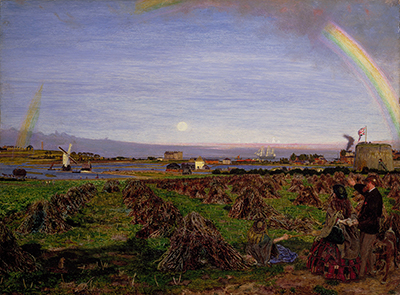
| Walton-on-the-Naze | 1859–1860 | Oil on canvas |
| Chaucer at the Court of Edward III (Tate) | 1856–1868 | Oil on canvas |
| Carrying Corn | 1854–1855 | Oil on mahogany |
| The Hayfield (The Hay Harvest) | 1855–1856 | Oil on mahogany |
| Stages of Cruelty | 1856–1890 | Oil on canvas |
| The Irish Girl | 1860 | Oil on canvas laid on board |
| Romeo and Juliet (Delaware) | 1869–1870 | Oil on canvas |
| The Seeds and Fruit of English Poetry | 1845–1853 | Oil on canvas |
| Self-Portrait | 1877 | Oil on canvas |
| The Bromley Children | Probably 1844 | Oil on canvas |
| The Bromley Family | 1844 | Oil on canvas |
| Byron’s Dream (Manchester) | 1874; worked on into 1875 | Oil on canvas |
| Cartoon for The Baptism of Edwin | 1879–1891 | Pastel, coloured chalks and grey gouache |
| The Coat of Many Colours | 1864–1866 | Oil on canvas |
| The Convalescent (Birmingham) | Dated October 1872 | Pastel |
| Crabtree Watching the Transit of Venus (reduced painting) | 1881–1888 | Tempera on panel |
| Cromwell on His Farm (Lady Lever) | Completed 1874 | Oil on canvas |
| Cromwell Protector of the Vaudois | 1877 | Oil on canvas |
| Dalton Collecting Marsh-Fire Gas (Town Hall mural) | 1886–1887 | Mural on canvas |
| The Establishment of the Flemish Weavers (reduced painting) | 1881; completed 1888 | Tempera on panel |
| The Finding of Don Juan by Haidée (NGV) | 1869–1870; later retouched | Watercolour and gouache over pencil |
| Henry and Millicent Fawcett | 1872 | Oil on canvas |
| Jacob and Joseph’s Coat (Ponce) | c.1868–1871 | Oil on canvas |
| James Leathart | 1863–1864; altered 1869 | Oil on canvas |
| King René’s Honeymoon (Tate watercolour) | 1864 | Graphite, watercolour, gouache and gum arabic on card |
| King René’s Honeymoon Cabinet (collaborative work) | 1861; exhibited 1862 | Oak, inlaid woods, painted panels and metal mounts; Brown designed Architecture |
| Manfred on the Jungfrau | 1841; retouched 1861 | Oil on canvas |
| Millie Smith | 1846 | Oil on paper laid on panel |
| William Michael Rossetti by Lamplight | 1856–1857 | Oil on panel |
| The Traveller (Manchester oil) | 1868–1884 | Oil on panel |
| Waiting: An English Fireside of 1854–55 | 1851–1855 | Oil on panel |
| An English Autumn Afternoon | 1852–1853; finished c.1854 | Oil on canvas |
| Alfred the Great: Sketch of Alfred drawing in the Sand | 1843–1845 | pencil |
| Historical Notes and Sketches of Alfred the Great | 1843–1850 | brown ink writing over pencil |
| Angels watching the Crown of Thorns: Study of clasped Hands | 1846 | black chalk |
| Architecture: Study of Gothic Arches and 14th Century Vaulting | c. 1847 | brown pen and ink over pencil on grey paper |
| The Ascension: Study of Angels and Hands | 1844 | brown pen and ink over pencil |
| The Ascension: Study of a Group of Angels | 1844 | brown pen and ink over pencil |
| The Ascension: Study of a Group of six flying Angels | 1844 | brown pen and ink over pencil |
| The Ascension: Two nude Angels holding onto each other | 1844 | brown brush and ink over pencil |
| The Ascension: Study for a kneeling Apostle | 1844 | black chalk touched with white on brown-toned paper |
| Head of a Child | c. 1844 | black chalk touched with white on brown toned paper |
| The Ascension: Drapery Study of a praying Apostle | 1844 | black chalk |
| The Spirit of Justice: Seated Figure in ecclesiastical Robes, gripping a Staff with left Hand raised in a Blessing | 1844 | black chalk |
| The Ascension: Study for an Apostle | 1844 | black chalk |
| The Spirit of Justice: Body of seated Figure in ecclesiastical Robes holding a Staff and a Book | 1844 | black chalk |
| The Ascension: Study of an Apostle | 1844 | black chalk on toned paper |
| Full-length Sketch of a standing, naked Child | 1844 | black chalk on toned paper |
| The Ascension: Study for Christ | 1844 | brown pen and ink over pencil |
| Caricature: Composite Drawing: A Stunner | 1861–1863 | pencil |
| A Victorian Woman in her Underwear | 1861–1863 | pencil |
| Caricature: Composite Drawing: Bewigged Head | 1861–1863 | pencil |
| Bowed Head of a bearded Man | 1861–1863 | pencil |
| Chaucer at the Court of Edward III: Early compositional Study | 1845 | pencil with brown pen and ink |
| Chaucer at the Court of Edward III: Study for Milton and two Designs for Tombstones | c.1845–c.1846 | pencil with brown frame outline |
| Chaucer at the Court of Edward III: Tracing of the Figure of Milton | c.1845–c.1849 | brown pen and ink with pencil on tracing paper |
| Chaucer at the Court of Edward III: Tracing of a Gothic Arch | c.1845–c.1849 | brown pen and ink with pencil on tracing paper |
| Chaucer at the Court of Edward III: Early compositional Study | 1845 | pencil with brown pen and ink |
| Chaucer at the Court of Edward III: Nude Studies of two Boys | 1845 | pencil, laid down |
| Chaucer at the Court of Edward III: Nude Studies of four Figures | 1845 | pencil |
| Chaucer at the Court of Edward III: Eight early Studies of Figures and Hands | 1845 | pencil |
| Chaucer at the Court of Edward III: Nude Studies for the Figures of Byron, Shakespeare and Burns | 1845 | black chalk |
| Chaucer at the Court of Edward III: Drapery Study for Burns | 1847 | black chalk |
| Chaucer at the Court of Edward III: Study of a right Leg and left Foot for Milton | 1847 | black chalk |
| Chaucer at the Court of Edward III: Study of a left Leg for Shakespeare | 1847 | black chalk |
| Chaucer at the Court of Edward III: Study of Drapery for Milton | 1847 | black chalk |
| Chaucer at the Court of Edward III: Drapery Study for Shakespeare | 1847 | black chalk |
| Chaucer at the Court of Edward III: Study of a Man in a medieval Hood | 1847 | black chalk |
| Chaucer at the Court of Edward III: Study for the Cardinal | 1847 | black chalk |
| Chaucer at the Court of Edward III: Drapery Study in Profile for Courtier | 1847 | black chalk |
| Chaucer at the Court of Edward III: Drapery Study | 1847 | black chalk |
| Chaucer at the Court of Edward III: Female Nude Study of a Muse holding onto a Rail | 1847 | pencil |
| Chaucer at the Court of Edward III: Female Nude: Study of a Muse | 1847 | pencil |
| Chaucer at the Court of Edward III: Nude Study for seated Lady | 1847 | pencil |
| Chaucer at the Court of Edward III: Nude Study of a Woman with right Arm raised | 1847 | pencil |
| Chaucer at the Court of Edward III: Two Studies of Back of a seated Woman's Head | 1847 | pencil |
| Chaucer at the Court of Edward III: Two Studies of a seated Woman in lost Profile Pose and from the Back | 1847 | pencil |
| Chaucer at the Court of Edward III: Nude Study of a Woman | 1847 | pencil |
| Chaucer at the Court of Edward III: Sketch of a Woman supporting another Figure | 1847 | pencil |
| Chaucer at the Court of Edward III: Study of the Heads and Shoulders of two Women | 1847 | pencil |
| Chaucer at the Court of Edward III: Drapery Study for Edward III with Outline of a Child | 1847 | black chalk |
| Chaucer at the Court of Edward III: Foreshortened Study for Head of a Jester | 1847 | pencil |
| Chaucer at the Court of Edward III: Head of Alexander Pope | 1847 | black chalk |
| Chaucer at the Court of Edward III: Two Hand Studies | 1847 | black chalk |
| Chaucer at the Court of Edward III: Study of Head of Milton copied from Sculpture | 1848 | black chalk |
| Chaucer at the Court of Edward III: Nude Studies for the Squire and the Courtier talking to Gower | 1848 | pencil |
| Chaucer at the Court of Edward III: Drapery Study for the Black Prince | 1848 | black chalk with touches of white |
| Chaucer at the Court of Edward III: Three Studies of Hands | 1848 | Black chalk |
| Chaucer at the Court of Edward III: Four Studies of Hands | 1848 | black chalk touched with white |
| Chaucer at the Court of Edward III: Study of a clasped right Hand for one of the Poets | 1848 | black chalk |
| Chaucer at the Court of Edward III: Study of a left Hand for Burns | 1848 | black chalk heightened with touches of white |
| Chaucer at the Court of Edward III: Study of Drapery for Burns | 1848 | black chalk |
| Chaucer at the Court of Edward III: Drapery Study | 1848 | black chalk |
| Chaucer at the Court of Edward III: Drapery Study for the Black Prince | 1851 | black and white chalks on brown-toned paper |
| Chaucer at the Court of Edward III: Study for Squire's Legs | 1851 | black chalk heightened with white |
| Chaucer at the Court of Edward III: Two Head Studies of an old Woman | 1851 | black chalk |
| Costume Study: Five Sketches of Armour and Costume | 1844 | brown pen and ink over pencil |
| Costume Study: Archbishop's Dress | 1845 | brown pen and ink on tracing paper |
| Costume Studies: French and Italian thirteenth and fourteenth-century Costumes (seven Drawings) | 1845 | brown pen and ink on tracing paper |
| Costume Study: Seigneur de Rimini | 1845 | brown pen and ink on tracing paper |
| Dalziels' Bible Gallery: The Death of Eglon | 1863–1865 | engraved woodblock; designed by Brown, engraved by the Dalziel Brothers |
| Dalziels' Bible Gallery: The Death of Eglon | 1881 | wood engraving; designed by Brown, engraved by the Dalziel Brothers |
| Dalziels' Bible Gallery: Elijah and the Widow's Son | 1863–1865 | engraved woodblock; designed by Brown, engraved by the Dalziel Brothers |
| Dalziels' Bible Gallery: Elijah and the Widow's Son | 1881 | wood engraving; designed by Brown, engraved by the Dalziel Brothers |
| Dalziels' Bible Gallery: Joseph’s Coat (Compositional Sketch and four Studies for Jacob's Granddaughter) | 1863–1865 | pencil on paper |
| Dalziels' Bible Gallery: Joseph's Coat | 1863–1865 | engraved woodblock; designed by Brown, engraved by the Dalziel Brothers |
| Dalziels' Bible Gallery: Joseph’s Coat | 1881 | wood engraving; designed by Brown, engraved by the Dalziel Brothers |
| Decorative Sketches: Venus Reclining on a Shell in the Midst of the Sea | 1848–1849 | brown pen and ink over pencil |
| Decorative Design: Ornamental Pattern | 1850 | watercolour and bodycolour over pen and ink, and pencil on two sheets of paper |
| Down Stream: Main Illustration (Last Year's First of May) | 1871 | wood engraving; designed by Brown, print execution by an engraver |
| Down Stream: Tailpiece to the Poem (This Year's First of June) | 1871 | wood engraving; designed by Brown, print execution by an engraver |
| The Establishment of Flemish Weavers in Manchester A.D. 1363: Four Studies of Parts of a Horse | 1879–1882 | black, white and red chalk on rough brown paper |
| Female: Two Studies of young Woman in eighteenth-century Costume | 1849 | pencil |
| Infant's Repast: Study of Mother and Child | 1848 | black and white chalk |
| Infant's Repast: Study of Mother and Child with separate Arm and Leg Studies of the Child | 1848 | black chalk with grey wash |
| King Lear: Sketch of Lear questioning Cordelia | 1844 | brown pen and ink over pencil |
| Alfred the Great: Compositional Sketches | 1843–1845 | pencil |
| King Lear: Sketches of Lear imagining his unfaithful Daughters’ Trial and Lear in the Storm | 1844 | brown pen and ink over pencil |
| Alfred the Great: Compositional Studies and Sketches and Chaucer at the Court of Edward III: Study of Cherubs | 1843–1849 | pencil |
| King Lear: Kent accuses Oswald | 1844 | brown pen and ink with pencil underneath |
| King Lear: Lear recounts his Wrongs to Regan | Undated | Brown pen and ink over pencil |
| King Lear: Cordelia at Lear's Bedside (Lear's Awakening) | 1844 | brown pen and ink over pencil |
| Cordelia Parting from Her Sisters (The Germ) | 1850; reprinted 1901 | Etching; designed by Brown, print execution by an engraver |
| King René's Honeymoon: Study for Architecture | 1861 | brush and brown ink, with watercolour, over pencil on brown paper |
| The Last of England: Cartoon | 1852 | pencil, image edged with brown ink |
| The Last of England: Portrait of Emma Hill | December 1852 | chalks with scratching out on two sheets of paper |
| Lear and Cordelia and The Infant’s Repast: Four Studies of Hands | 1849 | black chalk |
| Lyra Germanica - the Christian Life: Abraham and Isaac | 1868 | wood engraving; designed by Brown, print execution by an engraver |
| Lyra Germanica - the Christian Life: Finished Design for The Entombment | 1867 | black pen and ink |
| Lyra Germanica - the Christian Life: The Entombment | 1868 | wood engraving; designed by Brown, print execution by an engraver |
| Male: Sketch of Man reclining on Steps with Hands bound together | 1844 | brown pen and ink over pencil |
| Male: Academic nude Study, half-length with Moustache and Arms folded | 1846–1849 | black chalk |
| Male: Academic Study of Nude holding a Staff | 1847 | pencil |
| Male: Academic Study of Nude posed as a Sculptor | 1847 | chalk with grey wash |
| Male: Academic Study, three-quarter length Nude, with a Moustache and clenched Fists | 1847 | black chalk |
| Oure Ladye of Saturday Night: Seven Sketches | 1846 | pencil |
| Oure Ladye of Saturday Night: Four Studies for Angel holding Child | 1847 | pencil |
| Oure Ladye of Saturday Night: Study of Angel holding Child | 1847 | black chalk |
| Oure Ladye of Saturday Night: Study of Arm and Hands for Angel holding Bowl of Water | 1847 | black chalk |
| Oure Ladye of Saturday Night: Drapery Study for Angel holding Bowl of Water | 1847 | black chalk |
| Oure Ladye of Saturday Night: Study of Head for Angel holding Bowl of Water | 1847 | black chalk with rubbing and grey wash |
| Oure Ladye of Saturday Night: Study of Child seated on Knees of the Virgin and two separate Studies of the Child's Legs | 1847 | pencil on brown-toned paper |
| Oure Ladye of Saturday Night: Frieze Design | c. 1847 | pencil and black pen and ink |
| Oure Ladye of Saturday Night: Three Studies of Arms and Legs of Child | 1847 | pencil |
| Oure Ladye of Saturday Night: Three Studies of Child's Legs on Virgin's Knees | 1847 | pencil |
| Oure Ladye of Saturday Night: Studies of Right Foot and Left Hand of Child | 1847 | pencil on light brown paper |
| Oure Ladye of Saturday Night: Drapery Study for Virgin | 1847 | black chalk |
| Oure Ladye of Saturday Night: Study for Head of Virgin | 1847 | black chalk with wash |
| Parisina’s Sleep: Study for Prince Azo and Parisina | 1842 | black chalk with pencil side drawing |
| Parisina's Sleep: Study for Head of Prince Azo | 1842 | black chalk with grey wash |
| Parisina's Sleep: Study for the Head of Parisina | 1842 | black and white chalk with grey wash |
| Poets of the Nineteenth Century: The Prisoner of Chillon: Compositional Sketch | 1856 | pencil |
| Profile of a Man's left Eye and Nose | c.1856 | pencil |
| Poets of the Nineteenth Century: The Prisoner of Chillon: Study of a Corpse | 1856 | pencil |
| Designs for Decoration | c.1856 | pencil |
| Poets of the Nineteenth Century: The Prisoner of Chillon | 1857 | wood engraving; designed by Brown, print execution by an engraver |
| Portrait: Head Study of Daniel Casey (three-quarter view) | 1848 | black chalk |
| Portrait: Head Study of Daniel Casey (full-face) | 1848 | black chalk |
| Portrait: Miss Iza Duffus Hardy | 1872 | pastel and coloured chalks on brown paper |
| Portrait: Emma Hill (later Mrs Madox Brown) | 1848 | black chalk |
| Portrait: Emma Hill (later Mrs Madox Brown) | 1852 | pencil |
| Portrait: Mrs Madox Brown (neé Emma Hill) | 9 May 1854 | pencil |
| The Repose in Egypt: Compositional Sketch | 1847 | pencil |
| Study of a Statue of the Discobolus | 1845 | Black chalk |
| William Shakespeare: Study | 1849–1850 | pencil |
| William Shakespeare: Invitation Card | 1850 | wood engraving; designed by Brown, print execution by an engraver |
| The Spirit of Justice: Study for Baron and his Advisor, with Sketches of Erudition and Wisdom | 1844–1845 | brown pen and ink over pencil |
| The Spirit of Justice: Drapery Study for Erudition | 1844–1845 | black chalk |
| Drapery Study and Sketch of Two Legs | Undated | Black chalk |
| The Spirit of Justice: Study for Wisdom | 1844–1845 | black chalk with grey wash |
| The Spirit of Justice: Study for Head of the Baron | 1844–1845 | black chalk |
| The Spirit of Justice: Study for the Head of central Bishop | 1844–1845 | black chalk |
| The Spirit of Justice: Study for the Head of a Bishop | 1844–1845 | black chalk with grey wash |
| The Spirit of Justice: Study for the uplifted left Arm of Justice | 1844–1845 | black chalk |
| The Spirit of Justice: Study for Head of Counsellor in a Coronet | 1844–1845 | black chalk with touches of blue chalk |
| The Spirit of Justice: Study for Head of Counsellor | 1844–1845 | black chalk |
| The Spirit of Justice: Drapery Study for the Central Bishop | 1844–1845 | Black chalk |
| Part of a Drapery Study | 1844–1845 | black chalk |
| The Spirit of Justice: Study for Head of Widow | 1844–1845 | black chalk |
| Stages of Cruelty: Study for the Child (Catherine Madox Brown) | 1857 | black chalk on pale grey paper |
| Stained Glass Design: Cartoon for Zachariah, The High Priest | 1872 | black chalk |
| Stained Glass Design: Cartoon for The Young Milton | 1874 | black chalk |
| Stained Glass Design: Cartoon for St Simon | 1874 | black chalk |
| Sterne's 'Sentimental Journey': Study for Yorick and La Fleur talking to Maria’s Mother | 1842 | brown pen and ink over pencil |
| The Body of Harold brought before William the Conqueror: Eight Sketches of Figure Groups | c.1844 | pencil |
| Sterne's 'Sentimental Journey' : Yorick (Laurence Sterne) and Maria Walking | 1842 | pen and ink, watercolour and bodycolour over pencil |
| Study of Tree Trunk with Roots | c.1847 | black chalk, heightened with white chalk on buff paper |
| Two Studies of Tree Trunks | c.1846 | black chalk |
| Unknown Subject: Compositional Sketch | 1843–1850 | pencil |
| Wycliffe reading his Translation of the Bible: Nude Study for Chaucer | 1847 | pencil |
| Wycliffe reading his Translation of the Bible: Study for Chaucer | 1847 | pencil |
| Wycliffe reading his Translation of the Bible: Nude Study of Gower | 1847 | pencil |
| Wycliffe reading his Translation of the Bible: Study for Gower | 1847 | pencil |
| Wycliffe reading his Translation of the Bible: Nude Study for John of Gaunt and Chaucer's right Hand | 1847 | pencil and black chalk |
| Wycliffe reading his Translation of the Bible: Study of John of Gaunt and Chaucer's Left Hand | 1847 | pencil and black chalk |
| Wycliffe reading his Translation of the Bible: Study for Wycliffe | 1847 | black chalk |
| Wycliffe reading his Translation of the Bible: Nude Study for Wycliffe | 1847 | pencil |
| Wycliffe reading his Translation of the Bible: Drapery Study for Wycliffe | 1847 | black chalk |
| Wycliffe reading his Translation of the Bible: Drapery Study for Chaucer | 1848 | black chalk |
| Wycliffe reading his Translation of the Bible: Study of Legs for John of Gaunt and two Studies of Feet for Wycliffe | 1848 | black chalk |
| Wycliffe Reading his Translation of the Bible: Studies of Hands for John of Gaunt and Gower | 1847 | black chalk |
| Wycliffe reading his Translation of the Bible: Study for Head of Wycliffe | 1847 | pencil |
| Wycliffe reading his Translation of the Bible: Study for Constance and Child | 1847 | pencil |
| Wycliffe reading his Translation of the Bible: Unfinished Study for Head of Constance | 1847–48 | pencil |
| Wycliffe reading his Translation of the Bible: Portrait of Elizabeth Bamford modelling for Constance | 1848 | pencil |
| Wycliffe reading his Translation of the Bible: Study for Head of Constance | 1848 | chalk over pencil |
| Wycliffe reading his Translation of the Bible: Study for Head of Chaucer | 1848 | pencil |
| Wycliffe reading his Translation of the Bible: Study of Monk representing the Catholic Faith | 1848 | black chalk with brown pen and ink, squared up |
| Wycliffe reading his Translation of the Bible: Study of young Woman representing the Protestant Faith | 1848 | black chalk |
| Cathy Madox Brown at the Age of Three (Tate N01356) | 1853 | Graphite on paper |
| King René‘s Honeymoon (Tate N02409) | date not known | Ink on paper |
| Sheepshearing (Tate N02410) | c.1887 | Ink and graphite on paper |
| Studies for ‘Work’ (Tate N02411) | 1855 | Graphite and ink on paper |
| Design for Badge for Gillum’s Homes (Tate N02412) | date not known | Ink and graphite on paper |
| Arkwright’s Mill (Tate N02413) | 1878 | Graphite on paper |
| Study for ‘John Kay’ (Tate N02414) | 1889 | Graphite on paper |
| Study for ‘Southend’ (Tate N02415) | date not known | Graphite on paper |
| ‘Where are you going, my pretty maid?’ (Tate N02416) | date not known | Graphite on paper |
| Section of the Bridgewater Canal (Tate N02417) | 1890 | Ink on paper |
| A Barge on the Bridgewater Canal (Tate N02418) | 1890 | Graphite on paper |
| Study of the Tow-Path on the Bridgewater Canal (Tate N02419) | 1890 | Graphite on paper |
| Our Lady of Good Children (Tate N02684) | 1847–61 | Pastel, watercolour and gold paint on paper |
| Arkwright’s Mill (Tate N02791) | 1881 | Graphite on paper |
| The Bridgewater Canal (Tate N02792) | 1890 | Ink on paper |
| The Bridgewater Canal (Tate N02793) | date not known | Chalk and graphite on paper |
| The Last of England (Tate N03064) | 1864–6 | Watercolour on paper |
| Mauvais Sujet (Tate N03228) | 1863 | Watercolour on paper |
| Study of a Man Painting (Tate N03472) | 1839 | Graphite on paper |
| The Brent at Hendon (Tate N03528) | 1854–5 | Oil paint on board on mahogany |
| Study for the Dean in the ‘Execution of Mary Queen of Scots’ (Tate N04280) | c.1840 | Oil paint on paper |
| Sketch for ‘Jesus Washing Peter’s Feet’ (Tate N04281) | 1852 | Graphite on paper |
| Sketch for ‘Cromwell on his Farm’ (Tate N04282) | c.1853 | Graphite on paper |
| The Coat of Many Colours (Tate N04584) | 1867 | Watercolour and gouache on paper |
| Stages of Cruelty (Tate N04625) | c.1856 | Watercolour on paper |
| Head of a Girl (Tate N04803) | date not known | Oil paint on paper |
| Portrait of Dykes Barry as a Child (Tate N04866) | 1853 | Oil paint on mahogany |
| Jesus Washing Peter’s Feet (Tate N05301) | 1857–8 | Watercolour on paper |
| Platt Lane (Tate N05383) | 1884 | Oil paint on canvas |
| Study of F.G. Stephens for ‘Jesus Washing Peter’s Feet’. Verso: A Head Crowned with Laurels (Tate T00571) | 1852 | Graphite on paper. Verso: graphite on paper |
| Sketch for ‘Jesus Washing Peter’s Feet’ (Tate T01035) | c.1851 | Ink and graphite on paper |
| Chaucer at the Court of Edward III (Sydney) | 1845–1851 | Oil on canvas |
| Wycliffe Reading His Translation of the Bible to John of Gaunt (Bradford) | 1848 | Oil on canvas |
| Work (Birmingham replica) | 1859–1863 | Oil on canvas |
| The Spirit of Justice (Book of Art reproduction) | Published 1846 | Wood engraving after Brown’s cartoon; engraver unknown |
| The Execution of Mary Queen of Scots | 1840–1842 | Oil on canvas |
| The Prisoner of Chillon (Manchester oil) | 1843 | Oil on canvas |
| The Parting of Cordelia from Her Sisters (oil) | 1853 | Oil on canvas |
| Cordelia’s Portion (Lady Lever) | 1866–1872 | Watercolour, gouache and pastel |
| The Ascension | 1844–1845 | Oil on canvas |
| Manfred in the Chamois Hunter’s Hut (oil sketch) | 1840 | Oil on canvas |
| Dr Primrose and His Daughters (The Vicar of Wakefield) | 1840–1841 | Oil on canvas |
| The Body of Harold Brought before William the Conqueror | 1844–1861 | Oil on canvas |
| The Seeds and Fruits of English Poetry (Bedford cartoon) | 1845 | Black chalk on paper |
| Wycliffe Reading His Translation of the Bible (oil sketch) | 1847–1848 | Oil on board |
| Cromwell Discussing the Protection of the Vaudois (Nottingham) | 1877–1878 | Oil on canvas |
| Two Drawings of Men in Hoods | c.1845 | Pencil on paper |
| The Seeds and Fruits of English Poetry: Study of the Right Side | c.1845 | Brown pen and ink with pencil |
| Chaucer: A Man in a Hood with a Liripipe and Two Drapery Studies | 1848 | Oil on canvas |
| The Prisoner of Chillon Entreating His Jailors (Yale watercolour) | 1858 | Watercolour heightened with bodycolour |
| Elijah and the Widow’s Son (Birmingham oil) | 1864 | Oil on panel |
| He That Soweth (Lyra Germanica) | Published 1868 | Wood engraving by the Dalziel Brothers after Brown |
| The Entombment (NGV) | 1871–1878 | Watercolour, gouache, gold paint and gum arabic over pencil |
| The Sower (Morris firm tile) | c.1864–1873 | Tile; design by Brown, workshop execution |
| Childe Harold’s Pilgrimage (Byron illustration) | Published 1870 | Steel engraving by Herbert Bourne after Brown |
| The Two Foscari (Byron illustration) | Published 1870 | Steel engraving by Herbert Bourne after Brown |
| The Corsair (Byron illustration) | Published 1870 | Steel engraving by Herbert Bourne after Brown |
| Sardanapalus (Byron illustration) | Published 1870 | Steel engraving by Herbert Bourne after Brown |
| Don Juan (Byron illustration) | Published 1870 | Steel engraving by Herbert Bourne after Brown |
| Byron’s Dream (roundel title-page design) | Published 1870 | Steel engraving by Herbert Bourne after Brown |
| The Finding of Don Juan by Haidée (Birmingham oil) | 1870–1873 | Oil on canvas |
| The Dream of Sardanapalus (Delaware) | 1871–1872 | Watercolour on paper |
| The Traveller (Once a Week) | Published 1869 | Wood engraving by Joseph Swain after Brown |
| The Infant’s Repast | 1848 | Oil on board |
| Oliver Madox Brown Aged Four (Dwale Bluth frontispiece) | Published 1876 | Etching |
| Oliver Madox Brown as a Young Man (Dwale Bluth frontispiece) | Published 1876 | Etching |
| A Beggar and Other Fantasies: Title-page Illustration | Published 1889 | Photo-engraving after Brown |
| Dramas in Miniature: Title-page Illustration | Published 1891 | Photo-engraving after Brown |
| The Brown Owl: Frontispiece | Published 1892 | Photo-engraving after Brown |
| The Brown Owl: Central Illustration | Published 1892 | Photo-engraving after Brown |
| The Feather: Frontispiece | Published 1892 | Photo-engraving after Brown |
| The Ascension: Study for Christ | 1844 | Pen and ink |
| King Lear: Lear Questions Cordelia (Whitworth) | 1844 | Pencil, pen and brown ink |
| King Lear: France Claims the Dispossessed Cordelia (Whitworth) | 1844 | Pencil, pen and brown ink |
| King Lear: Cordelia Parts from Her Sisters (Whitworth) | 1844 | Pencil, pen and brown ink |
| King Lear: Goneril and Regan Together (Whitworth) | 1844 | Pencil, pen and brown ink |
| King Lear: Goneril Tells Oswald How to Treat Lear (Whitworth) | 1844 | Pencil, pen and brown ink |
| King Lear: Oswald’s Insolence to Lear (Whitworth) | 1844 | Pencil, pen and brown ink |
| King Lear: Lear Rebukes Oswald (Whitworth) | 1844 | Pencil, pen and brown ink |
| King Lear: Kent Trips Oswald (Whitworth) | 1844 | Pencil, pen and brown ink |
| King Lear: Goneril’s Complaint to Lear (Whitworth) | 1844 | Pencil, pen and brown ink |
| King Lear: Lear Curses Goneril’s Infidelity (Whitworth) | 1844 | Pencil, pen and brown ink |
| King Lear: Kent Challenges Oswald (Whitworth) | 1844 | Pencil, pen and brown ink |
| King Lear: Kent in the Stocks (Whitworth) | 1844 | Pencil, pen and brown ink |
| King Lear: Lear Recounts His Wrongs to Regan (Whitworth) | 1844 | Pencil, pen and brown ink |
| King Lear: Lear Parts from Regan and Goneril (Whitworth) | 1844 | Pencil, pen and brown ink |
| King Lear: Lear and the Fool in the Storm (Whitworth) | 1844 | Pencil, pen and brown ink |
| King Lear: Lear Mad on the Beach at Dover (Whitworth) | 1844 | Pencil, pen and brown ink |
| King Lear: Alternative Study: Lear Curses Goneril (Whitworth) | 1844 | Pencil, pen and brown ink |
| King Lear: Lear Imagines His Daughters’ Trial (Whitworth) | 1844 | Pencil |
| King Lear: Alternative Study: Lear in the Storm (Whitworth) | 1844 | Pencil, pen and brown ink |
| The Last of England (Fitzwilliam) | 1860 | Oil on canvas |
| The Convalescent (Metropolitan Museum) | Dated 1872 | Pastel |
| Self-Portrait (Walker drawing) | 1850; retouched 1853 | Black chalk |
| Byron’s Dream (Whitworth) | 1889 | Watercolour over graphite |
| Cordelia Parting from Her Sisters (Cleveland sketch) | 1854 | Pen and oil on paper mounted on panel |
| David and Goliath: Cartoon for Stained Glass Window at Jesus College, Cambridge | 1872 | Charcoal and graphite on Japanese paper |
| The Virgin Swooning (recto) | 1844 | Black chalk on laid paper |
| Two Drapery Studies (verso) | c.1844 | Black chalk |
| Architecture: King René’s Honeymoon (stained glass) | 1862 | Stained glass; designed by Brown, made by Morris, Marshall, Faulkner & Co. |
| The Romans Building a Fort at Mancenion (Town Hall mural) | 1880 | Spirit fresco |
| The Baptism of Edwin (Town Hall mural) | 1879–1880 | Spirit fresco |
| The Expulsion of the Danes (Town Hall mural) | 1880–1881 | Spirit fresco |
| The Establishment of the Flemish Weavers (Town Hall mural) | 1881–1882 | Spirit fresco |
| Crabtree Watching the Transit of Venus (Town Hall mural) | 1882–1883 | Spirit fresco |
| The Proclamation Regarding Weights and Measures (Town Hall mural) | 1883–1884 | Spirit fresco |
| Wycliffe on Trial (Town Hall mural) | 1885–1886 | Spirit fresco |
| Chetham’s Life’s Dream (Town Hall mural) | 1885–1886 | Mural on canvas |
| Bradshaw’s Defence of Manchester (Town Hall mural) | 1892–1893 | Mural on canvas |
| John Kay, Inventor of the Fly Shuttle (Town Hall mural) | 1888–1890 | Mural on canvas |
| The Opening of the Bridgewater Canal (Town Hall mural) | 1891–1892 | Mural on canvas |
Frequently Asked Questions
They belong to Brown’s Bromley family circle. Contradictions in the family records leave the individual identifications uncertain. [1]
Probably 1844. The inscribed year has also been read tentatively as 1843. [1]
Its present location is unconfirmed; the 2000 sale catalogue records family ownership. [1]
Discussion
Look again at the images and ideas explored in The Bromley Children by Ford Madox Brown. These editorial prompts invite your observations.
Reader Insights
The three children do not all look towards one another or towards us. Consider how their overlapping bodies and contrasting clothes make them feel connected despite those separate directions of attention.
Compare the central figure’s upright pose with the seated child’s exposed foot. Does this detail make the portrait feel more informal, or does it draw attention to how deliberately the whole group has been arranged?
Imagine the same children against an empty backdrop. What would disappear with the branches, dark foliage and distant light? Their setting shapes the portrait’s mood as well as its depth.
Join the Conversation
Share a detail, comparison or question about The Bromley Children by Ford Madox Brown below.
References
- Christie’s , Ford Madox Brown (1821–1893), The Bromley Children , 2000 sale catalogue: object details, provenance, exhibition history and lot essay. View source .
- Ford Madox Hueffer , Ford Madox Brown: A Record of His Life and Work , London: Longmans, Green, and Co., 1896, pp. 14–15, 26, 28–30 and 37; includes Brown’s 1865 catalogue statement about Parisina’s Sleep . View source .
- Ford Madox Hueffer, Ford Madox Brown: A Record of His Life and Work, 1896; selected career, object and mural passages. View source.
- Laura MacCulloch, Ford Madox Brown: Works on Paper and Archive Material at Birmingham Museums and Art Gallery, 2009, volumeI; catalogue entries. View source.
- Tim Barringer, Ford Madox Brown, Work, MAVCOR, 2014. View source.
- Tate, official historical collection dataset; Ford Madox Brown accession records. View source.
- National Portrait Gallery, Henry Fawcett and Millicent Garrett Fawcett, NPG1603; portrait and frame record. View source.
- Laura MacCulloch, Ford Madox Brown: Works on Paper and Archive Material at Birmingham Museums and Art Gallery, 2009, volumeII; illustration lists, pp1–24. View source.
- Fitzwilliam Museum, The Last of England, M.Add.3. View source.
- Metropolitan Museum of Art, The Convalescent, 10.46. View source.
- Carol Blackett-Ord / National Portrait Gallery, Ford Madox Brown: all known portraits. View source.
- The Whitworth / Art UK, Byron’s Dream, 1889 watercolour. View source.
- Cleveland Museum of Art, Cordelia Parting from Her Sisters, 2013.261. View source.
- Cleveland Museum of Art, David and Goliath: Cartoon for Stained Glass Window at Jesus College, Cambridge, 1872, 2013.247. View source.
- National Gallery of Art, The Virgin Swooning, recto, 1987.73.1.a. View source.
- National Gallery of Art, Two Drapery Studies, verso, object70237. View source.
- Victoria and Albert Museum, Architecture: King René’s Honeymoon, CIRC.516-1953. View source.
- Manchester City Council, The Ford Madox Brown Murals; cycle and individual scenes. View source.
- Splash image, Ford Madox Brown, The Bromley Children, probably 1844. Oil on canvas. The inscribed date and individual sitter identifications remain uncertain.