



 by
Tom Gurney
Tom Gurney BSc (Hons) is an art history expert with over 20 years experience
Published on June 19, 2020 / Updated on October 30, 2026
Email:
tomgurney1@gmail.com
/ Phone:
+44 7429 011000
The Last of England by Ford Madox Brown: Introduction
A man and a woman sit shoulder to shoulder on an emigrant ship. His face is shadowed by a broad hat; hers looks out from a bonnet tightened with pink ribbon. Their hands meet across his knee. Only after looking more closely do we discover a third member of the family: a baby's fingers emerging through the woman's shawl. Around them, other passengers jostle, vegetables hang from the ship's netting and the English coast dwindles behind an umbrella.
In The Last of England , Ford Madox Brown makes a large historical subject depend on a very small encounter. Emigration becomes the pressure of a hand, the discomfort of cold skin and the difficulty of imagining a future.
The principal painting dates from 1852–1855. [1] It belongs to Birmingham Museums Trust, an oil on panel numbered 1891P24. [2] The later Cambridge oil and Tate watercolour are separate versions. [3] [4]
Brown and his wife Emma supplied the faces of the central couple, but they did not make the voyage shown here. Their portraits inhabit an imagined departure, prompted partly by a friend's emigration and partly by Brown's own anxiety about earning a living. This distinction makes the picture more revealing: it is a carefully staged attempt to imagine leaving, made by someone who stayed. [5]
At a Glance
- Artist Ford Madox Brown
- Title The Last of England
- Date 1852–1855
- Medium Oil on panel
- Collection Birmingham Museums Trust
- Collection number 1891P24
- Subject An emigrant couple and their baby leaving England, surrounded by fellow passengers
Birmingham's collections inventory identifies 1891P24 as oil on panel. [2]
The collection identity and panel support distinguish this work from Brown’s later repetitions.
This work across Ford Madox Brown’s career
Manfred on the Jungfrau
1841; retouched 1861Pretty Baa-Lambs
1851–1859Work
1852–1865King René’s Honeymoon
Tate watercolour, 1864Manchester Murals
1878–1893Contents
- A departure Brown imagined
- Inside the oval
- The hands that hold the family together
- The other passengers and the ship's provisions
- How the composition changed
- Painting the cold
- Class, gender and the limits of Brown's explanation
- Success, repetition and a life in print
- Looking at migration now
- Annotated details
A departure Brown imagined
Thomas Woolner left for Australia in July 1852; Birmingham’s teaching notes identify his departure as a stimulus for the picture. [6]
His departure offered Brown an immediate, personal connection to emigration: an artist in his own circle was seeking possibilities overseas. Brown, struggling to sell his work, also contemplated taking his family to India. In August 1855, his diary still made seeking a new home dependent on whether he would go. After selling the picture, he recorded his decision to stay for the present. [7]
These were different prospective journeys. Woolner actually emigrated; Brown considered departure and remained in England. The painting should not be treated as a record of either man’s experience aboard a particular ship. Birmingham Museums describes the fictional couple as departing for Australia. [1]
That unrealised possibility gives the subject an unusual force. Brown could borrow his own appearance without making the picture a report of something he had done. He could place Emma beside him and imagine what their familiar faces might look like at the point of separation from home. His professional difficulties matter because they brought the decision close to him, rather than because every visible expression can be translated into a documented private feeling.
Writing about the painting for his exhibition catalogue in 1865, Brown called it “in the strictest sense, historical.” He was making a claim for the significance of recent experience. His subject was the emigration movement, which he associated particularly with 1852, rather than a distant episode populated by rulers or literary heroes. An anonymous couple could carry the weight of history. [8]
The title gives that history a painful point of view. England is becoming something seen for the last time. It does not name the country ahead, and the composition offers no image of arrival. The voyage stretches out beyond the picture, while the place being left is reduced to a narrow, pale strip. We share the family's uncertainty because Brown allows us to see so little of either destination or origin.
There is a further distinction between an individual departure and the finished painting. Woolner had returned to England before Brown completed it in 1855. The event that helped generate the design had already run a course of its own, while Brown was still shaping his imagined moment. The picture's suspended farewell belongs to painting, with its capacity to hold an instant, rather than to the timetable of the friend's journey. [8]
Inside the oval
The first effect is enclosure. The rounded edge presses the two adults into a single compact group. The man’s coat expands across the left half, the woman’s shawl across the right; their outer contours fill most of the available space. There is little room to stand back mentally from them.
Birmingham’s teaching notes describe how the oval “enfolds and concentrates the image.” [6]
The format makes the family immediate before we have worked out the surrounding story.
Inside that outer curve, Brown establishes more curves and barriers. The bonnet circles the woman's face. The umbrella arches behind her head and shoulder. The edge of the boat crosses below the joined hands, and the netting makes another boundary between the family and ourselves. Each layer offers a different degree of protection, yet none can keep out the weather completely.
The umbrella is particularly effective. Its dark underside supplies a deep backdrop for the bonnet and pale shawl, allowing the woman's head to stand out without a spotlight. At the same time it obscures part of the view behind her. An object brought to make the journey bearable also interrupts the last sight of home. Brown identified its practical purpose as shelter from sea spray in his 1865 description. [8]
The broad masses of clothing make the pair look almost immovable. Against them, the ribbon flies horizontally, hair escapes around the woman's forehead, and ropes cut through the crowded space. We register wind through things that yield to it. The adults endure its pressure by drawing themselves inward. This contrast between a still group and restless smaller details lets the weather seem active without requiring a sweeping view of a storm.
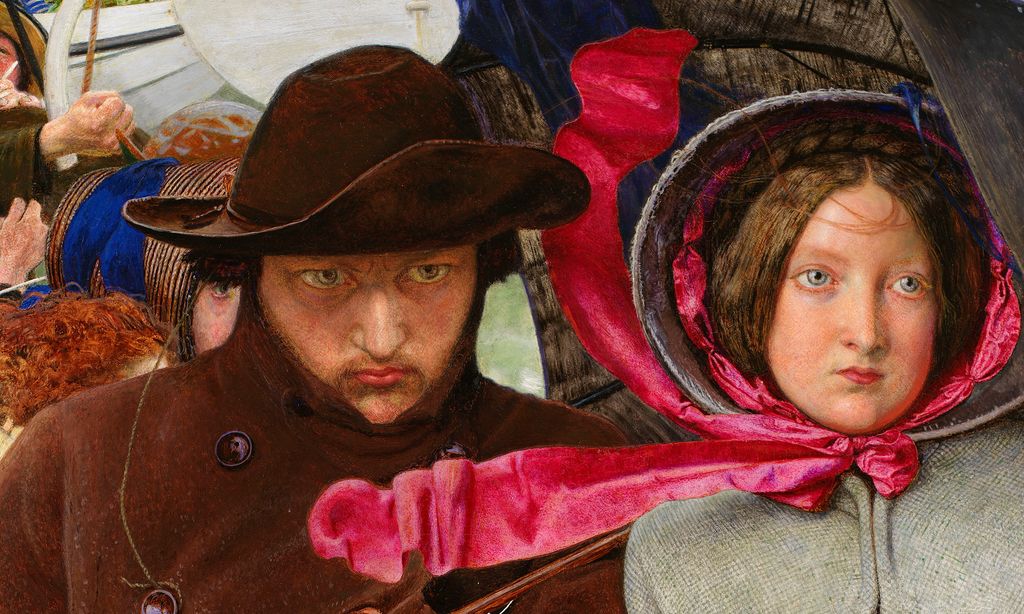
Neither adult turns towards the other. Their physical proximity does not become a face-to-face exchange: their eyes and closed mouths hold something back. The clasped hands therefore carry a message that their faces do not communicate openly. Brown gives us contact without conversation. We can recognise solidarity while also sensing two people occupied by separate thoughts.
The woman's face is more exposed than the man's. His hat creates a band of darkness across the eyes, while the pale framing of her bonnet draws attention to her gaze. Her frontal presence provides the clearest point of contact with the viewer. Yet she does not seem to perform an emotion for us. The painting leaves room between the expression we can see and the thoughts we might be tempted to assign to it.
The narrow background makes this closeness feel less comfortable. Other faces and bodies crowd the left edge, often cut off or partly concealed. Their fragmentary appearance suggests that the central family has no private space, even though it dominates our attention. Brown has made an intimate picture out of a situation in which intimacy must be maintained among strangers.
Annotated Details from The Last of England
The numbered points identify visible features discussed in this article. Return from each detail to the whole composition. Ford Madox Brown, The Last of England, Birmingham panel. This numbered overview retains the supplied support corners around the painted oval. Image source. CC0 / Public domain. Numbers added to the overview; details are cropped.
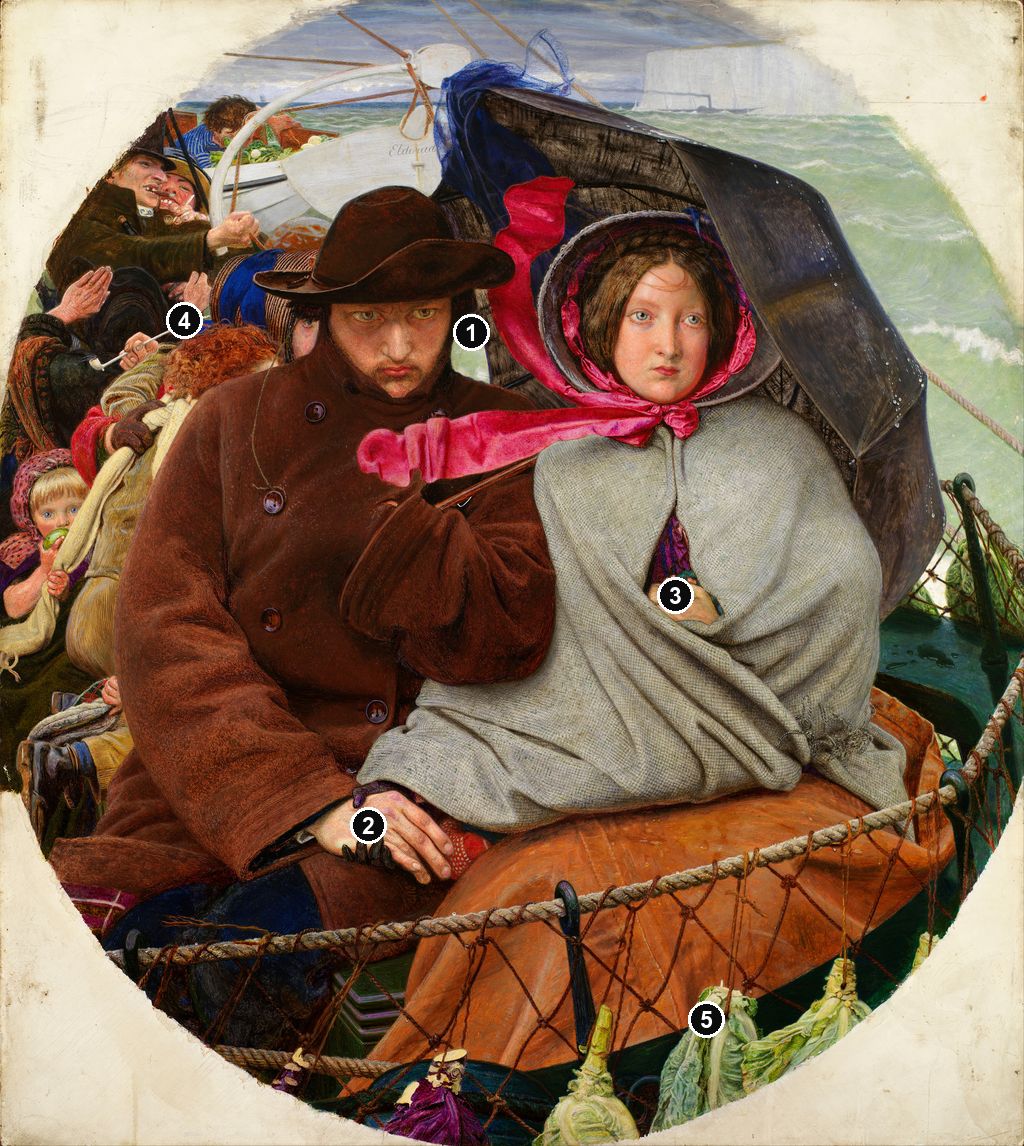
Details from THE LAST OF ENGLAND
Compare the cropped details with the complete images above. Notice how their colours, shapes and positions contribute to the larger compositions.
Two faces under the shelter
The faces occupy the protected centre of the oval. The dark hat and bright pink hood hold them apart, while the shared shelter binds the pair together.
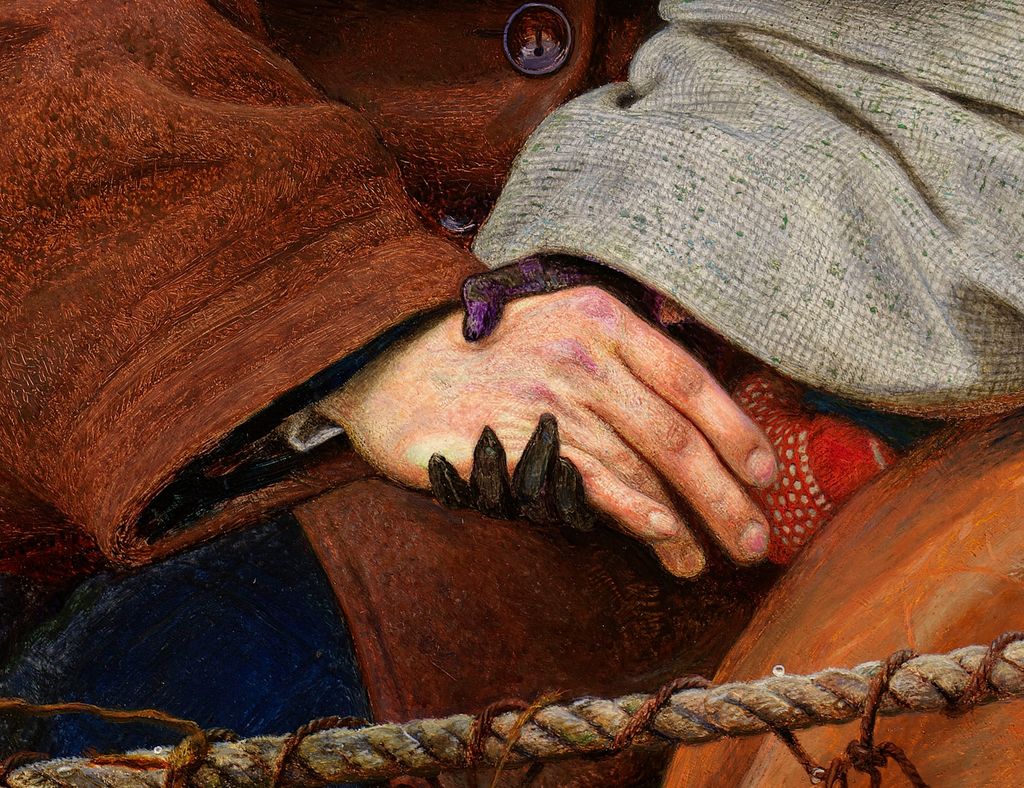
The joined hands
The hands form a small meeting point between two much larger areas of clothing. Follow the pale cuff and the dark sleeve towards their contact.
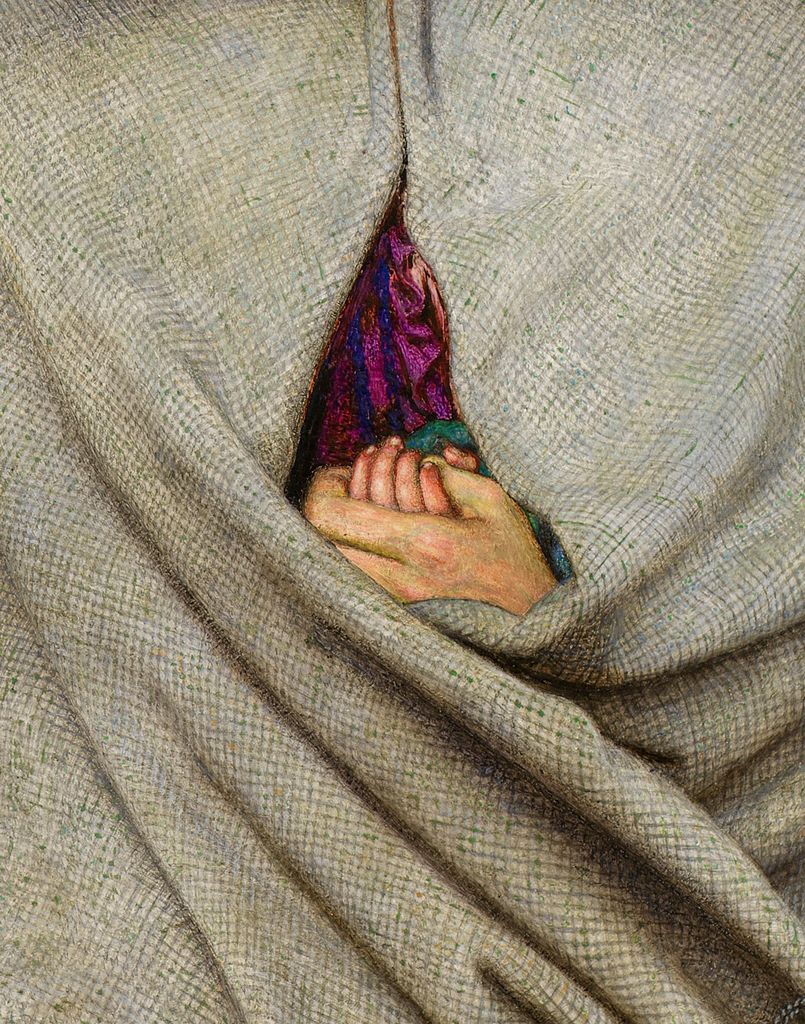
A smaller hand within the cloak
A small hand emerges against the pink-lined opening of the grey cloak. Much of the body remains concealed, making the tiny contact carry unusual visual weight.
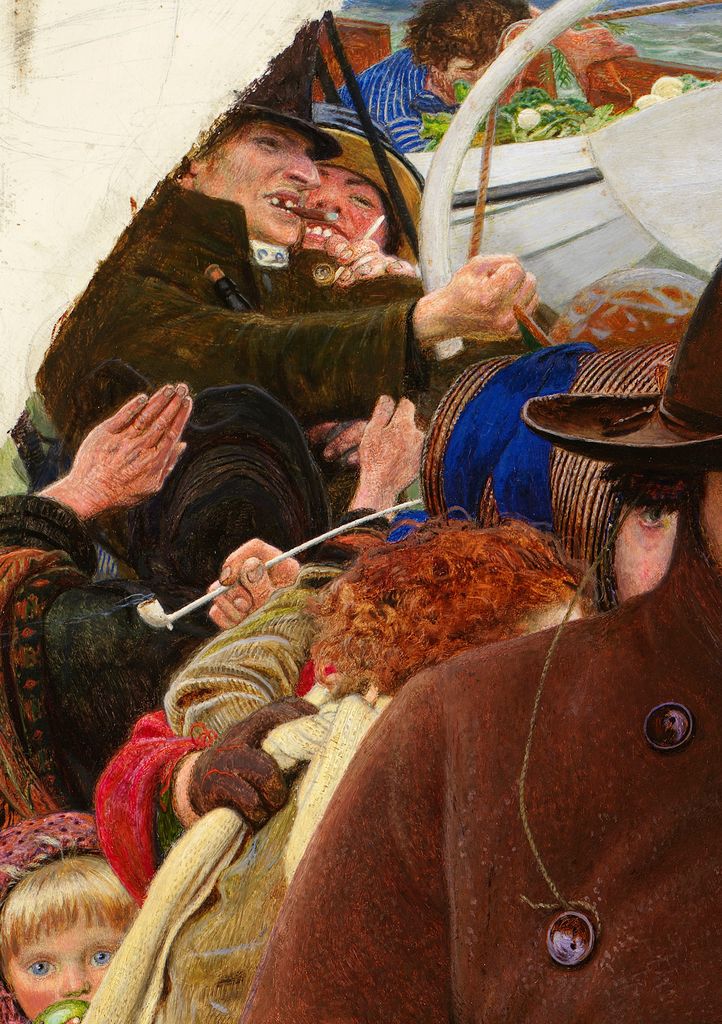
Other passengers behind the couple
Faces, hands and luggage crowd the left background. Their varied gestures contrast with the stillness of the two figures nearest us.
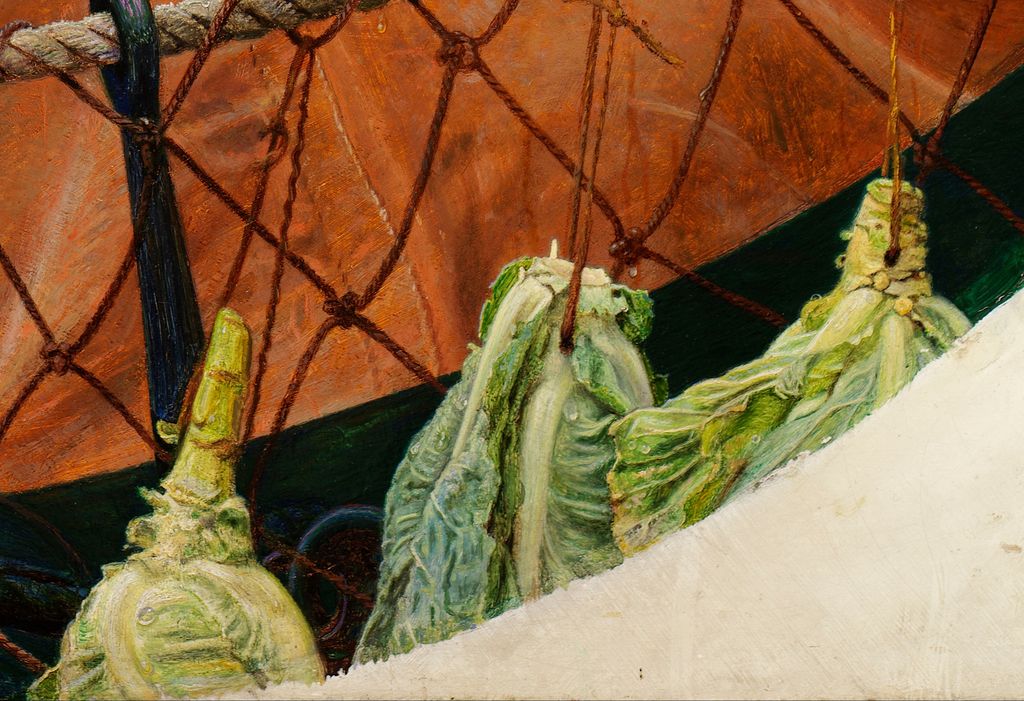
Rope, netting and vegetables
The foreground ropes cross the clothing, while pale vegetables gather against the lower edge. These objects make the cramped boat space tangible.
The hands that hold the family together
The picture can be read from face to face, but its most economical narrative runs through the hands. Low in the composition, an adult hand rests on a knee and another closes around it. Higher up, through a triangular opening in the shawl, a tiny hand reaches the woman's bare fingers. The baby is almost entirely withheld from sight. That small disclosure changes our understanding of the entire group.
Before we notice the infant, the shawl appears chiefly as a defence against the cold. Afterwards, its folds become a shelter for someone more vulnerable. The same form now has an interior that matters. Brown does not need to show a baby's face or stage a separate incident to establish responsibility, dependence and care.
There is also a difference of scale. The large bonnet, coat and umbrella assert themselves immediately; the child's fingers require a slower look. The picture rewards attention with a discovery that is emotionally disproportionate to its size. Something very small becomes central without occupying the centre of the composition.
The mother's two contacts connect the family across that difference. One joins her to the man; the other joins her to the infant. We can see a chain of attachment, but we cannot see what it will be required to withstand. The painted gesture assures us of an existing bond while leaving the outcome of the voyage open.
Brown's handling of concealment also prevents the family from becoming a conventional group portrait. A portrait might arrange the child so that every sitter can be recognised. Here, the infant's near-invisibility serves the action: the baby must be kept warm. Appearance is subordinated to a convincing need within the imagined scene.
Birmingham Museums identifies Brown and Emma as the main models, Cathy as the child in the background and Oliver as the baby. [1]
These are accounts of the people who supplied the artist with appearances, not the names of the fictional emigrants. Oliver did not thereby become a historical passenger on this voyage, any more than Brown’s self-portrait proves that he left England.
The other passengers and the ship's provisions
The central couple has often become the entire painting in memory. The surrounding passengers complicate that remembered image. A raised fist appears near the upper left; lower down, a young woman puts an arm around a child. A pipe, an apple, a glance and a partly hidden face introduce experiences that are different from the couple's silent withdrawal.
Brown supplied a specific account of these figures in 1865. He described a family of a greengrocer's social type, with a widowed father and several children, making the best of the passage through ordinary comforts. Farther back, a man curses the country he is leaving while his mother rebukes him and a companion encourages him. A cabin boy gets on with selecting vegetables. These identities are Brown's narrative explanation; they cannot all be established from the faces alone. [8]
The background therefore offers alternatives to the central mood. One person rages, others comfort or occupy themselves, and someone still has to prepare a meal. Emigration is a shared event without a single shared emotion. The ship brings together people who may have similar destinations and very different ways of enduring the journey.
At the bottom, green cabbages hang against the darker netting. Their prominent position can initially seem odd in a painting of farewell. Brown explained that they indicate the length of the voyage: the vessel needs provisions for a substantial journey. The vegetables belong to the practical machinery of migration. They turn an abstract departure into an undertaking that requires food, storage and daily work. [8]
Birmingham’s teaching notes add that Brown obtained spoiled cabbages from his greengrocer to use as props. [6]
The seemingly incidental foreground was prepared as deliberately as the faces. An ordinary object could matter to him because it made the situation more specific.
Colour helps integrate these practical details. The cold greens of sea and vegetables recur around the perimeter, while the warm brown of the coat and ochre of the boat hold the lower group together. The pink ribbon provides a sharper interruption. It is conspicuous as colour and legible as an indicator of wind: a decorative item becomes evidence of exposure.
MacCulloch records the vessel’s name changing from the cartoon’s Australian shipping-line inscription to Eldorado in the painting. [9]
The vessel’s name adds another register. The reference to a legendary place of riches allows the promise of an overseas future to hover around a scene dominated by present discomfort. It is a suggestive name, rather than proof that Brown meant to predict the emigrants’ failure.
How the composition changed
MacCulloch catalogues the 1852 pencil cartoon as no. 89, Birmingham 1906P795, reworked in 1855. [9]
It provides an unusually useful comparison with the painting. In this context a cartoon is a developed preparatory drawing. It is not a comic image. Preparation and completion were not a single uninterrupted sequence.
MacCulloch notes fewer figures, a more elongated oval and Emma’s checked shawl in the drawing. [9]
The painted shawl is much simpler in its broad effect. This change helps the woman’s wrapped body read as a continuous pale mass. Pattern would have broken up that surface and introduced another set of small distractions close to the baby’s hand. The documented alteration gives us a basis for seeing how Brown balanced detailed observation with large compositional shapes.
MacCulloch attributes the addition of the man’s hat string, absent from the drawing, to D. T. White’s insistence. [9] Brown’s September 1855 diary records adding the string alongside changes to the seat, boat, veil and sky, after White had bought the picture. [7]
A very small detail could affect the credibility of an outdoor scene: a broad hat needed to appear secure in this wind. The finished image’s apparent completeness includes a practical suggestion from someone other than the painter.
MacCulloch catalogues the separate December 1852 chalk portrait of Emma as no. 90, Birmingham 1906P791. [9]
In this study the bonnet ribbons are tied neatly and the hair is less windswept. The head study establishes the sitter’s likeness without yet carrying all the weather effects of the final painting. Brown developed the person and the conditions around her through related but distinct acts of looking.
These studies resist the idea that the finished scene was simply found and copied. Brown observed real people, real cloth and real vegetables, but he selected and revised their arrangement. The close likeness of the adults and the accuracy of a ribbon in wind belong to a composition that changed over time. Naturalism here depends on construction as well as patience.
The study predates Brown and Emma’s marriage in April 1853, as MacCulloch notes. [9]
The painting’s execution crosses that event. Calling Emma his wife is appropriate to the completed work, but it should not obscure the chronology of its earliest preparation. Their fuller story belongs to Brown’s biography , rather than supplying a simple explanation for the fictional couple’s feelings.
Watch: Ford Madox Brown
Choose a film exploring the people, stories and visual details in two of Brown’s best-known paintings.
Pre-Raphaelites: Ford Madox Brown – Work
Curator Tim Barringer explores the figures and stories within Work.
Watch on YouTubePainting the cold
Brown's retrospective account is precise about the light he wanted. In 1865 he described seeking “the peculiar look of light all round” found on a dull day at sea. He explained that much of the work had been painted outdoors on overcast days, with the flesh painted in cold weather. The aim was to make the illumination and the appearance of exposed skin belong to the same conditions. [8]
This is a different problem from painting a figure struck by sunshine. There is no strong beam dividing the picture into bright and dark halves. Light seems to reach the pale shawl, faces, ropes and painted wood from the surrounding air. Smaller variations of colour and surface have to do much of the descriptive work.
The face beneath the bonnet looks pinkened and pale at once. The man's face is dulled by shadow. Against the cold surroundings, the ribbon retains a vivid, almost startling presence. Rather than dissolve these differences into a general grey atmosphere, Brown keeps the materials distinct. We are asked to believe in cold air through many exact local observations.
MacCulloch dates a return to the interrupted painting to September 1854. [9]
Brown’s own retrospective account describes work beginning around the turn of 1852–1853, six weeks of painting before he set it aside, and four weeks spent on the bonnet ribbons. His diary records finishing and displaying it in September 1855. This was the slow assembly of an effect, rather than a rapid record of changing weather. [7]
Hueffer's 1896 biography stresses the additional delays caused by rain and by days that did not have the required degree of cold or cloud. His narrative celebrates Brown's perseverance, but the artist's own explanation gives the clearest reason for it. Minute detail, Brown believed, could make the subject's pathos more immediate to the spectator. Finish was intended to serve feeling. [8]
The pressure of this method also fell on Emma. Brown’s retrospective account recalls her coming from Highgate to sit in severe weather, with snow on the ground. The cold in the finished painting was partly achieved through another person’s uncomfortable labour. The history of making gives the sitter a role beyond being a familiar face for the artist to use. [7]
It is useful to compare the visual problem with Pretty Baa-Lambs . There, light and a mother-and-child group produce a very different experience from the compressed figures here. In The Last of England , shelter, wrapped clothing and reduced movement take precedence. The comparison directs attention to how Brown made outdoor conditions part of a human situation, rather than treating the weather as an interchangeable background.

Ford Madox Brown, Pretty Baa-Lambs, 1851–1859. Birmingham Museums Trust. A contrasting outdoor mother-and-child group in strong sunlight.
Class, gender and the limits of Brown's explanation
Brown's account helps us read the picture, but it also needs to be read critically. In 1865 he asserted that educated people possessed stronger ties to their country than the uneducated, whom he characterised as chiefly concerned with food and comfort. He chose a middle-class couple because, in his view, they could appreciate the fullest implications of departure while still having insufficient money to avoid an uncomfortable passage. This was his social hierarchy, not an impartial measure of who could experience loss. [8]
The hierarchy helps explain the unequal allocation of attention. The central figures receive almost the whole foreground and the greatest psychological weight. Around them, other passengers are more readily reduced to types: the respectable tradesman's family, the angry failure, the drunken companion. Brown's concern with ordinary people coexists with judgements about their relative refinement and sensitivity.
Yet the painting gives us more than a diagram of his catalogue. The child with the apple and the protecting arm nearby can command sympathy without being granted the same prominence. The background gestures may look like evidence of coping, irritation or care rather than proof of inferior feeling. Looking at the picture can lead us to question the distinctions the artist's prose seeks to establish.
His account of the wife is similarly restrictive. He describes the husband's bitterness in relation to failed aspirations, while making the woman's grief narrower and more domestic. The short phrase “The circle of her love moves with her” makes her attachment to husband and child the answer to her losses. It is a revealing Victorian formulation of gender, with the man's ambitions extending into the public world and the woman's emotional life defined around the family. [8]
In a 2022 study of gender in Pre-Raphaelite art, Anna E. Nikiforova reads the woman as a companion supporting the man through misfortune, emphasising endurance and patience. That is an attributed interpretation of Brown's representation, rather than evidence of Emma's actual feelings. It also draws attention to a tension in the painting: the woman whose concerns Brown limits in prose performs the visible work of connecting and protecting the family. [10]
Her figure can therefore seem stronger and more complex than the explanation permits. She is exposed to the cold, she holds the infant, and her other hand maintains contact with the man. These are visible actions. They do not tell us whether she welcomes departure, fears it or resents it. The painting's emotional restraint leaves that question more open than Brown's written characterisation.
The Fitzwilliam Museum offers a further reading of the later version, comparing the mother's pale face and encircling bonnet to Italian images of the Madonna. Such a comparison can illuminate the dignity of the family group, provided it remains an analogy rather than a claim that the picture is a disguised religious episode or copies a particular earlier painting. [5]
Success, repetition and a life in print
The painting’s first sale complicates the story of Brown’s frustration. His September 1855 diary records renting a room in Percy Street to show it with other work. D. T. White bought it for £150, including copyright, and paid another £7 for the pencil cartoon. [7]
MacCulloch records White subsequently selling both works to Benjamin Godfrey Windus. [9]
The work that imagined departure became a source of financial encouragement at home.
Hueffer presents it as the first Brown painting to receive something approaching general praise. Writing in 1896, he points to enthusiastic correspondence and Vernon Lushington's appreciation. This is a grandson's retrospective account of a turning point, rather than proof that every contemporary response was favourable. Even with that qualification, the subsequent repetitions show that the design acquired a market beyond its first purchaser. [8]
Three versions need to be kept separate. Birmingham’s principal painting dates from 1852–1855. [1] Its support is panel. [2]
The Fitzwilliam Museum’s painting, M.Add.3, is an oil on canvas dated 1860, measuring 46.4 × 42.3 cm. Its collection record traces it from Colonel W. J. Gillum, who bought it from Brown in 1860, through Mary Slater to the museum’s purchase in 1917. These are the smaller painting’s materials and ownership history. They do not describe the Birmingham panel. [3]
Tate owns a watercolour on paper, N03064, dated 1864–1866 and purchased in 1916. It is another object, rather than an alternative date or medium for the original. A reproduction captioned only with the title can easily conceal these differences. The familiar composition travelled across size, support and medium through Brown's own repetitions. [4]
Engraving carried it farther. The Metropolitan Museum of Art records Herbert Bourne's steel engraving after Brown: first published in The Art Journal in August 1870, then reissued in Philadelphia in 1875. Its example, 44.106.1, belongs to that later issue. Brown supplied the painting; Bourne translated it into an engraved image. This distinction matters to the story of Brown's prints , where the original artist and the person cutting a reproductive plate are not necessarily the same. [11]
The Met’s record also places the original painting in John Crossley’s collection at the time of the engraving. [11] It is now part of Birmingham’s collection. [2]
These are documented points in its ownership history; the later versions have their own separate chains of ownership.
Looking at migration now
The painting remains accessible because it makes a public subject personal without making it uncomplicated. The family's discomfort can be understood before we know anything about Woolner, Brown's finances or the artist's class assumptions. Historical knowledge then changes the encounter: the people leaving are Britons seeking a future overseas, and Brown has made the feelings of a particular social group his principal concern.
Writing for Art UK, art historian Ruth Millington places the picture in dialogue with modern representations of migration. She argues that its closeness encourages viewers to consider the people who undertake a dangerous passage, rather than seeing passengers from a distance as an anonymous mass. This is a modern use of the painting, not a prediction by Brown of present circumstances. [12]
The comparison is most useful when it preserves differences as well as inviting empathy. We need not imagine that every migrant's circumstances resemble those of Brown's fictional family. What the picture can offer is a discipline of attention: look long enough to notice the hand inside the shawl, the separate faces in the crowd and the practical arrangements required to keep people alive.
Beside Work , the painting also shows Brown's ability to bring a large social question into a densely observed human encounter. Here, however, the action is largely withheld. There is no arrival, revelation or settled resolution. In Take your Son, Sir , another exposed mother-and-child group generates questions through an insistently presented infant. In The Last of England , the child's concealment creates a quieter demand on our attention.
Artworks directory
Explore paintings, drawings, cartoons, illustrations and decorative designs documented in museum collections and specialist research. Distinct versions are listed separately; repeated print impressions are grouped. The coverage includes studies and works without a dedicated article and remains open to further research.
| Name | Date | Medium |
|---|---|---|
| Work (Manchester) | 1852–1865 | Oil on canvas |
| The Last of England (Birmingham) | 1852–1855 | Oil on panel |
| Jesus Washing Peter’s Feet | 1852–1856 | Oil on canvas |
| Pretty Baa-Lambs | 1851–1859 | Oil on panel |
| Take Your Son, Sir | ?1851–1892 | Oil on canvas |
| Lear and Cordelia | 1849–1854 | Oil on canvas |
| Cordelia’s Portion | 1867–1875 | Oil on canvas |
| Walton-on-the-Naze | 1859–1860 | Oil on canvas |
| Chaucer at the Court of Edward III (Tate) | 1856–1868 | Oil on canvas |
| Carrying Corn | 1854–1855 | Oil on mahogany |
| The Hayfield (The Hay Harvest) | 1855–1856 | Oil on mahogany |
| Stages of Cruelty | 1856–1890 | Oil on canvas |
| The Irish Girl | 1860 | Oil on canvas laid on board |
| Romeo and Juliet (Delaware) | 1869–1870 | Oil on canvas |
| The Seeds and Fruit of English Poetry | 1845–1853 | Oil on canvas |
| Self-Portrait | 1877 | Oil on canvas |
| The Bromley Children | Probably 1844 | Oil on canvas |
| The Bromley Family | 1844 | Oil on canvas |
| Byron’s Dream (Manchester) | 1874; worked on into 1875 | Oil on canvas |
| Cartoon for The Baptism of Edwin | 1879–1891 | Pastel, coloured chalks and grey gouache |
| The Coat of Many Colours | 1864–1866 | Oil on canvas |
| The Convalescent (Birmingham) | Dated October 1872 | Pastel |
| Crabtree Watching the Transit of Venus (reduced painting) | 1881–1888 | Tempera on panel |
| Cromwell on His Farm (Lady Lever) | Completed 1874 | Oil on canvas |
| Cromwell Protector of the Vaudois | 1877 | Oil on canvas |
| Dalton Collecting Marsh-Fire Gas (Town Hall mural) | 1886–1887 | Mural on canvas |
| The Establishment of the Flemish Weavers (reduced painting) | 1881; completed 1888 | Tempera on panel |
| The Finding of Don Juan by Haidée (NGV) | 1869–1870; later retouched | Watercolour and gouache over pencil |
| Henry and Millicent Fawcett | 1872 | Oil on canvas |
| Jacob and Joseph’s Coat (Ponce) | c.1868–1871 | Oil on canvas |
| James Leathart | 1863–1864; altered 1869 | Oil on canvas |
| King René’s Honeymoon (Tate watercolour) | 1864 | Graphite, watercolour, gouache and gum arabic on card |
| King René’s Honeymoon Cabinet (collaborative work) | 1861; exhibited 1862 | Oak, inlaid woods, painted panels and metal mounts; Brown designed Architecture |
| Manfred on the Jungfrau | 1841; retouched 1861 | Oil on canvas |
| Millie Smith | 1846 | Oil on paper laid on panel |
| William Michael Rossetti by Lamplight | 1856–1857 | Oil on panel |
| The Traveller (Manchester oil) | 1868–1884 | Oil on panel |
| Waiting: An English Fireside of 1854–55 | 1851–1855 | Oil on panel |
| An English Autumn Afternoon | 1852–1853; finished c.1854 | Oil on canvas |
| Alfred the Great: Sketch of Alfred drawing in the Sand | 1843–1845 | pencil |
| Historical Notes and Sketches of Alfred the Great | 1843–1850 | brown ink writing over pencil |
| Angels watching the Crown of Thorns: Study of clasped Hands | 1846 | black chalk |
| Architecture: Study of Gothic Arches and 14th Century Vaulting | c. 1847 | brown pen and ink over pencil on grey paper |
| The Ascension: Study of Angels and Hands | 1844 | brown pen and ink over pencil |
| The Ascension: Study of a Group of Angels | 1844 | brown pen and ink over pencil |
| The Ascension: Study of a Group of six flying Angels | 1844 | brown pen and ink over pencil |
| The Ascension: Two nude Angels holding onto each other | 1844 | brown brush and ink over pencil |
| The Ascension: Study for a kneeling Apostle | 1844 | black chalk touched with white on brown-toned paper |
| Head of a Child | c. 1844 | black chalk touched with white on brown toned paper |
| The Ascension: Drapery Study of a praying Apostle | 1844 | black chalk |
| The Spirit of Justice: Seated Figure in ecclesiastical Robes, gripping a Staff with left Hand raised in a Blessing | 1844 | black chalk |
| The Ascension: Study for an Apostle | 1844 | black chalk |
| The Spirit of Justice: Body of seated Figure in ecclesiastical Robes holding a Staff and a Book | 1844 | black chalk |
| The Ascension: Study of an Apostle | 1844 | black chalk on toned paper |
| Full-length Sketch of a standing, naked Child | 1844 | black chalk on toned paper |
| The Ascension: Study for Christ | 1844 | brown pen and ink over pencil |
| Caricature: Composite Drawing: A Stunner | 1861–1863 | pencil |
| A Victorian Woman in her Underwear | 1861–1863 | pencil |
| Caricature: Composite Drawing: Bewigged Head | 1861–1863 | pencil |
| Bowed Head of a bearded Man | 1861–1863 | pencil |
| Chaucer at the Court of Edward III: Early compositional Study | 1845 | pencil with brown pen and ink |
| Chaucer at the Court of Edward III: Study for Milton and two Designs for Tombstones | c.1845–c.1846 | pencil with brown frame outline |
| Chaucer at the Court of Edward III: Tracing of the Figure of Milton | c.1845–c.1849 | brown pen and ink with pencil on tracing paper |
| Chaucer at the Court of Edward III: Tracing of a Gothic Arch | c.1845–c.1849 | brown pen and ink with pencil on tracing paper |
| Chaucer at the Court of Edward III: Early compositional Study | 1845 | pencil with brown pen and ink |
| Chaucer at the Court of Edward III: Nude Studies of two Boys | 1845 | pencil, laid down |
| Chaucer at the Court of Edward III: Nude Studies of four Figures | 1845 | pencil |
| Chaucer at the Court of Edward III: Eight early Studies of Figures and Hands | 1845 | pencil |
| Chaucer at the Court of Edward III: Nude Studies for the Figures of Byron, Shakespeare and Burns | 1845 | black chalk |
| Chaucer at the Court of Edward III: Drapery Study for Burns | 1847 | black chalk |
| Chaucer at the Court of Edward III: Study of a right Leg and left Foot for Milton | 1847 | black chalk |
| Chaucer at the Court of Edward III: Study of a left Leg for Shakespeare | 1847 | black chalk |
| Chaucer at the Court of Edward III: Study of Drapery for Milton | 1847 | black chalk |
| Chaucer at the Court of Edward III: Drapery Study for Shakespeare | 1847 | black chalk |
| Chaucer at the Court of Edward III: Study of a Man in a medieval Hood | 1847 | black chalk |
| Chaucer at the Court of Edward III: Study for the Cardinal | 1847 | black chalk |
| Chaucer at the Court of Edward III: Drapery Study in Profile for Courtier | 1847 | black chalk |
| Chaucer at the Court of Edward III: Drapery Study | 1847 | black chalk |
| Chaucer at the Court of Edward III: Female Nude Study of a Muse holding onto a Rail | 1847 | pencil |
| Chaucer at the Court of Edward III: Female Nude: Study of a Muse | 1847 | pencil |
| Chaucer at the Court of Edward III: Nude Study for seated Lady | 1847 | pencil |
| Chaucer at the Court of Edward III: Nude Study of a Woman with right Arm raised | 1847 | pencil |
| Chaucer at the Court of Edward III: Two Studies of Back of a seated Woman's Head | 1847 | pencil |
| Chaucer at the Court of Edward III: Two Studies of a seated Woman in lost Profile Pose and from the Back | 1847 | pencil |
| Chaucer at the Court of Edward III: Nude Study of a Woman | 1847 | pencil |
| Chaucer at the Court of Edward III: Sketch of a Woman supporting another Figure | 1847 | pencil |
| Chaucer at the Court of Edward III: Study of the Heads and Shoulders of two Women | 1847 | pencil |
| Chaucer at the Court of Edward III: Drapery Study for Edward III with Outline of a Child | 1847 | black chalk |
| Chaucer at the Court of Edward III: Foreshortened Study for Head of a Jester | 1847 | pencil |
| Chaucer at the Court of Edward III: Head of Alexander Pope | 1847 | black chalk |
| Chaucer at the Court of Edward III: Two Hand Studies | 1847 | black chalk |
| Chaucer at the Court of Edward III: Study of Head of Milton copied from Sculpture | 1848 | black chalk |
| Chaucer at the Court of Edward III: Nude Studies for the Squire and the Courtier talking to Gower | 1848 | pencil |
| Chaucer at the Court of Edward III: Drapery Study for the Black Prince | 1848 | black chalk with touches of white |
| Chaucer at the Court of Edward III: Three Studies of Hands | 1848 | Black chalk |
| Chaucer at the Court of Edward III: Four Studies of Hands | 1848 | black chalk touched with white |
| Chaucer at the Court of Edward III: Study of a clasped right Hand for one of the Poets | 1848 | black chalk |
| Chaucer at the Court of Edward III: Study of a left Hand for Burns | 1848 | black chalk heightened with touches of white |
| Chaucer at the Court of Edward III: Study of Drapery for Burns | 1848 | black chalk |
| Chaucer at the Court of Edward III: Drapery Study | 1848 | black chalk |
| Chaucer at the Court of Edward III: Drapery Study for the Black Prince | 1851 | black and white chalks on brown-toned paper |
| Chaucer at the Court of Edward III: Study for Squire's Legs | 1851 | black chalk heightened with white |
| Chaucer at the Court of Edward III: Two Head Studies of an old Woman | 1851 | black chalk |
| Costume Study: Five Sketches of Armour and Costume | 1844 | brown pen and ink over pencil |
| Costume Study: Archbishop's Dress | 1845 | brown pen and ink on tracing paper |
| Costume Studies: French and Italian thirteenth and fourteenth-century Costumes (seven Drawings) | 1845 | brown pen and ink on tracing paper |
| Costume Study: Seigneur de Rimini | 1845 | brown pen and ink on tracing paper |
| Dalziels' Bible Gallery: The Death of Eglon | 1863–1865 | engraved woodblock; designed by Brown, engraved by the Dalziel Brothers |
| Dalziels' Bible Gallery: The Death of Eglon | 1881 | wood engraving; designed by Brown, engraved by the Dalziel Brothers |
| Dalziels' Bible Gallery: Elijah and the Widow's Son | 1863–1865 | engraved woodblock; designed by Brown, engraved by the Dalziel Brothers |
| Dalziels' Bible Gallery: Elijah and the Widow's Son | 1881 | wood engraving; designed by Brown, engraved by the Dalziel Brothers |
| Dalziels' Bible Gallery: Joseph’s Coat (Compositional Sketch and four Studies for Jacob's Granddaughter) | 1863–1865 | pencil on paper |
| Dalziels' Bible Gallery: Joseph's Coat | 1863–1865 | engraved woodblock; designed by Brown, engraved by the Dalziel Brothers |
| Dalziels' Bible Gallery: Joseph’s Coat | 1881 | wood engraving; designed by Brown, engraved by the Dalziel Brothers |
| Decorative Sketches: Venus Reclining on a Shell in the Midst of the Sea | 1848–1849 | brown pen and ink over pencil |
| Decorative Design: Ornamental Pattern | 1850 | watercolour and bodycolour over pen and ink, and pencil on two sheets of paper |
| Down Stream: Main Illustration (Last Year's First of May) | 1871 | wood engraving; designed by Brown, print execution by an engraver |
| Down Stream: Tailpiece to the Poem (This Year's First of June) | 1871 | wood engraving; designed by Brown, print execution by an engraver |
| The Establishment of Flemish Weavers in Manchester A.D. 1363: Four Studies of Parts of a Horse | 1879–1882 | black, white and red chalk on rough brown paper |
| Female: Two Studies of young Woman in eighteenth-century Costume | 1849 | pencil |
| Infant's Repast: Study of Mother and Child | 1848 | black and white chalk |
| Infant's Repast: Study of Mother and Child with separate Arm and Leg Studies of the Child | 1848 | black chalk with grey wash |
| King Lear: Sketch of Lear questioning Cordelia | 1844 | brown pen and ink over pencil |
| Alfred the Great: Compositional Sketches | 1843–1845 | pencil |
| King Lear: Sketches of Lear imagining his unfaithful Daughters’ Trial and Lear in the Storm | 1844 | brown pen and ink over pencil |
| Alfred the Great: Compositional Studies and Sketches and Chaucer at the Court of Edward III: Study of Cherubs | 1843–1849 | pencil |
| King Lear: Kent accuses Oswald | 1844 | brown pen and ink with pencil underneath |
| King Lear: Lear recounts his Wrongs to Regan | Undated | Brown pen and ink over pencil |
| King Lear: Cordelia at Lear's Bedside (Lear's Awakening) | 1844 | brown pen and ink over pencil |
| Cordelia Parting from Her Sisters (The Germ) | 1850; reprinted 1901 | Etching; designed by Brown, print execution by an engraver |
| King René's Honeymoon: Study for Architecture | 1861 | brush and brown ink, with watercolour, over pencil on brown paper |
| The Last of England: Cartoon | 1852 | pencil, image edged with brown ink |
| The Last of England: Portrait of Emma Hill | December 1852 | chalks with scratching out on two sheets of paper |
| Lear and Cordelia and The Infant’s Repast: Four Studies of Hands | 1849 | black chalk |
| Lyra Germanica - the Christian Life: Abraham and Isaac | 1868 | wood engraving; designed by Brown, print execution by an engraver |
| Lyra Germanica - the Christian Life: Finished Design for The Entombment | 1867 | black pen and ink |
| Lyra Germanica - the Christian Life: The Entombment | 1868 | wood engraving; designed by Brown, print execution by an engraver |
| Male: Sketch of Man reclining on Steps with Hands bound together | 1844 | brown pen and ink over pencil |
| Male: Academic nude Study, half-length with Moustache and Arms folded | 1846–1849 | black chalk |
| Male: Academic Study of Nude holding a Staff | 1847 | pencil |
| Male: Academic Study of Nude posed as a Sculptor | 1847 | chalk with grey wash |
| Male: Academic Study, three-quarter length Nude, with a Moustache and clenched Fists | 1847 | black chalk |
| Oure Ladye of Saturday Night: Seven Sketches | 1846 | pencil |
| Oure Ladye of Saturday Night: Four Studies for Angel holding Child | 1847 | pencil |
| Oure Ladye of Saturday Night: Study of Angel holding Child | 1847 | black chalk |
| Oure Ladye of Saturday Night: Study of Arm and Hands for Angel holding Bowl of Water | 1847 | black chalk |
| Oure Ladye of Saturday Night: Drapery Study for Angel holding Bowl of Water | 1847 | black chalk |
| Oure Ladye of Saturday Night: Study of Head for Angel holding Bowl of Water | 1847 | black chalk with rubbing and grey wash |
| Oure Ladye of Saturday Night: Study of Child seated on Knees of the Virgin and two separate Studies of the Child's Legs | 1847 | pencil on brown-toned paper |
| Oure Ladye of Saturday Night: Frieze Design | c. 1847 | pencil and black pen and ink |
| Oure Ladye of Saturday Night: Three Studies of Arms and Legs of Child | 1847 | pencil |
| Oure Ladye of Saturday Night: Three Studies of Child's Legs on Virgin's Knees | 1847 | pencil |
| Oure Ladye of Saturday Night: Studies of Right Foot and Left Hand of Child | 1847 | pencil on light brown paper |
| Oure Ladye of Saturday Night: Drapery Study for Virgin | 1847 | black chalk |
| Oure Ladye of Saturday Night: Study for Head of Virgin | 1847 | black chalk with wash |
| Parisina’s Sleep: Study for Prince Azo and Parisina | 1842 | black chalk with pencil side drawing |
| Parisina's Sleep: Study for Head of Prince Azo | 1842 | black chalk with grey wash |
| Parisina's Sleep: Study for the Head of Parisina | 1842 | black and white chalk with grey wash |
| Poets of the Nineteenth Century: The Prisoner of Chillon: Compositional Sketch | 1856 | pencil |
| Profile of a Man's left Eye and Nose | c.1856 | pencil |
| Poets of the Nineteenth Century: The Prisoner of Chillon: Study of a Corpse | 1856 | pencil |
| Designs for Decoration | c.1856 | pencil |
| Poets of the Nineteenth Century: The Prisoner of Chillon | 1857 | wood engraving; designed by Brown, print execution by an engraver |
| Portrait: Head Study of Daniel Casey (three-quarter view) | 1848 | black chalk |
| Portrait: Head Study of Daniel Casey (full-face) | 1848 | black chalk |
| Portrait: Miss Iza Duffus Hardy | 1872 | pastel and coloured chalks on brown paper |
| Portrait: Emma Hill (later Mrs Madox Brown) | 1848 | black chalk |
| Portrait: Emma Hill (later Mrs Madox Brown) | 1852 | pencil |
| Portrait: Mrs Madox Brown (neé Emma Hill) | 9 May 1854 | pencil |
| The Repose in Egypt: Compositional Sketch | 1847 | pencil |
| Study of a Statue of the Discobolus | 1845 | Black chalk |
| William Shakespeare: Study | 1849–1850 | pencil |
| William Shakespeare: Invitation Card | 1850 | wood engraving; designed by Brown, print execution by an engraver |
| The Spirit of Justice: Study for Baron and his Advisor, with Sketches of Erudition and Wisdom | 1844–1845 | brown pen and ink over pencil |
| The Spirit of Justice: Drapery Study for Erudition | 1844–1845 | black chalk |
| Drapery Study and Sketch of Two Legs | Undated | Black chalk |
| The Spirit of Justice: Study for Wisdom | 1844–1845 | black chalk with grey wash |
| The Spirit of Justice: Study for Head of the Baron | 1844–1845 | black chalk |
| The Spirit of Justice: Study for the Head of central Bishop | 1844–1845 | black chalk |
| The Spirit of Justice: Study for the Head of a Bishop | 1844–1845 | black chalk with grey wash |
| The Spirit of Justice: Study for the uplifted left Arm of Justice | 1844–1845 | black chalk |
| The Spirit of Justice: Study for Head of Counsellor in a Coronet | 1844–1845 | black chalk with touches of blue chalk |
| The Spirit of Justice: Study for Head of Counsellor | 1844–1845 | black chalk |
| The Spirit of Justice: Drapery Study for the Central Bishop | 1844–1845 | Black chalk |
| Part of a Drapery Study | 1844–1845 | black chalk |
| The Spirit of Justice: Study for Head of Widow | 1844–1845 | black chalk |
| Stages of Cruelty: Study for the Child (Catherine Madox Brown) | 1857 | black chalk on pale grey paper |
| Stained Glass Design: Cartoon for Zachariah, The High Priest | 1872 | black chalk |
| Stained Glass Design: Cartoon for The Young Milton | 1874 | black chalk |
| Stained Glass Design: Cartoon for St Simon | 1874 | black chalk |
| Sterne's 'Sentimental Journey': Study for Yorick and La Fleur talking to Maria’s Mother | 1842 | brown pen and ink over pencil |
| The Body of Harold brought before William the Conqueror: Eight Sketches of Figure Groups | c.1844 | pencil |
| Sterne's 'Sentimental Journey' : Yorick (Laurence Sterne) and Maria Walking | 1842 | pen and ink, watercolour and bodycolour over pencil |
| Study of Tree Trunk with Roots | c.1847 | black chalk, heightened with white chalk on buff paper |
| Two Studies of Tree Trunks | c.1846 | black chalk |
| Unknown Subject: Compositional Sketch | 1843–1850 | pencil |
| Wycliffe reading his Translation of the Bible: Nude Study for Chaucer | 1847 | pencil |
| Wycliffe reading his Translation of the Bible: Study for Chaucer | 1847 | pencil |
| Wycliffe reading his Translation of the Bible: Nude Study of Gower | 1847 | pencil |
| Wycliffe reading his Translation of the Bible: Study for Gower | 1847 | pencil |
| Wycliffe reading his Translation of the Bible: Nude Study for John of Gaunt and Chaucer's right Hand | 1847 | pencil and black chalk |
| Wycliffe reading his Translation of the Bible: Study of John of Gaunt and Chaucer's Left Hand | 1847 | pencil and black chalk |
| Wycliffe reading his Translation of the Bible: Study for Wycliffe | 1847 | black chalk |
| Wycliffe reading his Translation of the Bible: Nude Study for Wycliffe | 1847 | pencil |
| Wycliffe reading his Translation of the Bible: Drapery Study for Wycliffe | 1847 | black chalk |
| Wycliffe reading his Translation of the Bible: Drapery Study for Chaucer | 1848 | black chalk |
| Wycliffe reading his Translation of the Bible: Study of Legs for John of Gaunt and two Studies of Feet for Wycliffe | 1848 | black chalk |
| Wycliffe Reading his Translation of the Bible: Studies of Hands for John of Gaunt and Gower | 1847 | black chalk |
| Wycliffe reading his Translation of the Bible: Study for Head of Wycliffe | 1847 | pencil |
| Wycliffe reading his Translation of the Bible: Study for Constance and Child | 1847 | pencil |
| Wycliffe reading his Translation of the Bible: Unfinished Study for Head of Constance | 1847–48 | pencil |
| Wycliffe reading his Translation of the Bible: Portrait of Elizabeth Bamford modelling for Constance | 1848 | pencil |
| Wycliffe reading his Translation of the Bible: Study for Head of Constance | 1848 | chalk over pencil |
| Wycliffe reading his Translation of the Bible: Study for Head of Chaucer | 1848 | pencil |
| Wycliffe reading his Translation of the Bible: Study of Monk representing the Catholic Faith | 1848 | black chalk with brown pen and ink, squared up |
| Wycliffe reading his Translation of the Bible: Study of young Woman representing the Protestant Faith | 1848 | black chalk |
| Cathy Madox Brown at the Age of Three (Tate N01356) | 1853 | Graphite on paper |
| King René‘s Honeymoon (Tate N02409) | date not known | Ink on paper |
| Sheepshearing (Tate N02410) | c.1887 | Ink and graphite on paper |
| Studies for ‘Work’ (Tate N02411) | 1855 | Graphite and ink on paper |
| Design for Badge for Gillum’s Homes (Tate N02412) | date not known | Ink and graphite on paper |
| Arkwright’s Mill (Tate N02413) | 1878 | Graphite on paper |
| Study for ‘John Kay’ (Tate N02414) | 1889 | Graphite on paper |
| Study for ‘Southend’ (Tate N02415) | date not known | Graphite on paper |
| ‘Where are you going, my pretty maid?’ (Tate N02416) | date not known | Graphite on paper |
| Section of the Bridgewater Canal (Tate N02417) | 1890 | Ink on paper |
| A Barge on the Bridgewater Canal (Tate N02418) | 1890 | Graphite on paper |
| Study of the Tow-Path on the Bridgewater Canal (Tate N02419) | 1890 | Graphite on paper |
| Our Lady of Good Children (Tate N02684) | 1847–61 | Pastel, watercolour and gold paint on paper |
| Arkwright’s Mill (Tate N02791) | 1881 | Graphite on paper |
| The Bridgewater Canal (Tate N02792) | 1890 | Ink on paper |
| The Bridgewater Canal (Tate N02793) | date not known | Chalk and graphite on paper |
| The Last of England (Tate N03064) | 1864–6 | Watercolour on paper |
| Mauvais Sujet (Tate N03228) | 1863 | Watercolour on paper |
| Study of a Man Painting (Tate N03472) | 1839 | Graphite on paper |
| The Brent at Hendon (Tate N03528) | 1854–5 | Oil paint on board on mahogany |
| Study for the Dean in the ‘Execution of Mary Queen of Scots’ (Tate N04280) | c.1840 | Oil paint on paper |
| Sketch for ‘Jesus Washing Peter’s Feet’ (Tate N04281) | 1852 | Graphite on paper |
| Sketch for ‘Cromwell on his Farm’ (Tate N04282) | c.1853 | Graphite on paper |
| The Coat of Many Colours (Tate N04584) | 1867 | Watercolour and gouache on paper |
| Stages of Cruelty (Tate N04625) | c.1856 | Watercolour on paper |
| Head of a Girl (Tate N04803) | date not known | Oil paint on paper |
| Portrait of Dykes Barry as a Child (Tate N04866) | 1853 | Oil paint on mahogany |
| Jesus Washing Peter’s Feet (Tate N05301) | 1857–8 | Watercolour on paper |
| Platt Lane (Tate N05383) | 1884 | Oil paint on canvas |
| Study of F.G. Stephens for ‘Jesus Washing Peter’s Feet’. Verso: A Head Crowned with Laurels (Tate T00571) | 1852 | Graphite on paper. Verso: graphite on paper |
| Sketch for ‘Jesus Washing Peter’s Feet’ (Tate T01035) | c.1851 | Ink and graphite on paper |
| Chaucer at the Court of Edward III (Sydney) | 1845–1851 | Oil on canvas |
| Wycliffe Reading His Translation of the Bible to John of Gaunt (Bradford) | 1848 | Oil on canvas |
| Work (Birmingham replica) | 1859–1863 | Oil on canvas |
| The Spirit of Justice (Book of Art reproduction) | Published 1846 | Wood engraving after Brown’s cartoon; engraver unknown |
| The Execution of Mary Queen of Scots | 1840–1842 | Oil on canvas |
| The Prisoner of Chillon (Manchester oil) | 1843 | Oil on canvas |
| The Parting of Cordelia from Her Sisters (oil) | 1853 | Oil on canvas |
| Cordelia’s Portion (Lady Lever) | 1866–1872 | Watercolour, gouache and pastel |
| The Ascension | 1844–1845 | Oil on canvas |
| Manfred in the Chamois Hunter’s Hut (oil sketch) | 1840 | Oil on canvas |
| Dr Primrose and His Daughters (The Vicar of Wakefield) | 1840–1841 | Oil on canvas |
| The Body of Harold Brought before William the Conqueror | 1844–1861 | Oil on canvas |
| The Seeds and Fruits of English Poetry (Bedford cartoon) | 1845 | Black chalk on paper |
| Wycliffe Reading His Translation of the Bible (oil sketch) | 1847–1848 | Oil on board |
| Cromwell Discussing the Protection of the Vaudois (Nottingham) | 1877–1878 | Oil on canvas |
| Two Drawings of Men in Hoods | c.1845 | Pencil on paper |
| The Seeds and Fruits of English Poetry: Study of the Right Side | c.1845 | Brown pen and ink with pencil |
| Chaucer: A Man in a Hood with a Liripipe and Two Drapery Studies | 1848 | Oil on canvas |
| The Prisoner of Chillon Entreating His Jailors (Yale watercolour) | 1858 | Watercolour heightened with bodycolour |
| Elijah and the Widow’s Son (Birmingham oil) | 1864 | Oil on panel |
| He That Soweth (Lyra Germanica) | Published 1868 | Wood engraving by the Dalziel Brothers after Brown |
| The Entombment (NGV) | 1871–1878 | Watercolour, gouache, gold paint and gum arabic over pencil |
| The Sower (Morris firm tile) | c.1864–1873 | Tile; design by Brown, workshop execution |
| Childe Harold’s Pilgrimage (Byron illustration) | Published 1870 | Steel engraving by Herbert Bourne after Brown |
| The Two Foscari (Byron illustration) | Published 1870 | Steel engraving by Herbert Bourne after Brown |
| The Corsair (Byron illustration) | Published 1870 | Steel engraving by Herbert Bourne after Brown |
| Sardanapalus (Byron illustration) | Published 1870 | Steel engraving by Herbert Bourne after Brown |
| Don Juan (Byron illustration) | Published 1870 | Steel engraving by Herbert Bourne after Brown |
| Byron’s Dream (roundel title-page design) | Published 1870 | Steel engraving by Herbert Bourne after Brown |
| The Finding of Don Juan by Haidée (Birmingham oil) | 1870–1873 | Oil on canvas |
| The Dream of Sardanapalus (Delaware) | 1871–1872 | Watercolour on paper |
| The Traveller (Once a Week) | Published 1869 | Wood engraving by Joseph Swain after Brown |
| The Infant’s Repast | 1848 | Oil on board |
| Oliver Madox Brown Aged Four (Dwale Bluth frontispiece) | Published 1876 | Etching |
| Oliver Madox Brown as a Young Man (Dwale Bluth frontispiece) | Published 1876 | Etching |
| A Beggar and Other Fantasies: Title-page Illustration | Published 1889 | Photo-engraving after Brown |
| Dramas in Miniature: Title-page Illustration | Published 1891 | Photo-engraving after Brown |
| The Brown Owl: Frontispiece | Published 1892 | Photo-engraving after Brown |
| The Brown Owl: Central Illustration | Published 1892 | Photo-engraving after Brown |
| The Feather: Frontispiece | Published 1892 | Photo-engraving after Brown |
| The Ascension: Study for Christ | 1844 | Pen and ink |
| King Lear: Lear Questions Cordelia (Whitworth) | 1844 | Pencil, pen and brown ink |
| King Lear: France Claims the Dispossessed Cordelia (Whitworth) | 1844 | Pencil, pen and brown ink |
| King Lear: Cordelia Parts from Her Sisters (Whitworth) | 1844 | Pencil, pen and brown ink |
| King Lear: Goneril and Regan Together (Whitworth) | 1844 | Pencil, pen and brown ink |
| King Lear: Goneril Tells Oswald How to Treat Lear (Whitworth) | 1844 | Pencil, pen and brown ink |
| King Lear: Oswald’s Insolence to Lear (Whitworth) | 1844 | Pencil, pen and brown ink |
| King Lear: Lear Rebukes Oswald (Whitworth) | 1844 | Pencil, pen and brown ink |
| King Lear: Kent Trips Oswald (Whitworth) | 1844 | Pencil, pen and brown ink |
| King Lear: Goneril’s Complaint to Lear (Whitworth) | 1844 | Pencil, pen and brown ink |
| King Lear: Lear Curses Goneril’s Infidelity (Whitworth) | 1844 | Pencil, pen and brown ink |
| King Lear: Kent Challenges Oswald (Whitworth) | 1844 | Pencil, pen and brown ink |
| King Lear: Kent in the Stocks (Whitworth) | 1844 | Pencil, pen and brown ink |
| King Lear: Lear Recounts His Wrongs to Regan (Whitworth) | 1844 | Pencil, pen and brown ink |
| King Lear: Lear Parts from Regan and Goneril (Whitworth) | 1844 | Pencil, pen and brown ink |
| King Lear: Lear and the Fool in the Storm (Whitworth) | 1844 | Pencil, pen and brown ink |
| King Lear: Lear Mad on the Beach at Dover (Whitworth) | 1844 | Pencil, pen and brown ink |
| King Lear: Alternative Study: Lear Curses Goneril (Whitworth) | 1844 | Pencil, pen and brown ink |
| King Lear: Lear Imagines His Daughters’ Trial (Whitworth) | 1844 | Pencil |
| King Lear: Alternative Study: Lear in the Storm (Whitworth) | 1844 | Pencil, pen and brown ink |
| The Last of England (Fitzwilliam) | 1860 | Oil on canvas |
| The Convalescent (Metropolitan Museum) | Dated 1872 | Pastel |
| Self-Portrait (Walker drawing) | 1850; retouched 1853 | Black chalk |
| Byron’s Dream (Whitworth) | 1889 | Watercolour over graphite |
| Cordelia Parting from Her Sisters (Cleveland sketch) | 1854 | Pen and oil on paper mounted on panel |
| David and Goliath: Cartoon for Stained Glass Window at Jesus College, Cambridge | 1872 | Charcoal and graphite on Japanese paper |
| The Virgin Swooning (recto) | 1844 | Black chalk on laid paper |
| Two Drapery Studies (verso) | c.1844 | Black chalk |
| Architecture: King René’s Honeymoon (stained glass) | 1862 | Stained glass; designed by Brown, made by Morris, Marshall, Faulkner & Co. |
| The Romans Building a Fort at Mancenion (Town Hall mural) | 1880 | Spirit fresco |
| The Baptism of Edwin (Town Hall mural) | 1879–1880 | Spirit fresco |
| The Expulsion of the Danes (Town Hall mural) | 1880–1881 | Spirit fresco |
| The Establishment of the Flemish Weavers (Town Hall mural) | 1881–1882 | Spirit fresco |
| Crabtree Watching the Transit of Venus (Town Hall mural) | 1882–1883 | Spirit fresco |
| The Proclamation Regarding Weights and Measures (Town Hall mural) | 1883–1884 | Spirit fresco |
| Wycliffe on Trial (Town Hall mural) | 1885–1886 | Spirit fresco |
| Chetham’s Life’s Dream (Town Hall mural) | 1885–1886 | Mural on canvas |
| Bradshaw’s Defence of Manchester (Town Hall mural) | 1892–1893 | Mural on canvas |
| John Kay, Inventor of the Fly Shuttle (Town Hall mural) | 1888–1890 | Mural on canvas |
| The Opening of the Bridgewater Canal (Town Hall mural) | 1891–1892 | Mural on canvas |
Frequently Asked Questions
It shows an emigrant couple with a baby aboard a ship leaving England. Other passengers and provisions surround them. Brown linked the subject to the emigration movement of the early 1850s and explained the different reactions of the people on board in his 1865 exhibition catalogue. [8]
Brown explained that they signal a lengthy voyage. They are provisions, making the scale and practical demands of the journey visible within the farewell scene. [8]
Birmingham’s teaching notes emphasise how the oval encloses and concentrates the image. [6] A literal view through a ship’s porthole is not established as Brown’s explanation for the format.
Discussion
Look again at the images and ideas explored in The Last of England by Ford Madox Brown. These editorial prompts invite your observations.
Reader Insights
Follow the contacts between the adults and the baby before returning to their faces. Consider how much of the family's relationship is carried by touch, and how the concealed child changes the meaning of the woman's shawl.
Compare the space given to the principal couple with the fragmentary figures behind them. Does the painting encourage a different judgement of these passengers from the social distinctions in Brown's written account?
The title names what is being left, while the destination remains unseen. Consider how the picture might feel if Brown had included a distant port ahead, or shown the family at the end of its journey.
Join the Conversation
Share a detail, comparison or question about The Last of England by Ford Madox Brown below.
References
- Birmingham Museums Trust , The Last of England , institutional painting description, 1852–1855, subject and family models. View source .
- Birmingham Museums Trust , Collections Annual Report 2023–24 , returned-loan inventory identifying The Last of England , 1891P24, as oil on panel. View source .
- The Fitzwilliam Museum , The Last of England , M.Add.3, official object record: date, medium, measurements and provenance of the Cambridge painting. View source .
- Tate Gallery , official historical collection dataset, The Last of England , N03064: watercolour on paper, 1864–1866, purchased 1916. View source .
- The Fitzwilliam Museum , The Last of England , collection highlight for the 1860 version: Brown's contemplated emigration, Woolner, family models and the Madonna comparison. View source .
- Birmingham Museum and Art Gallery Learning Department , The Pre-Raphaelites: Teachers' Notes , p. 13, The Last of England . View source .
- Ford Madox Brown , retrospective account of work in 1852–1854 and diary entries of August–September 1855, in William Michael Rossetti, ed., Præraphaelite Diaries and Letters (1900), pp.111–114 and 191–195: outdoor sittings, ribbons, contemplated India journey, display, sale and final alterations. View source .
- Ford Madox Hueffer , Ford Madox Brown: A Record of His Life and Work , 1896, pp. 97–101, including Brown's description of The Last of England from his 1865 exhibition catalogue on pp. 100–101. View source .
- Laura MacCulloch , Ford Madox Brown: Works on Paper and Archive Material at Birmingham Museums and Art Gallery , PhD thesis, University of Birmingham, September 2009, vol. 1, pp. 252–255, catalogue nos. 89–90. View source .
- Anna E. Nikiforova , “Gender Aspect in the Pre-Raphaelite Art,” Vestnik SPbGIK , 1(50), 2022, pp. 75–80, especially p. 76; DOI: 10.30725/2619-0303-2022-1-75-80. View source .
- The Metropolitan Museum of Art , The Last of England , after Ford Madox Brown, engraved by Herbert Bourne, 1875, 44.106.1: publication and original-painting context. View source .
- Ruth Millington / Art UK , “In the boat with ‘The Last of England’,” modern interpretation of the painting and migration. View source .
- Ford Madox Hueffer, Ford Madox Brown: A Record of His Life and Work, 1896; selected career, object and mural passages. View source.
- Laura MacCulloch, Ford Madox Brown: Works on Paper and Archive Material at Birmingham Museums and Art Gallery, 2009, volumeI; catalogue entries. View source.
- Tim Barringer, Ford Madox Brown, Work, MAVCOR, 2014. View source.
- Tate, official historical collection dataset; Ford Madox Brown accession records. View source.
- National Portrait Gallery, Henry Fawcett and Millicent Garrett Fawcett, NPG1603; portrait and frame record. View source.
- Laura MacCulloch, Ford Madox Brown: Works on Paper and Archive Material at Birmingham Museums and Art Gallery, 2009, volumeII; illustration lists, pp1–24. View source.
- Metropolitan Museum of Art, The Convalescent, 10.46. View source.
- Carol Blackett-Ord / National Portrait Gallery, Ford Madox Brown: all known portraits. View source.
- The Whitworth / Art UK, Byron’s Dream, 1889 watercolour. View source.
- Cleveland Museum of Art, Cordelia Parting from Her Sisters, 2013.261. View source.
- Cleveland Museum of Art, David and Goliath: Cartoon for Stained Glass Window at Jesus College, Cambridge, 1872, 2013.247. View source.
- National Gallery of Art, The Virgin Swooning, recto, 1987.73.1.a. View source.
- National Gallery of Art, Two Drapery Studies, verso, object70237. View source.
- Victoria and Albert Museum, Architecture: King René’s Honeymoon, CIRC.516-1953. View source.
- Manchester City Council, The Ford Madox Brown Murals; cycle and individual scenes. View source.
- Splash image, Ford Madox Brown, The Last of England, 1852–1855. Oil on panel. Birmingham Museums Trust, 1891P24.


