 by Tom Gurney
Tom Gurney BSc (Hons) is an art history expert with over 20 years experience
Published on June 19, 2020 / Updated on August 2, 2026
Email: tomgurney1@gmail.com / Phone: +44 7429 011000
Bacchus and Leonardo’s Workshop
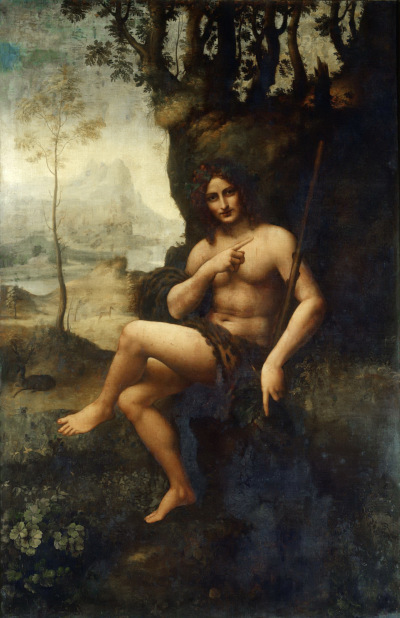
The painting commonly known as Bacchus needs a cautious attribution from the outset. The Louvre’s governing collection record does not present it simply as Bacchus by Leonardo. It records the object under the title Saint Jean Baptiste, gives the inventory INV 780 ; MR 325, and places it in Leonardo da Vinci’s workshop, with an attribution to Francesco Melzi [1].
That complicated identity is exactly what makes the picture worth a focused account. The work stands at the edge of Leonardo’s late inventions, workshop practice, later collecting history and seventeenth-century transformation. It appears today as a youthful, full-length figure in a landscape, crowned and equipped with attributes associated with Bacchus. Yet the Louvre record explains that it began as a Saint John the Baptist image and was transformed into Bacchus in the seventeenth century [1].
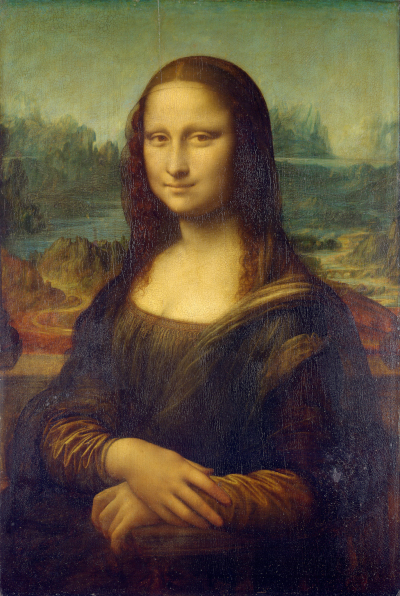
This work therefore needs a different kind of attention from the better-known Leonardo paintings. Mona Lisa, The Virgin and Child with Saint Anne and the small Louvre Saint John the Baptist have object identities governed by direct Leonardo attribution at the Louvre [2] [3]. Bacchus is more fragile. It has to be read as a transformed workshop painting, connected with Leonardo’s invention and with Melzi’s name, but not safely described as an autograph Leonardo masterpiece.
That does not make the work unimportant. It makes it a revealing object in a different way. The painting shows how Leonardo’s late figure types could circulate, be reworked, retitled and reinterpreted. It also shows why object identity matters. A familiar title can hide a more complicated history. In this case, the word Bacchus names the painting’s later appearance, while the Louvre title Saint Jean Baptiste preserves the older religious subject beneath the transformation [1].
At a Glance
- AttributionLeonardo da Vinci’s workshop; attributed to Francesco Melzi
- Page titleBacchus
- Louvre titleSaint Jean Baptiste
- DateAround 1517–1520
- Medium and supportOil on canvas, transferred from wood to canvas
- Dimensions1.77 m high × 1.15 m wide
- CollectionMusée du Louvre, Department of Paintings
- DisplaySalle 710, Denon wing, Level 1
- InventoryINV 780 ; MR 325
- StatusSaint John image transformed into Bacchus in the seventeenth century
Contents
- Introduction
- At a Glance
- Bacchus and the Louvre’s Saint Jean Baptiste
- Object Facts: Inventory, Date, Medium and Display
- Workshop Attribution and Francesco Melzi
- From Saint John the Baptist to Bacchus
- Relationship to Leonardo’s Small Saint John the Baptist
- Transformation, Restoration and Technical Caution
- Provenance: Fontainebleau, the Royal Collection and the Louvre
- What Not to Claim
- Why the Bacchus Page Matters
Bacchus and the Louvre’s Saint Jean Baptiste
The Louvre’s collection record is the safest starting point. It identifies the object as Saint Jean Baptiste, gives the inventory INV 780 ; MR 325, and assigns it to the Department of Paintings [1]. The painting is listed as currently visible in Salle 710, Denon wing, Level 1, the same broad Louvre context in which several major Leonardo works are displayed [1] [2].
The title is part of the evidence. Bacchus remains the familiar name in the Leonardo tradition and on this route, but the Louvre record shows that the work began as a Saint John the Baptist image and was later changed into Bacchus [1].
This matters because Bacchus and Saint John carry very different meanings. Bacchus is the classical god of wine, ecstasy and transformation. Saint John the Baptist is a prophetic religious figure who announces Christ and points beyond himself. A painting that moves between those identities is not just a subject picture. It is an object with a visible history of reinterpretation.
The visible attributes now point toward classical mythology: vine or ivy, staff, grapes and landscape. The Louvre record, however, preserves the earlier identity by titling the work Saint Jean Baptiste and recording its seventeenth-century transformation [1]. The page therefore keeps both facts in view: the work is commonly encountered as Bacchus, and the Louvre object is a transformed Saint John.
That double identity gives the work its place in the Leonardo cluster. It belongs near the small Louvre Saint John the Baptist, but it must not be confused with it. The small Saint John, inventory INV 775 ; MR 318, is a separate autograph Leonardo painting, a half-length figure emerging from darkness and pointing upward [3]. Bacchus, inventory INV 780 ; MR 325, is a larger full-length landscape figure with a different attribution and a transformed subject history [1].
Object Facts: Inventory, Date, Medium and Display
The Louvre dates the Bacchus/Saint John object to the first quarter of the sixteenth century, around 1517 to 1520 [1]. That places it in the late orbit of Leonardo’s final years and his immediate circle. The date is important, but it should not be used to make the painting an autograph Leonardo work. The Louvre’s attribution language is more cautious: Leonardo da Vinci’s workshop, attributed to Francesco Melzi [1].
The medium and support also show that the object has a history of physical change. The Louvre records it as oil on canvas, transferred from wood to canvas [1]. That transfer matters because it reminds the reader that the painting’s present material state is not identical with its original support. The fact does not need to become a dramatic conservation story. The basic point is enough: the work is now on canvas, but it was transferred from wood [1].
The Louvre gives the dimensions as 1.77 metres high by 1.15 metres wide, with accessory dimensions recorded separately [1]. This makes it a substantially larger work than the small Louvre Saint John the Baptist, which the Louvre records at 0.729 metres by 0.563 metres [3]. The scale difference supports the object distinction. These are not two labels for the same picture. They are two different Louvre objects, with different inventories, formats, subjects and attribution problems.
The Louvre currently lists the painting as visible in Salle 710, Denon wing, Level 1 [1]. Because museum displays can change, that room location is cited as the Louvre’s current listing, not as a permanent condition of the object.
The inventory number deserves to be visible because it protects the reader from the common confusion around Leonardo-related Saint John imagery. INV 780 ; MR 325 belongs to the transformed workshop object discussed here [1]. INV 775 ; MR 318 belongs to the small autograph Saint John the Baptist [3]. Keeping those numbers in view is a simple way to keep the account honest.
Workshop Attribution and Francesco Melzi
The attribution is central. The Louvre record does not assign the painting to Leonardo alone. It connects the object with Leonardo’s workshop and names Francesco Melzi as the attributed artist [1]. Melzi was one of Leonardo’s closest pupils and heirs, and his name is important for works that stand near Leonardo’s late designs without being secure autograph paintings.
That attribution posture changes the whole tone of the article. The painting can be described as Leonardo-related, workshop-associated and connected with Leonardo’s late invention. It should not be presented as a secure painting by Leonardo da Vinci. The difference is not pedantic. It changes how the reader understands every feature of the object: its style, its subject, its relationship to the small Saint John, and its place in the Louvre’s Leonardo rooms.
The Louvre record also discusses a red-chalk drawing formerly considered by some scholars as evidence for Leonardo’s own design. The museum’s account is more cautious, saying that the Varese drawing should rather be considered a workshop work, perhaps by Francesco Melzi [1]. That note is useful because it blocks an easy but unsafe argument. A related drawing does not automatically make the painted object autograph Leonardo.
The painting therefore resists a romantic story in which Leonardo created a Bacchus, Melzi merely helped, and later history obscured the truth. The Louvre record points in another direction. It preserves the Leonardo workshop connection, but it gives the attribution to Melzi and treats the subject transformation as a later intervention [1].
That caution strengthens the account. Workshop attribution shows how Leonardo’s late figure inventions moved through pupils, assistants and collectors, and why a museum record may preserve a familiar Leonardo association without treating the object as a secure autograph painting.
From Saint John the Baptist to Bacchus
The Louvre record states that the painting was transformed into Bacchus in the seventeenth century [1]. That sentence should guide the public interpretation. The Bacchic identity is real in the present image, but it is not the original subject in a simple sense. The figure’s attributes were changed so that a Saint John image became readable as Bacchus.
This transformation helps explain why the painting can feel slightly unstable. It is not simply a classical god standing in a landscape. The pose, body type and pointing gesture belong to a wider field of Leonardo-related Saint John imagery. Later attributes redirect that figure toward Bacchus. The result is an image that carries traces of two worlds: Christian prophecy and classical mythology.
The Louvre identifies specific Bacchic changes, including the addition or alteration of attributes such as grapes, the ivy crown and the thyrsus [1]. These elements make the present image legible as Bacchus. But because they belong to a later transformation, they should not be treated as proof of Leonardo’s original mythological intention.
The original Saint John identity matters because John’s iconography depends on witness and pointing. In the Gospel of John, John is described as a witness to the light, not the light itself [4]. In the Gospel of Matthew, he appears as the wilderness preacher associated with an austere prophetic role [5]. Leonardo’s small Louvre Saint John the Baptist turns that witness into a dark, concentrated half-length figure [3]. The larger Bacchus/Saint John object belongs near that tradition, but through workshop transmission and later transformation rather than direct identity.
The seventeenth-century change is also part of collecting history. Early modern collectors often received, renamed, altered or reinterpreted works according to changing tastes. A religious figure could become a mythological figure if its pose and attributes allowed the shift. In this case, the later Bacchic surface did not erase the older Saint John identity completely. The Louvre record keeps both histories in view [1].
Relationship to Leonardo’s Small Saint John the Baptist
The most important comparison is the small Louvre Saint John the Baptist, inventory INV 775 ; MR 318 [3]. That painting is an autograph Leonardo work according to the Louvre, dated around 1508 to 1519, painted in oil on walnut wood, and still unfinished at Leonardo’s death [3]. It shows a single half-length figure emerging from darkness, smiling and pointing upward.
The Bacchus/Saint John object is different in almost every practical respect. It is larger, full-length, set in a landscape, recorded as oil on canvas transferred from wood, and attributed to Leonardo’s workshop with Francesco Melzi named [1]. Its inventory is INV 780 ; MR 325 [1]. Those differences should be made explicit because the two works can otherwise become tangled in a reader’s mind.
The comparison is still useful. Both works involve the Baptist tradition, a youthful figure, a turned body and a pointing gesture. Both belong to the late Leonardo orbit at the Louvre. Both show how a figure can direct the viewer’s attention beyond himself. But the comparison must never collapse the two objects into one.
A careful account can say that Bacchus helps reveal the afterlife of Leonardo’s Saint John type. It can also say that the small Saint John gives readers a secure autograph point of reference for Leonardo’s late handling of the Baptist. What it cannot safely say is that the larger Bacchus is simply another Leonardo Saint John or that the transformation into Bacchus was part of Leonardo’s own final plan.
The distinction also protects the two works from being folded together. The smaller Saint John centres the autograph Louvre painting INV 775 ; MR 318 and its witness-to-light iconography. Bacchus centres INV 780 ; MR 325, the workshop attribution, and the later transformation. The two works can illuminate each other, but each needs its own governing object record.
Transformation, Restoration and Technical Caution
The Louvre record makes transformation central to the object’s history [1]. It also notes restoration and technical examination in relation to understanding the painting’s state and changes [1]. Those details are valuable, but they need disciplined language.
The strongest public claim is that the work was changed into Bacchus in the seventeenth century and that later study has helped clarify aspects of the transformation [1]. A responsible account does not need to invent a full technical sequence, name hidden layers that have not been directly sourced, or claim that every present attribute can be assigned to a precise moment or hand.
The transfer from wood to canvas is also important [1]. Transfers can profoundly affect a painting’s material history, but the process does not need to be dramatised without evidence. It is enough to state the current medium/support information and explain why it matters: the object we see today has passed through both iconographic transformation and material intervention.
Transformed paintings invite speculation, but the surviving evidence does not answer every question. The Louvre record establishes the earlier Saint John identity and the later Bacchus transformation; it does not fully reconstruct the original appearance or settle how much of the first design can be connected to Leonardo’s own hand [1].
That uncertainty can become part of the reader’s experience. The painting matters not because it provides a simple solution, but because it shows layers of artistic invention, workshop execution, collecting taste and restoration history. A strong account should let those layers remain visible without pretending that they are all settled.
Provenance: Fontainebleau, the Royal Collection and the Louvre
The Louvre record gives the object a French royal and museum history that helps explain why it belongs in the Louvre Leonardo context [1]. The painting is first mentioned in 1625 by Cassiano dal Pozzo at Fontainebleau [1]. The record indicates that an earlier entry into the French royal collection is probable, but that certainty is not available in the same way as for later documented stages [1].
That early reference places the picture in a major French royal setting. Fontainebleau mattered deeply to the later reception of Leonardo-related works in France, but a probable early French history is not the same as a documented commission or secure gift.
The painting later belonged to the Crown collection and entered the Louvre in the revolutionary museum period [1]. The Louvre record gives the acquisition context as 1793 [1]. That public museum history matters because the object’s identity as Bacchus or Saint Jean Baptiste has been shaped not only by its making, but also by the way it was collected, displayed and catalogued.
The provenance story also fits the transformation story. By the time a painting is recorded in a royal collection, it may already have passed through changes of title, subject and appearance. The Bacchus/Saint John object is not a static Renaissance object frozen at the moment of creation. It is a work with an afterlife.
The painting’s French afterlife connects it to Leonardo’s reception in France and to the Louvre’s broader Leonardo holdings [2]. Provenance can establish historical presence and collecting importance, but attribution still has to be governed by the museum’s object record.
What Not to Claim
The simplest wording, Bacchus by Leonardo da Vinci, is too strong for the current source evidence. The safer frame is Bacchus and Leonardo’s Workshop, or another formulation that keeps the attribution question visible from the start.
The second mistake is to treat the Bacchic attributes as original. The Louvre’s record says the painting was transformed into Bacchus in the seventeenth century [1]. Grapes, ivy and the thyrsus belong to the current Bacchic reading, but they should not be made to express Leonardo’s original mythological programme.
The third mistake is to merge the painting with the small autograph Saint John the Baptist. The two Louvre objects have different inventory numbers, different formats, different media/support information and different attribution status [1] [3]. They are related by subject tradition and Leonardo’s circle, not identical as objects.
The fourth mistake is to use workshop attribution as a vague compromise. “Workshop” is not an apology or a decorative label. In this case, it is the governing attribution category, with Francesco Melzi specifically named by the Louvre [1]. That fact can stand plainly.
Technical evidence also needs restraint. The Louvre record supports the transformation and gives important material facts, but a detailed conservation narrative would require directly cited technical sources.
Why the Bacchus Page Matters
Bacchus matters because it shows how a Leonardo-related image can change identity across time. It is not one of the cleanest Leonardo subjects, but it is one of the most revealing. It asks readers to think about attribution, workshop practice, iconographic transformation and museum naming all at once.
The painting’s value is not that it gives us another secure Leonardo autograph. It does not. Its value is that it preserves a late Leonardo workshop invention, attributed by the Louvre to Francesco Melzi, in a form that was later reshaped into Bacchus [1]. That makes it a story about transformation in more than one sense: religious subject into classical god, wood support into canvas, workshop object into royal and museum painting, simplified traditional title into a more careful modern account.
For the Leonardo sequence, this subject does important repair work. It protects the small autograph Saint John the Baptist from confusion. It gives Melzi and the workshop a clearer role. It shows readers why museum attribution language matters. And it replaces a misleading autograph frame with a more interesting truth.
The familiar title Bacchus remains useful, but the object identity behind it is more precise: a Louvre Saint Jean Baptiste, transformed into Bacchus, tied to Leonardo’s workshop and attributed to Francesco Melzi [1].
Frequently Asked Questions
Discussion
Use this space to discuss Bacchus, its source evidence and how it fits into Leonardo da Vinci's wider cluster.
Keep comments focused on close looking, attribution language, object evidence and page-specific caveats.
Reader Insights
Which detail on this page most changes how you read the work?
How does this page connect to Leonardo's paintings, drawings, inventions or workshop context?
Where should the wording stay cautious because the source evidence is qualified?
Join the Conversation
Share your reading of Bacchus below.
References
- Musée du Louvre, Saint Jean Baptiste, collection record, INV 780 ; MR 325.
- Musée du Louvre, Leonardo da Vinci, exhibition page, 2019–2020.
- Musée du Louvre, Saint Jean Baptiste, collection record, INV 775 ; MR 318.
- Bible Gateway, John 1:6–8, King James Version.
- Bible Gateway, Matthew 3:1–4, King James Version.