 by Tom Gurney
Tom Gurney BSc (Hons) is an art history expert with over 20 years experience
Published on June 19, 2020 / Updated on July 26, 2026
Email: tomgurney1@gmail.com / Phone: +44 7429 011000
The Love Letter by Johannes Vermeer: Introduction
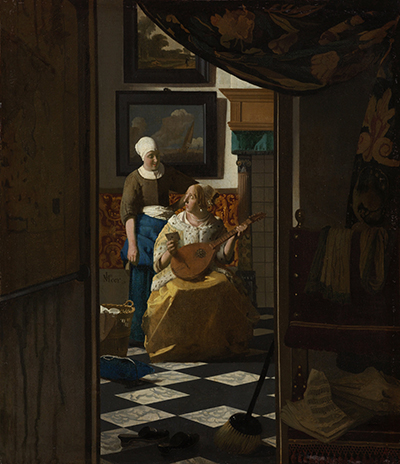
Johannes Vermeer’s The Love Letter is one of his most theatrical paintings of private communication. The viewer looks through a dark foreground into a bright interior where a seated woman receives a letter from a maid. A lute rests in her lap. The maid stands above her with a knowing presence. The scene is intimate, but it is also staged through doorways, curtains, objects and withheld information.
The Rijksmuseum records the painting as The Love Letter, about 1669-1670, oil on canvas, 44 by 38.5 cm, object number SK-A-1595. [1] It is signed IVMeer and displayed in the Gallery of Honour. [1] The title gives the likely emotional territory, but Vermeer still refuses to tell the whole story.
At a Glance
- ArtistJohannes Vermeer
- TitleThe Love Letter
- DateAbout 1669-1670
- MediumOil on canvas
- Dimensions44 x 38.5 cm
- CollectionRijksmuseum, Amsterdam
- Object numberSK-A-1595
- Key themesLetter, love, music, maid, threshold, privacy, looking
Contents
- Introduction
- At a Glance
- What the Painting Shows
- Love, Music and Letters
- The Threshold View
- Paintings Within the Painting
- Maid and Mistress
- Objects in the Foreground
- Cittern, Music and Emotional Expectation
- Theft, Damage and Restraint
- Place in Vermeer’s Work
- Theft and Recovery
What the Painting Shows
The painting is built around a view into another room. The foreground is dark and partly obstructed, with a curtain, doorway and domestic objects creating the sense that the viewer is looking from outside the main action. Inside the brighter room, a seated woman holds or receives a letter from a maid. The woman’s lute and the paintings on the back wall deepen the association between music, love and emotional exchange.
This structure makes the viewer a kind of witness. We are not placed comfortably inside the room. We look through a threshold, as if the scene has been discovered. Vermeer uses architecture to create privacy and distance at the same time.
The maid is crucial. She stands upright, looking down toward the seated woman. Her expression and posture suggest that she understands the letter’s significance, but Vermeer keeps the psychological relationship ambiguous. Is she delivering good news, teasing her mistress, or simply performing a household task? The painting does not settle the question.
Love, Music and Letters
In Dutch painting, letters and music often carry associations of love. Vermeer uses those associations, but he does not reduce the scene to a simple emblem. The lute in the woman’s lap points toward harmony, courtship and emotional responsiveness. The letter introduces absence and communication. The maid brings the outside world into the private room.
The title The Love Letter encourages a romantic reading, and the objects support it. Yet the painting’s real strength lies in its uncertainty. The viewer sees the moment of delivery or response, but not the letter’s contents. As in many Vermeer paintings, the message is present but inaccessible.
This makes the scene more compelling. A fully explained love story would be smaller. Vermeer gives us the conditions of a story—letter, messenger, music, privacy—but leaves the emotional outcome open.
The Threshold View
The dark foreground is one of the painting’s most important inventions. It makes the main scene feel set back, framed and partially hidden. The curtain, doorway and objects create a sense of looking through rather than simply looking at. This gives The Love Letter a theatrical quality, but the theatre is domestic.
The device also controls the viewer’s role. We are invited to look, but the painting reminds us that we are outside the private exchange. The composition turns curiosity into part of the subject. To look at the painting is to experience the tension between access and exclusion.
This threshold structure connects The Love Letter to Vermeer’s broader interest in rooms within rooms, foreground barriers and mediated seeing. He often makes the viewer aware of the act of looking. Here, that awareness becomes almost narrative.
Paintings Within the Painting
The pictures on the back wall are not incidental. They belong to the network of meaning around love, travel, sea and emotional uncertainty. In seventeenth-century Dutch interiors, paintings-within-paintings often guide interpretation, but Vermeer uses them with restraint. They suggest rather than explain.
The seascape is especially relevant because Dutch viewers often associated ships and the sea with absence, danger, travel and unstable fortune. In a letter scene, that background can deepen the sense of separation between lovers. But again, Vermeer avoids a single fixed meaning. The painting’s objects work together as atmosphere, not as a code to be solved mechanically.
Maid and Mistress
The relationship between the two women is central to the painting. The seated woman receives the letter, but the maid controls the moment of delivery. She stands above her mistress and seems to understand more than she says. This creates a delicate social drama inside the household.
Vermeer often uses servants and maids as mediators of communication. Here the maid is not background staff. She is the figure who brings the outside message into the private room. Her posture gives the scene its spark of human tension.
The painting also depends on difference in height, position and knowledge. The mistress is seated with the instrument in her lap, interrupted by the letter. The maid stands, active and watchful. The viewer is outside both positions, looking through the darkened threshold.
Objects in the Foreground
The foreground objects help define the viewer’s distance from the scene. The dark framing area, domestic items and curtain do not simply decorate the composition. They obstruct and mediate the view. Vermeer makes the viewer aware that private life is being seen from outside.
The broom, slippers and household objects recorded by the Rijksmuseum contribute to this threshold effect. [1] They belong to the everyday world of the house, but their placement makes them part of the painting’s visual theatre. They remind the viewer that love, music and letters occur inside ordinary domestic space.
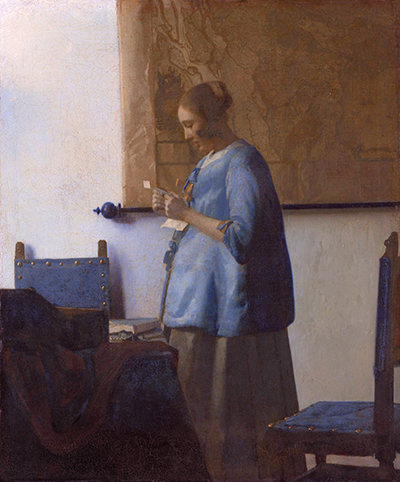
This is one reason The Love Letter feels more staged than Woman in Blue Reading a Letter. The Rijksmuseum painting of the woman in blue removes almost everything except reader, letter and map. The Love Letter adds architecture, messenger, instrument and foreground barrier. It turns privacy into a spatial performance.
Cittern, Music and Emotional Expectation
The instrument in the woman’s lap is central to the interpretation. The Rijksmuseum identifies it within the lute or cittern family, and the musical association supports the theme of love. [1] Music in Dutch painting often suggests harmony, courtship, emotional tuning or social exchange.
Here the instrument is interrupted by the letter. That interruption matters. The seated woman has been engaged in music or is associated with music, but the arrival of the message shifts the scene into another mode of attention. Sound gives way to reading, or perhaps music and letter become two forms of love communication.
Vermeer leaves the emotional result unresolved. The woman’s expression is expectant rather than fully legible. The maid’s presence hints at shared knowledge. The instrument suggests feeling, but the letter withholds its words.
Theft, Damage and Restraint
The painting’s 1971 theft and recovery are part of its modern history, but they require restraint. The episode is relevant because it affected the painting’s public life and conservation history, yet it should not turn the page into a crime story. Vermeer’s composition remains the central subject.
If the theft is discussed, it should be kept brief and tied to museum documentation. The stronger art-historical story is Vermeer’s spatial construction: a private room seen through a dark threshold, a letter that cannot be read, music suspended by communication and a maid who mediates the event.
Place in Vermeer’s Work
The Love Letter belongs to Vermeer’s late group of letter and music paintings. It connects directly with Woman in Blue Reading a Letter, A Lady Writing, Girl Reading a Letter at an Open Window, Lady Writing a Letter with her Maid, The Music Lesson and The Concert. Together these works show how Vermeer used communication and music to explore privacy, desire and social performance.
The painting is also important because it demonstrates Vermeer’s control of spatial framing. Compared with the frontal quiet of Woman in Blue Reading a Letter, The Love Letter is more staged and more layered. It makes the viewer conscious of distance from the scene.
It also provides an important bridge between the letter paintings and the music paintings. The letter supplies absence and message; the instrument supplies emotional harmony and courtship. Vermeer joins them inside one carefully framed interior.
Theft and Recovery
The painting has a modern history that should be kept proportionate. It was stolen in 1971 and later recovered, an episode that can add to the work’s reception history. But the theft should not overwhelm the painting itself. The central subject remains Vermeer’s carefully constructed interior of letter, music, maid and threshold.
Frequently Asked Questions
The Love Letter is in the Rijksmuseum in Amsterdam. [1]
The Rijksmuseum dates it to about 1669-1670. [1]
The contents of the letter are not shown. Vermeer suggests a love letter through title, context, music and the relationship between mistress and maid.
The lute and musical associations connect the scene with love, harmony and emotional response, themes that recur in Vermeer’s interiors.
Discussion
What feels most revealing about The Love Letter: Vermeer's handling of light, the silence of the scene, the object details, the attribution history, or the way the painting fits within Dutch Golden Age art?
Reader Insights
Vermeer rewards slow attention. Begin with the main action, then move outward to light, edges, objects and the quiet spaces that hold the composition together.
Many of these paintings are small, but their meanings open through Delft, collecting history, technical study and comparison with related Dutch interiors.
Pair this article with the biography and one neighbouring Vermeer work to see how subject, light and attention shift across the artist's compact oeuvre.
Join the Conversation
Have a thought or observation about The Love Letter? Share it below. Thoughtful responses may be added to this section as the Vermeer pages develop.
References
- Rijksmuseum, The Love Letter, SK-A-1595.