


 by Tom Gurney
Tom Gurney BSc (Hons) is an art history expert with over 20 years experience
Published on June 19, 2020 / Updated on July 16, 2026
Email: tomgurney1@gmail.com / Phone: +44 7429 011000
The Guitar Player and the Vermeer Comparison Problem: Introduction
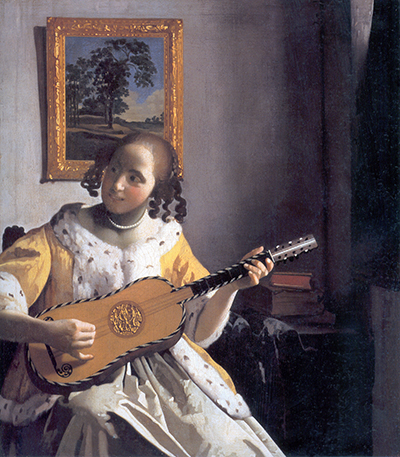
The Guitar Player is one of Vermeer’s late music paintings and one of the most useful cases for explaining how attribution, copies and technical evidence can complicate a famous artist’s catalogue. The accepted version is associated with Kenwood House in London, while a closely related painting in the Philadelphia Museum of Art has recently received renewed attention through side-by-side comparison.
This subject should not be treated as a simple “famous painting” story. It needs the late Vermeer context, the Kenwood work, the Philadelphia comparison and the limits of current evidence.
At a Glance
- Main subjectThe accepted Kenwood version of The Guitar Player
- Comparison workPhiladelphia Museum of Art, The Guitar Player
- Philadelphia current maker fieldArtist/maker unknown
- Key themesLate style, music, copy, attribution, technical comparison
- Image notePublic imagery should be clearly separated from attribution claims
Contents
- Introduction
- At a Glance
- Why This Page Needs Caution
- The Kenwood Work
- The Philadelphia Comparison Painting
- Double Vision at Kenwood
- Late Style and the Guitar
- Copy, Self-Copy and Attribution
- Relation to Other Vermeer Attribution Pages
- Place in Vermeer’s Work
- Frequently Asked Questions
- Discussion
Why This Page Needs Caution
The caution is necessary because the page sits between two different tasks. One is to explain Vermeer’s late Guitar Player. The other is to explain why the Philadelphia comparison painting matters without presenting it as an accepted Vermeer.
The Philadelphia Museum of Art object record currently identifies its The Guitar Player as by an unknown artist, with Vermeer in the attribution history rather than as the current maker. [1] That distinction must remain visible. A comparison can be important without giving both objects the same status.
Recent public discussion around the Kenwood and Philadelphia works has made the comparison more visible, but visibility is not the same as settled authorship. The safest reading avoids announcing a conclusion not supported by the current institutional records.
The Kenwood Work
The accepted Kenwood version of The Guitar Player is usually discussed as a late Vermeer. It shows a young woman with a guitar, an instrument that gives the painting a livelier and more modern musical character than many earlier lute or virginal scenes.
The painting belongs near Vermeer’s late music works: The Music Lesson, The Concert, A Young Woman Standing at a Virginal and A Young Woman Seated at a Virginal. Yet its mood is different. The guitar suggests movement, sound and informality. The player’s pose is more animated than the stillness of many earlier Vermeer interiors.
That late energy is one reason the painting matters. Vermeer’s final works are not simply quieter versions of his earlier interiors. They often show bolder composition, sharper pattern and more active musical presence.
The Philadelphia Comparison Painting
The Philadelphia Museum of Art holds a related painting also titled The Guitar Player. Its visible object record lists the maker as unknown and records Vermeer as formerly attributed. [1] That makes the painting valuable for comparison and attribution history, but not safe to present as an accepted Vermeer.
The comparison matters because copies and near-duplicates can reveal how an artist’s work circulated, how connoisseurship changed and how modern technical study tests older assumptions. A copy can be historically important even when it is not autograph.
The Philadelphia work therefore belongs in the page as a comparison object, not as a second secure Vermeer.
Double Vision at Kenwood
Recent coverage of Double Vision: Vermeer at Kenwood reported that the Kenwood and Philadelphia guitar-player paintings were shown together, inviting close comparison. The display ran from 1 September 2025 to 11 January 2026, according to contemporary reporting. [2]
This is exactly the kind of situation where a reader needs careful guidance. A side-by-side display can make differences visible, but it does not automatically settle attribution. It can sharpen the questions: which painting has the stronger material evidence, which handling is closer to Vermeer’s late style, and whether the relationship is copy, workshop, later imitation or something more unusual.
Country Life’s coverage summarised reported technical contrasts, including differences in ground and blue pigments between the two paintings. [3] Those details are useful as current context, but they should not replace official object records or final scholarly publication.
Late Style and the Guitar
The guitar gives the Kenwood painting much of its character. Compared with the lute, the guitar suggests a more direct and lively musical presence. It is associated with strumming, rhythm and movement.
In Vermeer’s late style, that matters. Earlier works often hold sound at a distance, through poised lessons or silent instruments. The Guitar Player feels more active. The player is not merely positioned beside an instrument; she seems engaged in performance.
This musical difference links the painting to broader changes in Vermeer’s final years. Music becomes less only a sign of refinement and more a sign of immediacy, motion and social presence.
Copy, Self-Copy and Attribution
The central comparison question is not whether the Philadelphia painting resembles the Kenwood work. It does. The question is what kind of relationship the evidence supports.
A later copy, a studio-related work, a version by another artist and a self-copy by Vermeer would all mean different things. They would change how readers understand Vermeer’s working practice, his market, his studio environment and the afterlife of his images.
Because the current Philadelphia record does not present the work as Vermeer, the language of discovery would be misleading. The safer wording is that recent technical and public comparison has reopened discussion while institutional attribution remains cautious.
Relation to Other Vermeer Attribution Pages
This work belongs with Girl with a Flute and the Leiden seated-virginal painting as part of Vermeer’s attribution-history story. Each case is different. Girl with a Flute is currently presented by the National Gallery of Art as Studio of Johannes Vermeer. The Leiden seated virginal is currently presented by its collection as Vermeer but has a complex reception and title-confusion history. The Philadelphia guitar-player comparison is currently listed as by an unknown artist.
Together, these pages teach the same larger lesson: Vermeer’s small oeuvre requires careful status language. A painting can be close to Vermeer, historically important and visually compelling without being safely described as an accepted autograph work.
That lesson should be visible to readers rather than hidden in footnotes.
Place in Vermeer’s Work
The Kenwood Guitar Player matters because it extends Vermeer’s music theme into a livelier late register. It connects the refined music interiors to a more animated image of performance.
The comparison with Philadelphia matters for a different reason. It shows how Vermeer’s late style remains a live field of technical and attribution research. Even when the accepted work is clear, related versions can complicate the story.
The subject has strong value, but it is not a straightforward accepted-work story. Its usefulness depends on keeping the accepted Kenwood context separate from the unsettled Philadelphia comparison.
Frequently Asked Questions
The accepted version is associated with Kenwood House in London.
It is a closely related painting in the Philadelphia Museum of Art. The museum’s visible record currently lists the maker as unknown and records Vermeer as formerly attributed. [1]
It should not be presented as an accepted Vermeer under the current Philadelphia object record. It is best treated as a comparison and attribution-history object.
They allow readers to see how technical evidence, materials, condition and handling can shape attribution discussions around closely related works.
No. The approved first Forensic Comparison feature is planned for Girl with the Red Hat and Girl with a Flute. This guitar-player page may later support a different comparison treatment, but it should not duplicate the Kenwood display.
Discussion
What feels most revealing about The Guitar Player and the Vermeer Comparison Problem: Vermeer's handling of light, the silence of the scene, the object details, the attribution history, or the way the painting fits within Dutch Golden Age art?
Reader Insights
Vermeer rewards slow attention. Begin with the main action, then move outward to light, edges, objects and the quiet spaces that hold the composition together.
Many of these paintings are small, but their meanings open through Delft, collecting history, technical study and comparison with related Dutch interiors.
Pair this article with the biography and one neighbouring Vermeer work to see how subject, light and attention shift across the artist's compact oeuvre.
Join the Conversation
Have a thought or observation about The Guitar Player and the Vermeer Comparison Problem? Share it below. Thoughtful responses may be added to this section as the Vermeer pages develop.
References
- Philadelphia Museum of Art, The Guitar Player, object 102282.
- The Guardian, coverage of Double Vision: Vermeer at Kenwood, 2025.
- Country Life, coverage of Double Vision: Vermeer at Kenwood, 2025.
- Vermeer research notes on Kenwood, Philadelphia and late music paintings.