


 by
Tom Gurney
Tom Gurney BSc (Hons) is an art history expert with over 20 years experience
Published on June 19, 2020 / Updated on October 22, 2026
Email:
tomgurney1@gmail.com
/ Phone:
+44 7429 011000
Christ Taken Captive (Large Passion): Introduction
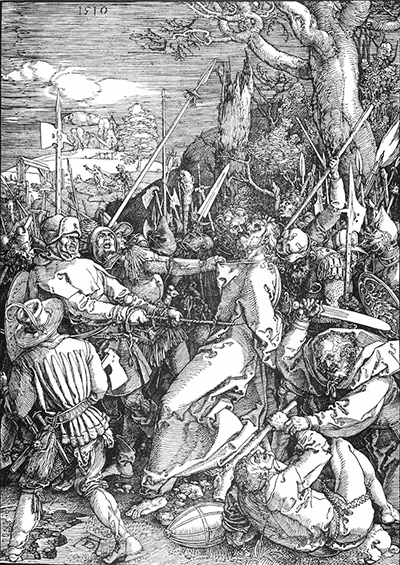
Christ is almost engulfed by the arresting party in Albrecht Dürer’s Christ Taken Captive . Weapons cross above his head, a rope stretches across his body, and two men fight at his feet. His light robe remains visible through the crush, but the space around him has closed. Dated 1510 at the upper left, this woodcut belongs to the Large Passion , published in book form in 1511. The ALBERTINA’s impression DG1994/15/4 is catalogued as part of that book edition, with the familiar Dürer monogram at the lower left. [1]
The scene takes place in the Garden of Gethsemane, where Judas has led an armed party to seize Jesus. The Allen Memorial Art Museum at Oberlin describes Dürer’s chosen instant as immediately after the identifying kiss, with Judas withdrawing from Christ’s side. That makes the picture’s suspended action particularly disturbing. An intimate approach has already delivered Christ into other hands. The event spreads outward into restraint, resistance and flight while the figures remain entangled. [2]
At a Glance
- Design date 1510 [1]
- Process Woodcut [1]
- Series Large Passion; 1511 book edition [1]
- Pushkin impression, Г-2380397 × 283 mm [22]
This work across Albrecht Dürer’s career
Young Hare
1502Praying Hands
1508Melencolia I
1514Four Apostles
1526Contents
- A crowd made of competing movements
- The arrest in the Gospels
- Christ’s lifted face
- Ink, paper and the life of the design
- Frequently Asked Questions
A crowd made of competing movements
Dürer gives the crowd several incompatible directions. The armoured man at the left foreground strides towards the lower edge, showing his back and the pleated lower part of his costume. Men behind him press towards Christ. Across the centre, hands, rope and sleeves form a horizontal band that seems to pull the group sideways. At the right, the raised sword of Peter creates another force, poised to descend. These movements obstruct one another, giving the arrest a physical urgency even before one follows the story.
The weapons extend this agitation above the figures. Some shafts run nearly upright; others lean steeply across the open sky or converge beside the great tree. They give the crowd a reach far beyond its packed heads and shoulders. The exposed blades and long poles also prevent the upper half of the picture from becoming a resting place for the eye. Even where there are few bodies, their instruments occupy the space.
Christ’s robe provides a different kind of line. Its broad, comparatively open surfaces can be followed down through the congestion, allowing the principal figure to hold together amid fragments of armour, hats and faces. He stands at an angle, with his head lifted and turned. One arm reaches out across the surrounding men. His body has been caught, yet his gesture carries farther than the small enclosure they have made around him. Dürer establishes the drama through this difference between a figure one can read as a whole and a crowd encountered in interrupted pieces.
The foreground offers no safe distance from the violence. Peter bends over the fallen servant, his weapon raised, while the servant’s body twists along the lower right. A lantern lies close to the bottom edge. Christ’s long garment, Peter’s bent torso and the man on the ground form a chain of pale shapes across the lower half. Following that chain leads the eye from the captive to the violence being committed in his defence.
The arrest in the Gospels
Matthew supplies the kiss, the seizure and the sudden sword attack. Judas has arranged a sign with the armed multitude: the person he kisses is to be taken. After the arrest begins, one of Jesus’s companions draws a sword and cuts off the high priest’s servant’s ear. Jesus orders the weapon put away and explains his acceptance of what must happen. The passage ends with the disciples abandoning him and fleeing. Dürer gathers these connected actions into one field, so that betrayal, resistance and desertion can be understood together. [13]
The names Peter and Malchus come from John’s account. John identifies Simon Peter as the swordsman and Malchus as the high priest’s servant, specifying that the right ear is cut off. His narrative also describes the party’s lanterns, torches and weapons, and concludes this stage with Jesus being bound. These details help explain why the woodcut contains both the apparatus of a night arrest and a conspicuous struggle in front. The swordsman is one of Christ’s disciples; the man beneath him belongs to the group that has come to take Christ. [14]
Luke adds a further element: Jesus touches the injured ear and heals the servant. The accounts should retain their separate emphases. Matthew stresses the command to stop fighting and the fulfilment of scripture; John gives the participants’ names; Luke describes the healing. The print’s outstretched hand can be considered alongside that act of mercy, but a hand extended across a crowded picture does not by itself establish that the healing is being shown. Peter’s raised blade keeps the injury, or its imminent threat, before us. [15]
The contrast between Jesus and Peter is therefore more demanding than a division between a peaceful victim and his hostile captors. Peter is trying to help, yet his action belongs to the violence Jesus refuses. His forceful downward movement competes with Christ’s reaching arm. The disciple’s loyalty has become an assault on another body. That complication gives the scene a moral tension which would disappear if every armed figure were treated as an interchangeable enemy.
There is also a smaller drama of escape beyond the principal group. Tiny figures occupy the rising ground at the upper left, where distance has reduced the arrest’s bodily pressure to scattered movements. Mark’s account includes the striking episode of a young man who escapes capture by leaving his linen covering behind. The distant activity broadens the woodcut’s world: while Christ is held fast in front, movement remains possible elsewhere. Dürer makes the viewer look past the seizure to discover that other people can still get away. [16]
Christ’s lifted face
Christ’s expression does not resolve into a single easily named emotion. His upward turn separates his attention from the immediate tasks of the men around him, whose looks and gestures are absorbed by the seizure. Oberlin emphasises the calm of his gaze. The nineteenth-century German art historian Hermann Knackfuß responded differently. In his 1897 Dürer , he read the lifted eyes as an appeal to heaven marked by human terror, and Peter’s anger as understandable but futile. [2] [17]
Those responses draw attention to a real tension in the image. Christ’s head is raised, but his body remains within the captors’ reach. The face can suggest an appeal beyond the visible scene without making the physical danger less immediate. His large, light garment gives him composure within the design; the constriction around his head and arms denies him ease. The woodcut allows acceptance of suffering and the experience of suffering to remain close together.
Its place in the Large Passion sharpens that effect. The arrest follows the Agony in the Garden , an earlier design dated around 1496–97 in the Pushkin Museum’s catalogue. In that image, Christ kneels apart from the sleeping disciples, beside a great tree, with room around his raised hands. Armed figures are still approaching from the distance. In Christ Taken Captive , the threat has arrived. Raised hands, tree and approaching weapons have become elements of a densely occupied foreground. Moving between the two images changes the viewer’s experience from watching an isolated prayer to trying to see through a crowd. [18]
Touch itself has become unstable. Men grasp Christ to restrain him; Judas’s affectionate sign has betrayed him; Peter intervenes by wounding someone else. In her study of the separate Small Passion , Shira Brisman argues that Dürer’s encounters of bodies and hands explore the relation between human beings and Christ, while also recalling the contact through which a print is made. Her argument offers a useful way of attending to this larger woodcut’s gestures. Here, a touch can identify, seize, injure or promise help. The closeness of bodies makes their purposes harder, and more necessary, to distinguish. [19]
Ink, paper and the life of the design
The extraordinary density is achieved in woodcut. In this relief process, the areas around the printable lines are removed from a wooden block; the remaining raised surface receives ink. Engraving works differently, carrying ink in lines cut into a metal plate. In Dürer’s image, the dark line must therefore remain standing through the cutting of the block. The fine passages around faces, fingers and the tree’s branches depend on an intricate network of printable surfaces. [20]
Looking across the sheet reveals how varied that network can be. Long horizontal strokes stretch across the sky, while short, turning marks articulate the bark. Dense patches behind the heads make the pale edges of faces emerge more abruptly. Curved lines follow metal helmets and pieces of armour; parallel strokes thicken into shadows within folds of cloth. The white of the paper supplies the broadest lights. Christ’s robe and the tree trunk become especially prominent because the eye can move across their open areas after working through the closely divided blacks nearby.
These marks also bind the setting to the action. The great trunk at the right rises through the crowd and breaks into twisting branches above it. Its swelling surface and restless outline carry some of the bodily energy of the people below. Beside it, the narrow upright forms of the weapons look harder and more abrupt. Farther left, a pale opening towards buildings and distant ground offers depth, but the crowded foreground prevents that opening from feeling accessible. The image describes a landscape while making enclosure its immediate experience.
The sheet was designed for a larger sequence with a material life of its own. The Large Passion contains eleven narrative woodcuts and a title image; the arrest was one of four narrative designs dated 1510 added to the earlier group. Its publication in 1511 placed it within a book combining full-page images and Latin verse. The University Library at Regensburg identifies Benedictus Chelidonius as the author of the accompanying texts and describes the arrangement of images on right-hand pages opposite explanatory text. The reader could pause over this complicated encounter, then turn onwards into the stages of Christ’s suffering. [18] [21]
Individual impressions preserve different moments in that history. The Pushkin Museum’s sheet Г-2380 measures 397 × 283 mm and has Latin text on its reverse. The museum assigns it to the 1511 edition and records a watermark of a tower with a crown and flower. Its other impression, Г-2381, has no reverse text and no watermark recorded. Such differences matter because the date within the image identifies the design, while paper, printing and text help distinguish particular sheets. The same 1510 composition could reach readers through different printings. [22]
The woodcut’s movement remains caught at the point when outcomes are still unfolding. Peter’s sword is lifted, the rope is taut, Christ reaches outward and the small figures in the distance move away. Dürer has given these actions a common space without making them agree. Looking closely means following one gesture after another until the crowded arrest becomes a set of distinct choices about how to approach, defend, abandon or take hold of another person.
Frequently Asked Questions
Artworks directory
These 187 records include individual works, reverse sides, detail views, paired panels and reconstructed arrangements. Three additional catalogue images repeat works already listed. Related views are not counted as separate originals; qualified attributions and published dating are retained.
Discussion
Look again at the images and ideas explored in Christ Taken Captive (Large Passion). These editorial prompts invite your observations.
Reader Insights
Which detail or idea in Christ Taken Captive (Large Passion) most changed your reading, and why?
How does the discussion of “A crowd made of competing movements” affect your understanding?
What comparison would you bring to the discussion of “Ink, paper and the life of the design”?
Join the Conversation
Share a detail, comparison or question about Christ Taken Captive (Large Passion) below.
References
- ALBERTINA , Die Gefangennahme Christi (Große Passion, 4) , DG1994/15/4. German collection record. View source .
- Allen Memorial Art Museum , Oberlin College, Betrayal of Christ, from the Large Passion , 1957.4. View source .
- ALBERTINA, Selbstbildnis als Dreizehnjähriger, inv. 4839 (German). View source.
- Metropolitan Museum, Four Horsemen from The Apocalypse, 19.73.209 (English). View source.
- Bayerische Staatsgemäldesammlungen, Selbstbildnis im Pelzrock, inv. 537 (German). View source.
- ALBERTINA, Feldhase, inv. 3073 (German). View source.
- ALBERTINA, Das große Rasenstück, inv. 3075 (German). View source.
- Metropolitan Museum, Adam and Eve, 19.73.1 (English). View source.
- ALBERTINA, Betende Hände, inv. 3113 (German). View source.
- Metropolitan Museum, Knight, Death, and the Devil, 43.106.2 (English). View source.
- Metropolitan Museum, Melencolia I, 43.106.1 (English). View source.
- Bayerische Staatsgemäldesammlungen, inventory 545: current collection record (German; descriptive citation). View source.
- Matthew 26:47–56 , King James Version. English translation. View source .
- John 18:1–12 , King James Version. English translation. View source .
- Luke 22:47–53 , King James Version. English translation. View source .
- Mark 14:43–52 , King James Version. English translation. View source .
- Hermann Knackfuß , Dürer , fifth edition, Bielefeld and Leipzig: Velhagen & Klasing, 1897, discussion accompanying fig. 64. German; Project Gutenberg transcription. View source .
- Pushkin State Museum of Fine Arts , The Large Passion , series introduction and individual design list. English edition. View source .
- Shira Brisman , “A Touching Compassion: Dürer’s Haptic Theology”, Open Arts Journal 4, Winter 2014–15, pp. 9–27, particularly pp. 11–17. DOI: 10.5456/issn.2050-3679/2015w01. View source .
- Suzanne Boorsch and Nadine M. Orenstein , The Print in the North: The Age of Albrecht Dürer and Lucas van Leyden , The Metropolitan Museum of Art Bulletin 54, no. 4, Spring 1997, pp. 3–4. View source .
- Universitätsbibliothek Regensburg , Die drei großen Bücher Dürers . German exhibition essay. View source .
- Pushkin State Museum of Fine Arts , The Betrayal of Christ , Г-2380 and Г-2381. English collection record. View source .
- Germanisches Nationalmuseum, Barbara Dürer (German and English). View source.
- Web Gallery of Art, Tucher–Rieter reverse (English). View source.
- National Gallery of Art, Portrait of a Clergyman (English). View source.
- Dürer Art, Portrait of a Man (English). View source.
- Hessen Kassel Heritage, Elsbeth Tucher (German). View source.
- Web Gallery of Art, Hans Tucher (English). View source.
- Germanisches Nationalmuseum, Emperor Maximilian I (German and English). View source.
- National Gallery of Art, Lot and His Daughters, reverse (English). View source.
- Bayerische Staatsgemäldesammlungen, Glim Lamentation (German). View source.
- Museo Nacional del Prado, Portrait of a Man (Spanish). View source.
- Bayerische Staatsgemäldesammlungen, Madonna of the Carnation (German). View source.
- Städel Museum, Job on the Dungheap (German). View source.
- Wallraf-Richartz-Museum, Piper and Drummer (German). View source.
- Italian Ministry of Culture / Uffizi, Head of Saint James (Italian). View source.
- Klassik Stiftung Weimar, Dresden Altarpiece (German). View source.
- Staatliche Museen zu Berlin, Girl with a Red Beret (German and English). View source.
- Dresden State Art Museums / Roland Enke, Bernhard von Reesen (German). View source.
- Royal Collection Trust, Burkhard von Speyer (English). View source.
- Dresden State Art Museums, Seven Sorrows of the Virgin (English). View source.
- Bayerische Staatsgemäldesammlungen, Mater Dolorosa (German). View source.
- Bayerische Staatsgemäldesammlungen, Lucretia (German). View source.
- Städel Museum, Young Woman with Her Hair Down (English). View source.
- ALBERTINA, Portrait of a Young Man (German). View source.







