


 by
Tom Gurney
Tom Gurney BSc (Hons) is an art history expert with over 20 years experience
Published on June 19, 2020 / Updated on October 22, 2026
Email:
tomgurney1@gmail.com
/ Phone:
+44 7429 011000
Crab: Introduction
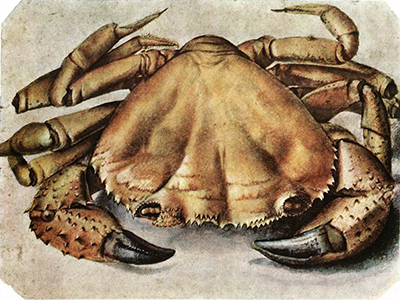
A broad shell rises above two heavy claws, their black tips turned inward across an open strip of paper. Behind it, jointed legs fold over one another like an untidy framework. The Rotterdam Crab gives this compact animal an imposing presence: its body almost fills the sheet, yet every spike and rounded joint invites a closer look. Museum Boijmans Van Beuningen now catalogues the drawing as previously attributed to Albrecht Dürer. Its collection number is MB 1958/T 30 (PK). The familiar name therefore carries an important qualification. [1] [2]
The drawing's fascination survives the uncertainty about its maker. It offers an unusually sustained encounter with a creature whose hardness, weight and articulated structure have been translated into marks on a flat surface. Looking at it involves moving between two kinds of attention: following the crab's anatomy and enjoying the ways light and shade make that anatomy visible. [1]
At a Glance
- Current attribution Artist unidentified; formerly attributed to Dürer [1]
- Retained museum date About 1494–1495; maker and place remain uncertain [1]
- Collection Museum Boijmans Van Beuningen, Rotterdam; MB 1958/T 30 (PK) [2]
- TypeDrawing [3]
This work across Albrecht Dürer’s career
Crab (current article)
c. 1494–1495; attribution withdrawnYoung Hare
1502Praying Hands
1508Melencolia I
1514Four Apostles
1526Contents
- A shell built from light
- Ink, wash and the surrounding paper
- Why the attribution matters
- A collector's purchase
- The crab returns to the shore
- Frequently Asked Questions
A shell built from light
The viewpoint looks down onto the carapace while keeping the front of the animal in view. Across its broad surface, warm brown passages alternate with softer, paler ridges. A raised central division leads towards the jagged front edge. On either side, shallow hollows darken and then open into rounded lobes. These changes make the shell seem uneven and substantial, with a relief that can be followed almost as if by touch.
The front edge receives a different treatment. Its repeated points turn the smooth sweep of the shell into a serrated boundary. Beside the eyes, clusters of tiny raised dots break the surface again. The contrast is carefully scaled: broad changes of tone describe the main mass, while small dark and light accents describe the irregularities close to its rim. Looking becomes progressively more exact as the eye approaches the animal's face.
The claws occupy the lower corners. Their swollen brown sections carry sharp protuberances, each picking up a small light or shadow. At the tips, the colour deepens into grey-black, with pale strokes travelling along the curved hard edges. The right-hand pincer is larger and more fully exposed than the left-hand one. It sits close to the lower margin and makes the animal's reach feel immediate. The space between the two tips is equally important: the pale opening gives the dark curves room to register, while leaving their possible movement to the viewer's imagination.
Above and behind the shell, the legs change the rhythm. Some extend diagonally; others double back at abrupt angles. Joints interrupt long sections, and fine projections give certain edges a bristling appearance. Their overlaps are readable locally, but the central body conceals much of their attachment. This limited view keeps the animal convincing as a solid object. It does not open the crab into an explanatory anatomical diagram or arrange every limb for equal visibility.
There is also an expressive imbalance. The carapace anchors the image firmly near the centre, while the surrounding limbs reach different distances and point in different directions. The body can seem settled and the extremities restless. That impression comes from the arrangement of the image; it cannot establish whether the artist worked from a living animal, a preserved specimen or an existing representation. A convincing pose does not supply a record of the drawing session.
Ink, wash and the surrounding paper
The museum lists brushwork, brown ink and black ink, washes and white heightening on paper. The sheet measures 26.4 × 35.4 centimetres. Flowing tonal passages alternate with sharply selected accents across the animal. Wash allows a curved section to darken gradually. White heightening introduces light marks that remain distinct on the warmer surface. [1][4]
The bright details are distributed selectively. Along parts of the front edge of the shell they collect into short strokes; on the claw and leg joints, they can become small flashes. They make particular surfaces seem to turn towards the light. The darker bands have an equally constructive role, separating overlapping limbs and pressing the pincers forward against their surroundings. The apparent hardness of the creature emerges from the relationship between these soft transitions and crisp interruptions.
Beneath the front of the body lies a cool grey shadow. It broadens under the right claw, where the darkest passage makes that claw seem to rest close to a supporting surface. Elsewhere, lighter shadow leaves more air between limb and ground. There is no drawn shoreline, pool or distant landscape. A few changes of tone establish enough space for the crab to occupy, while the pale paper remains visually open.
The sheet's cut corners are another conspicuous part of its present appearance. They make the support an irregular, eight-sided boundary around the animal. Within that boundary, several legs press towards the sides, while the claws dominate the foreground. Nothing in the image establishes when or why those corners were cut. Their visible effect, however, is to tighten the enclosure around a body already spreading almost to its limits.
Why the attribution matters
The museum no longer accepts the attribution to Dürer, yet retains a date of about 1494–95 and an older explanation connecting the sheet with his first Venetian journey. It gives no withdrawal rationale, leaving the maker and place of execution unresolved. [1]
An artist's name encourages one kind of reading: individual marks can become evidence of a recognisable style or larger historical category. Starting from the depicted animal makes other features prominent, such as its outline and the way its parts overlap. These approaches ask different things of the same picture; neither turns a familiar label into proof of authorship. [5]
A useful comparison is the Lobster in Berlin's Kupferstichkabinett, KdZ 4942. The 1999 catalogue From Schongauer to Holbein records that drawing as Dürer's, signed and dated 1495, and notes the discolouration and abrasion of its paper. Its authors, Fedja Anzelewsky and Stefan Moret, discussed the Rotterdam Crab alongside it under the older attribution. That comparison belongs to the history of scholarship, rather than serving as a fresh confirmation of the Rotterdam sheet's maker. [6]
In the Berlin image, the animal stretches across a long horizontal sheet. A segmented tail occupies one end, while long antennae and widely opening claws extend from the other. Much of its structure is carried by relatively fine, exposed drawing. Rotterdam's creature presents a more compact mass: the broad carapace blocks our view through the centre, and the dark foreground pincers have a strong tonal weight. The comparison helps distinguish two ways an animal can dominate a page, through length and extension or through concentrated bulk. Their different present surfaces also caution against judging either solely by its reproduction's brightness. [6][2]
A collector's purchase
The drawing's modern collection history has firmer documentary anchors. In his study of D. G. van Beuningen's collecting, Jeroen Giltaij identifies the Sea Crab among three drawings acquired through the dealer Goudstikker on 5 May 1939 from the Comtesse de Béhague collection. The other two were the Lime Tree on a Bastion and a study of feet. The combined payment was 130,000 guilders. The published transcription groups them; this was not an individually recorded price for the crab. [7]
The distinction between a private purchase and a museum acquisition is important here. Rotterdam bought Van Beuningen's collection in 1958, after his death in 1955, and added it to Museum Boymans. The enlarged institution took the Van Beuningen name. The crab thus entered the museum through a later collection purchase, rather than through its 1939 transaction with the dealer. [7]
The purchase book also preserves a collecting decision. A landscape, a sea creature and human feet became a group under one artist's name. That historical grouping survives the change in attribution: it records what Van Beuningen acquired and how he understood it.
The crab returns to the shore
The drawing continues to prompt questions about what an image represents. In his 2023 article The Image in a Vat? , Michele Di Monte used this exact crab as an example: a viewer might attend to an individual animal, a species, artistic style or a broader historical category. Which properties become important depends on the viewer's purpose. His discussion retained the Dürer attribution, so it is evidence of the image's continuing intellectual use, rather than an authority for its present authorship. [5]
That flexibility becomes especially vivid in a contemporary artwork. In 2000, Domenico Pupilli made Dürer Tav. III, Granchio dell'Adriatico , a photographic installation now in the Centro Pecci collection, Prato. Giorgio Di Domenico's collection entry identifies the reproduced drawing by its Rotterdam inventory number. Pupilli placed a photographic reproduction by the sea and photographed the action. The resulting work measures 30 × 20 centimetres and was donated by the artist after the exhibition Fotoalchimie . [2]
In Pupilli's photograph, the crab appears low in a tall stretch of wet sand. Small shells and fragments lie nearby; above it, a thin uneven line of foam marks the edge of the water. The reproduction remains visibly a picture, with its pale surrounding field and recognisable arrangement of claws. Its edges interrupt the sand. That interruption matters: the viewer can recognise the proposed return of a marine creature to the shore while still seeing the flat object through which the return has been staged.
The change of scale within the composition is striking. In the Rotterdam drawing, the crab commands almost the whole available surface. In the photograph, the reproduced image occupies a small patch within a much larger environment. The shell's pale ridges and dark pincers still draw attention, but they now compete with the ordinary textures of sand, foam and scattered debris. An image organised around a single animal has become one element in a landscape. [2]
Pupilli supplies the shore that the earlier drawing leaves unspecified. His intervention also makes its isolation newly apparent. Returning to the Rotterdam sheet after seeing the photograph, one notices how little setting the artist needed: a shadow, a pale field and carefully arranged intervals between limbs were enough to give the crab its weight and presence. Its unsettled attribution leaves real historical questions open, but the visual achievement remains available to anyone willing to look closely. [1][2]
Frequently Asked Questions
Eight sides frame the animal, but the image alone does not establish when or why the corners were cut. [1]
Dark shadow spreads beneath the front of the body and under the larger claw. Pale ridges and dark pincers make the animal appear solid. [1]
Winkler recorded it in the Countess Béhague's collection in Paris. His plate reproduces the same broad shell, asymmetric pincers and eight-sided outline. [3]
Artworks directory
These 187 records include individual works, reverse sides, detail views, paired panels and reconstructed arrangements. Three additional catalogue images repeat works already listed. Related views are not counted as separate originals; qualified attributions and published dating are retained.
Discussion
Look again at the images and ideas explored in Crab. These editorial prompts invite your observations.
Reader Insights
Which detail or idea in Crab most changed your reading, and why?
How does the discussion of “A shell built from light” affect your understanding?
What comparison would you bring to the discussion of “The crab returns to the shore”?
Join the Conversation
Share a detail, comparison or question about Crab below.
References
- Museum Boijmans Van Beuningen , Crab (Eriphia Spinifrons) , MB 1958/T 30 (PK). Current collection record and object image. English; Dutch version available. View source .
- Giorgio Di Domenico , “Dürer Tav. III, Granchio dell'Adriatico,” Domenico Pupilli, 2000, inventory 0206, Centro Pecci, collection entry and artwork image. Italian. View source .
- Friedrich Winkler, Die Zeichnungen Albrecht Dürers, vols. I–II (Berlin: Deutscher Verein für Kunstwissenschaft, 1936–1937): I, no. 92, pp. 67–68, plate 92; II, no. 357, pp. 73–74. Additional digitised records: I, 0380; II, 0404. German. View source View source View source View source
- Joseph Meder, Die Handzeichnung: ihre Technik und Entwicklung (Vienna: Kunstverlag Anton Schroll & Co., 1919), pp. 51–52, 580. Original German. View source
- Michele Di Monte , “The Image in a Vat?”, JoLMA 4, no. 1 (2023), pp. 123–140, especially pp. 128–130 and figure 2. English. View source .
- Fedja Anzelewsky, adapted and edited by Stefan Moret, cat. 51, in From Schongauer to Holbein (Washington: National Gallery of Art and Hatje Cantz, 1999), pp. 131–132. English translation by Jack Horn from German. View source
- Jeroen Giltaij, D.G. 50 jaar Van Beuningen 1958–2008, 2009 (2012), pp. 5, 22–23 and 45–46. Dutch. View source
- ALBERTINA, Selbstbildnis als Dreizehnjähriger, inv. 4839 (German). View source.
- Metropolitan Museum, Four Horsemen from The Apocalypse, 19.73.209 (English). View source.
- Bayerische Staatsgemäldesammlungen, Selbstbildnis im Pelzrock, inv. 537 (German). View source.
- ALBERTINA, Feldhase, inv. 3073 (German). View source.
- ALBERTINA, Das große Rasenstück, inv. 3075 (German). View source.
- Metropolitan Museum, Adam and Eve, 19.73.1 (English). View source.
- ALBERTINA, Betende Hände, inv. 3113 (German). View source.
- Metropolitan Museum, Knight, Death, and the Devil, 43.106.2 (English). View source.
- Metropolitan Museum, Melencolia I, 43.106.1 (English). View source.
- Bayerische Staatsgemäldesammlungen, inventory 545: current collection record (German). View source
- Germanisches Nationalmuseum, Barbara Dürer (German and English). View source.
- Web Gallery of Art, Tucher–Rieter reverse (English). View source.
- National Gallery of Art, object 1952.2.17 (English). Associated catalogue: John Oliver Hand, with the assistance of Sally E. Mansfield, an illustrated collection catalogue of late medieval and early modern German painting (Washington: National Gallery of Art, with Cambridge University Press, 1993), pp. 61–66. View source
- Dürer Art, Portrait of a Man (English). View source.
- Hessen Kassel Heritage, Elsbeth Tucher (German). View source.
- Web Gallery of Art, Hans Tucher (English). View source.
- Germanisches Nationalmuseum, Emperor Maximilian I (German and English). View source.
- National Gallery of Art, Lot and His Daughters, reverse (English). View source.
- Bayerische Staatsgemäldesammlungen, Glim Lamentation (German). View source.
- Museo Nacional del Prado, Portrait of a Man (Spanish). View source.
- Bayerische Staatsgemäldesammlungen, Madonna of the Carnation (German). View source.
- Städel Museum, Job on the Dungheap (German). View source.
- Wallraf-Richartz-Museum, Piper and Drummer (German). View source.
- Italian Ministry of Culture / Uffizi, Head of Saint James (Italian). View source.
- Klassik Stiftung Weimar, Dresden Altarpiece (German). View source.
- Staatliche Museen zu Berlin, collection record for painting 557I (1507), object 870760 (German and English). View source
- Dresden State Art Museums / Roland Enke, Bernhard von Reesen (German). View source.
- Royal Collection Trust, Burkhard von Speyer (English). View source.
- Dresden State Art Museums, Seven Sorrows of the Virgin (English). View source.
- Bayerische Staatsgemäldesammlungen, Mater Dolorosa (German). View source.
- Bayerische Staatsgemäldesammlungen, Lucretia (German). View source.
- Städel Museum, Young Woman with Her Hair Down (English). View source.
- ALBERTINA, Portrait of a Young Man (German). Embedded essay credited to Eva Michel, no. 48, p. 98, fig. 48, in Sabine Haag, Christiane Lange, Christof Metzger and Karl Schütz (eds.), Dürer – Cranach – Holbein. Die Entdeckung des Menschen: Das deutsche Porträt um 1500 (Munich: Hirmer, 2011), inv. 3122.. View source
- Joseph Heller, Das Leben und die Werke Albrecht Dürer's, vol. II, part 1 (Bamberg: C. F. Kunz, 1827), p. 118, no. 138; pp. 160–162, Florence entry 13; pp. 196–197, Munich entry 17; additional selected pp. 230–231, no. 6 and p. 260, entry e. Original German edition. View source
- S. R. Koehler, A Chronological Catalogue of the Engravings, Dry-Points and Etchings of Albert Dürer, as Exhibited at the Grolier Club (New York: Grolier Club, 1897), nos. 5, 16 and 71, pp. 5, 17–18, 63. English. View source View source
- Campbell Dodgson, Catalogue of Early German and Flemish Woodcuts Preserved in the Department of Prints and Drawings in the British Museum, vol. 1 (London: British Museum, 1903). Original English edition Selected pp. 246, 260, 262, 272, 274, 288, 290, 294–296, 299–300, 302, 307. View source
- William Martin Conway, Literary Remains of Albrecht Dürer (Cambridge, 1889), pp. 34–38, 41, 44, 55–58, 60, 64–71, 76, 134–135, 246–249 (English/German). View source
- Charles Ephrussi, Albert Dürer et ses dessins (Paris: A. Quantin, 1882), selected pp.2,14–16,20,78–80,107,109,120,153,178,188,298,302; index pp.399,403,405–406,409–410; additional selected pp. 86, 111–112, 152, 158 (footnote 1) and 202. Original French edition. View source
- T. Sturge Moore, Albert Dürer (London: Duckworth and Co.; New York: Charles Scribner’s Sons, 1905), part III, portrait discussion and caption of the 1500 Munich self-portrait; additional selected Part III, II Portraits, subsection III, Hans Tucher paragraph. Original English edition. View source
- Hermann Knackfuß, Dürer, 12th edition (Bielefeld and Leipzig: Velhagen & Klasing, 1921), printed pp. 19–20, 24–26, 45–46, 58–60 and 138; plates 22, 30, 36 and 61. Original German edition. View source
- Heinrich Wölfflin, Die Kunst Albrecht Dürers, second enlarged edition (Munich: F. Bruckmann, 1908), pp. 110, 298. Original German edition. View source
- “Ein wiederaufgefundenes Gemälde von Albrecht Dürer”, Hamburgischer Correspondent, no. 473, Abend-Ausgabe (9 October 1900), p. 5, centre column (German). View source
- Albrecht Dürer, Records of Journeys to Venice and the Low Countries (Boston, 1913), translated Rudolph Tombo, diary pp. 31–32, 47–48, 59–60, 75, 83–87 (English). View source
- Stijn Alsteens and Freyda Spira, with Maryan W. Ainsworth, Dirk H. Breiding, George R. Goldner, Guido Messling, Marjorie Shelley and Joshua P. Waterman, Dürer and Beyond: Central European Drawings in The Metropolitan Museum of Art, 1400–1700 (New York: Metropolitan Museum of Art; New Haven and London: Yale University Press, 2012), p. 15, fig. 2, Three Studies of a Left Hand, ALBERTINA 26327. English. View source
- Moriz Thausing, Albert Dürer: His Life and Works, translated from German, edited by Fred. A. Eaton, vol. II (London: John Murray, 1882), pp. 16–18. Original English edition. View source
- Burlington Fine Arts Club, Exhibition of Early German Art (London: Burlington Fine Arts Club, 1906). Original English catalogue P.24, no.38. View source
- Johann Carl Sigmund Kiefhaber, ed., Nachrichten zur ältern und neuern Geschichte der freyen Reichsstadt Nürnberg: ein Beytrag zur Geschichte der Reichsstädte in Teutschland, vol.1 (Nuremberg: Lechner, 1803), first quarter, pp.6–9,14–16. Original German historical edition of correspondence and inventory. View source
- Maud Cruttwell, Andrea Mantegna, London: George Bell and Sons, 1901, pp. 110–112. View source
- Moriz Thausing, Dürer: Geschichte seines Lebens und seiner Kunst (Leipzig: E. A. Seemann, 1876). Original German edition Selected pp.303, 306, 308–309. View source
- Hans W. Singer, Drawings of Albrecht Dürer (London: G. Newnes; New York: C. Scribner’s Sons, 1906), p. 8; Little Owl (Schönbrunner and Meder no. 829). Original English edition. View source
- Germanisches Nationalmuseum, Katalog der im Germanischen Museum befindlichen Gemälde (Nürnberg: Verlag des Germanischen Museums, 1893), pp.34–35, nos.206–209. Original German catalogue. View source
- Joachim von Sandrart, L’Academia Todesca della Architectura, Scultura & Pittura: oder Teutsche Academie der Edlen Bau- Bild- und Mahlerey-Künste (Nuremberg, 1675), II, book 3, p. 224; facsimile and transcription. View source
- Albrecht Dürer and Benedictus Chelidonius, Epitome in Divae Parthenices Mariae Historiam ab Alberto Durero Norico per figuras digestam cum versibus annexis Chelidonii (Nuremberg: Albrecht Dürer, 1511); Vatican Library, Cicognara.IX.2022, scans 7–46, including all twenty designs, facing texts and final imprint. Latin. View source
- National Gallery of Art, Annual Report 1974 (Washington: National Gallery of Art, 1975), p. 23; title and copyright pages. English. View source
- Heinrich Weizsäcker, Catalog der Gemälde-Gallerie des Städelschen Kunstinstituts in Frankfurt am Main, Erste Abtheilung: Die Werke der älteren Meister vom vierzehnten bis zum achtzehnten Jahrhundert (Frankfurt am Main: Druckerei von August Osterrieth, 1900), nos. 83 and 85, pp. 91–98. Original German edition. View source
- Moriz Thausing, Albert Dürer: His Life and Works, translated from German, English edition edited by Fred. A. Eaton, vol. I (London: John Murray, 1882), pp. 119–120. Historical English edition. View source
- The Metropolitan Museum of Art, Handbook of the Benjamin Altman Collection, with painting descriptions by Bryson Burroughs, other object descriptions by Durr Friedley and William M. Milliken, and introduction by Edward Robinson (New York: The Metropolitan Museum of Art; printed by The Gilliss Press, November 1914), no. 32, pp. 50–52; staff credits, pp. xiv–xv. Original English edition. View source







