


 by
Tom Gurney
Tom Gurney BSc (Hons) is an art history expert with over 20 years experience
Published on June 19, 2020 / Updated on October 22, 2026
Email:
tomgurney1@gmail.com
/ Phone:
+44 7429 011000
Lobster by Albrecht Dürer: Introduction
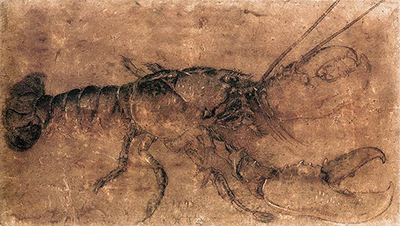
Albrecht Dürer's Lobster spreads across its sheet with an awkward, compelling grandeur. The tail almost touches the left edge; long feelers run towards the upper right; an enormous open claw occupies the lower corner. Between them, the small legs gather beneath a broad, rounded shell. Everything belongs to one creature, yet each part seems to demand a different kind of drawing. The eye moves from solid armour to jointed limbs, then out along lines so thin that they almost disappear into the paper.
The drawing is dated 1495 and belongs to the Kupferstichkabinett, Staatliche Museen zu Berlin, under inventory number KdZ 4942. Berlin's museum-supplied record gives its dimensions as 24.7 × 42.9 centimetres and describes brown and black brushwork with white heightening on browned paper. Its generous width matters. This is a substantial horizontal sheet, with room for the animal's extended weapons and delicate feelers to establish very different rhythms. [1]
At a Glance
- Date 1495 [1]
- Materials Brown and black brushwork with white heightening on browned paper [1]
- Collection Kupferstichkabinett, Berlin; KdZ 4942 [1]
This work across Albrecht Dürer’s career
Young Hare
1502Praying Hands
1508Melencolia I
1514Four Apostles
1526Contents
- An animal that fills the picture
- Wash, white and a changed surface
- The date and the Venetian question
- A study with room to stand alone
- Frequently Asked Questions
An animal that fills the picture
The lobster faces right, but its body does not form a simple straight silhouette. The broad central shell tilts across the sheet; the segmented tail narrows and bends behind it; the legs open beneath it at irregular angles. The nearer claw reaches forward and down, while the farther one sits higher and appears more lightly described. These differences make the image legible as a body seen from an angle. They also prevent the drawing from becoming a symmetrical display of anatomical parts.
The tail has a particularly clear structure. Dark divisions articulate its successive sections, each with a curved surface catching a different degree of light. At the far left, its spreading end turns the horizontal movement back into the sheet. Farther right, the shell appears as a large continuous volume. Small marks and tonal variations interrupt its surface, but its broad shape holds together against the complicated gathering of legs below.
There is a striking change of pace at the head. Closely packed lines describe a knot of smaller appendages before the great claws open into comparatively spacious shapes. The lower claw encloses a long, narrow patch of paper. Its pointed ends curve towards one another without meeting, so that the empty space between them becomes one of the drawing's most forceful forms. Looking through that opening makes the claw's thickness and reach unusually palpable.
The feelers create a different sensation. Their long diagonals leave the mass of the body and run towards the top boundary. They ask the eye to travel beyond the densely worked centre, making the creature seem larger than its shell alone would suggest. The sheet offers very little environmental information: no seabed, water or surrounding objects provide a scale. Its boundaries become the measure against which the animal's span is felt.
Wash, white and a changed surface
The drawing's present appearance includes later intervention. Berlin's official worklist for the 2023 exhibition Dürer für Berlin records that a later hand retraced the principal lines in graphite. It also identifies a Japanese-paper backing. The particularly emphatic contours therefore need to be read with care: the image we see combines Dürer's work with a subsequent attempt to reinforce it. The worklist does not date that intervention. [12]
The 1999 catalogue From Schongauer to Holbein describes pen and brown ink, brown and black washes, and white heightening. It records discolouration and abrasion, measuring the sheet at 24.6 × 42.8 centimetres. Both records identify KdZ 4942. [13]
Line and wash perform visibly different jobs. Lines establish divisions, edges and narrow appendages; broader tonal passages give the shell its weight. Where a limb bends, a dark accent can make the joint readable without enclosing every surface in an equally strong boundary. The white additions introduce a third register above the paper's middle tone. They allow brightness to be placed within a form instead of being obtained solely by leaving a white sheet untouched.
In the reproduction, some passages have a faint, interrupted appearance while others remain emphatic. Around the upper claw, the paper seems to absorb much of the drawing; the tail divisions and lower claw are easier to follow. This unevenness encourages slow looking, but it also limits what can be inferred about the original balance of the image. The current brown field cannot tell us exactly how much brighter the whites once appeared, or how continuously every delicate passage originally read.
There is a useful limit to the technical evidence. The joint Germanisches Nationalmuseum and Bundesanstalt für Materialforschung und -prüfung ink project lists the Lobster among its objects, but records that examination was impossible for conservation reasons. Its presence in that project is consequently not proof that the drawing's inks or inscription were scientifically identified there. [14]
The date and the Venetian question
The catalogue also records an Ad monogram, a bow-and-arrow watermark and Berlin's acquisition in 1879. Its authors, Fedja Anzelewsky and Stefan Moret, associate the monogram's form with Venice. The small inscription sits quietly below the animal, providing a dated identity without competing with it. [13]
Their confident description of a live Adriatic specimen needs qualification. The spread legs and open claws convey energy. They cannot establish whether the specimen moved during the session, where it had been obtained, or precisely where Dürer studied it. Venice is a plausible context, with the circumstances still open. [13]
The familiar comparison with a Crab in Rotterdam also needs qualification. Museum Boijmans Van Beuningen now labels that drawing “Previously attributed” to Dürer, although an older description on its website still associates it with his first Venetian journey. It can illuminate the history of how scholars grouped crustacean studies, but it cannot safely function as an unquestioned second autograph drawing that proves a shared occasion. The Berlin sheet must carry its own evidence. [15]
A study with room to stand alone
Anzelewsky and Moret report Elisabeth Trux's reading of the Lobster as independent study material, unconnected with a specific work. Its pose, scale and alternation of dense and open passages already sustain attention within the sheet. [13]
The large format does not mean that every detail receives an identical finish. On the contrary, the drawing holds together through differences: a heavily articulated tail, a broad shell, a tangle beneath the head, the uncertain reach of the farther claw. It is possible to follow an entire animal while also noticing how its parts are being described. The work's interest lies partly in that movement between recognition and the act of drawing.
Dürer's later writing provides a useful context for such accumulated study. In the passage translated on page 247 of William Martin Conway's Literary Remains , he places artistic knowledge in nature and connects it with experience, geometry and sustained learning. He then explains that a practised artist can draw upon what has already been gathered through study, without copying every individual figure afresh from life. This is a later statement, not a recorded explanation of the 1495 sheet. It nevertheless helps explain why a drawing could have lasting value without being a transfer pattern for one known painting. [16]
The Lobster offers precisely that kind of concentrated visual knowledge: how a hard covering rounds into shadow, how separate segments join, how a narrow limb turns, how an opening can describe the reach of a claw. Its present condition and reinforced contours complicate access to Dürer's original handling, while the animal's encompassing shape remains remarkably clear. Across the long sheet, weight and delicacy continue to coexist. The immense claw draws attention first; the fine appendages reward the time spent following them.
Frequently Asked Questions
Artworks directory
These 187 records include individual works, reverse sides, detail views, paired panels and reconstructed arrangements. Three additional catalogue images repeat works already listed. Related views are not counted as separate originals; qualified attributions and published dating are retained.
Discussion
Look again at the images and ideas explored in Lobster by Albrecht Dürer. These editorial prompts invite your observations.
Reader Insights
Which detail or idea in Lobster by Albrecht Dürer most changed your reading, and why?
How does the discussion of “An animal that fills the picture” affect your understanding?
What comparison would you bring to the discussion of “A study with room to stand alone”?
Join the Conversation
Share a detail, comparison or question about Lobster by Albrecht Dürer below.
References
- Kupferstichkabinett , Staatliche Museen zu Berlin, A lobster with unusually large scissors , 1495, KdZ 4942, museum-supplied collection record, Google Arts & Culture. View source .
- ALBERTINA, Selbstbildnis als Dreizehnjähriger, inv. 4839 (German). View source.
- Metropolitan Museum, Four Horsemen from The Apocalypse, 19.73.209 (English). View source.
- Bayerische Staatsgemäldesammlungen, Selbstbildnis im Pelzrock, inv. 537 (German). View source.
- ALBERTINA, Feldhase, inv. 3073 (German). View source.
- ALBERTINA, Das große Rasenstück, inv. 3075 (German). View source.
- Metropolitan Museum, Adam and Eve, 19.73.1 (English). View source.
- ALBERTINA, Betende Hände, inv. 3113 (German). View source.
- Metropolitan Museum, Knight, Death, and the Devil, 43.106.2 (English). View source.
- Metropolitan Museum, Melencolia I, 43.106.1 (English). View source.
- Bayerische Staatsgemäldesammlungen, inventory 545: current collection record (German; descriptive citation). View source.
- Staatliche Museen zu Berlin , Werkliste „Dürer für Berlin“ , 12 May–27 August 2023, no. 091, p. 15. German. View source .
- Fedja Anzelewsky , adapted/edited by Stefan Moret, “Lobster, 1495,” no. 51, in From Schongauer to Holbein: Master Drawings from Basel and Berlin , National Gallery of Art, 1999, p. 131; illustration p. 132. English edition translated from German. View source .
- Germanisches Nationalmuseum and Bundesanstalt für Materialforschung und -prüfung , Dürer Tintenanalyse: Tintenprojekt , project of 2011–12, object-list entry for Hummer , Berlin, KdZ 4942. German. View source .
- Museum Boijmans Van Beuningen , Crab (Eriphia Spinifrons) , MB 1958/T 30 (PK), current collection record. View source .
- Albrecht Dürer , extract from the third book on human proportion, translated in William Martin Conway, Literary Remains of Albrecht Dürer , Cambridge, 1889, p. 247. View source .
- Germanisches Nationalmuseum, Barbara Dürer (German and English). View source.
- Web Gallery of Art, Tucher–Rieter reverse (English). View source.
- National Gallery of Art, Portrait of a Clergyman (English). View source.
- Dürer Art, Portrait of a Man (English). View source.
- Hessen Kassel Heritage, Elsbeth Tucher (German). View source.
- Web Gallery of Art, Hans Tucher (English). View source.
- Germanisches Nationalmuseum, Emperor Maximilian I (German and English). View source.
- National Gallery of Art, Lot and His Daughters, reverse (English). View source.
- Bayerische Staatsgemäldesammlungen, Glim Lamentation (German). View source.
- Museo Nacional del Prado, Portrait of a Man (Spanish). View source.
- Bayerische Staatsgemäldesammlungen, Madonna of the Carnation (German). View source.
- Städel Museum, Job on the Dungheap (German). View source.
- Wallraf-Richartz-Museum, Piper and Drummer (German). View source.
- Italian Ministry of Culture / Uffizi, Head of Saint James (Italian). View source.
- Klassik Stiftung Weimar, Dresden Altarpiece (German). View source.
- Staatliche Museen zu Berlin, Girl with a Red Beret (German and English). View source.
- Dresden State Art Museums / Roland Enke, Bernhard von Reesen (German). View source.
- Royal Collection Trust, Burkhard von Speyer (English). View source.
- Dresden State Art Museums, Seven Sorrows of the Virgin (English). View source.
- Bayerische Staatsgemäldesammlungen, Mater Dolorosa (German). View source.
- Bayerische Staatsgemäldesammlungen, Lucretia (German). View source.
- Städel Museum, Young Woman with Her Hair Down (English). View source.
- ALBERTINA, Portrait of a Young Man (German). View source.







