


 by
Tom Gurney
Tom Gurney BSc (Hons) is an art history expert with over 20 years experience
Published on June 19, 2020 / Updated on October 22, 2026
Email:
tomgurney1@gmail.com
/ Phone:
+44 7429 011000
Portrait of a Man Aged Ninety-Three: Introduction
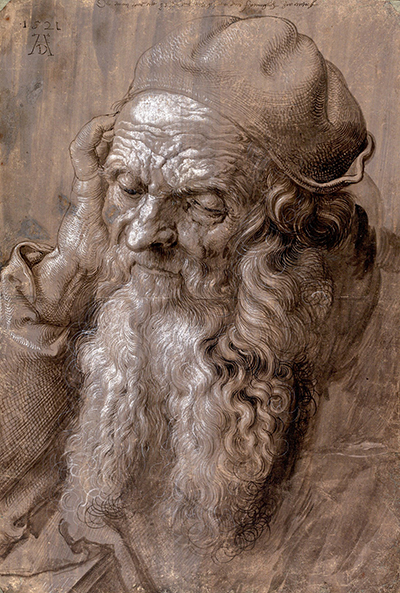
A hand presses against a temple, a cap settles into soft folds, and a long beard spreads almost to the lower edge of the sheet. Dürer's Portrait of a Man Aged Ninety-Three brings us extraordinarily close to its subject. The nose projects towards us, while the eyes withdraw beneath their lids. Across the forehead, bright ridges and dark creases make the skin seem to gather and buckle. Yet the drawing's strongest impression comes from the relationship between these crowded details and the larger, quiet movement of the lowered head.
Dated 1521, this ALBERTINA drawing (Vienna, inv. 3167) measures 41.5 × 28.2 cm: black and grey brushwork, opaque white, grey-violet prepared paper. Dürer recorded above the head that the man was ninety-three, still healthy and vigorous, in Antwerp. His name remains unknown. The age supplies its title; the close, concentrated face is also a preparatory study. [1] [2]
At a Glance
- Date 1521 [1]
- Materials Black and grey brushwork with opaque white on grey-violet prepared paper [1]
- Collection ALBERTINA, Vienna; 3167 [1]
This work across Albrecht Dürer’s career
Young Hare
1502Praying Hands
1508Melencolia I
1514Four Apostles
1526Contents
- The light within the paper
- What the inscription tells us
- An Antwerp face becomes Saint Jerome
- A drawing kept, a painting given
- Frequently Asked Questions
The light within the paper
The prepared surface is essential to the effect. Its middle tone allows light and darkness to emerge in both directions. White touches appear to lift the forehead towards us; dark strokes push the creases back. Between them, passages of ground remain available as a third value. Looking at the unworked space beside the cap helps make this visible. The same underlying tone participates in the face, beard and clothing, binding together areas that are described with very different marks.
The forehead provides the most compact demonstration. Narrow dark channels separate irregular islands of white. The wrinkles do not form a uniform pattern across the brow: they change direction, gather above the nose, and loosen towards the temple. A painter describing this much relief could easily make the face appear carved. Here the variation between short strokes, broader pale patches and softer transitions keeps the surface mobile. The creases are sharp, but the volumes around them remain rounded.
Below, the beard changes the pace of looking. Individual light strands curl away from darker masses, sometimes running in long waves, sometimes tightening into loops. Along the right edge of the beard, dark curls stand out clearly against the ground. Near its centre, pale threads overlap and disperse. White serves two different purposes within a few centimetres: it describes the large illuminated body of the beard and picks out slender hairs that seem to float in front of it. The moustache makes a denser horizontal interruption above this downward flow.
The cap is almost the opposite. Closely spaced dark strokes turn around its folds, building a broad, soft crown. Its rounded upper contour encloses the head, while the projecting edge on the right leads the eye down towards the ear and hair. Cloth, skin and beard share the limited palette, but their different patterns of marks keep them distinct. The drawing asks us to notice what a brush can do with almost no colour: stipple a bright brow, follow a curl, or accumulate a woven-looking field of little strokes.
There is also a marked difference in finish. The beard and face receive persistent attention, while parts of the garment towards the lower right are left much more broadly indicated. The image does not supply an equally complete description of everything in front of the artist. Its intensity depends on that selection. We move from a relatively open shoulder into the densely worked head, and then through the beard towards the looser lower edge. The surrounding paper gives the close detail room to breathe. The ear offers a small pause between the cap and the beard. Its light rim turns outwards against a dark recess, while nearby curls overlap it. This small interruption prevents the side of the head from becoming one continuous band of hair. Beside the wrist, the sleeve changes scale again: its broader folds make the closely articulated fingers appear still more exact.
What the inscription tells us
Dürer's note supplies information that the face alone could never establish. Its German includes the words “noch gesunt vnd fermuglich”: still healthy and vigorous. The inscription records the artist's account of the sitter; it is not an independent verification of his precise age or a medical assessment. It also complicates an easy reading of the pose as exhaustion. A head resting against a hand may suggest weariness to us, but here the written testimony calls attention to continuing vitality. [1]
The hand itself is active in the composition. It rises beside the face as a nearly vertical support, with the fingers curving around the temple. Light catches the back of the hand and the projecting joints; the dark interval beside the cheek separates the two forms. This contact places a second set of folded surfaces next to the forehead. Skin pressing against skin becomes part of the drawing's structure, joining the sleeve below to the cap above.
The lowered eyelids make the expression difficult to pin down. They interrupt any direct exchange with the viewer, and the tucked mouth offers little help. We can describe the effect as inward or absorbed without assigning the man a particular thought. Neither the folds in his brow nor the downward inclination supplies a biography. What Dürer gives us is a remarkably specific arrangement of features and gestures, accompanied by only a few written facts.
An Antwerp face becomes Saint Jerome
The head prepared Dürer's Saint Jerome , now in Lisbon's Museu Nacional de Arte Antiga. The finished work is an oil painting on oak, 59.5 × 48.5 cm. Looking from the sheet to the complete painting reveals a substantial change in the encounter. The saint's head still leans against his right hand, and the long beard remains central, but his eyes now meet ours. His other hand points down towards a skull. Books occupy the lower left, a crucifix stands above them, and an inkpot appears at the opposite corner. The anonymous man has become the face of a named religious figure through the arrangement surrounding him as well as through changes to the head. [3]
Colour reorganises the forms too. The red garment spreads around the beard and gives the upper body a much broader presence. In the drawing, the bright beard merges at points with the highlighted cheek and hand. In the painting, its pale length is enclosed by darker hair and clothing, carrying the eye down towards the book and skull. The facial study has already established the intimate scale of the encounter, but the panel extends that intimacy into an address: Jerome looks at us while directing our attention to the object beneath his finger.
Heinz Widauer treats Berlin's head as a portrait preceding Vienna's; Christof Metzger's 2021 corpus also includes it among the Netherlandish drawings. Berlin's 2023 exhibition list, however, describes KdZ 38 as the work of an unidentified imitator of Dürer. That difference matters when reconstructing the sequence. The relationship between the Vienna drawing and Lisbon painting is clear; the Berlin sheet's status needs qualification before it can serve as a securely autograph first stage. [1] [4] [5]
The surviving preparations also show that the head did not solve the whole picture. Three further ALBERTINA sheets isolate an arm and hand, a skull, and a lectern with books. Matthias Mende's object essays identify changes between these studies and the panel: the pointing forearm becomes more strongly foreshortened, while the lectern is shortened and a small storage box disappears. Dürer was continuing to make decisions as the composition took shape. [6] [7] [8]
Seen together, the sheets offer different kinds of attention. The arm study leaves much of a lightly indicated figure open, then enlarges the sleeve and pointing hand beside it. The skull sits low within an extensive field of grey, its pale brow standing out against the darkness of its sockets. In the lectern drawing, white light lies across the open pages, while closed books and a rounded box occupy the space below. The head study's extraordinary finish belongs within this varied working process. Some parts called for exact modelling; other passages could remain provisional.
A drawing kept, a painting given
Dürer's Netherlandish diary provides a direct documentary connection with the finished painting. In William Martin Conway's 1889 translation, he writes that he painted a Jerome carefully in oils and gave it to Rodrigo of Portugal, the recipient identified by the Lisbon museum as Rui Fernandes de Almada. The same passage records a ducat given to Susanna as a gratuity. It describes a gift; it does not establish a paid commission for the panel or the study. [3] [9]
The surrounding entries place this exchange among purchases, payments, presents and the packing of belongings. Rodrigo gives Dürer coconuts, coral and Portuguese coins; the artist sends other gifts to friends in Nuremberg. These particulars give the religious painting a setting in an active exchange of objects and favours. They do not tell us how Dürer first encountered the ninety-three-year-old or what arrangements brought him before the artist. Nor should the date attached to a neighbouring diary entry be turned into a precise day for the gift or a sitting.
Dürer's gift carried the painted Jerome into an exchange of objects and favours. The ALBERTINA presents retained drawings as workshop resources. Its provenance lists Willibald Imhoff, Rudolf II (1588), the Imperial Court Library (1783) and Duke Albert of Saxe-Teschen (1796). At the edge of the beard, fine pale lines extend beyond the darker mass of hair. These stray strands keep the silhouette open, drawing the eye back from its outline into the densely marked surface. [1]
That independent appeal is visible in a later copy now also in the ALBERTINA. Assigned to Hans Hoffmann and dated about 1574–85, inventory 3190 repeats the elderly man and his age inscription; the museum records a misleading 1519 date and Dürer monogram on it. The copy's existence shows how this particular study continued to attract attention. It also makes the exact identity of the Vienna original important when similar images circulate under the same descriptive title. [10]
Return to that original and the richest passage remains the meeting of hand, brow and beard. The prepared ground is still visible between the strokes, allowing us to follow the construction without losing the presence of the face. The inscription preserves Dürer's note of the man's age and continuing vigour. Small dark strokes continue across the cap, while longer pale curves carry the beard downwards. That change of direction gives the close view its rhythm, holding together the compact brow and the spreading hair.
Frequently Asked Questions
Artworks directory
These 187 records include individual works, reverse sides, detail views, paired panels and reconstructed arrangements. Three additional catalogue images repeat works already listed. Related views are not counted as separate originals; qualified attributions and published dating are retained.
Discussion
Look again at the images and ideas explored in Portrait of a Man Aged Ninety-Three. These editorial prompts invite your observations.
Reader Insights
Which detail or idea in Portrait of a Man Aged Ninety-Three most changed your reading, and why?
How does the discussion of “The light within the paper” affect your understanding?
What comparison would you bring to the discussion of “A drawing kept, a painting given”?
Join the Conversation
Share a detail, comparison or question about Portrait of a Man Aged Ninety-Three below.
References
- ALBERTINA, 3167; Heinz Widauer’s commentary, 2008 (German/English).. View source .
- Charles Ephrussi, Albert Dürer et ses dessins (Paris: A. Quantin, 1882), selected pp.2,14–16,20,78–80,107,109,120,153,178,188,298,302; index pp.399,403,405–406,409–410; additional selected pp. 86, 111–112, 152, 158 (footnote 1) and 202. Original French edition. View source.
- Museu Nacional de Arte Antiga , São Jerónimo , inv. 828 Pint, museum-contributed record and complete painting image on Google Arts & Culture. Portuguese. View source .
- National Gallery: Christof Metzger’s 2021 drawing-corpus supplement, pp. 50–51 (English).. View source .
- Staatliche Museen zu Berlin , Kupferstichkabinett, Werkliste „Dürer für Berlin“, 12.5.–27.8.2023 , p. 14, no. 084, KdZ 38. German. View source .
- ALBERTINA, 3168; Matthias Mende’s commentary, 2003 (German/English).. View source .
- ALBERTINA, 3175; Matthias Mende’s commentary, 2003 (German/English).. View source .
- ALBERTINA, 3176; Matthias Mende’s commentary, 2003 (German/English).. View source .
- William Martin Conway, Literary Remains of Albrecht Dürer (Cambridge, 1889), pp. 34–38, 41, 44, 55–58, 60, 64–71, 76, 134–135, 246–249 (English/German) Additional diary pp. 113–116, especially p. 115 (oil Jerome gift and Susanna gratuity). View source 1. View source 2.
- ALBERTINA , Hans Hoffmann, Bildnis eines 93-jährigen Mannes , inv. 3190, about 1574–85. German. View source .
- ALBERTINA, current record 4839 (German).. View source.
- Metropolitan Museum, Four Horsemen from The Apocalypse, 19.73.209 (English). View source.
- Bayerische Staatsgemäldesammlungen, current record 537 (German).. View source.
- ALBERTINA, current record 3073 (German).. View source.
- ALBERTINA, current record 3075 (German).. View source.
- Metropolitan Museum, Adam and Eve, 19.73.1 (English). View source.
- ALBERTINA, current record 3113 (German).. View source.
- Metropolitan Museum, Knight, Death, and the Devil, 43.106.2 (English). View source.
- Metropolitan Museum, Melencolia I, 43.106.1 (English). View source.
- Bayerische Staatsgemäldesammlungen, inventory 545: current collection record (German; descriptive citation). View source.
- Germanisches Nationalmuseum, Barbara Dürer (German and English). View source.
- Web Gallery of Art, Tucher–Rieter reverse (English). View source.
- National Gallery of Art, Portrait of a Clergyman (English). View source.
- Dürer Art, Portrait of a Man (English). View source.
- Hessen Kassel Heritage, Elsbeth Tucher (German). View source.
- Web Gallery of Art, Hans Tucher (English). View source.
- Germanisches Nationalmuseum, Emperor Maximilian I (German and English). View source.
- National Gallery of Art, Lot and His Daughters, reverse (English). View source.
- Bayerische Staatsgemäldesammlungen, Glim Lamentation (German). View source.
- Museo Nacional del Prado, Portrait of a Man (Spanish). View source.
- Bayerische Staatsgemäldesammlungen, Madonna of the Carnation (German). View source.
- Städel Museum, Job on the Dungheap (German). View source.
- Wallraf-Richartz-Museum, Piper and Drummer (German). View source.
- Italian Ministry of Culture / Uffizi, Head of Saint James (Italian). View source.
- Klassik Stiftung Weimar, Dresden Altarpiece (German). View source.
- Staatliche Museen zu Berlin, current painting record 870760 (German/English).. View source.
- Dresden State Art Museums / Roland Enke, Bernhard von Reesen (German). View source.
- Royal Collection Trust, Burkhard von Speyer (English). View source.
- Dresden State Art Museums, Seven Sorrows of the Virgin (English). View source.
- Bayerische Staatsgemäldesammlungen, Mater Dolorosa (German). View source.
- Bayerische Staatsgemäldesammlungen, Lucretia (German). View source.
- Städel Museum, Young Woman with Her Hair Down (English). View source.
- ALBERTINA, Portrait of a Young Man (German). View source.
- Joseph Heller, Das Leben und die Werke Albrecht Dürer's, vol. II, part 1 (Bamberg: C. F. Kunz, 1827), p. 118, no. 138; pp. 160–162, Florence entry 13; pp. 196–197, Munich entry 17; additional selected pp. 230–231, no. 6 and p. 260, entry e. Original German edition. View source.
- S. R. Koehler, A Chronological Catalogue of the Engravings, Dry-Points and Etchings of Albert Dürer, as Exhibited at the Grolier Club (New York: Grolier Club, 1897), nos. 16, 34 and 71, pp. 17–18, 37–39, 63. English. View source.
- Campbell Dodgson, Catalogue of Early German and Flemish Woodcuts Preserved in the Department of Prints and Drawings in the British Museum, vol. 1 (London: British Museum, 1903). Original English edition Selected pp. 246, 260, 262, 272, 274, 288, 290, 294–296, 299–300, 302, 307. View source.
- T. Sturge Moore, Albert Dürer (London: Duckworth and Co.; New York: Charles Scribner’s Sons, 1905), part III, portrait discussion and caption of the 1500 Munich self-portrait; additional selected Part III, II Portraits, subsection III, Hans Tucher paragraph. Original English edition. View source.
- Hermann Knackfuß, Dürer, 12th edition (Bielefeld and Leipzig: Velhagen & Klasing, 1921), printed pp. 19–20, 24–26, 45–46, 58–60 and 138; plates 22, 30, 36 and 61. Original German edition. View source.
- Heinrich Wölfflin, Die Kunst Albrecht Dürers, second enlarged edition (Munich: F. Bruckmann, 1908), pp. 110, 298. Original German edition. View source.
- “Ein wiederaufgefundenes Gemälde von Albrecht Dürer”, Hamburgischer Correspondent, no. 473, Abend-Ausgabe (9 October 1900), p. 5, centre column (German). View source.
- Albrecht Dürer, Records of Journeys to Venice and the Low Countries (Boston, 1913), translated Rudolph Tombo, diary pp. 31–32, 47–48, 59–60, 75, 83–87 (English). View source.
- Maryan W. Ainsworth, Salvator Mundi, in Dürer and Beyond: Central European Drawings, 1400–1700, Metropolitan Museum, 2012, catalogue 8, pp. 19–22 (English). View source.
- Moriz Thausing, Albert Dürer: His Life and Works, translated from German, edited by Fred. A. Eaton (London: John Murray, 1882), vol. I, pp. 119–120; vol. II, pp. 16–18 (English). View source 1. View source 2.
- Burlington Fine Arts Club, Exhibition of Early German Art (London: Burlington Fine Arts Club, 1906). Original English catalogue P.24, no.38. View source.
- Johann Carl Sigmund Kiefhaber, ed., Nachrichten zur ältern und neuern Geschichte der freyen Reichsstadt Nürnberg: ein Beytrag zur Geschichte der Reichsstädte in Teutschland, vol.1 (Nuremberg: Lechner, 1803), first quarter, pp.6–9,14–16. Original German historical edition of correspondence and inventory. View source.
- Maud Cruttwell, Andrea Mantegna, London: George Bell and Sons, 1901, pp. 110–112. View source.
- Moriz Thausing, Dürer: Geschichte seines Lebens und seiner Kunst (Leipzig: E. A. Seemann, 1876). Original German edition Selected pp.303, 306, 308–309. View source.
- Hans W. Singer, Drawings of Albrecht Dürer (London: G. Newnes; New York: C. Scribner’s Sons, 1906), p. 8; Little Owl (Schönbrunner and Meder no. 829). Original English edition. View source.
- Germanisches Nationalmuseum, Katalog der im Germanischen Museum befindlichen Gemälde (Nürnberg: Verlag des Germanischen Museums, 1893), pp.34–35, nos.206–209. Original German catalogue. View source.
- Joachim von Sandrart, L’Academia Todesca della Architectura, Scultura & Pittura: oder Teutsche Academie der Edlen Bau- Bild- und Mahlerey-Künste (Nuremberg, 1675), II, book 3, p. 224; facsimile and transcription. View source.
- Albrecht Dürer and Benedictus Chelidonius, Epitome in Divae Parthenices Mariae Historiam ab Alberto Durero Norico per figuras digestam cum versibus annexis Chelidonii (Nuremberg: Albrecht Dürer, 1511); Vatican Library, Cicognara.IX.2022, scans 7–46, including all twenty designs, facing texts and final imprint. Latin. View source.
- Friedrich Winkler, Die Zeichnungen Albrecht Dürers, II (Berlin: Deutscher Verein für Kunstwissenschaft, 1937), no. 357, pp. 73–74. German. View source.
- National Gallery of Art, Annual Report 1974 (Washington: National Gallery of Art, 1975), p. 23; title and copyright pages. English. View source.
- Heinrich Weizsäcker, Catalog der Gemälde-Gallerie des Städelschen Kunstinstituts in Frankfurt am Main, Erste Abtheilung: Die Werke der älteren Meister vom vierzehnten bis zum achtzehnten Jahrhundert (Frankfurt am Main: Druckerei von August Osterrieth, 1900), nos. 83 and 85, pp. 91–98. Original German edition. View source.
- The Metropolitan Museum of Art, Handbook of the Benjamin Altman Collection, with painting descriptions by Bryson Burroughs, other object descriptions by Durr Friedley and William M. Milliken, and introduction by Edward Robinson (New York: The Metropolitan Museum of Art; printed by The Gilliss Press, November 1914), no. 32, pp. 50–52; staff credits, pp. xiv–xv. Original English edition. View source.







