


 by
Tom Gurney
Tom Gurney BSc (Hons) is an art history expert with over 20 years experience
Published on June 19, 2020 / Updated on October 22, 2026
Email:
tomgurney1@gmail.com
/ Phone:
+44 7429 011000
Girl from Cologne and Agnes Dürer: Introduction
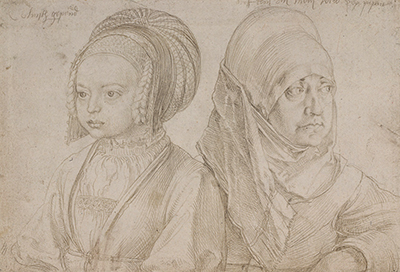
The two women almost touch, yet their attention travels in opposite directions. On the left, a girl looks past the edge of the sheet beneath an elaborate, rounded headdress. On the right, Agnes Dürer turns towards something outside the other edge, her head and neck enclosed in cloth. Their shoulders make a compact group, while their eyes open the composition outwards. The drawing gives a striking impression of two people occupying the same small space. Its history is more mobile: Dürer brought separately made portraits together on a page of his travelling sketchbook.
The ALBERTINA in Vienna dates the sheet to 1521: silverpoint on white prepared paper, 13.5 × 19.6 centimetres, inventory 22385r. That modest scale matters. Both women can be taken in at once, but the fine work asks the eye to move closer, from the broad shapes of their head coverings to the smaller changes around their eyes and mouths. [1]
At a Glance
- Date 1521 [1]
- Materials Silverpoint on white prepared paper [1]
- Collection ALBERTINA, Vienna; 22385r [1]
This work across Albrecht Dürer’s career
Young Hare
1502Praying Hands
1508Melencolia I
1514Four Apostles
1526Contents
- Two heads, two kinds of cloth
- Following the return journey
- A portable way of looking
- Frequently Asked Questions
Two heads, two kinds of cloth
The girl's headwear spreads upwards and backwards in a large oval. Curved bands overlap across its surface; narrower patterned strips border the forehead and descend beside the face. Dürer distinguishes these parts without using colour. One band is lightly shaded, another crossed by small diagonal marks, and the outer curves are reinforced where one layer turns behind another. The arrangement seems intricate even before the viewer has worked out how its different pieces fit together. Her clear forehead and small face remain the still centre of this busy frame.
Below it, the high neckline breaks into numerous short folds. A decorated horizontal band crosses the chest, and the outer garment opens into long diagonals that descend towards the belt. These changes in direction prevent the costume from becoming one uniform patterned surface. The little folds close to the neck and the wider slopes across the shoulders register different scales of fabric. The drawing is attentive to how a body carries clothing as well as to the clothing's design.
Agnes's covering has a different structure. A broad, comparatively uninterrupted dome rises above her forehead. The cloth gathers at the side of her head and falls beside her cheek in a deep vertical strip, then crosses beneath her chin. Long strokes follow the rounded crown; shorter, more crowded strokes darken the turns beside the face. Across her chest, diagonal folds gather towards the right. At the bottom edge, the curve of her forearm cuts across these lines and gives her figure a substantial base.
The faces, too, are built through small differences. The girl's eyes are wide and her lips slightly parted. Agnes's eyes sit beneath more sharply marked brows, and the lines around her nose and mouth receive greater emphasis. These are visible distinctions in the drawing, but their expressions remain open. An outward glance cannot tell us what either sitter was thinking, and the close juxtaposition supplies no conversation for us to overhear.
Dürer's inscriptions identify different interests: “Cölnisch gepend” names the Cologne headwear; “awff dem rin mein weib pey popart” identifies his wife on the Rhine near Boppard. One label records a regional feature, the other a personal relationship and a place. The lettering floats above the heads, leaving the figures themselves free of attributes or a painted setting. It gives the page two points of contact with the world beyond its edges. [1]
Art historian Matthias Mende identifies the girl's headdress as a Cologne Stickelchen . He reconstructs her portrait as the earlier drawing and Agnes's as a later addition during the third week of July 1521. Her wrap, he argues, suits river travel; the girl's elaborate dress suits a domestic or ceremonial setting. [1]
Following the return journey
The diary provides a firm sequence up to Cologne. In the English translation published by William Martin Conway in 1889, Dürer records difficulty obtaining a carriage in Brussels, followed by an early departure on Friday 12 July 1521. The party travelled through Louvain and spent the night at Thienen. The next day's route led through Sint-Truiden and Tongeren to Maastricht. On Sunday they reached Aachen; the driver subsequently lost the way, making the next stage a six-hour journey. On Monday 15 July, they passed through Jülich and Bergheim and arrived in Cologne. The surviving diary account ends there. [13]
These entries bring the journey into focus through breakfasts, overnight stops, fares and a driver's mistake. They also establish the limit of the written narrative. The Boppard inscription carries Agnes's portrait beyond the diary's final destination; Mende's dating joins that inscription to the return route. We can follow the reasoning without imagining a diary passage describing the drawing's execution. The sheet itself preserves something that the written itinerary does not.
Cologne was already connected with Dürer's family. In his family chronicle of 1524, he identifies his cousin Niklas, a goldsmith settled there, and explains that Niklas had trained with his father in Nuremberg. The travel diary records gifts and hospitality involving this household in 1520. Dürer gave Niklas a fur-lined coat and his wife money; during the later autumn stay he gave Niklas's daughter money for lace and further small gifts when leaving. He also acknowledged the trouble the household had taken for him. [13]
Mende suggests that the girl might be Niklas's daughter; her identity remains unproved. The family records make the suggestion intelligible, but they do not attach a name to the drawn face. Nor does the diary's arrival in Cologne establish whom Dürer met on that final visit. The girl's carefully rendered individuality survives more securely than her biography. [1]
Mende interprets the age contrast as a vanitas theme, a reminder that youth passes. The pairing certainly makes differences between the faces unusually available to view: eyes, cheeks, mouths and enclosing cloth all invite comparison. Yet the drawing also rewards attention to what the women share. Both heads turn in three-quarter view; both bodies are cut by the lower edge; both costumes are explored through the same fine network of strokes. Each woman holds her own part of the page. The contrast need not become a verdict on either one's appearance. [1]
A portable way of looking
Silverpoint helps explain how such a page could accumulate during a journey. The artist draws with a metal-tipped stylus across a specially coated surface. Its slight abrasiveness takes minute particles from the metal and leaves a line. As the National Gallery of Art explains, silverpoint offers travellers practical advantages: no inkwell, no waiting for ink to dry, and comparatively little smearing. Its generally even line encourages the building of tone through many strokes; erasing can be difficult or impossible, depending on the ground. Silver lines begin grey and commonly turn golden brown through tarnishing. [14]
In this drawing, light and shade emerge gradually. The girl has pale, open cheeks against the denser marks of her headwear. Beside Agnes's face, closely set strokes give the hanging fabric greater depth. A contour can remain delicate because the neighbouring hatching does much of the work of separating one surface from another. The unmarked intervals are equally active: they keep the foreheads luminous and let the larger forms breathe. Enlarging the sheet makes its labour easier to see, but its original intimacy belongs to a drawing held close enough for these small changes to register.
Turn the sheet over and the world changes. A lion lies with its body extending to the left, its mane spreading around a nearly frontal head. The rear legs are folded low, while a foreleg stretches towards the right edge. Long, loose strands describe the mane; shorter curved marks follow the haunch and ribs. Horizontal strokes beneath the animal provide enough ground for its weight. Compared with the recto's two upright busts, this broad, low body uses the page in a markedly different way.
The verso, numbered 22385v, bears the place inscription “zw gent”, identifying Ghent. On 10 April 1521, the diary records Dürer's ascent of a tower overlooking the city and his viewing of the Van Eyck altarpiece. It then records seeing lions and drawing one with metalpoint, followed by a tip for the sacristan and the lions' keepers. The drawn animal and this entry bring the page back to an earlier stage of the trip. The lion's gaze meets the viewer more directly than either woman's, but no narrative joins the animal to the portraits across the paper. [1] [13]
Christof Metzger's corpus of the journey drawings reconstructs this sheet as part of the silverpoint book: the Ghent lion occupies folio 14r and the portraits folio 14v. The current museum inventory uses recto for the portraits and verso for the lion. His table places the portraits in Cologne and the Middle Rhine in July 1521, and the lion in Ghent in April. The reconstructed book and the present collection thus organise the same physical sheet differently. For a reader, the essential point is the relationship between the sides: a page could be revisited, turned and used again, carrying observations from separate places. [15]
The book was inventoried in Rudolf II's Prague collection in 1607–11. Its later transfer from Vienna's Imperial Court Library to the ALBERTINA came in 1921, distinct from the 1796 acquisition of individual Dürer sheets. Its present appearance as a self-contained double portrait can obscure that history of handling and accumulation. Looking at both sides restores the movement: an animal encountered in Ghent, a girl distinguished by her Cologne dress, and the artist's wife recorded along the Rhine. Their connection is the travelling draughtsman's attention, preserved on a single small piece of prepared paper. [1] [15]
Frequently Asked Questions
Artworks directory
These 187 records include individual works, reverse sides, detail views, paired panels and reconstructed arrangements. Three additional catalogue images repeat works already listed. Related views are not counted as separate originals; qualified attributions and published dating are retained.
Discussion
Look again at the images and ideas explored in Girl from Cologne and Agnes Dürer. These editorial prompts invite your observations.
Reader Insights
Which detail or idea in Girl from Cologne and Agnes Dürer most changed your reading, and why?
How does the discussion of “Two heads, two kinds of cloth” affect your understanding?
What comparison would you bring to the discussion of “A portable way of looking”?
Join the Conversation
Share a detail, comparison or question about Girl from Cologne and Agnes Dürer below.
References
- ALBERTINA , Vienna, Bildnisse eines Mädchens in kölnischer Tracht und Agnes Dürers , inv. 22385r, including Matthias Mende's catalogue essay in Albrecht Dürer , edited by Klaus Albrecht Schröder and Maria Luise Sternath (2003), pp. 496–498; and Liegender Löwe , inv. 22385v. German texts with English introductions; collection metadata and inscriptions. View source 1 . View source 2 .
- ALBERTINA, Selbstbildnis als Dreizehnjähriger, inv. 4839 (German). View source.
- Metropolitan Museum, Four Horsemen from The Apocalypse, 19.73.209 (English). View source.
- Bayerische Staatsgemäldesammlungen, Selbstbildnis im Pelzrock, inv. 537 (German). View source.
- ALBERTINA, Feldhase, inv. 3073 (German). View source.
- ALBERTINA, Das große Rasenstück, inv. 3075 (German). View source.
- Metropolitan Museum, Adam and Eve, 19.73.1 (English). View source.
- ALBERTINA, Betende Hände, inv. 3113 (German). View source.
- Metropolitan Museum, Knight, Death, and the Devil, 43.106.2 (English). View source.
- Metropolitan Museum, Melencolia I, 43.106.1 (English). View source.
- ALBERTINA, Cologne girl and Agnes Durer22385r (German/English). View source.
- Bayerische Staatsgemäldesammlungen, inventory 545: current collection record (German; descriptive citation). View source.
- Albrecht Dürer , family chronicle and diary of the Netherlands journey, English translations in William Martin Conway, Literary Remains of Albrecht Dürer (Cambridge University Press, 1889), p. 34; pp. 95, 107–108, 117–118 and 124–125. Primary texts in a historical English edition. View source .
- National Gallery of Art , Washington, Drawing in Silver and Gold: From Leonardo to Jasper Johns (2015), exhibition overview and explanation of metalpoint technique. View source .
- Christof Metzger , “Dürer's Drawings from the Netherlandish Journey,” in Susan Foister and Peter van den Brink, Dürer's Journeys: Travels of a Renaissance Artist—Catalogue Supplement (National Gallery Company, London, 2021), table entries on printed pp. 52 and 55: A Lion in Ghent Zoo and Girl in Cologne and Agnes Dürer in Boppard . View source .
- Germanisches Nationalmuseum, Barbara Dürer (German and English). View source.
- Web Gallery of Art, Tucher–Rieter reverse (English). View source.
- National Gallery of Art, Portrait of a Clergyman (English). View source.
- Dürer Art, Portrait of a Man (English). View source.
- Hessen Kassel Heritage, Elsbeth Tucher (German). View source.
- Web Gallery of Art, Hans Tucher (English). View source.
- Germanisches Nationalmuseum, Emperor Maximilian I (German and English). View source.
- National Gallery of Art, Lot and His Daughters, reverse (English). View source.
- Bayerische Staatsgemäldesammlungen, Glim Lamentation (German). View source.
- Museo Nacional del Prado, Portrait of a Man (Spanish). View source.
- Bayerische Staatsgemäldesammlungen, Madonna of the Carnation (German). View source.
- Städel Museum, Job on the Dungheap (German). View source.
- Wallraf-Richartz-Museum, Piper and Drummer (German). View source.
- Italian Ministry of Culture / Uffizi, Head of Saint James (Italian). View source.
- Klassik Stiftung Weimar, Dresden Altarpiece (German). View source.
- Staatliche Museen zu Berlin, Girl with a Red Beret (German and English). View source.
- Dresden State Art Museums / Roland Enke, Bernhard von Reesen (German). View source.
- Royal Collection Trust, Burkhard von Speyer (English). View source.
- Dresden State Art Museums, Seven Sorrows of the Virgin (English). View source.
- Bayerische Staatsgemäldesammlungen, Mater Dolorosa (German). View source.
- Bayerische Staatsgemäldesammlungen, Lucretia (German). View source.
- Städel Museum, Young Woman with Her Hair Down (English). View source.
- ALBERTINA, Portrait of a Young Man (German). View source.







