by
Tom Gurney
Tom Gurney BSc (Hons) is an art history expert with over 20 years experience
Published on June 19, 2020 / Updated on October 22, 2026
Email:
tomgurney1@gmail.com
/ Phone:
+44 7429 011000
Hands Holding a Book: Introduction
Two hands rest across a closed book, one laid over the other. The fingers curl around its upper edge, while the heavy volume descends towards the bottom of the sheet. Seen alone, this group can look like a complete little portrait of concentration. It belongs, however, to a larger drawing containing a second pair of hands and another book. Dürer made Two Pairs of Hands with Book in Venice in 1506. The 24.9 × 41.5-centimetre sheet is now in Nuremberg's Germanisches Nationalmuseum, a loan from the Bernhard Hausmann collection. [1]
The full drawing offers two quite different solutions to the same practical problem: how to make hands and a book occupy space together. At the left, the hands settle across a thick, nearly upright volume. At the right, one hand spreads over a broad cover while the other supports its lower edge. The studies are closely related to Jesus among the Doctors , now in Madrid. Their relationship to that crowded composition makes the sheet especially revealing: the action of holding something can become part of an argument, even when the person holding it has disappeared from view. [1] [2]
At a Glance
- Date 1506 [1]
- Object Detail of Two Pairs of Hands with Book [1]
- Collection Germanisches Nationalmuseum, Nuremberg [1]
- TypeDrawing [1]
This work across Albrecht Dürer’s career
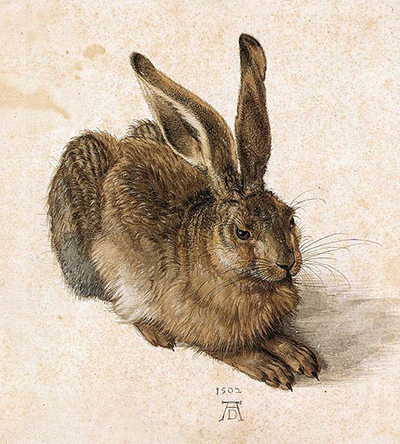
Young Hare
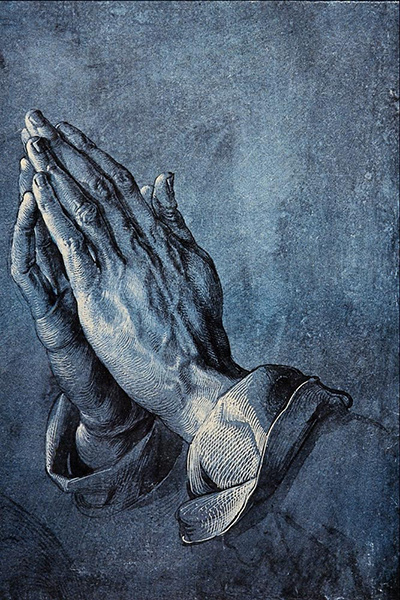
1502Praying Hands
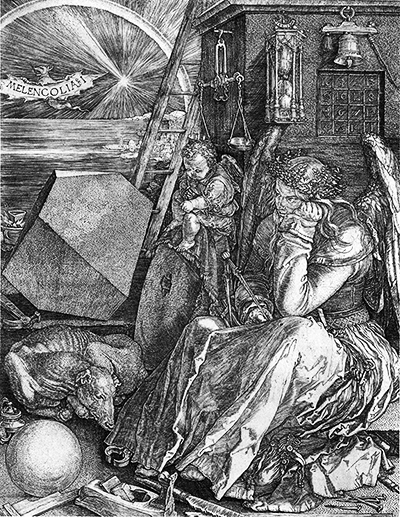
1508Melencolia I
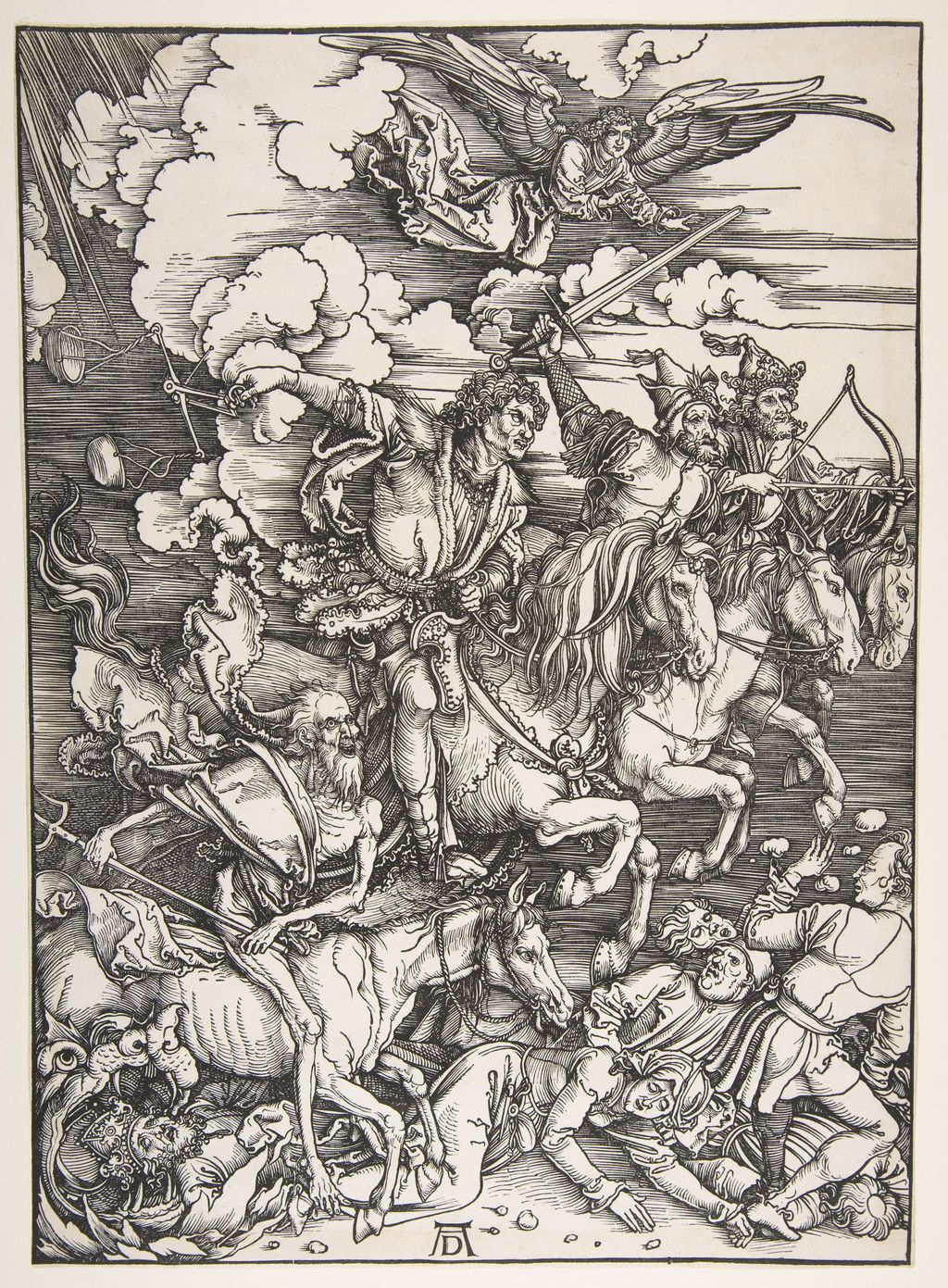
1514Four Apostles
1526Contents
- The weight beneath the fingers
- Drawing light on blue paper
- The hands enter the painting
- A study with room for alternatives
- Frequently Asked Questions
The weight beneath the fingers
The left group has an unusually compact structure. Four fingers descend over the back of the lower hand, their rounded nails punctuating the contour. Beneath them, the lower hand turns across the top of the book. Its fingers bend down at the far side, giving the volume an edge that can almost be felt. The two wrists approach from different directions, yet the hands close into a single broad mass. A cuff at the lower left opens into loose folds; beside it, the straight side of the binding rises like a small architectural support.
Much of the effect comes from the meeting of curved flesh and squared construction. The book has covers, projecting edges and a thick block of leaves. Its pages are indicated by numerous close lines, but their surface is uneven enough to suggest separate layers rather than a solid block. A narrow clasp fitting runs beside the wrist. The fingers press and turn around these rigid parts. Where one hand crosses the other, the dark interval makes their overlap legible without breaking the continuity of the group.
It is tempting to read the pose as peaceful because the hands are at rest. Look longer, and it becomes less settled. The upper fingers hook over the lower hand; the lower fingers themselves grip the binding. There is pressure within the apparent stillness. This ambiguity is useful to a painter. A pose can suggest attention, possession, patience or resistance according to the face and neighbouring gestures that accompany it. The drawing gives us the physical arrangement before the painting supplies those further relationships.
The right group keeps that question open. Its book lies obliquely, with the broad cover facing us and the leaves visible along the upper edge. A thumb and bent fingers work across its surface; the supporting hand reaches around the bottom. More of the book is exposed, and its diagonal gives this half of the sheet a different rhythm. The two groups neither illustrate a sequence of opening a volume nor repeat an identical pose. They test alternative ways of gathering fingers around an object with weight and thickness.
Drawing light on blue paper
Dürer used a brush in black, grey and ochre washes, with white heightening, on Venetian blue paper. The coloured support is essential to what we see. It supplies a middle value across the sheet. Dark strokes deepen the spaces between fingers and beneath the wrists, while the white rises above that middle tone along knuckles, nails and the crests of folds. The hand seems to turn because light and shadow are added on opposite sides of the same blue surface. [1]
The marks also have direction. Fine strokes follow the swell of a finger, shorten at a joint and gather where a form turns away. On the broad back of a hand they spread into longer courses. The cover of the right-hand book carries dense parallel strokes that meet the softer modelling of the flesh above it. This makes looking a double experience: one can read the forms as bodies and objects, or move close enough to follow the separate brush marks that construct them.
Such a technique involves more than colouring an outline. It gives the artist a way to investigate how a form will receive light before the addition of the painting's local colours. The sleeves are particularly instructive. Broad shaded folds and thin bright ridges allow cloth to emerge from relatively few changes of tone. The treatment of the fingers is much more intricate. Dürer adjusts the density and scale of his strokes to the surface he is describing.
Art historian Iris Brahms distinguishes inherently coloured blue paper from white sheets coated with a coloured ground. In her study of Dürer's Venetian drawing practice, she emphasises the practical advantage of a support already suited to light-and-dark modelling: it avoided a separate coating and drying stage. She also cautions against assuming that an inexpensive or recycled material meant an artist valued the resulting drawing less. The small range of drawing materials here supports a demanding exercise in observation. [13]
Paper conservator Irene Brückle explains that blue paper could be manufactured from coloured rags, with other colouring methods also available. Venetian production benefited from textile dyeing and trade. Her technical account reminds us that a drawing's colour begins with the making of its support, before the artist's brush touches it. It does not identify the precise dye or fibre mixture in Dürer's sheet. Those would require examination of this particular paper. [14]
The hands enter the painting
In Jesus among the Doctors , the left pair reappears at the lower left, belonging to the scholar with a grey beard. The right pair has no direct counterpart in the finished composition. Looking between the works reveals how much the left motif retains: the hands overlap above the book, the cuff opens beside the wrist, and the book's thickness helps anchor the figure at the edge of the painting. Colour then joins the group to the scholar's green clothing and warm complexion. [1]
The painted hands also occupy a very different social space. Above them, the scholar turns towards the young Jesus. Another book opens behind his head. Across the foreground, a long-bearded man holds a large volume with raised leaves. The isolated study becomes one contribution to a picture filled with bodies, faces, books and interrupted attention. Its compactness gives the lower left corner a firm base, while the central hands remain free to move.
Mar Borobia's catalogue essay identifies the young Christ's finger-counting gesture as the enumeration of arguments familiar from theological discussion. She also draws attention to the inscription claiming that the painting was executed in five days, distinguishing that claim from the labour of preparing the surviving studies. The hand drawing helps us understand that distinction. A finished painting's declared speed can coexist with careful prior work on the bodily actions through which its subject becomes intelligible. [15]
The biblical episode is brief. Luke describes the twelve-year-old Jesus remaining in Jerusalem and being found by his parents after three days, sitting among the teachers, listening, questioning and astonishing those around him with his understanding. Dürer's tightly gathered figures turn that account into an encounter at close range. We receive little architectural information. Hands take on some of the work that a larger narrative setting might otherwise perform: holding a book, pointing, touching and counting establish relations between the participants. [16]
The museum in Nuremberg interprets the old scholars' grasp on their books as a counterpart to Jesus's freely arguing hands, associating the volumes with religious tradition. That is a reading of the picture's Christian rhetoric. The drawn fingers themselves do not establish a person's beliefs or character. In the left group, their detailed and responsive movement remains absorbing even when the theological opposition is set aside. [1]
A study with room for alternatives
Friedrich Winkler gave this sheet particular importance in his 1937 catalogue of Dürer's drawings. He regarded it as an unusually good indication of how such hand studies had occupied large sheets of blue paper, and praised the arrangement of its motifs together. His observation directs attention beyond the isolated left group to the composition of the entire drawing. He also suggested that the unused right pair might have been intended for the bearded old man opposite. That remains a proposal about Dürer's planning, distinct from the visible reuse of the left pair. [2]
The unused group matters precisely because it complicates any idea of the sheet as an instruction followed mechanically. Dürer explored more than the final painting retained. Both alternatives received enough attention to have substance as drawings. The relation between study and picture includes selection: a convincing solution on paper may be changed or set aside when it meets the requirements of a larger arrangement.
The relationship does not supply a complete chronology of drawing and painting. Brahms argues that Dürer’s elaborate Venetian studies could also have served as ricordi : records taken home to Nuremberg to demonstrate his achievements in Italy. She presents this as a likely function, not a documented occasion on which these particular hands were shown. A sheet could preserve a successful motif, make the artist’s handling available for scrutiny and still remain useful within his work. Its high finish gives us reason to ask about these possibilities; it cannot settle them on its own. [13]
Other surviving drawings belong to this work of preparation. The ALBERTINA's Hand with Book , inventory 3103, studies a separate motif for the scholar in the upper left background. Its catalogue essay explains how grey and white parallel strokes on blue paper build the forms that become so prominent in the painting. It is a useful comparison because it shows that several distinct problems could be investigated within the same general technique. The Nuremberg sheet's two pairs of hands should be understood as one substantial part of this varied work. [17]
The 1506 date and Dürer monogram at the bottom of the sheet were added by a later hand, according to the museum. They record an attribution and date without serving as the artist's own dated signature. [1]
The familiar description Hand Study with Bible is more specific than the evidence warrants. The museum identifies closed books. No readable text in the drawing establishes a particular volume. Their religious setting gives them meaning, but the drawing asks us first to notice their physical presence. The hands meet covers, leaves and clasps. Flesh bends around a weight it can carry and hold. In that carefully studied contact, an everyday action acquires the concentration needed to sustain a larger painted encounter. [1]
Frequently Asked Questions
Artworks directory
These 187 records include individual works, reverse sides, detail views, paired panels and reconstructed arrangements. Three additional catalogue images repeat works already listed. Related views are not counted as separate originals; qualified attributions and published dating are retained.
Discussion
Look again at the images and ideas explored in Hands Holding a Book. These editorial prompts invite your observations.
Reader Insights
Which detail or idea in Hands Holding a Book most changed your reading, and why?
How does the discussion of “The weight beneath the fingers” affect your understanding?
What comparison would you bring to the discussion of “A study with room for alternatives”?
Join the Conversation
Share a detail, comparison or question about Hands Holding a Book below.
References
- Germanisches Nationalmuseum , Zwei Händepaare mit Buch , Hz5481, current collection record. German. View source .
- Friedrich Winkler , Die Zeichnungen Albrecht Dürers , vol. II: 1503–1510/11 (1937), no. 405, p. 99. German. View source .
- ALBERTINA, Selbstbildnis als Dreizehnjähriger, inv. 4839 (German). View source.
- Metropolitan Museum, Four Horsemen from The Apocalypse, 19.73.209 (English). View source.
- Bayerische Staatsgemäldesammlungen, Selbstbildnis im Pelzrock, inv. 537 (German). View source.
- ALBERTINA, Feldhase, inv. 3073 (German). View source.
- ALBERTINA, Das große Rasenstück, inv. 3075 (German). View source.
- Metropolitan Museum, Adam and Eve, 19.73.1 (English). View source.
- ALBERTINA, Betende Hände, inv. 3113 (German). View source.
- Metropolitan Museum, Knight, Death, and the Devil, 43.106.2 (English). View source.
- Metropolitan Museum, Melencolia I, 43.106.1 (English). View source.
- Bayerische Staatsgemäldesammlungen, inventory 545: current collection record (German; descriptive citation). View source.
- Iris Brahms , “Ecologies of Blue Paper: Dürer and Beyond”, 21: Inquiries into Art, History, and the Visual 4, no. 4 (2023), pp. 603–638, especially sections I–II and note 29. View source .
- Irene Brückle , “Historical Manufacture and Use of Blue Paper”, The Book and Paper Group Annual 12 (1993). View source .
- Mar Borobia , Jesus among the Doctors , Albrecht Dürer, Museo Nacional Thyssen-Bornemisza, collection catalogue essay. View source .
- Luke 2:41–52 , New American Bible, Revised Edition , United States Conference of Catholic Bishops. View source .
- Heinz Widauer , Hand mit Buch (Detail aus “Jesus unter den Schriftgelehrten”) , inventory 3103, ALBERTINA collection record, reproducing the 2003 catalogue text. German. View source .
- Germanisches Nationalmuseum, Barbara Dürer (German and English). View source.
- Web Gallery of Art, Tucher–Rieter reverse (English). View source.
- National Gallery of Art, Portrait of a Clergyman (English). View source.
- Dürer Art, Portrait of a Man (English). View source.
- Hessen Kassel Heritage, Elsbeth Tucher (German). View source.
- Web Gallery of Art, Hans Tucher (English). View source.
- Germanisches Nationalmuseum, Emperor Maximilian I (German and English). View source.
- National Gallery of Art, Lot and His Daughters, reverse (English). View source.
- Bayerische Staatsgemäldesammlungen, Glim Lamentation (German). View source.
- Museo Nacional del Prado, Portrait of a Man (Spanish). View source.
- Bayerische Staatsgemäldesammlungen, Madonna of the Carnation (German). View source.
- Städel Museum, Job on the Dungheap (German). View source.
- Wallraf-Richartz-Museum, Piper and Drummer (German). View source.
- Italian Ministry of Culture / Uffizi, Head of Saint James (Italian). View source.
- Klassik Stiftung Weimar, Dresden Altarpiece (German). View source.
- Staatliche Museen zu Berlin, Girl with a Red Beret (German and English). View source.
- Dresden State Art Museums / Roland Enke, Bernhard von Reesen (German). View source.
- Royal Collection Trust, Burkhard von Speyer (English). View source.
- Dresden State Art Museums, Seven Sorrows of the Virgin (English). View source.
- Bayerische Staatsgemäldesammlungen, Mater Dolorosa (German). View source.
- Bayerische Staatsgemäldesammlungen, Lucretia (German). View source.
- Städel Museum, Young Woman with Her Hair Down (English). View source.
- ALBERTINA, Portrait of a Young Man (German). View source.
- Splash image , Albrecht Dürer, Two Pairs of Hands with Books, 1506. Germanisches Nationalmuseum, Hz5481. Historical monochrome reproduction; original colour is not represented. Image source . Public domain .