


 by
Tom Gurney
Tom Gurney BSc (Hons) is an art history expert with over 20 years experience
Published on June 19, 2020 / Updated on October 22, 2026
Email:
tomgurney1@gmail.com
/ Phone:
+44 7429 011000
A Lion, 1494: Introduction
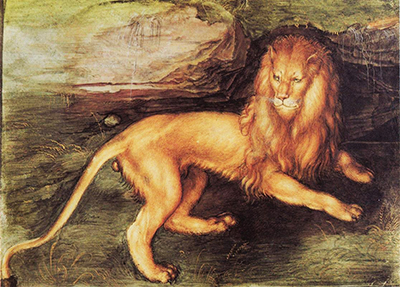
The lion fills his little landscape as if he owns every inch of it. His golden body stretches across green ground, while his mane rises against the dark hollow of a rock. His eyes turn towards us, alert beneath a creased brow. Albrecht Dürer made this small work in 1494, using opaque colour and watercolour heightened with gold on parchment. Measuring just 12.6 × 17.2 centimetres, it belongs to the Hamburger Kunsthalle. Its scale invites the close attention that the hairs, whiskers and scattered golden grasses reward. [1]
At a Glance
- Date 1494 [1]
- Materials Opaque colour and watercolour heightened with gold on parchment [1]
- Collection Hamburger Kunsthalle [1]
This work across Albrecht Dürer’s career
Young Hare
1502Praying Hands
1508Melencolia I
1514Four Apostles
1526Contents
- A creature in a rocky shelter
- Gold, parchment and a finished image
- Where did Dürer find his lion?
- A model that could be used again
- The later encounter at Ghent
- From an art book to Hamburg
- Frequently Asked Questions
A creature in a rocky shelter
The face is the picture's point of greatest concentration. Fine pale whiskers extend from the muzzle, and small dark dots punctuate the fur around the mouth. Light picks out the bridge of the nose and the areas beneath the eyes. The ears barely interrupt the crest of the mane. Below them, long locks divide, twist and overlap, making the head appear much larger than the narrow body behind it. Some strands end in curls that seem almost deliberately arranged. The lion's colouring ranges from pale cream through tawny orange to deep reddish brown, giving the mane considerable weight without turning it into a single dark mass.
The body runs sideways across the sheet, but the head confronts the viewer at an angle. That change of direction makes the animal seem aware of someone outside his enclosure. The nearer foreleg reaches diagonally down and right; the farther paw rests higher, partly withdrawn into shadow. Behind, one hind leg drops towards the lower border and another bends beneath the belly. These limbs do not combine into an easily named action. The lion appears suspended between settling down and getting up. His firmly outlined paws suggest contact with the ground, while the stretched trunk keeps the whole figure unusually taut.
The tail carries that tension almost to the opposite corner. It begins high on the rump and sweeps down towards the left edge, ending in a dark tuft against the border. Its pale upper surface catches the light, continuing the bright outline of the back. Follow that line and the picture briefly becomes an exercise in long curves: tail, spine, mane and reaching foreleg. The darker underside of the belly and the shadows between the legs prevent the gold-coloured silhouette from becoming flat.
The surroundings are less immediately legible. Above the lion's back, a broad pale rock face projects into the picture from the left. Layers of reddish stone lead towards the dark recess behind his head. Fine roots hang from the upper ledges. At the far left, pale horizontal bands suggest water beyond the darker foreground. Along the bottom, separate strokes suggest blades of grass growing out of darker, more loosely brushed ground. The hard rock, trailing roots, soft fur and wiry grasses each receive a different treatment. Dürer has given the animal a place to inhabit, though the cramped shelter and uncertain openings leave us to imagine how that place continues beyond the frame.
Gold, parchment and a finished image
At this size, the difference between a broad patch of colour and a single fine stroke becomes especially telling. The stone is built from horizontal bands; the lion's flank carries closely repeated marks following the turn of his body. The gold accents among the grasses interrupt the green like little hooked threads. They help connect the richly coloured animal with his setting, making the whole surface feel worked and precious.
The black painted border gives the scene a definite stopping point. On its lower edge Dürer placed the date at the left and his initials at the right in gold. The marks belong to the picture's presentation as well as identifying its maker. Their small scale asks the eye to move from the imposing head to the edge of an object that could be held in the hands. An enlarged reproduction makes the lion monumental; the measurements restore the intimacy of the actual sheet. [1]
Petra Roettig records Eduard Flechsig's suggestion that the sheet was a New Year greeting from Italy to Nuremberg. The museum also reports an unexplained black preparation on the reverse. The gift remains hypothetical. The front's completeness leaves its first recipient and use uncertain. [1]
Where did Dürer find his lion?
A related sheet in the ALBERTINA, dated 1494/95, provides a useful glimpse of Dürer's store of imagery. Three lion heads occupy its upper right corner, above an archer and a standing figure; a separate mythological scene fills the left half. The museum suggests that the lion heads may reflect Venetian representations of the lion of Saint Mark and sees a possible anticipation of the Hamburg animal in the head at the far right. It also allows that the two halves of the sheet were worked on at different times. The drawing offers a possible connection whose precise sequence remains uncertain. [12]
Looking between the two works makes the distinction clear. In the pen drawing the heads are isolated, with different turns and different arrangements of the mane. On the parchment, a head has become the commanding centre of an entire coloured scene. We can recognise a shared interest in the heavy brow, projecting muzzle and hanging locks without claiming to have found the precise object Dürer copied.
The alternatives remain open. Sarvenaz Ayooghi and Heidrun Lange-Krach discuss both Italian influence and a proposed Upper Rhenish connection, while stressing that direct dependence on a particular sculpture, painting or print has not been demonstrated. Roettig reviews suggestions of a heraldic head combined with another animal's body, possibly a dog's, and a resemblance to lions associated with the planetary figure of Sol. These are interpretations of the image's unusual construction. The parchment does not identify its model or announce an astrological subject. [13] [1]
Its detail once encouraged a very different conclusion. In the English edition of his study of Dürer, published in 1882, Moriz Thausing argued that the painstaking rendering of individual hairs demonstrated work from a living animal. He even claimed a pioneering place for it among northern European pictures of lions studied from nature. His argument reveals how easily finish could be treated as proof of firsthand observation. The surviving picture demonstrates patient attention, while leaving its model unidentified. [14]
Charles Ephrussi, writing in French in the same year, admired the careful execution but found the anatomy awkward, particularly the hind legs, and the mane and tail disproportionately developed. These responses pull in different directions: one reader saw convincing evidence of nature, another saw a highly accomplished image with structural difficulties. The disagreement is still useful when looking at the lion. The face and coat can absorb us before we begin to ask exactly how the animal bears his weight. [15]
A model that could be used again
The lion's relationship to Dürer's small painting of Saint Jerome in London's National Gallery gives the sheet a practical place within his work. Susan Foister's 2024 catalogue treats the painting as Dürer's and explains how closely its lion depends on the Hamburg image. The animal was adapted to fit beside the saint: the mane was reduced and the space between chin and foreleg compressed. Foister considers the parchment likely to have belonged to the studies Dürer retained for use in his workshop. [16]
That reading accommodates both care and usefulness. A finished image could preserve a particular animal type for later compositions. Once placed beside Jerome, the lion became the saint's recognisable companion, associated with the legend of the thorn removed from its paw. In Hamburg there is no saint, crucifix or accompanying narrative. The animal and his shelter have the viewer's entire attention. The difference allows us to see how a figure could serve a religious story elsewhere while sustaining a picture of its own here. [16]
The later encounter at Ghent
Dürer's travel diary offers firmer evidence for a living model much later. During his visit to Ghent in April 1521, he recorded seeing the lions and drawing one in silverpoint. He also noted a gratuity for the sacristan and the lions' keeper. The encounter appears among accounts of the city's buildings, paintings and hospitality, giving the act of drawing a concrete place in a day's sightseeing. It occurred twenty-seven years after the date on the Hamburg parchment and cannot document the circumstances of its making. [17]
Berlin's Two Seated Lions , drawn in silverpoint on prepared paper in 1521, is associated with that Ghent visit. Hans Mielke's museum account suggests that its two views could show the same animal, following the diary's reference to drawing one lion. On that sheet, the repeated subject allows a profile and a more frontal head to be considered together. Lines run through the coat in long, fine streams, while the paws rest low on the page. There is no coloured rocky enclosure. Comparing it with Hamburg brings out how much the earlier work achieves through the warmth of the body, the enclosing darkness and the decorative sweep of the tail, as well as through the animal's features. [18]
From an art book to Hamburg
The parchment's later history records sustained interest in this carefully finished lion. The National Gallery's 2021 loan documentation identifies it with an entry in the Imhoff collection's 1588 inventory describing a lion on parchment with a patch of turf. It passed to Emperor Rudolf II that year and subsequently belonged to the imperial collections. It was in the Imperial Court Library in Vienna from 1783. [19]
Its departure from imperial ownership is less secure. The same record preserves alternatives involving a sale or theft in 1809, or misappropriation after a possible transfer to Duke Albert in 1796. The evidence does not justify selecting one of these accounts as certain. The sheet later belonged to Sir Thomas Lawrence, whose collection inventory of 1834 described a highly finished lion in colours by Dürer, and then to Georg Ernst Harzen. Harzen's bequest dates to 1863; transfer to the city followed in 1868, ahead of the Kunsthalle's opening in 1869. [19] [1]
That collecting history has preserved an image whose first purpose remains elusive. Its most absorbing qualities are still available at close range: the light muzzle against the heavy mane, the dark spaces between the legs, the roots suspended above the head and the thin golden marks scattered through the grass. Together they make the lion feel present, even while his extraordinary posture keeps the act of constructing him visible.
Frequently Asked Questions
Artworks directory
These 187 records include individual works, reverse sides, detail views, paired panels and reconstructed arrangements. Three additional catalogue images repeat works already listed. Related views are not counted as separate originals; qualified attributions and published dating are retained.
Discussion
Look again at the images and ideas explored in A Lion, 1494. These editorial prompts invite your observations.
Reader Insights
Which detail or idea in A Lion, 1494 most changed your reading, and why?
How does the discussion of “A creature in a rocky shelter” affect your understanding?
What comparison would you bring to the discussion of “From an art book to Hamburg”?
Join the Conversation
Share a detail, comparison or question about A Lion, 1494 below.
References
- Petra Roettig , “Löwe, 1494,” Hamburger Kunsthalle, inv. 23005, collection entry, inscription and provenance (German). View source .
- ALBERTINA, Selbstbildnis als Dreizehnjähriger, inv. 4839 (German). View source.
- Metropolitan Museum, Four Horsemen from The Apocalypse, 19.73.209 (English). View source.
- Bayerische Staatsgemäldesammlungen, Selbstbildnis im Pelzrock, inv. 537 (German). View source.
- ALBERTINA, Feldhase, inv. 3073 (German). View source.
- ALBERTINA, Das große Rasenstück, inv. 3075 (German). View source.
- Metropolitan Museum, Adam and Eve, 19.73.1 (English). View source.
- ALBERTINA, Betende Hände, inv. 3113 (German). View source.
- Metropolitan Museum, Knight, Death, and the Devil, 43.106.2 (English). View source.
- Metropolitan Museum, Melencolia I, 43.106.1 (English). View source.
- Bayerische Staatsgemäldesammlungen, inventory 545: current collection record (German; descriptive citation). View source.
- ALBERTINA , “Skizzenblatt mit dem Raub der Europa, Löwen, Apollo und einem Orientalen,” inv. 3062, collection essay and object record, updated 24 January 2025 (German; introductory summary also in English). View source .
- Sarvenaz Ayooghi and Heidrun Lange-Krach , “Impressionen einer Reise: Dürers Blick auf Mensch, Landschaft, Tiere und ‘Exotika’,” in Dürer war hier: Eine Reise wird Legende , publisher's selected preview, pp. 288–289 (German). View source .
- Moriz Thausing , Albert Dürer: His Life and Works , vol. I, English edition edited by Fred. A. Eaton (London: John Murray, 1882), pp. 117–118. View source .
- Charles Ephrussi , Albert Dürer et ses dessins (Paris: A. Quantin, 1882), pp. 35–36 (French). View source .
- Susan Foister , “Saint Jerome,” The German Paintings before 1800 (National Gallery, 2024), especially “Subject: Obverse” and “Attribution.” View source .
- Albrecht Dürer , Records of Journeys to Venice and the Low Countries , translated by Rudolph Tombo, diary section “Visit to Bruges and Ghent (April 6–11, 1521).” View source .
- Hans Mielke / Kupferstichkabinett , Staatliche Museen zu Berlin, “Two seated lions,” KdZ 33 verso, museum text and object record via Google Arts & Culture. View source .
- National Gallery , The Credit Suisse Exhibition: Dürer's Journeys—Travels of a Renaissance Artist , immunity from seizure documentation (2021), individual record X10845, Hamburger Kunsthalle 23005. View source .
- Germanisches Nationalmuseum, Barbara Dürer (German and English). View source.
- Web Gallery of Art, Tucher–Rieter reverse (English). View source.
- National Gallery of Art, Portrait of a Clergyman (English). View source.
- Dürer Art, Portrait of a Man (English). View source.
- Hessen Kassel Heritage, Elsbeth Tucher (German). View source.
- Web Gallery of Art, Hans Tucher (English). View source.
- Germanisches Nationalmuseum, Emperor Maximilian I (German and English). View source.
- National Gallery of Art, Lot and His Daughters, reverse (English). View source.
- Bayerische Staatsgemäldesammlungen, Glim Lamentation (German). View source.
- Museo Nacional del Prado, Portrait of a Man (Spanish). View source.
- Bayerische Staatsgemäldesammlungen, Madonna of the Carnation (German). View source.
- Städel Museum, Job on the Dungheap (German). View source.
- Wallraf-Richartz-Museum, Piper and Drummer (German). View source.
- Italian Ministry of Culture / Uffizi, Head of Saint James (Italian). View source.
- Klassik Stiftung Weimar, Dresden Altarpiece (German). View source.
- Staatliche Museen zu Berlin, Girl with a Red Beret (German and English). View source.
- Dresden State Art Museums / Roland Enke, Bernhard von Reesen (German). View source.
- Royal Collection Trust, Burkhard von Speyer (English). View source.
- Dresden State Art Museums, Seven Sorrows of the Virgin (English). View source.
- Bayerische Staatsgemäldesammlungen, Mater Dolorosa (German). View source.
- Bayerische Staatsgemäldesammlungen, Lucretia (German). View source.
- Städel Museum, Young Woman with Her Hair Down (English). View source.
- ALBERTINA, Portrait of a Young Man (German). View source.







