 by
Tom Gurney
Tom Gurney BSc (Hons) is an art history expert with over 20 years experience
Published on June 19, 2020 / Updated on October 22, 2026
Email:
tomgurney1@gmail.com
/ Phone:
+44 7429 011000
Map of the Northern Sky: Introduction
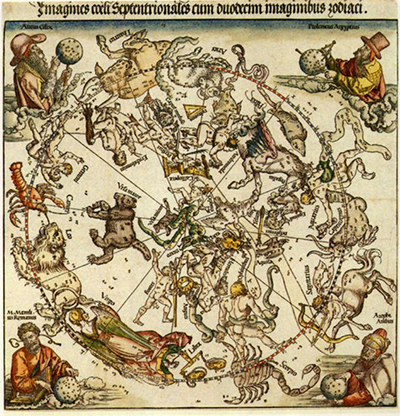
Albrecht Dürer’s Map of the Northern Sky fills the heavens with bodies. A dragon winds between bears; a winged horse rises beside a chained woman; a muscular man struggles with a serpent. Small stars and numbers spread across their skin, fur and feathers. Published in Nuremberg in 1515, the woodcut belongs to a pair made through Dürer’s collaboration with the astronomer Conrad Heinfogel and the scholar Johann Stabius. Its northern sheet includes the twelve constellations of the zodiac, as the Latin title across the top announces. Four learned men, each accompanied by a celestial globe, occupy the corners. [1] [2]
The first pleasure is discovering how much the circle contains. The second is recognising that its exuberance has a structure. Long straight lines radiate from a common centre, passing through animals and people towards the graduated circumference. Figures turn in different directions, while their names follow their individual orientations. Reading the map means rotating it, or mentally changing one’s position around the sheet. The printed rectangle has an obvious top, fixed by the title and the corner portraits, but the sky inside it continually invites another way up. [2]
The term “northern” needs to be understood through this structure. The map uses a polar stereographic projection based on the ecliptic, the Sun’s apparent annual path through the stars. Its centre corresponds to the north pole of that circle, rather than the point above the Earth’s geographical North Pole. The zodiacal figures are ranged around the outside because they belong along the ecliptic. This explains the commanding place of Draco, the Dragon, in the central region, and why the familiar pattern of a modern map centred on the north celestial pole is not the right guide to the arrangement. [3]
Follow the rim and the zodiac becomes a series of changing silhouettes. The broad, curling mane of Leo gives way to the long folds and feathers of Virgo. Nearby, Libra is a pair of scales suspended in open space, followed by the segmented body and claws of Scorpio. On the opposite side, the paired bodies of Gemini and the many limbs of Cancer offer different ways of enclosing groups of stars. The figures do not fit neatly into twelve isolated boxes. They approach, cross and spread beyond the graduated circle, giving the border the irregular rhythm of an inhabited place. [2]
Within that ring, larger and smaller images compete for attention without losing their distinct characters. Pegasus opens a wide span of wings. Andromeda extends her bound arms, while Perseus strides nearby with the severed head identified by the label Caput Medusae . Cassiopeia’s seat supplies a small piece of furniture in the sky. Among these elaborate bodies, the plain triangle labelled Deltoton is especially striking: three lines are enough to make this constellation legible. Moving between such different shapes, the eye encounters a whole vocabulary of ways to remember the heavens. [2]
The tiny numbers have a more exact purpose. They connect individual stars with their entries in the Ptolemaic catalogue, a system inherited from the earlier manuscript maps. The pictures and the numbering therefore offer two kinds of recognition: one allows the reader to find a familiar creature, the other to identify a particular star within it. The marks remain visibly separate from the outlines. Some sit inside bodies and others occupy the surrounding paper; the sky is never reduced entirely to a continuous carpet of ornament. [4] [2]
At a Glance
- Publication 1515, Nuremberg [1] [2]
- Process Woodcut [1] [2]
- Collaboration Dürer, Conrad Heinfogel and Johann Stabius [1] [2]
This work across Albrecht Dürer’s career
Young Hare
1502Praying Hands
1508Melencolia I
1514Four Apostles
1526Contents
- A sky remembered through figures
- The four readers of the heavens
- Earlier maps and a printed future
- Frequently Asked Questions
A sky remembered through figures
Near the centre, Draco’s long body offers a particularly clear example of the relationship between a constellation and its neighbours. It folds around the little bear and sends another length towards the larger one. The bears’ lifted paws, pointed faces and bristling coats make them appear active, although their positions are fixed. Their bodies provide broad areas for the star marks, while the dragon’s narrow turns carry the eye through the more crowded central knots. Dürer gives the three creatures different kinds of movement: a heavy animal’s reach, a smaller creature’s curl, and a reptile’s almost unbroken winding. [2]
One of the corner authorities had described this relationship in words long before the woodcut. In the Phaenomena , Aratus places the Dragon between the two Bears and traces its tail and coils by reference to their heads and feet. His account then turns to a nearby kneeling man whose identity and labour he leaves uncertain. These passages help explain why a poet belongs among the map’s authorities. Verse could make the arrangement of the heavens memorable through the relations between figures. Dürer’s sheet labels the kneeling man Hercules and equips him with a club and an animal skin, giving that bodily arrangement a more definite mythological identity. [15]
Hercules is one of the most compressed figures on the map. His bent legs and turned torso fit between the winding forms around him; the lion skin becomes another complicated surface of curls and projections. Close by, Ophiuchus, the Serpent Bearer, is seen from behind, his arms extended to grip the snake that loops around his waist. Muscles, shoulders and buttocks are carefully articulated. The drawing makes the labour of holding the serpent persuasive, even as the star marks interrupt the illusion of living flesh. [2]
These back views serve an astronomical convention as well as a pictorial opportunity. The map takes an external view of the celestial sphere, comparable to looking at a globe from outside. As the Bibliothèque nationale de France explains, bodily orientation preserves the catalogue’s references to particular sides of a figure: a star described as belonging to a right hand remains attached to that figure’s right hand. A shoulder, knee or wrist is thus a location that can be named. Anatomy helps the picture fulfil its work as a map. [16]
There are also images that resist a single familiar identity. Near Hercules, a bird is combined with a stringed instrument under the name Vultur cadens . Its feathered body and the lyre before it remain separately recognisable. Anna Friedman Herlihy places this hybrid within the map’s transmission of Islamic constellation imagery, and notes its importance for later representations of Lyra. It is a small but useful reminder that the sheet’s classical-looking population contains several historical traditions, sometimes joined within one creature. [2] [4]
The four readers of the heavens
The corner figures give that inheritance human form. Aratus, at upper left, has a flowing beard and a broad, curling hat. At upper right, Ptolemy brings a pair of dividers towards his globe. Below, Manilius sits with a large open book, while al-Sufi cradles a star-covered sphere. Clouds gather around their seats and connect these otherwise separate portraits with the sky they frame. The differences in headwear, beard, pose and equipment make each figure immediately distinct. [2]
Their labels identify a Greek poet, an Alexandrian astronomer, a Roman poet and a Persian astronomer: Aratus, Ptolemy, Manilius and al-Sufi. The mixture matters. The map presents celestial knowledge as something carried by texts, images and mathematical description across languages and centuries. Its designation of al-Sufi as Azophi Arabus records the Latin terminology on the print; the astronomer himself was Persian. His position gives the Persian astronomer the same pictorial prominence as the ancient Greek and Roman authors. All four are placed before the reader as part of the map’s intellectual ancestry. [1] [16]
The globes repeated in their hands also create a visual argument. Each man possesses a small, rounded version of the starry whole, whereas the large circular map opens that whole across the middle of the sheet. Manilius’s book adds another material form through which knowledge can pass. These objects establish a chain between reading, handling and representing the heavens. The four figures appear absorbed in their instruments, but their arrangement also turns the chart into a public display of learning. [2]
The people responsible for the 1515 publication were a different group. Stabius published the work; Heinfogel was responsible for the placement of the stars; Dürer gave the constellations their graphic and figural form. This division makes the achievement easier to understand. The position of a star could constrain the curve of an arm, while an effective figure could make a difficult distribution of points intelligible. The resulting picture required agreement between astronomical information and an artist’s ability to arrange bodies. [3]
Earlier maps and a printed future
The collaboration worked within an existing visual tradition. Manuscript maps made in Vienna in 1435 survive in Codex 5415 of the Austrian National Library; a further pair made in Nuremberg in 1503 is now in the Germanisches Nationalmuseum. Martin Roland argues that the 1503 pair alone cannot explain Dürer’s figures. His comparison of the Serpent Bearer’s head finds a closer relationship with the earlier Viennese image. He also draws attention to the treatment of Hercules, including Dürer’s solution for placing the lion skin behind the bent knee. The comparison reveals specific artistic decisions within an inherited arrangement. Exactly how Dürer gained access to the earlier material remains uncertain. [17]
The geometry, too, deserves close comparison. Keeping complete zodiacal figures on this sheet meant including some stars south of the ecliptic. In her study of the maps’ construction, Elly Dekker distinguishes the equidistant projection of the Viennese charts from the stereographic basis of the 1503 and 1515 versions. She finds that stars extending sufficiently far south of the ecliptic on Dürer’s northern sheet depart from a strict stereographic scheme. Her proposed explanation is an approximation that limited their outward expansion. She also concludes that none of the surviving star catalogues she examined fully accounts for the maps’ data. The apparently orderly circle therefore preserves decisions and compromises that a modern technical name cannot explain by itself. [18]
The printed sheet gave this combination of inherited information and inventive drawing a reproducible form. The Rijksmuseum describes its northern impression as a woodcut with letterpress text on paper, measuring 43 by 43 centimetres. At that scale, the fine numbers, labels and star signs make sustained inspection possible. The strong outlines keep even an intricate creature recognisable among the converging lines. Fur, feathers, hair and cloth introduce variations of texture without requiring the reader to lose sight of the constellation as a whole. [19] [2]
Individual impressions can nevertheless look quite different. The coloured example reproduced here picks out bodies, garments and the Dragon with washes of colour, bringing some of the densely interwoven shapes forward. The uncoloured BnF impression makes the continuity of the black line particularly apparent. Colour belongs to the history of a particular printed sheet; it cannot, by itself, establish who coloured it or when. Measurements likewise need to be attached to a named impression: Greenwich records a sheet of 488 by 441 millimetres. These surviving objects carry the same design within different physical margins and subsequent histories. [2] [16] [1]
The design’s influence extended beyond further impressions. Herlihy traces its contribution to later planispheres and globes, including the close adaptation for Gemma Frisius’s celestial globe of 1537, and Johannes Honter’s 1532 charts, which changed the viewpoint to one looking from within the heavens. Such transformations show what the northern map made available: recognisable figures, an ordered field of stars and a compelling way to hold the whole together. Its lasting fascination lies in the movement between those scales, from a numbered point on a shoulder to an entire imagined sky. [4]
Frequently Asked Questions
Artworks directory
These 187 records include individual works, reverse sides, detail views, paired panels and reconstructed arrangements. Three additional catalogue images repeat works already listed. Related views are not counted as separate originals; qualified attributions and published dating are retained.
Discussion
Look again at the images and ideas explored in Map of the Northern Sky. These editorial prompts invite your observations.
Reader Insights
Which detail or idea in Map of the Northern Sky most changed your reading, and why?
How does the discussion of “A sky remembered through figures” affect your understanding?
What comparison would you bring to the discussion of “Earlier maps and a printed future”?
Join the Conversation
Share a detail, comparison or question about Map of the Northern Sky below.
References
- Royal Museums Greenwich , Imagines coeli septentrionales cum duodecim imaginibus zodiaci , 1515, National Maritime Museum, Caird Collection, G200:1/6A. English. View source .
- Albrecht Dürer , Conrad Heinfogel and Johann Stabius, Carte de l’hémisphère céleste Nord , 1515, Bibliothèque nationale de France, RES CA-8 (B)-FT 4. Primary image; Latin inscriptions; French catalogue. Visual observations also refer to the hand-coloured impression reproduced with this article. View source .
- Christina Posselt , “Sternkarte der nördlichen Hemisphäre”, Sandrart.net , annotation dated 14 November 2011. German. View source .
- Anna Friedman Herlihy , “Renaissance Star Charts”, in The History of Cartography , vol. 3, part 1, University of Chicago Press, 2007, especially p. 111. English. View source .
- ALBERTINA, Selbstbildnis als Dreizehnjähriger, inv. 4839 (German). View source.
- Metropolitan Museum, Four Horsemen from The Apocalypse, 19.73.209 (English). View source.
- Bayerische Staatsgemäldesammlungen, Selbstbildnis im Pelzrock, inv. 537 (German). View source.
- ALBERTINA, Feldhase, inv. 3073 (German). View source.
- ALBERTINA, Das große Rasenstück, inv. 3075 (German). View source.
- Metropolitan Museum, Adam and Eve, 19.73.1 (English). View source.
- ALBERTINA, Betende Hände, inv. 3113 (German). View source.
- Metropolitan Museum, Knight, Death, and the Devil, 43.106.2 (English). View source.
- Metropolitan Museum, Melencolia I, 43.106.1 (English). View source.
- Bayerische Staatsgemäldesammlungen, inventory 545: current collection record (German; descriptive citation). View source.
- Aratus , Phaenomena , lines 45–88, translated by G. R. Mair, 1921, reproduced in the Theoi Classical Texts Library. Ancient Greek work; English translation. View source .
- Bibliothèque nationale de France , “Carte de l’hémisphère céleste Nord publiée par Albrecht Dürer”, Le monde en sphères , object caption and commentary. French. View source .
- Martin Roland , “Die Wiener Sternkarten von 1435: Astronomie – Ikonographie – Stil – Gesellschaft”, Beiträge zur Astronomiegeschichte 13, 2016, pp. 9–46, especially pp. 42–45 and figures 13–15. German, with English abstract. View source .
- Elly Dekker , “Construction and copy: aspects of the early history of celestial maps”, Beiträge zur Astronomiegeschichte 13, 2016, pp. 47–93, especially pp. 59–70. English; author-uploaded full text. View source .
- Rijksmuseum , Hemelkaart van het noordelijk halfrond , 1515, RP-P-OB-1493. Dutch and English. View source .
- Germanisches Nationalmuseum, Barbara Dürer (German and English). View source.
- Web Gallery of Art, Tucher–Rieter reverse (English). View source.
- National Gallery of Art, Portrait of a Clergyman (English). View source.
- Dürer Art, Portrait of a Man (English). View source.
- Hessen Kassel Heritage, Elsbeth Tucher (German). View source.
- Web Gallery of Art, Hans Tucher (English). View source.
- Germanisches Nationalmuseum, Emperor Maximilian I (German and English). View source.
- National Gallery of Art, Lot and His Daughters, reverse (English). View source.
- Bayerische Staatsgemäldesammlungen, Glim Lamentation (German). View source.
- Museo Nacional del Prado, Portrait of a Man (Spanish). View source.
- Bayerische Staatsgemäldesammlungen, Madonna of the Carnation (German). View source.
- Städel Museum, Job on the Dungheap (German). View source.
- Wallraf-Richartz-Museum, Piper and Drummer (German). View source.
- Italian Ministry of Culture / Uffizi, Head of Saint James (Italian). View source.
- Klassik Stiftung Weimar, Dresden Altarpiece (German). View source.
- Staatliche Museen zu Berlin, Girl with a Red Beret (German and English). View source.
- Dresden State Art Museums / Roland Enke, Bernhard von Reesen (German). View source.
- Royal Collection Trust, Burkhard von Speyer (English). View source.
- Dresden State Art Museums, Seven Sorrows of the Virgin (English). View source.
- Bayerische Staatsgemäldesammlungen, Mater Dolorosa (German). View source.
- Bayerische Staatsgemäldesammlungen, Lucretia (German). View source.
- Städel Museum, Young Woman with Her Hair Down (English). View source.
- ALBERTINA, Portrait of a Young Man (German). View source.