by
Tom Gurney
Tom Gurney BSc (Hons) is an art history expert with over 20 years experience
Published on June 19, 2020 / Updated on October 22, 2026
Email:
tomgurney1@gmail.com
/ Phone:
+44 7429 011000
Portrait of Dürer’s Father at Seventy: Introduction
The man in the black cap looks steadily towards us, his narrow face framed by greying curls and a heavy brown coat. The National Gallery catalogues The Painter’s Father as a copy after Dürer, possibly from the later sixteenth century. Its inscription records the lost model’s date, 1497, and Albrecht Dürer the Elder’s age, seventy. The London painting is oil on limewood, measuring 51 × 40.3 cm. [1]
Almost everything in the composition concentrates attention on the face. The cap forms a dark, irregular crown above the forehead; below, the black clothing and fur create a long wedge down the chest. Between these dark areas the exposed skin seems especially pale. A sharply illuminated nose, the ridges beneath the eyes and the compressed line of the mouth give the head a firm structure. The eyes look outward from a body turned slightly aside, producing the feeling that the sitter has noticed someone entering his space.
The coat supplies a different rhythm. It spreads broadly across the lower panel, with the sleeves gathering into deep folds at the elbows and wrists. On one side, long channels of shadow descend from the shoulder; lower down, the fabric bunches into shorter, heavier shapes. A few fingertips emerge between the folded sleeves. They are small beside the expanse of cloth, and no tool or ornament identifies the sitter’s occupation. His presence rests on the particularity of the face and the contained posture.
The pink background keeps the silhouette clear while refusing to settle into an even field. Vertical streaks remain visible, especially beside the shoulder and around the head. Their movement contrasts with the curved locks of hair and the larger folds of the robe. There is no window, interior furnishing or distant landscape to give the figure a place to inhabit. The enclosed pose and the surrounding colour make the encounter unusually concentrated.
At a Glance
- Current attribution Copy after Dürer [1]
- Copy date Possibly later sixteenth century [1]
- Lost model Inscribed date 1497 [1]
- Collection National Gallery, London [1]
- TypePainting [1]
This work across Albrecht Dürer’s career
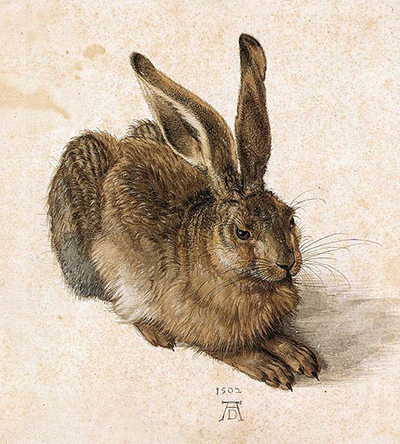
Young Hare
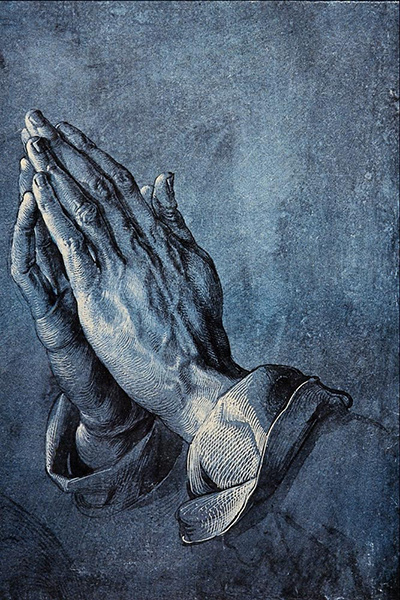
1502Praying Hands
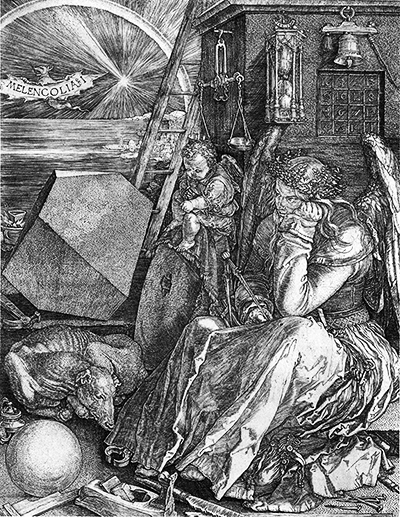
1508Melencolia I
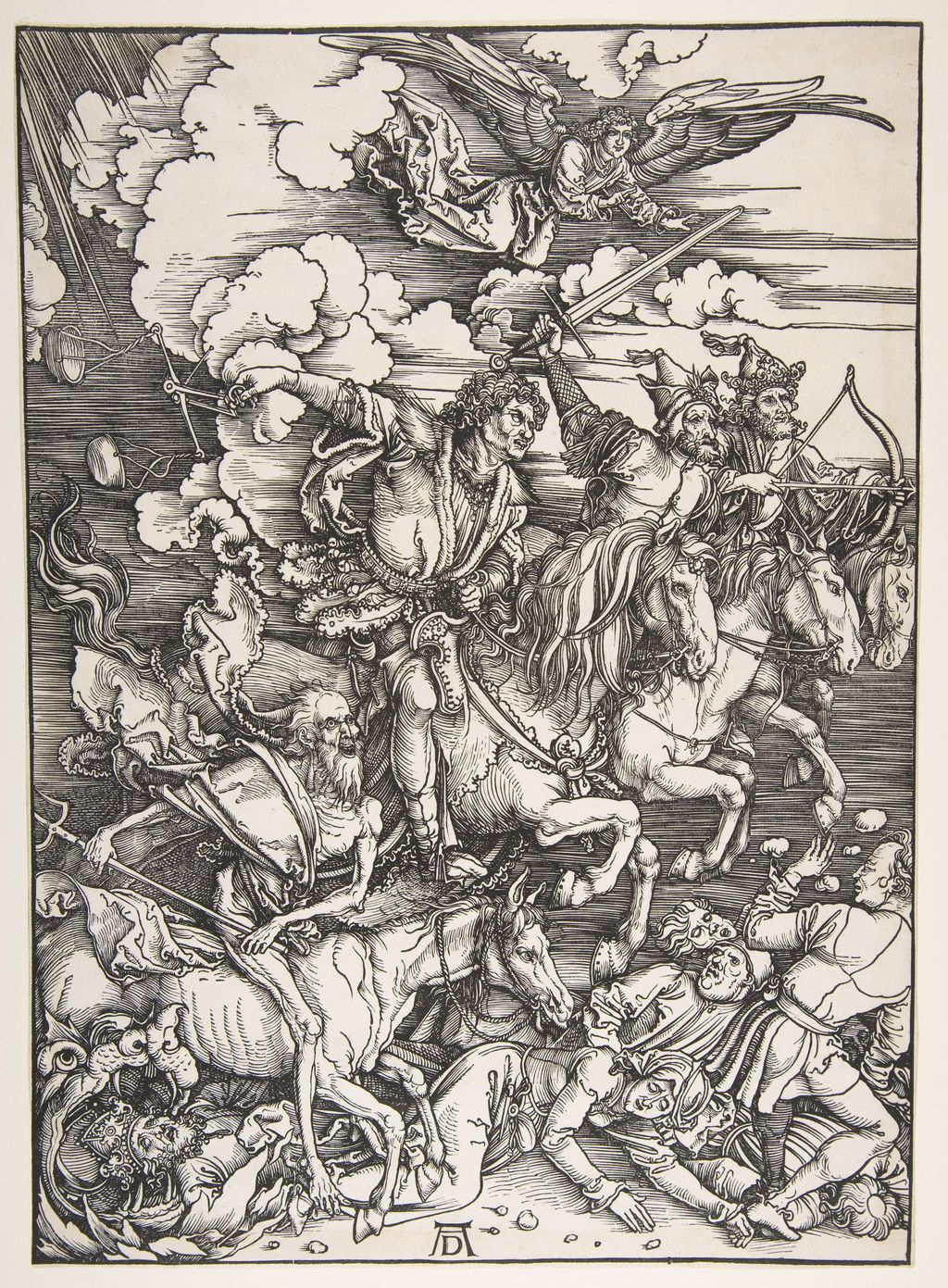
1514Four Apostles
1526Portrait of Dürer’s Father at Seventy (current article)
Possibly later sixteenth centuryContents
- A father remembered
- What the surface can tell us
- A picture in the king’s collection
- The likeness travels
- Frequently Asked Questions
A father remembered
The sitter’s identity gives that encounter a personal history. In the family account he compiled in 1524, Dürer described his father’s Hungarian origins, his arrival in Nuremberg in 1455 and his work as a goldsmith. The son remembered a life of sustained labour supporting a wife and children, and praised his father’s patience, honesty and religious devotion. These are the memories of a son looking back, shaped by affection and the wish to preserve an exemplary life. [12]
The same account records a small disagreement with lasting consequences. After learning to read and write, the younger Albrecht entered his father’s craft. His preference for painting disappointed the elder man, who regretted the time already spent training him. He nevertheless allowed the change and arranged an apprenticeship with Michael Wolgemut in 1486. The portrait therefore represents someone who had taught the artist practical skills and then accepted his decision to pursue a different profession. Dürer’s written gratitude helps explain why this face mattered to him without supplying a particular occasion for the 1497 painting. [12]
There is a temptation to turn every furrow into an illustration of the father’s hardships. The image offers something more restrained. The brow is creased, the cheeks hollow and the lips closely held, but these visible features cannot establish what the sitter was thinking. His directness can suggest resolve or reserve; it does not reveal a medical condition or foretell his death. The writing and the likeness illuminate one another most usefully when each retains its own kind of evidence.
Father and son were later collected as a pair. Dürer’s authentic Self-portrait of 1498, now in the Prado, accompanied the father’s portrait in the gift Nuremberg sent to Charles I through the Earl of Arundel in 1636. Looking at the two compositions explains their appeal together. Both figures turn within a narrow upright rectangle and bring their hands together near the lower edge. The younger man’s striped cap, cascading curls, bright shirt and gloves create a much more elaborate display. A window opens his room towards mountains. Against this, the father’s closed sleeves and uninterrupted background appear quieter and more compressed. The comparison concerns two surviving images with different attribution histories; it cannot recover every detail of the lost original. [13]
What the surface can tell us
Susan Foister’s technical study describes head, body and background as one painting campaign. She identifies madder in the faded pink ground and ultramarine in the lettering. Broad drying cracks, little visible underdrawing and paint applied largely in one layer distinguish the panel from securely attributed portraits built in successive layers. These findings underpin the copy attribution. Its reported radiocarbon range, 1480–1650, could not establish a precise date for the wood. [14]
That conclusion remains disputed. In February 2026, Christof Metzger told Artnet News that he regarded the portrait as authentic, praising its brushwork and glazing while considering the background ruined and the inscription a later addition. The National Gallery told the same publication that it stood by Foister’s research. The disagreement concerns how the surviving paint should be understood. The collection’s current attribution remains the essential starting point for identifying the London object. [15]
A picture in the king’s collection
The royal catalogue compiled by Abraham van der Doort, published through George Vertue’s papers in 1757, places the two portraits consecutively. Its description of the younger Dürer mentions long hair, gloves and a landscape through a window. The next entry calls the father’s portrait a “fellow piece” and gives both pictures matching dimensions and similar frames. It describes an old Hungarian-style black cap, hands concealed in broad sleeves and a reddish, cracked surface. [16]
These details make the inventory much more useful than a bare artist’s name. A black cap alone would identify very little; the combination of cap, sleeves, colour and condition creates a more particular record. It also shows what an early keeper noticed. The large areas of cloth and the damaged background, which might now be passed over while studying the eyes, were part of the painting’s identity in the collection. The National Gallery connects this description with its panel. [1]
The same historical publication lists two copies of Dürer and his father made by Mr Greenbury at the Lord Marshal’s appointment. Elsewhere, its account of the dispersed royal collection records the father and son portraits together, appraised and sold for £100. Copying and collecting were thus entangled in the documented history of these images. A reference to a portrait of Dürer’s father needs to be attached to a particular version before it can serve as evidence for that panel’s movements. [16]
The difficulty was already apparent before the London painting entered the National Gallery. Writing in 1896, Max J. Friedländer examined the versions then known at Syon House, Frankfurt and Munich. He compared their inscriptions as well as their appearance, noting that the Munich version preserved a first-person statement comparable to the wording on Dürer’s Prado self-portrait. His essay challenged the assumption that the Syon painting was the original. It belongs to the history of investigating the versions, rather than providing a modern verdict on the London panel, acquired eight years later. [17]
The likeness travels
Wenceslaus Hollar gave the father another form in an etching dated 1644. The Rijksmuseum’s impression shows the composition reversed: the heavy sleeve now rises on the opposite side, and the sitter’s nose points the other way. Hollar replaces the pink field with a fine mesh of crossed lines, while the folds become banks of light and shadow described through hatching. The few visible fingers, the open coat and the cap’s turned-up sides remain recognisable. [18]
The print carries the father’s identifying inscription above the image and a substantial Latin dedication below. The Rijksmuseum identifies Hendrik van der Borcht II as dedicator and Johann Maximilian zum Jungen as dedicatee. This added apparatus gives the intimate likeness a public setting among named collectors and patrons. It also makes a useful visual distinction: Hollar transmits the portrait’s arrangement in his own medium. His printed lines cannot be treated as a transparent record of the brushwork of whichever painted version he followed. [18]
The London panel’s red number 208 identifies it securely in the Spanish royal inventory of 1747. Its later passage into the Ashburton collection remains less clear: acquisition in Spain through Thomas Baring around 1855 is a possibility. The National Gallery bought it in 1904. [1]
Returning to the painting, the broad coat makes a protective shape around the slight, angular head. At the lower edge the hands almost disappear; above them, the eyes remain exposed. Their small highlights and surrounding shadows keep drawing attention back from the expanse of brown cloth to the face.
Frequently Asked Questions
Artworks directory
These 187 records include individual works, reverse sides, detail views, paired panels and reconstructed arrangements. Three additional catalogue images repeat works already listed. Related views are not counted as separate originals; qualified attributions and published dating are retained.
Discussion
Look again at the images and ideas explored in Portrait of Dürer’s Father at Seventy. These editorial prompts invite your observations.
Reader Insights
Which detail or idea in Portrait of Dürer’s Father at Seventy most changed your reading, and why?
How does the discussion of “A father remembered” affect your understanding?
What comparison would you bring to the discussion of “The likeness travels”?
Join the Conversation
Share a detail, comparison or question about Portrait of Dürer’s Father at Seventy below.
References
- National Gallery , After Albrecht Dürer: The Painter’s Father , NG1938, current collection record and Susan Foister’s provenance text extracted from The German Paintings before 1800 (2024). View source .
- ALBERTINA, Selbstbildnis als Dreizehnjähriger, inv. 4839 (German). View source.
- Metropolitan Museum, Four Horsemen from The Apocalypse, 19.73.209 (English). View source.
- Bayerische Staatsgemäldesammlungen, Selbstbildnis im Pelzrock, inv. 537 (German). View source.
- ALBERTINA, Feldhase, inv. 3073 (German). View source.
- ALBERTINA, Das große Rasenstück, inv. 3075 (German). View source.
- Metropolitan Museum, Adam and Eve, 19.73.1 (English). View source.
- ALBERTINA, Betende Hände, inv. 3113 (German). View source.
- Metropolitan Museum, Knight, Death, and the Devil, 43.106.2 (English). View source.
- Metropolitan Museum, Melencolia I, 43.106.1 (English). View source.
- Bayerische Staatsgemäldesammlungen, inventory 545: current collection record (German; descriptive citation). View source.
- Albrecht Dürer , family account of 1524, translated in William Martin Conway, Literary Remains of Albrecht Dürer (Cambridge, 1889), pp. 34–35. View source .
- Museo Nacional del Prado , Self-portrait , 1498, collection entry, text extracted from Pilar Silva Maroto in El retrato del Renacimiento (2008), p. 280. Spanish. View source .
- Susan Foister , “Dürer’s Nuremberg Legacy: The Case of the National Gallery Portrait of Dürer’s Father”, especially pp. 4–6 and notes 37–44. View source .
- Vivienne Chow , “This Dürer Portrait, Long Dismissed as a Copy, Is the Real Deal, Historian Says”, Artnet News , 3 February 2026, including responses from Christof Metzger and the National Gallery. View source .
- Abraham van der Doort , transcribed and prepared for publication by George Vertue, A Catalogue and Description of King Charles the First’s Capital Collection of Pictures, Limnings, Statues, Bronzes, Medals, and Other Curiosities (London: W. Bathoe, 1757), preliminary sale account p. 5, no. 4; catalogue p. 157, nos. 25–26; p. 173, no. 28. View source .
- Max J. Friedländer , “Dürer’s Bildnisse seines Vaters”, Repertorium für Kunstwissenschaft 19 (1896), pp. 12–19, especially pp. 12–14; facsimile reprint, 1968. German. View source .
- Rijksmuseum , Wenceslaus Hollar, Portret van Albrecht Dürer I , 1644, RP-P-OB-11.375, collection record and image. Dutch. View source .
- Germanisches Nationalmuseum, Barbara Dürer (German and English). View source.
- Web Gallery of Art, Tucher–Rieter reverse (English). View source.
- National Gallery of Art, Portrait of a Clergyman (English). View source.
- Dürer Art, Portrait of a Man (English). View source.
- Hessen Kassel Heritage, Elsbeth Tucher (German). View source.
- Web Gallery of Art, Hans Tucher (English). View source.
- Germanisches Nationalmuseum, Emperor Maximilian I (German and English). View source.
- National Gallery of Art, Lot and His Daughters, reverse (English). View source.
- Bayerische Staatsgemäldesammlungen, Glim Lamentation (German). View source.
- Museo Nacional del Prado, Portrait of a Man (Spanish). View source.
- Bayerische Staatsgemäldesammlungen, Madonna of the Carnation (German). View source.
- Städel Museum, Job on the Dungheap (German). View source.
- Wallraf-Richartz-Museum, Piper and Drummer (German). View source.
- Italian Ministry of Culture / Uffizi, Head of Saint James (Italian). View source.
- Klassik Stiftung Weimar, Dresden Altarpiece (German). View source.
- Staatliche Museen zu Berlin, Girl with a Red Beret (German and English). View source.
- Dresden State Art Museums / Roland Enke, Bernhard von Reesen (German). View source.
- Royal Collection Trust, Burkhard von Speyer (English). View source.
- Dresden State Art Museums, Seven Sorrows of the Virgin (English). View source.
- Bayerische Staatsgemäldesammlungen, Mater Dolorosa (German). View source.
- Bayerische Staatsgemäldesammlungen, Lucretia (German). View source.
- Städel Museum, Young Woman with Her Hair Down (English). View source.
- ALBERTINA, Portrait of a Young Man (German). View source.