by
Tom Gurney
Tom Gurney BSc (Hons) is an art history expert with over 20 years experience
Published on June 19, 2020 / Updated on October 22, 2026
Email:
tomgurney1@gmail.com
/ Phone:
+44 7429 011000
Saint Jerome in the Wilderness: Introduction
Jerome kneels between a broken tree and a lion, with a vast, restless sky behind him. His attention passes across the painting towards a small crucifix on the left. The lion looks out towards us. Between these two gazes, Albrecht Dürer draws the viewer into a place of prayer that feels both secluded and open to the world. Painted around 1495, this oil on pearwood measures 23.1 × 17.4 centimetres overall, with a painted area of approximately 22 × 16.2 centimetres. It is NG6563 in London's National Gallery. [1]
The dimensions matter to the experience. A reproduction can make the picture seem like a large altarpiece, with its prominent figure and mountain prospect. In the original, the whole scene is scarcely taller than a spread hand. To follow the narrow stream, examine the book or separate one tree from another requires an intimate kind of looking. Dürer gives that attention somewhere to go: almost every clear shape opens onto another, smaller detail.
At a Glance
This work across Albrecht Dürer’s career
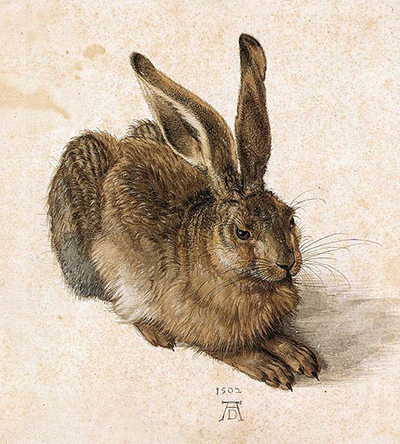
Young Hare
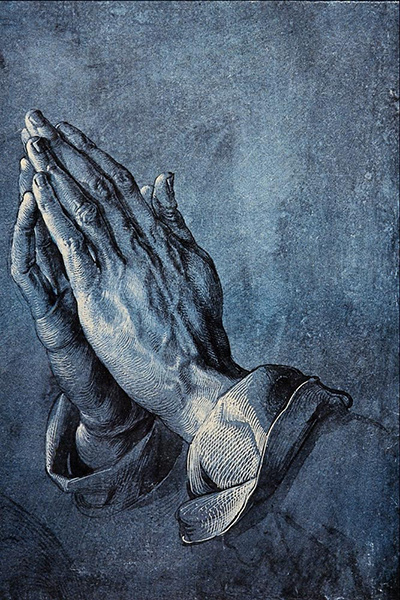
1502Praying Hands
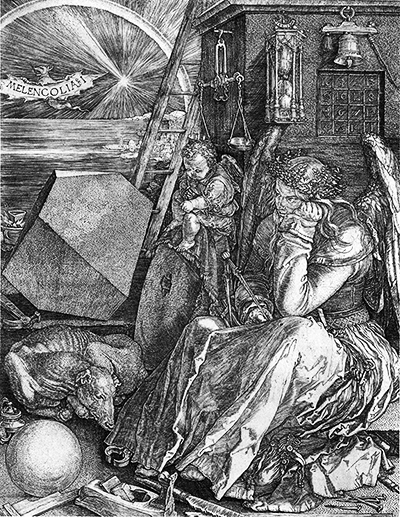
1508Melencolia I
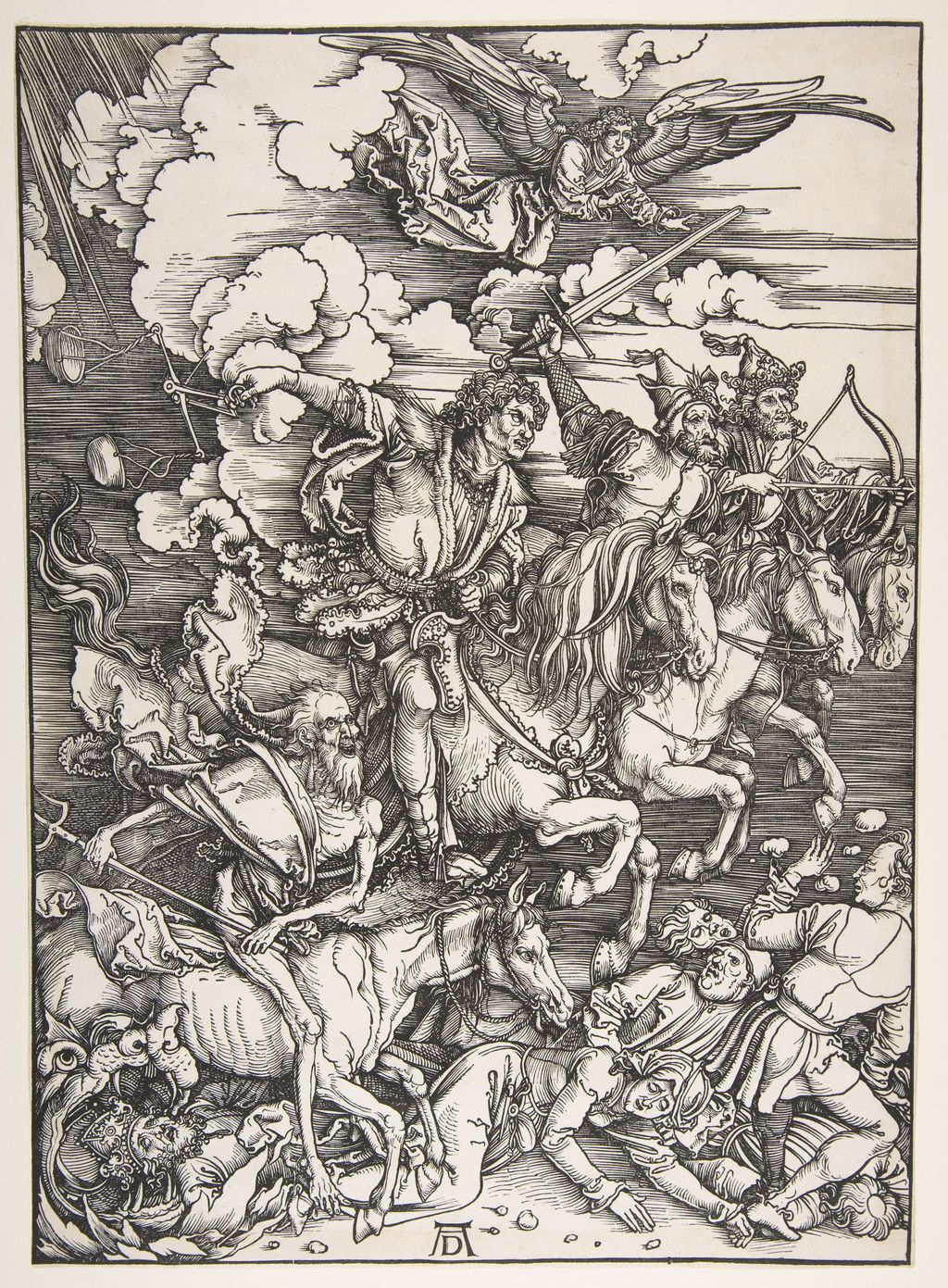
1514Four Apostles
1526Contents
- The saint's interrupted reading
- The book, the hat and the lion
- A wilderness with a distant church
- Paint, survival and the other side
- Frequently Asked Questions
The saint's interrupted reading
The blue robe creates the largest continuous shape in the foreground. Its opening exposes Jerome's chest, while the cloth spreads across his bent knees and trails towards the lion. His body turns slightly away from the direction of his face. One arm descends to the red book; the other bends across his torso, bringing a stone against his breast. Reading, bodily discipline and prayer meet in the same figure. Although the book remains open, his eyes have left its pages.
Jerome's own account of his desert retreat helps explain the intensity of this action. In Letter 22 to Eustochium, section 7, he describes solitude as a struggle with memories and desires that followed him from Rome. He recalls fasting, weeping, praying through the night and beating his breast until peace returned. He also describes seeking out valleys, mountains and cliffs as places of prayer. This is a demanding account of the inner life: physical removal from society does not immediately remove the distractions of the mind. [12]
The letter makes the relationship between the saint and his setting particularly suggestive. His sun-parched desert has become a dense, green refuge, with water moving past the praying figure. Dürer's cliffs and dark trees offer a place apart, yet the painting surrounds Jerome with things that might engage the eye. His concentrated gaze holds those distractions in suspension. Reading the letter alongside the picture illuminates the subject; it does not establish that Dürer followed this passage directly or consulted a particular edition.
The crucifix is easy to overlook because its thin branches scarcely interrupt the foliage. Seen obliquely, it offers the viewer much less of Christ's body than Jerome appears able to see. The saint's face supplies the response that the tiny image cannot display at this distance. Dürer makes devotion legible through the relationship between an attentive person and a scarcely visible object.
Jerome's long beard catches pale light against his blue clothing. Individual wisps soften the outline of his head, while the exposed shoulder and slender forearm give his body a more angular structure. His hands remain active and separate: one keeps contact with the book, the other with his chest. The pose binds mental attention to physical effort without turning the scene into a dramatic outward gesture.
The book, the hat and the lion
The book recalls Jerome's work on the Latin Bible, the Vulgate. The cardinal's clothing belongs to a later convention honouring his standing in the Church: the office did not exist during his lifetime. Here the broad red hat lies almost flat against the foreground, beside a more loosely folded garment. These objects bring the viewer very close to the saint's knees, before the eye climbs towards his face. [13]
Their placement also gives material form to withdrawal from status. The hat has an emphatic outline and a bright surface, but Jerome neither wears nor touches it. The red book remains within his reach. Seen together, the objects suggest a distinction between the honours attached to a learned churchman and the work of faith that continues in seclusion. The painting allows the familiar attributes to identify him while showing how little attention he gives them.
The lion is another inherited sign of his identity. According to the legend, Jerome removed a thorn from its paw and gained a faithful companion. Dürer shows the result of that encounter. The animal rests close behind him, its large head emerging beside the sweep of blue cloth. Its mouth is closed and its gaze steady. The brilliant eyes give it a watchfulness that answers the saint's concentration, although the two look in different directions. [14]
The resemblance to Dürer's dated Lion of 1494 in Hamburg is especially revealing. That work uses watercolour, opaque colour and gold on parchment. Petra Roettig's catalogue discussion stresses the uncertainty about its models and original purpose; its lifelike detail does not establish that Dürer drew it from a living lion. In the two images, the heavy mane surrounds a much narrower muzzle, and small, sharply defined eyes give the head an almost human attentiveness. In the London painting, the visible body has less space to unfold. The saint's robe and the picture's edge press the animal into a sheltered corner. [15]
Roettig's essay questions the London painting's attribution, finding its lion comparatively masklike. Carritt and Schilling published the Dürer attribution independently in 1957; the National Gallery retains it despite later challenges. The lion offers a concrete point of comparison, but the picture rewards looking beyond that single connection. Fur, beard, foliage and folds all demand different kinds of marks. Dürer varies their density so that the two living figures emerge clearly from the abundance around them. [15] [1]
A wilderness with a distant church
The landscape has a strong vertical structure. On the right, exposed rock rises almost to the treetops; on the left, dark conifers enclose a slender church spire. These two masses hold open a narrow prospect behind Jerome's head. Farther away, small pointed mountains stand against bands of yellow light. The setting expands rapidly, from plants beside the saint to a horizon that seems many miles distant.
The church complicates the idea of absolute solitude. It is close enough to be recognised, yet partly absorbed into the trees. Its spire repeats their upward movement. Jerome has withdrawn into a wilderness that still contains a sign of communal worship, and the viewer encounters that sign along the same leftward direction as his prayer. The little building makes the landscape feel inhabited without adding another person to the scene.
In a 2024 study, Margit Stadlober proposes a more specific Alpine geography. She associates the pointed formations on the right with the earth pyramids of Segonzano, places the scene in the Regnana valley and suggests that the church might be San Pietro in Cembra, with the Fiemme mountains beyond. She presents these connections as evidence for Dürer's engagement with the Cembra valley. They offer a stimulating way of looking at the unusually slender rock formations. They remain a scholarly proposal, rather than a secure identification of every feature or an exact date for the painting. [16]
Even without a settled place-name, the terrain has variety and resistance. The cliff's narrow ridges differ from the rounded stones on the path below. Some trees stand on top of the rock; others appear rooted in its fissures. The stream at the lower right squeezes past the foreground before disappearing from view. Two tiny birds beside it introduce a scale almost absurdly small beside the lion, yet they help make the immediate surroundings feel alive.
Above this detailed earth, the clouds change the pace of looking. Broad dark masses drift across a paler opening, and thin streaks near the horizon concentrate the yellow glow. The brightest light lies behind the saint, while his face remains distinct within the closer, more enclosed space. Whether read as morning or evening, the sky gives his prayer a sense of duration. The world continues to change around the kneeling figure.
Paint, survival and the other side
Technical examination records a three-millimetre board: chalk-and-glue ground and pink priming under Jerome, paint directly on wood behind. Green glazes have browned, red lake faded and ultramarine deteriorated. Infrared examination revealed no underdrawing; an undetected drawing may still exist. The blue robe is consequently a reminder that today's colour relationships carry a material history. Its pale fold patterns are conspicuous, but the present appearance cannot serve as an unaltered record of every original shadow. [1]
The panel's reverse contains a fiery celestial image. Foister connects it with Jerome and impending Judgement, while discussing an alternative inspiration reading; identification with the 1492 Ensisheim meteor remains disputed. This second face changes the object from a single landscape into a picture that invites turning and renewed thought. The concentrated prayer on the front acquires a larger horizon when considered beside an image of heavenly disturbance. Private devotion is the probable purpose, without an identified original owner. [1]
The painting's documented history begins with Beckett's 1849 purchase as Caroto. It entered the National Gallery in 1996, after loans to Oxford in 1957 and Cambridge in 1958–96. Its small scale can still make it an easily underestimated object. The most rewarding approach is to allow the eye to travel slowly: from the discarded hat to the book, from the saint's hands to his face, then out through the trees towards the bright horizon. Dürer has made a secluded act of attention the centre of a remarkably expansive world. [1]
Frequently Asked Questions
Artworks directory
These 187 records include individual works, reverse sides, detail views, paired panels and reconstructed arrangements. Three additional catalogue images repeat works already listed. Related views are not counted as separate originals; qualified attributions and published dating are retained.
Discussion
Look again at the images and ideas explored in Saint Jerome in the Wilderness. These editorial prompts invite your observations.
Reader Insights
Which detail or idea in Saint Jerome in the Wilderness most changed your reading, and why?
How does the discussion of “The saint's interrupted reading” affect your understanding?
What comparison would you bring to the discussion of “Paint, survival and the other side”?
Join the Conversation
Share a detail, comparison or question about Saint Jerome in the Wilderness below.
References
- Susan Foister , “Saint Jerome,” The German Paintings before 1800 , National Gallery, London, 2024, pp. 250–272, with technical notes and attribution, function, dating and provenance discussions. English. View source .
- ALBERTINA, Selbstbildnis als Dreizehnjähriger, inv. 4839 (German). View source.
- Metropolitan Museum, Four Horsemen from The Apocalypse, 19.73.209 (English). View source.
- Bayerische Staatsgemäldesammlungen, Selbstbildnis im Pelzrock, inv. 537 (German). View source.
- ALBERTINA, Feldhase, inv. 3073 (German). View source.
- ALBERTINA, Das große Rasenstück, inv. 3075 (German). View source.
- Metropolitan Museum, Adam and Eve, 19.73.1 (English). View source.
- ALBERTINA, Betende Hände, inv. 3113 (German). View source.
- Metropolitan Museum, Knight, Death, and the Devil, 43.106.2 (English). View source.
- Metropolitan Museum, Melencolia I, 43.106.1 (English). View source.
- Bayerische Staatsgemäldesammlungen, inventory 545: current collection record (German; descriptive citation). View source.
- Jerome , Letter 22 to Eustochium, section 7, translated by W. H. Fremantle, G. Lewis and W. G. Martley, in Nicene and Post-Nicene Fathers , second series, volume 6, 1893; reproduced by New Advent. English translation of Latin primary text. View source .
- National Gallery , London, “Saint Jerome as Cardinal,” possibly by El Greco, NG1122, collection entry, undated. English. View source .
- National Gallery , London, Vincenzo Catena, “Saint Jerome in his Study,” NG694, collection entry, undated. English. View source .
- Petra Roettig , Hamburger Kunsthalle, “Löwe,” Albrecht Dürer, 1494, inventory 23005, collection catalogue essay and object record, undated. German. View source .
- Margit Stadlober , “Die Marke Alpen in der Malerei und der Grafik einer Zeitenwende”, in Anliegen Kunst , edited by Reimann-Pichler, Scherke and Stadlober, University of Graz, 2024; Dürer discussion, printed pp. 120–126, especially p. 126 and notes 39–44. German. View source .
- Germanisches Nationalmuseum, Barbara Dürer (German and English). View source.
- Web Gallery of Art, Tucher–Rieter reverse (English). View source.
- National Gallery of Art, Portrait of a Clergyman (English). View source.
- Dürer Art, Portrait of a Man (English). View source.
- Hessen Kassel Heritage, Elsbeth Tucher (German). View source.
- Web Gallery of Art, Hans Tucher (English). View source.
- Germanisches Nationalmuseum, Emperor Maximilian I (German and English). View source.
- National Gallery of Art, Lot and His Daughters, reverse (English). View source.
- Bayerische Staatsgemäldesammlungen, Glim Lamentation (German). View source.
- Museo Nacional del Prado, Portrait of a Man (Spanish). View source.
- Bayerische Staatsgemäldesammlungen, Madonna of the Carnation (German). View source.
- Städel Museum, Job on the Dungheap (German). View source.
- Wallraf-Richartz-Museum, Piper and Drummer (German). View source.
- Italian Ministry of Culture / Uffizi, Head of Saint James (Italian). View source.
- Klassik Stiftung Weimar, Dresden Altarpiece (German). View source.
- Staatliche Museen zu Berlin, Girl with a Red Beret (German and English). View source.
- Dresden State Art Museums / Roland Enke, Bernhard von Reesen (German). View source.
- Royal Collection Trust, Burkhard von Speyer (English). View source.
- Dresden State Art Museums, Seven Sorrows of the Virgin (English). View source.
- Bayerische Staatsgemäldesammlungen, Mater Dolorosa (German). View source.
- Bayerische Staatsgemäldesammlungen, Lucretia (German). View source.
- Städel Museum, Young Woman with Her Hair Down (English). View source.
- ALBERTINA, Portrait of a Young Man (German). View source.