by
Tom Gurney
Tom Gurney BSc (Hons) is an art history expert with over 20 years experience
Published on June 19, 2020 / Updated on October 22, 2026
Email:
tomgurney1@gmail.com
/ Phone:
+44 7429 011000
Two Squirrels by Hans Hoffmann: Introduction
Two Squirrels , also known as Zwei Eichhörnchen , is a work by Hans Hoffmann, made in watercolour and bodycolour on parchment, 26 × 25.1 cm, and recorded in a private collection. Its conspicuous “AD” monogram and date “1512” falsely claim Dürer's authorship; they do not establish when Hoffmann painted it. [1]
The picture brings two very different encounters with an animal into the same small space. The squirrel in front bends towards a nut held between its forepaws. Its head, shoulder and raised tail form a succession of pointed and rounded shapes, while its long hind feet spread across the pale ground. Behind it, a second squirrel turns away. We see a broad, dark back and the side of a head looking towards the left edge. A thin red collar interrupts the brown fur. Their bodies almost meet, but their attention travels in different directions.
This arrangement gives the viewer more than a doubled example of the same creature. The front animal offers face, hands, belly and toes; the other provides the back and the transition from head to shoulders. One is occupied with an action that we can follow closely, while the other's turned head leaves its immediate purpose less clear. Neither looks directly at us. Their absorption makes it possible to inspect them without the sense of a staged exchange with a human spectator.
At a Glance
- Artist Hans Hoffmann [1]
- Materials Watercolour and bodycolour on parchment [1]
- Date qualification The false AD and 1512 inscription do not date Hoffmann’s work [1]
This work across Albrecht Dürer’s career
Two Squirrels by Hans Hoffmann (current article)
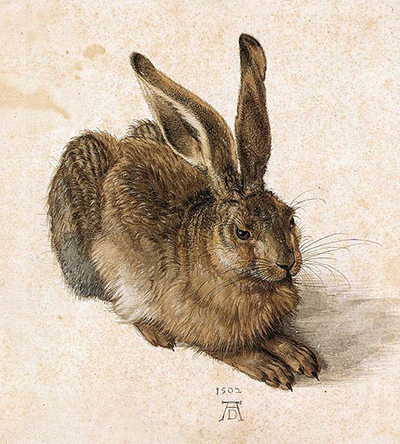
Execution date not establishedYoung Hare
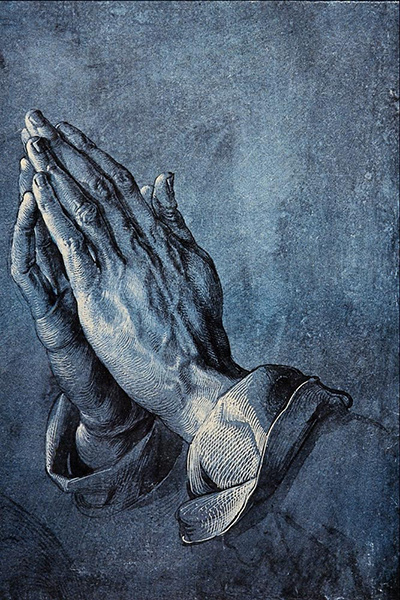
1502Praying Hands
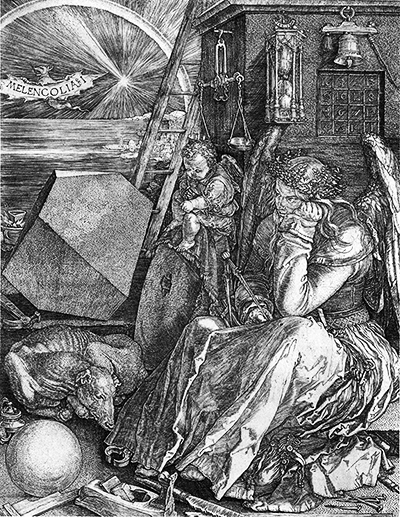
1508Melencolia I
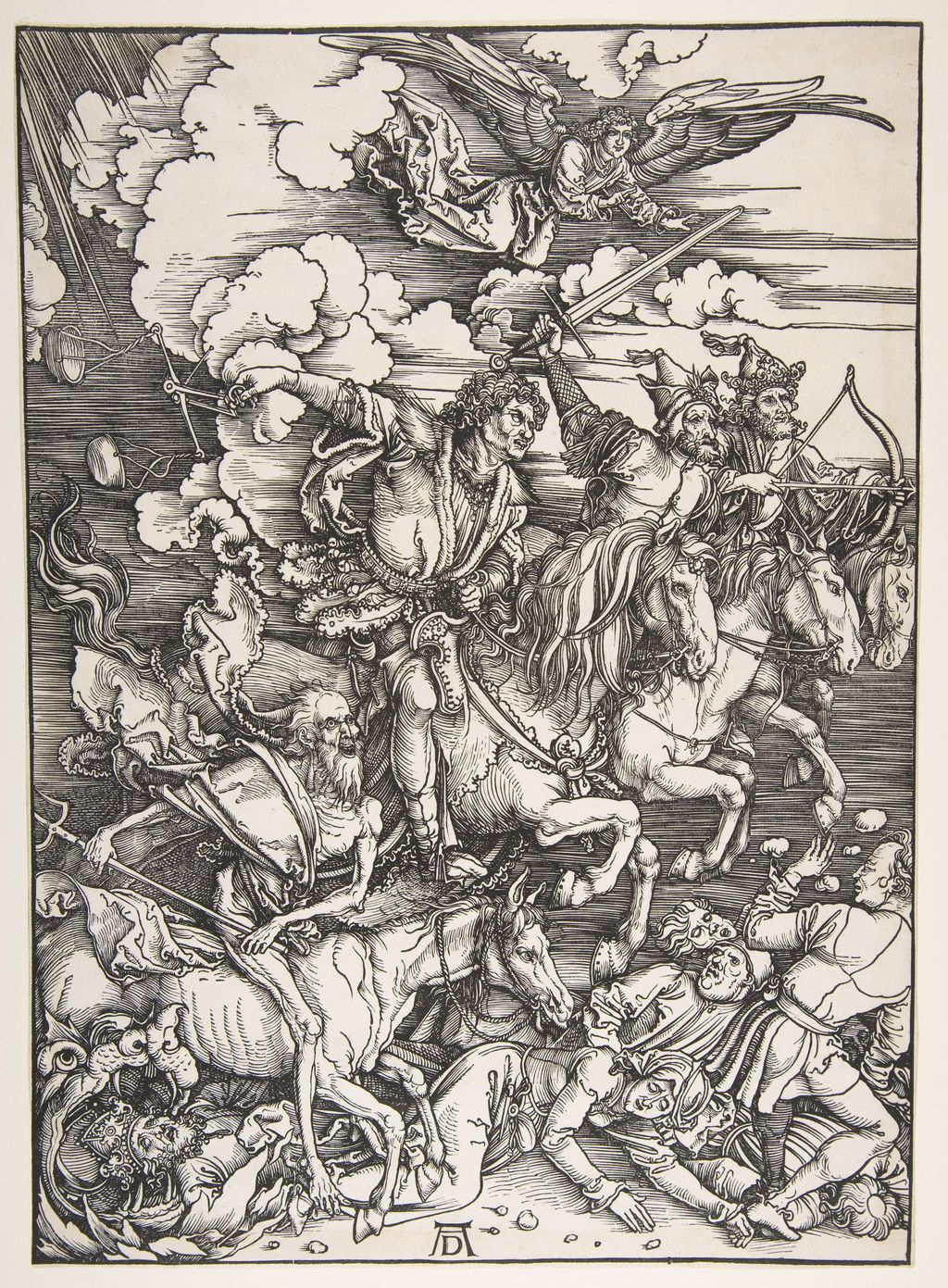
1514Four Apostles
1526Contents
- Fur, tails and a meal
- A second version signed by Hoffmann
- A painter admired for imitation
- Frequently Asked Questions
Fur, tails and a meal
The front squirrel's tail is the great expansive shape in the picture. It rises above the head, spreads out towards the right margin and darkens as it approaches the rump. At its upper edge, individual strokes break away from the main mass, making the outline seem lighter than the body below. The fur on the flank lies more compactly against the rounded thigh. Looking from one to the other, the eye moves between a loose, airy fringe and a firm weight-bearing form.
The rear squirrel's tail supplies a different movement. It descends from the dark body, then curls across the ground towards the feeding animal. The sweep helps join two otherwise separate silhouettes. It also leads towards the small claws, scraps and nutshells at the bottom of the sheet. The picture's broadest gestures belong to the tails; its most concentrated activity belongs to the paws. That difference of scale keeps the eye travelling between the animals as whole bodies and the minute business of eating.
The forepaws are especially engaging because they appear to work together. Pale joints and darker creases distinguish the digits around the nut, immediately below the lowered muzzle. Beneath them, the two hind feet are planted apart, with separate toes and curved claws. The arrangement makes the squirrel's posture intelligible: the large haunch supports the raised body while the forelimbs are free to manipulate food. The tiny dark eye and the line of the mouth give this elaborate structure a point of concentration.
Nuts and broken shells extend that action into the surrounding space. Some fragments are little more than dark marks; larger pieces have curved edges and pale interiors. They suggest a meal already under way, with something discarded as well as something held. Yet there is no branch, tree trunk or undergrowth to situate it. The ground is largely unoccupied parchment, with small areas of shadow beneath the bodies. The result has the intimacy of watching animals at close quarters and the clarity of an arrangement made for inspection.
The collar changes that encounter. Its red line makes the rear animal stand out despite its comparatively subdued colour, and it introduces a human object into an image without a human figure. It may prompt questions about how the animals were kept or encountered, but it cannot tell us how this particular picture was made. The finished image supplies neither a record of a sitting nor an explanation of how the painter held a moving subject in view.
A second version signed by Hoffmann
An especially useful comparison is Hoffmann's Red Squirrel in the National Gallery of Art, Washington. This separate sheet is dated 1578 and bears “Hh / 1578” at the lower centre. The museum records watercolour and gouache over traces of graphite on parchment, measuring 25 × 17.8 cm; it entered the collection as a Woodner gift in 1991. [12]
Here one squirrel occupies a narrower, upright field. The essential activity is familiar: the animal sits on its haunches, holds a nut below its mouth and lifts a large tail behind its body. But the visual balance changes. The tail climbs steeply above the head and the upper part of the back, while the two hind feet stand well clear against the empty ground. There are no scattered shells to carry attention sideways. The inscription below the feet adds another reason for the eye to return to the centre of the sheet.
The single squirrel also gives a different account of its face. Its lowered muzzle sits between the dark eye and the clasped forepaws, with long whiskers reaching into the open background. A pale patch below the arm makes a strong break between the chest and the rounded thigh. In the paired picture, the forward animal's face appears more elongated, its near eye is more sharply enclosed, and the far-reaching tail helps fill the broad space above and beside it. These changes affect the animal's presence even before we consider questions of authorship.
Ruth E. Fine, discussing the Washington sheet in 2000, emphasised that the two compositions differ in orientation and detail. She treated them as variants whose order cannot readily be determined. A lost Dürer original has been proposed, but no such original is known, and Fine allowed that it might never have existed. She also left open direct observation of nature as a possibility for the single squirrel. The comparison therefore establishes a close relationship without supplying a secure sequence from a Dürer model to two later copies. [13]
That uncertainty makes looking at the differences worthwhile. Removing the second animal changes how much the feeding squirrel must accomplish alone. In Washington, tail, head, paws and feet together hold a single vertical composition. In Two Squirrels , the turned back introduces another large dark volume, while the lower tail and shells spread the action across the width of the parchment. Each arrangement has its own internal demands. The paired study rewards attention to the intervals between the animals as much as to the anatomy of either one.
A painter admired for imitation
Hoffmann's relationship with Dürer developed through access to works that collectors valued and preserved. The Germanisches Nationalmuseum's 2022 exhibition account places him among the privileged visitors to Willibald Imhoff's collection in Nuremberg. It distinguishes precise copies, freely developed variations and independent compositions within his work, and records his appointment as Rudolf II's court painter in 1585. This provides a more useful setting for the squirrels than an assumption that every animal bearing “AD” must have come from Dürer's studio. [14]
A much earlier account shows how closely Hoffmann's reputation became associated with convincing imitation. In his continuation of Nuremberg artists' lives, dated 1660, Andreas Gulden described “Hanns Hofmann” as a diligent painter working in miniature and gum colours. He reported that Hoffmann copied Dürer so closely that many of his works were traded as Dürer originals, and that he eventually entered Emperor Rudolf's service. Written after Hoffmann's lifetime, this short notice preserves a historical assessment of his skill and the circulation of his work. It identifies neither this pair of squirrels nor a particular transaction. Its wording leaves the people responsible for selling the pictures unnamed, so it cannot establish the circumstances in which the inscription on this sheet was applied or understood. [15]
The inscription nevertheless belongs to the picture's effect. Set high in the otherwise open field, it is easy to notice once the eye moves beyond the animals. Its separation from the bodies gives the small lettering unusual prominence within the composition.
Ksenija Tschetschik-Hammerl relates the small hooks around the false “AD” to Hoffmann's own monogram, interpreting them as a play between deception and disclosure. This interpretation does not document the sheet's commission. [1]
She also cautions that Hans Hieronymus Imhoff's seventeenth-century attempts to sell Hoffmann works as Dürers cannot establish fraudulent intentions in his grandfather, Willibald Imhoff the Elder. The inscription alone leaves those intentions unresolved. [1]
Tschetschik-Hammerl reports the sheet's acquisition by Lord Northbrook from the Jolly de Bammeville collection in 1854 and its sale at Christie's, London, on 3 July 1990, lot 143. [1]
The two pictures invite a final, practical change of attention. After reading the initials, look again at the handling of a tail, the relationship of the forepaws to the muzzle, and the way a turned back balances a feeding body. These are decisions that belong to the making of an image. In the paired sheet, the discarded shells and the red collar complicate the apparent simplicity of two animals on a blank ground. Naming Hoffmann allows those choices to become part of his achievement, while keeping the unanswered questions about dates, models and inscriptions visible.
Frequently Asked Questions
Artworks directory
These 187 records include individual works, reverse sides, detail views, paired panels and reconstructed arrangements. Three additional catalogue images repeat works already listed. Related views are not counted as separate originals; qualified attributions and published dating are retained.
Discussion
Look again at the images and ideas explored in Two Squirrels by Hans Hoffmann. These editorial prompts invite your observations.
Reader Insights
Which detail or idea in Two Squirrels by Hans Hoffmann most changed your reading, and why?
How does the discussion of “Fur, tails and a meal” affect your understanding?
What comparison would you bring to the discussion of “A painter admired for imitation”?
Join the Conversation
Share a detail, comparison or question about Two Squirrels by Hans Hoffmann below.
References
- Ksenija Tschetschik-Hammerl , “Das Dürer-Monogramm als Gegenstand der Nachahmung im 16. und frühen 17. Jahrhundert,” kunsttexte.de , 3/2018, pp. 1–4 and notes 3, 13–17, pp. 18–19. German. View source .
- ALBERTINA, Selbstbildnis als Dreizehnjähriger, inv. 4839 (German). View source.
- Metropolitan Museum, Four Horsemen from The Apocalypse, 19.73.209 (English). View source.
- Bayerische Staatsgemäldesammlungen, Selbstbildnis im Pelzrock, inv. 537 (German). View source.
- ALBERTINA, Feldhase, inv. 3073 (German). View source.
- ALBERTINA, Das große Rasenstück, inv. 3075 (German). View source.
- Metropolitan Museum, Adam and Eve, 19.73.1 (English). View source.
- ALBERTINA, Betende Hände, inv. 3113 (German). View source.
- Metropolitan Museum, Knight, Death, and the Devil, 43.106.2 (English). View source.
- Metropolitan Museum, Melencolia I, 43.106.1 (English). View source.
- Bayerische Staatsgemäldesammlungen, inventory 545: current collection record (German; descriptive citation). View source.
- National Gallery of Art , “Red Squirrel,” Hans Hoffmann, 1578, accession 1991.182.5, collection record. View source .
- Ruth E. Fine , “Red Squirrel,” in Art for the Nation: Collecting for a New Century , National Gallery of Art, Washington, 2000, pp. 154–155. View source .
- Germanisches Nationalmuseum , “Hans Hoffmann. Ein europäischer Künstler der Renaissance,” exhibition press release, 10 May 2022, pp. 1–3. German. View source .
- Andreas Gulden , “Hanns Hofmann,” continuation dated 1660, in Johann Neudörffer, Nachrichten von den vornehmsten Künstlern und Werkleuten … nebst der Fortsetzung von Andreas Gulden 1660 , edited by Friedrich Campe, Nuremberg, 1828, digitised leaf 85. German; historical primary text. View source .
- Germanisches Nationalmuseum, Barbara Dürer (German and English). View source.
- Web Gallery of Art, Tucher–Rieter reverse (English). View source.
- National Gallery of Art, Portrait of a Clergyman (English). View source.
- Dürer Art, Portrait of a Man (English). View source.
- Hessen Kassel Heritage, Elsbeth Tucher (German). View source.
- Web Gallery of Art, Hans Tucher (English). View source.
- Germanisches Nationalmuseum, Emperor Maximilian I (German and English). View source.
- National Gallery of Art, Lot and His Daughters, reverse (English). View source.
- Bayerische Staatsgemäldesammlungen, Glim Lamentation (German). View source.
- Museo Nacional del Prado, Portrait of a Man (Spanish). View source.
- Bayerische Staatsgemäldesammlungen, Madonna of the Carnation (German). View source.
- Städel Museum, Job on the Dungheap (German). View source.
- Wallraf-Richartz-Museum, Piper and Drummer (German). View source.
- Italian Ministry of Culture / Uffizi, Head of Saint James (Italian). View source.
- Klassik Stiftung Weimar, Dresden Altarpiece (German). View source.
- Staatliche Museen zu Berlin, Girl with a Red Beret (German and English). View source.
- Dresden State Art Museums / Roland Enke, Bernhard von Reesen (German). View source.
- Royal Collection Trust, Burkhard von Speyer (English). View source.
- Dresden State Art Museums, Seven Sorrows of the Virgin (English). View source.
- Bayerische Staatsgemäldesammlungen, Mater Dolorosa (German). View source.
- Bayerische Staatsgemäldesammlungen, Lucretia (German). View source.
- Städel Museum, Young Woman with Her Hair Down (English). View source.
- ALBERTINA, Portrait of a Young Man (German). View source.