by
Tom Gurney
Tom Gurney BSc (Hons) is an art history expert with over 20 years experience
Published on June 19, 2020 / Updated on October 22, 2026
Email:
tomgurney1@gmail.com
/ Phone:
+44 7429 011000
Little Owl Attributed to Dürer: Introduction
The owl faces us with dark eyes framed by pale feathers. Its hooked beak interrupts the soft, rounded face, while below the broad breast two slender feet open into formidable claws. The encounter feels immediate: a compact bird, apparently alert to something just beyond the sheet.
The ALBERTINA in Vienna currently attributes Little Owl , inventory 3123, to Albrecht Dürer, dating it 1502 or 1508 (?) . The 19.2 × 14 centimetre sheet combines watercolour, opaque white and brown and grey-black inks on brown-washed paper, applied with brush and pen. Its “1508” and AD were added by another hand. Authorship remains unresolved. [1] [2] [3] [4]
At a Glance
- Current attribution Attributed to Albrecht Dürer [1]
- Museum date 1502 or 1508 (?) [1]
- Collection ALBERTINA, Vienna; inventory 3123 [1]
- TypeDrawing [1]
This work across Albrecht Dürer’s career
Young Hare
1502Little Owl Attributed to Dürer (current article)
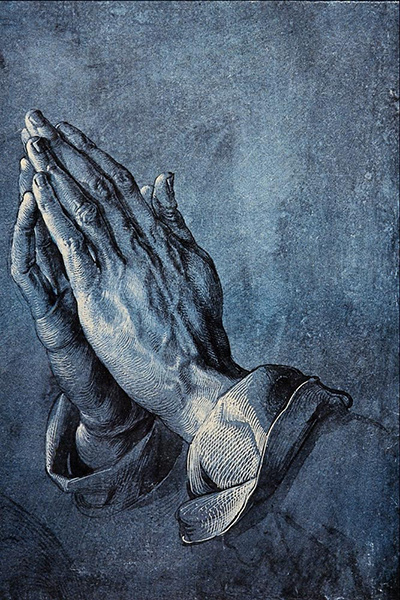
1502 or 1508 (?)Praying Hands
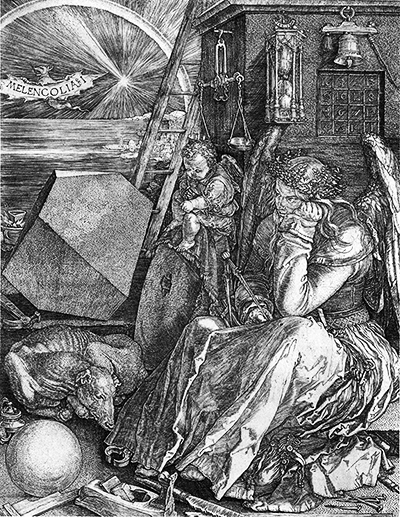
1508Melencolia I
1514Four Apostles
1526Contents
- A small body with a commanding face
- Light, colour and a practised hand
- Looking beside other nature studies
- Copies, inscriptions and attribution
- An owl in eighteenth-century collections
- Frequently Asked Questions
A small body with a commanding face
The body turns towards the left of the picture, while the face presents a fuller view. That difference gives the pose a gentle twist. The brown wing forms a long, sloping mass on the right; the lighter breast curves down towards the feet on the left. Above them, the rounded head seems almost to settle into the shoulders. The outline is compact, but the asymmetry keeps the bird from resembling a rigid emblem.
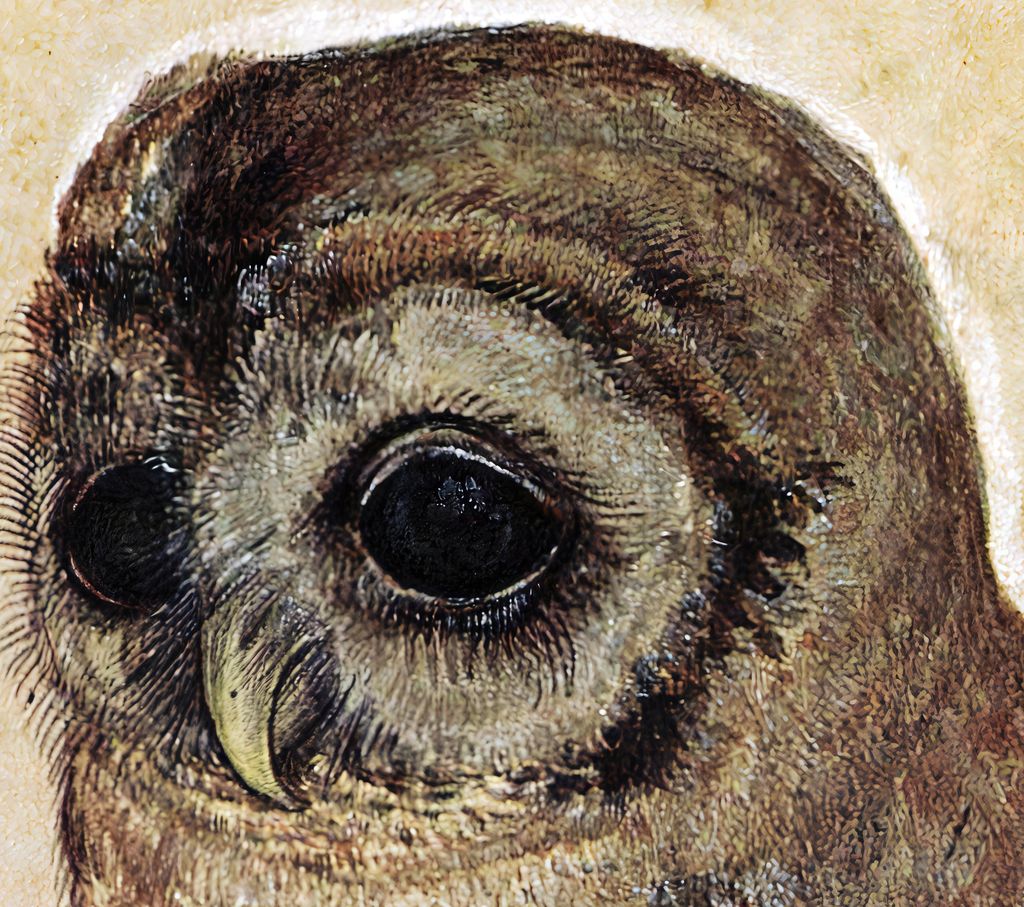
The eyes dominate because they gather the deepest darkness into two concentrated shapes. Fine pale arcs catch their upper edges. Around them, short strokes fan out through the lighter facial feathers, then meet darker bands at the sides and above the beak. These surrounding marks give the eyes depth. The small hooked beak, yellowish against the browns and greys, projects between them and turns sharply downwards. Its hard edge offers a precise interruption to the feathered face.
The two sides of that face are unequal in width. One eye lies closer to the outer contour; the other has more room around it. This makes the slight turn of the head legible without a sweeping change in silhouette. Tiny dark strokes at the outer edge of the head also keep the contour porous, allowing the soft covering to meet the surrounding pale field without acquiring the appearance of a cut-out shape.
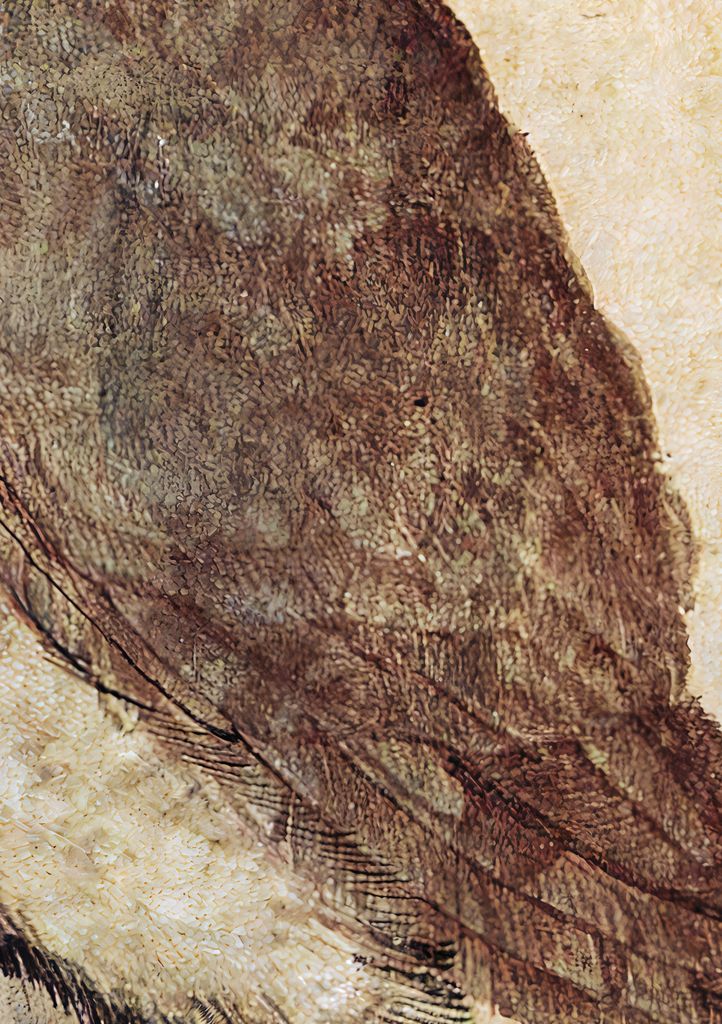
Across the breast, the feather marks are short and broken. Pale passages alternate with brown bars and small dark accents, creating a dappled surface that swells towards the light. On the folded wing the marks lengthen and overlap. Curving boundaries suggest successive layers, and the lower feathers draw together towards the tail. The vocabulary changes with the part being described: short, almost bristling touches around the face; softer, dispersed marks across the breast; longer lines and darker bands over the wing.
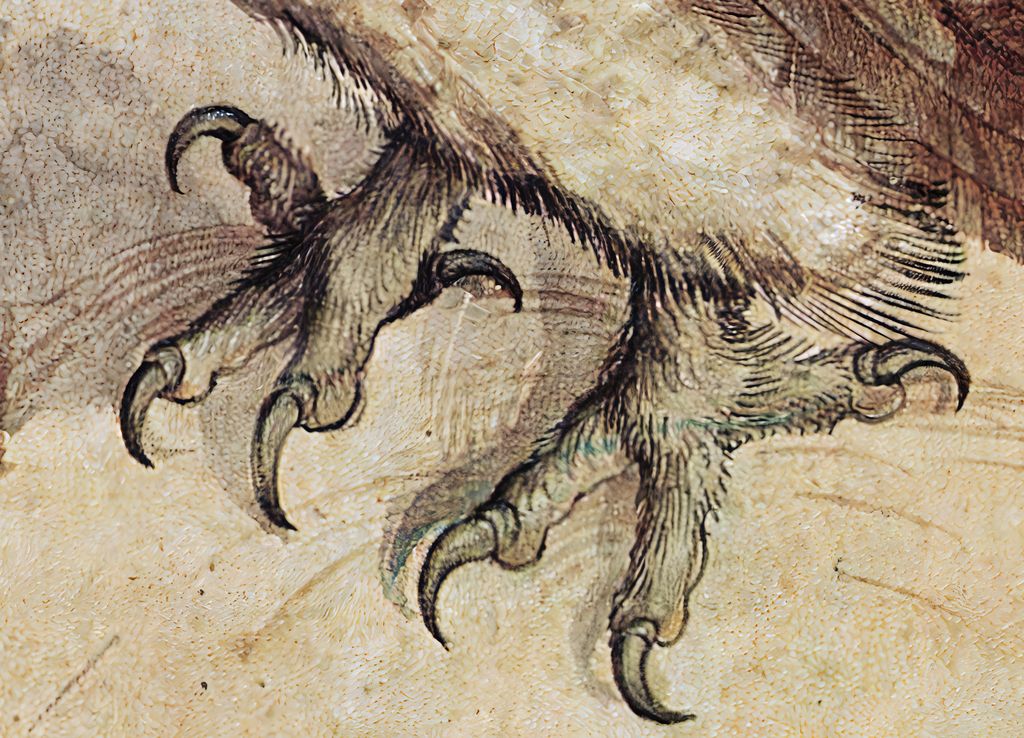
The feet bring a further change. Their slender, grey-green forms have dark outlines, small divisions and strongly curved claws. They appear harder and more angular than the body above them. Loose feathers break over their upper edges, making the transition from plumage to exposed toes particularly vivid. The owl's weight seems gathered here, where those delicate legs support a much broader mass. Curved brown strokes beneath the feet and a muted grey area to the left supply enough ground to make the stance believable.
That ground remains spare. There is no tree, nest or developed landscape to turn the bird into an episode in a larger scene. The surrounding field is open, and the owl occupies it with little competition. The image offers the pleasure of a close encounter while leaving the circumstances largely unstated.
Annotated Details from Little Owl
Compare the dark eyes, the folded wing and the sharply curving claws.
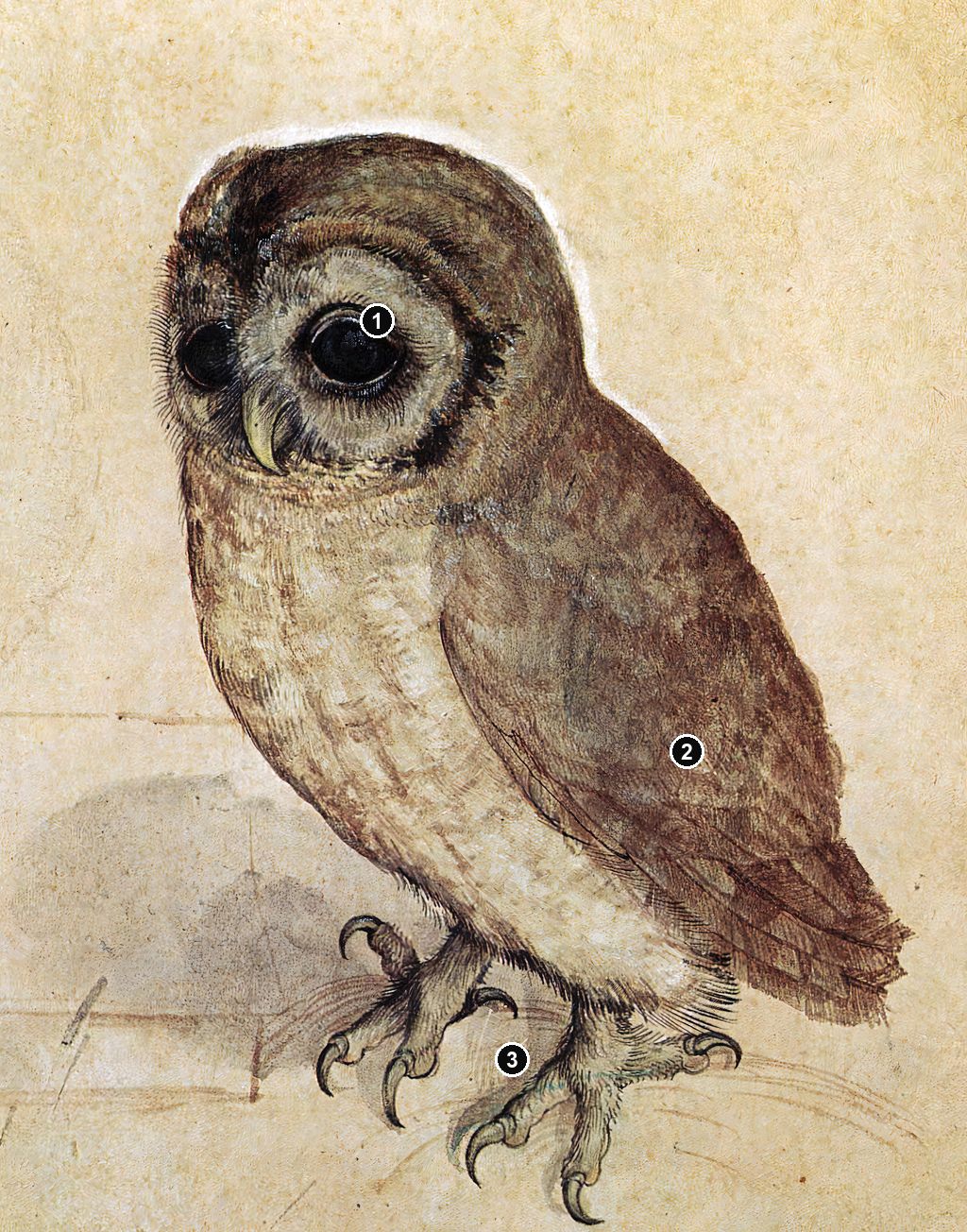
Details from LITTLE OWL
Open the details to follow changes from small feather marks to longer contours.
Dark eyes and pale feathers
Pale arcs border the dark eyes. Short marks spread out through the surrounding feathers, meeting darker bands beside the hooked beak.
The folded wing
Rounded feather shapes overlap along the upper wing. Farther down, longer bands slope towards the tail and end in a darker, uneven edge.
Curved claws and slender toes
Dark contours follow the spreading toes into sharply hooked claws. Small bands cross the harder-looking surfaces, while loose feather strokes break over the legs above.
Light, colour and a practised hand
Watercolour can let its support contribute to the visible colour. The Metropolitan Museum of Art’s account of the medium distinguishes transparent washes from opaque bodycolour, which artists can use for highlights. It also explains how wet applications produce diffuse edges, while drier work allows sharper definition. These are general possibilities of the medium, not a technical examination of this owl. They help explain why a watercolour drawing can combine a soft impression of plumage with crisp accents. Here the pale facial rings and breast stand against a warm surrounding colour; darker touches sharpen the eyes, beak and claws. A reproduction lets us follow those contrasts, but cannot establish the exact pigments, binder, order of application or condition of the sheet. [23]
Dürer’s later writing offers a useful distinction between observation and execution. In the theoretical passage translated in W. M. Conway’s 1889 Literary Remains , he locates art in nature and urges the artist to study it. He then explains that prolonged study stores up resources within the mind: an experienced artist need not copy every individual figure directly from a living model. Practice gives the hand the ability to use that accumulated knowledge. [24]
The passage belongs to Dürer’s later discussion of proportion and artistic training, chiefly concerned here with human figures. It is not an explanation written for this owl. Its value is in resisting an easy assumption about naturalistic images: minute detail need not record a single uninterrupted encounter. Observation, memory and a trained hand can work together. The apparent life of the painted bird therefore invites us to look closely without inventing a story about its capture, a workshop pet or a patient model.
Looking beside other nature studies
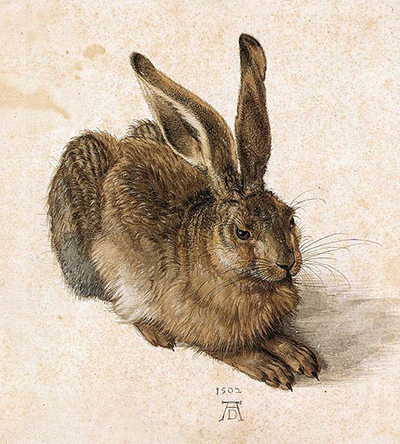
Beside the Young Hare , the owl’s upright shape becomes especially apparent. The hare’s long ears rise above a low body; its forepaws extend towards us and its whiskers spread out into the empty space. The owl gathers its limbs beneath its breast, with the claws supplying the sharpest outward movements. In both images, a substantial bodily shape resolves into countless small marks. Yet the directions differ: the hare’s fur flows in waves, while the owl’s feathers gather into bands and overlapping layers. Following those changes is more rewarding than treating the pictures as interchangeable examples of meticulous detail.
The Wing of a Blue Roller , dated around 1500 by the ALBERTINA, changes the comparison again. Its support is finely smoothed and polished parchment. Heinz Widauer’s accompanying essay treats the roller studies as autonomous works and notes their later imitation, stressing the difficulty of separating originals, copies and works in Dürer’s manner. His discussion makes resemblance a starting point for investigation, rather than a verdict on the owl’s authorship. [25]
The spread roller wing lets long feathers fan across the picture. Their dark ends lead into blue and green passages, with smaller rounded feathers clustered above. The owl’s wing closes against its body and largely stays within brown, grey and cream. In the roller image, a single appendage becomes the whole subject; in the owl, the folded appendage helps make the entire creature rounded and solid. A common interest in feathers can thus produce quite different compositions.
Margaret Doyle’s 2013 National Gallery of Art brochure points out that Dürer’s highly finished nature sheets were not necessarily preparations for other compositions. She also describes their early recognition and their use as models for replicas and variations. That account holds two possibilities together: a finished nature image could have value in its own right, and could become the starting point for another artist’s work. [26]
In the ALBERTINA’s 2019 exhibition, Christof Metzger interpreted the Hare and Great Piece of Turf as demonstrations of virtuosity that could show visitors to Dürer’s workshop what he could achieve. This gives the painstaking finish of an isolated subject a possible audience and function. It remains an interpretation of those works; it supplies no documented commission or original display setting for the owl. [27]
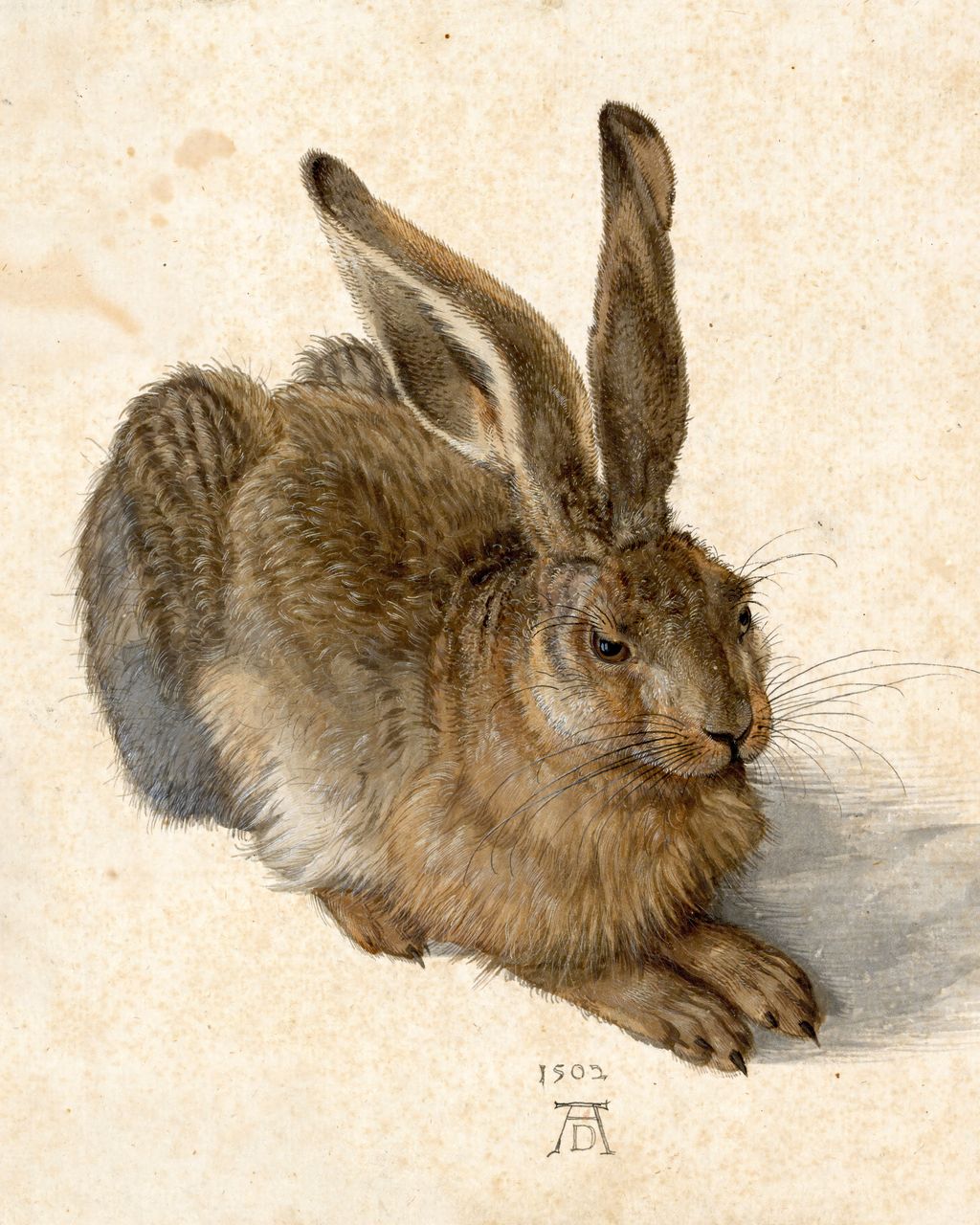
Young Hare: the changing direction of small marks describes the coat.
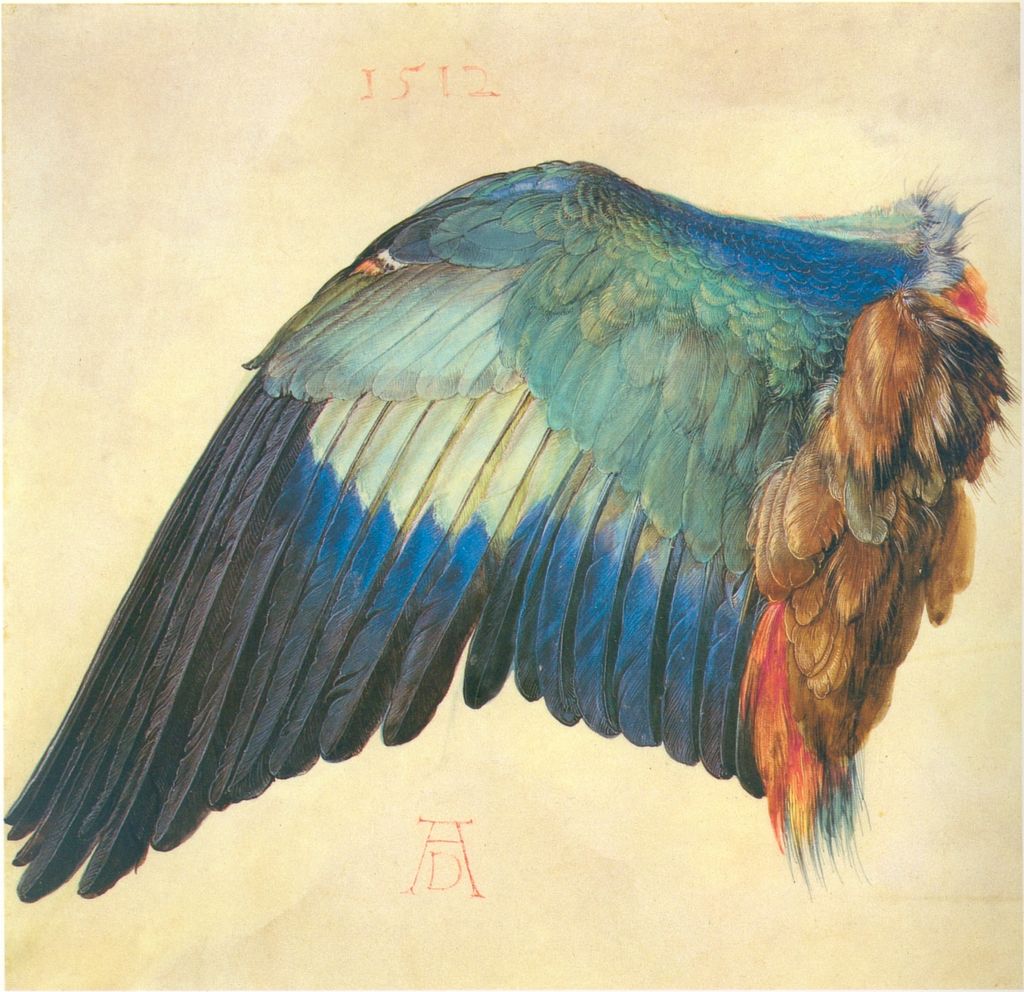
Wing of a Blue Roller: long flight feathers fan out from the shorter overlapping plumage.
Copies, inscriptions and attribution
The museum’s register reports the 1991 Tokyo catalogue’s designation “Dürer-Nachahmer”: an imitator of Dürer. [1]
Hans Hoffmann’s career shows how varied imitation could be. The Germanisches Nationalmuseum’s 2022 exhibition account describes exact copies, free variations and independent nature studies. Access to the Imhoff collection enabled him to study Dürer’s works; depending on his audience he used his own initials or Dürer’s monogram. It also describes a convincing crowned crane made from a preserved specimen in Rudolf II’s collection. [28]
Those examples distinguish several acts that a lifelike image can conceal: copying a picture, adapting a model and working from an animal specimen. They also caution against treating every copy as a fraud. Hoffmann supplies historical context for the difficulty of judging nature studies. This comparison proposes no new author for the owl and identifies neither the person who added its inscription nor that person’s intention.
A debate over the Stag Beetle shows how exacting attribution can become. In his 1988 Getty catalogue, George R. Goldner defended Dürer’s authorship against objections by Fritz Koreny. He considered anatomical differences, the sequence between independent studies and finished compositions, and the handwriting of dates and monograms. His argument insists that differences in scale, purpose and medium affect comparisons. [29]
That is a useful method to bring to an uncertain animal drawing: resemblance, anatomical precision and a familiar monogram each require examination within a larger case. None works as an automatic test. Goldner’s argument concerns the beetle; its conclusion cannot be borrowed for the owl. An attractive image and a defensible attribution answer different questions, and the pleasure of looking does not settle the historical one.
An owl in eighteenth-century collections
The ALBERTINA links the owl to Mariette’s 1775 sale, lot 896, and tentatively to Ploos van Amstel’s 1800 sale, BBB 64. [1]
Pierre-François Basan’s original Mariette catalogue, published in 1775, places lot 896 within a run headed with Dürer’s name. On page 138 it describes a coloured figure of an owl standing on its feet, followed within the same lot by a carefully executed wash study of black and white wings. The catalogue thus offered two subjects together. It does not say that the wings belong to the owl, or describe a single sheet combining them. [30]
The wording catches something a viewer can still recognise: the standing pose and the importance of colour. It also preserves a setting quite different from a modern museum display. This was an auction lot, listed among other drawings under an artist’s name. Immediately before it comes a coloured dead duck hanging by its beak, described as dated 1515; after it, drawings of religious subjects and landscapes. Such neighbours show the range assembled under the Dürer heading. They do not prove that every attribution in that group would survive present-day examination.
For identifying the owl, the entry has limits. It supplies neither measurements nor a date or monogram for the bird, and it says little about the face or plumage. Its historical Dürer classification is evidence of how the auction presented the work. It is not independent confirmation of who made it. Reading the full lot also prevents a useful detail from disappearing: the owl was offered alongside another nature study, whose description must remain separate from the surviving owl image.
The Ploos van Amstel sale catalogue offers another historical description of an owl. The sale of Cornelis Ploos van Amstel’s collection in Amsterdam was announced for 3 March 1800 and following days. On page 266, within Kunstboek BBB, number 64 describes an owl very finely drawn in watercolours and assigns it to “Alb. Durer”. [31]
Its description is shorter than Basan’s. It gives an owl, a medium, praise for the execution and an artist’s name. It does not give the sheet’s size, its inscription, a collector’s stamp or an earlier owner. Those missing identifiers matter: an owl in watercolour could be a promising match without uniquely identifying the object now in Vienna. The old attribution likewise tells us how the drawing was catalogued in 1800, rather than resolving its authorship today.
Kunstboek BBB contained more than animal images. The preceding entries on the same page include portrait heads and figure studies; the previous printed page lists a coloured bird’s wing under Dürer’s name. The catalogue brings such works into a collector’s sequence, alongside drawings assigned to other masters. That context helps us imagine the owl as something compared, arranged and exchanged among drawings. It does not establish that the wing was the companion listed with Mariette’s owl, or connect either auction entry through a continuous chain of ownership.
The record also names Vassal de Saint-Hubert, but finds no owl in his 1779 and 1783 sales. Albert’s acquisition is undated. Albert’s and Mariette’s stamps are Lugt 174 and 1852; no watermark is recorded. [1]
The owl’s intricate finish has not always invited admiration. In his 1906 Drawings of Albrecht Dürer, Hans W. Singer named the Little Owl among nature studies whose minute precision he found artistically excessive. He resisted equating patient labour and scientific exactness with artistic achievement. His judgement offers a useful counterpoint to the pleasure of close looking: the same abundance of detail can impress one viewer and weary another. This was a historical judgement of taste, not evidence that resolves the owl’s authorship. [3]
Return finally to the face, where the marks gather around the eyes and then loosen towards the breast. The image moves between that concentrated stare and the fine, almost restless activity of its surface. Looking slowly allows the bird’s rounded presence and the small decisions that construct it to remain equally vivid.
Frequently Asked Questions
Artworks directory
These 187 records include individual works, reverse sides, detail views, paired panels and reconstructed arrangements. Three additional catalogue images repeat works already listed. Related views are not counted as separate originals; qualified attributions and published dating are retained.
Discussion
Look again at the images and ideas explored in Little Owl Attributed to Dürer. These editorial prompts invite your observations.
Reader Insights
Which detail or idea in Little Owl Attributed to Dürer most changed your reading, and why?
How does the discussion of “A small body with a commanding face” affect your understanding?
What comparison would you bring to the discussion of “An owl in eighteenth-century collections”?
Join the Conversation
Share a detail, comparison or question about Little Owl Attributed to Dürer below.
References
- ALBERTINA , Käuzchen , 3123. German. View source .
- Joseph Heller, Das Leben und die Werke Albrecht Dürers, volume II, part 1 (Bamberg: C. F. Kunz, 1827), p. 118, no. 138. German original. View source.
- Hans W. Singer, Drawings of Albrecht Dürer (London: G. Newnes; New York: C. Scribner’s Sons, 1906), p. 8; Little Owl (Schönbrunner and Meder no. 829). Original English edition. View source.
- Josef Schönbrunner and Joseph Meder, Handzeichnungen alter Meister aus der Albertina und anderen Sammlungen, vol.VII (Vienna: Ferdinand Schenk, n.d.), critical contents, entry829 (inv.3123), and plate829. Original German edition, with English and French plate labels. View source.
- Charles Ephrussi, Albert Dürer et ses dessins (Paris: A. Quantin, 1882). Original French edition. View source.
- Campbell Dodgson, Catalogue of Early German and Flemish Woodcuts Preserved in the Department of Prints and Drawings in the British Museum, vol. 1 (London: British Museum, 1903). Original English edition Selected pp. 260, 262, 272, 274, 288, 290, 294–296, 299–300, 302, 307. View source.
- Heinrich Wölfflin, Die Kunst Albrecht Dürers, second enlarged edition (Munich: F. Bruckmann, 1908), pp. 110, 298. Original German edition. View source.
- Johann Carl Sigmund Kiefhaber, ed., Nachrichten zur ältern und neuern Geschichte der freyen Reichsstadt Nürnberg: ein Beytrag zur Geschichte der Reichsstädte in Teutschland, vol.1 (Nuremberg: Lechner, 1803), first quarter, pp.6–9,14–16. Original German historical edition of correspondence and inventory. View source.
- T. Sturge Moore, Albert Dürer (London: Duckworth and Co.; New York: Charles Scribner’s Sons, 1905), part III, portrait discussion and caption of the 1500 Munich self-portrait. Original English edition. View source.
- Albrecht Dürer; William Martin Conway, Literary Remains of Albrecht Dürer (Cambridge: Cambridge University Press, 1889), pp. 134–135. Original historical English translation. View source.
- Moriz Thausing, Albert Dürer: His Life and Works, edited by F. A. Eaton, vol. II (London: John Murray, 1882), pp. 16–18. English edition. View source.
- S. R. Koehler, A Chronological Catalogue of the Engravings, Dry-Points and Etchings of Albert Dürer (New York: Grolier Club, 1897). Original English edition Selected pp. 5, 14, 17–18, 32, 37, 42, 44, 51, 58, 60, 63, 81. View source.
- ALBERTINA, Selbstbildnis als Dreizehnjähriger, inv. 4839 (German). View source.
- Metropolitan Museum, Four Horsemen from The Apocalypse, 19.73.209 (English). View source.
- Bayerische Staatsgemäldesammlungen, Selbstbildnis im Pelzrock, inv. 537 (German). View source.
- ALBERTINA, Feldhase, inv. 3073 (German). View source.
- ALBERTINA, Das große Rasenstück, inv. 3075 (German). View source.
- Metropolitan Museum, Adam and Eve, 19.73.1 (English). View source.
- ALBERTINA, Betende Hände, inv. 3113 (German). View source.
- Metropolitan Museum, Knight, Death, and the Devil, 43.106.2 (English). View source.
- Metropolitan Museum, Melencolia I, 43.106.1 (English). View source.
- Bayerische Staatsgemäldesammlungen – Alte Pinakothek München, Vier Apostel: Hll. Johannes Ev. und Petrus, 1526, inv. 545 (German).. View source.
- Metropolitan Museum of Art , “Watercolor”, Materials and Techniques, 2020. English. View source .
- Albrecht Dürer , later theoretical writing in W. M. Conway, Literary Remains of Albrecht Dürer (1889), pp. 246–248. Historical English translation from German. View source .
- ALBERTINA , Der Flügel einer Blauracke , 4840, including Heinz Widauer’s 2008 essay. German. View source .
- Margaret Doyle , Albrecht Dürer: Master Drawings, Watercolors, and Prints from the Albertina (2013), pp. 14–15. English. View source .
- ALBERTINA , Albrecht Dürer , exhibition press dossier (2019), pp. 5, 10. German. View source .
- Germanisches Nationalmuseum , Hans Hoffmann. Ein europäischer Künstler der Renaissance (2022), pp. 1–3. German. View source .
- George R. Goldner , European Drawings 1 (1988), cat. 129, pp. 287–290. English. View source .
- Pierre-François Basan , Catalogue raisonné… du cabinet de feu Mr. Mariette (1775), pp. 137–138, lot 896. French. View source .
- Catalogus der teekeningen… Cornelis Ploos van Amstel (1800) , pp. 265–266, Kunstboek BBB, no. 64. Dutch. View source .
- Burlington Fine Arts Club, Exhibition of Early German Art (London: Burlington Fine Arts Club, 1906). Original English catalogue P.24, no.38. View source.
- Maud Cruttwell, Andrea Mantegna, London: George Bell and Sons, 1901, pp. 110–112. View source.
- Moriz Thausing, Dürer: Geschichte seines Lebens und seiner Kunst (Leipzig: E. A. Seemann, 1876). Original German edition Selected pp.303, 306, 308–309. View source.
- ALBERTINA, Innsbruck von Norden, inv. 3056, current record and Christof Metzger’s 2012 essay, pp. 140–141. German. View source.
- Germanisches Nationalmuseum, Barbara Dürer (German and English). View source.
- Web Gallery of Art, Tucher–Rieter reverse (English). View source.
- National Gallery of Art, Portrait of a Clergyman (English). View source.
- Dürer Art, Portrait of a Man (English). View source.
- Hessen Kassel Heritage, Elsbeth Tucher (German). View source.
- Web Gallery of Art, Hans Tucher (English). View source.
- Germanisches Nationalmuseum, Emperor Maximilian I (German and English). View source.
- National Gallery of Art, Lot and His Daughters, reverse (English). View source.
- Bayerische Staatsgemäldesammlungen, Glim Lamentation (German). View source.
- Museo Nacional del Prado, Portrait of a Man (Spanish). View source.
- Bayerische Staatsgemäldesammlungen, Madonna of the Carnation (German). View source.
- Städel Museum, Job on the Dungheap (German). View source.
- Wallraf-Richartz-Museum, Piper and Drummer (German). View source.
- Italian Ministry of Culture / Uffizi, Head of Saint James (Italian). View source.
- Klassik Stiftung Weimar, Dresden Altarpiece (German). View source.
- Staatliche Museen zu Berlin, Girl with a Red Beret (German and English). View source.
- Dresden State Art Museums / Roland Enke, Bernhard von Reesen (German). View source.
- Royal Collection Trust, Burkhard von Speyer (English). View source.
- Dresden State Art Museums, Seven Sorrows of the Virgin (English). View source.
- Bayerische Staatsgemäldesammlungen, Mater Dolorosa (German). View source.
- Bayerische Staatsgemäldesammlungen, Lucretia (German). View source.
- Städel Museum, Young Woman with Her Hair Down (English). View source.
- ALBERTINA, Portrait of a Young Man (German). View source.