by
Tom Gurney
Tom Gurney BSc (Hons) is an art history expert with over 20 years experience
Published on June 19, 2020 / Updated on October 22, 2026
Email:
tomgurney1@gmail.com
/ Phone:
+44 7429 011000
Valley near Kalchreuth: Introduction
Albrecht Dürer’s Valley near Kalchreuth fits a remarkably extensive landscape into a strip of paper little more than a hand’s breadth high. The eye travels across open ground, follows a valley into the distance and returns along the broken shoulders of the hills. In its 2023 exhibition worklist, Berlin’s Kupferstichkabinett catalogued the sheet as Tal bei Kalchreuth , inventory KdZ 5, in watercolour and opaque colour, measuring 10.5 × 31.7 centimetres and dating from about 1495–1500. [1]
Those proportions matter to the experience of the picture. At roughly three times as wide as it is high, the sheet encourages a sideways scan, yet its strongest movement leads inward. The ground narrows towards a passage left of centre, while the succession of dark ridges carries the gaze back towards the right. There is very little space above the highest hill. Sky becomes a pale interval around a silhouette, and the varied surface of the earth commands almost all our attention.
At a Glance
- Date About 1495–1500 [1]
- Materials Watercolour and opaque colour [1]
- Collection Kupferstichkabinett, Berlin; KdZ 5 [1]
This work across Albrecht Dürer’s career
Valley near Kalchreuth (current article)
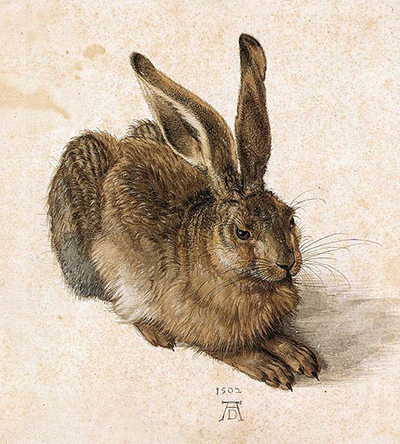
c. 1495–1500Young Hare
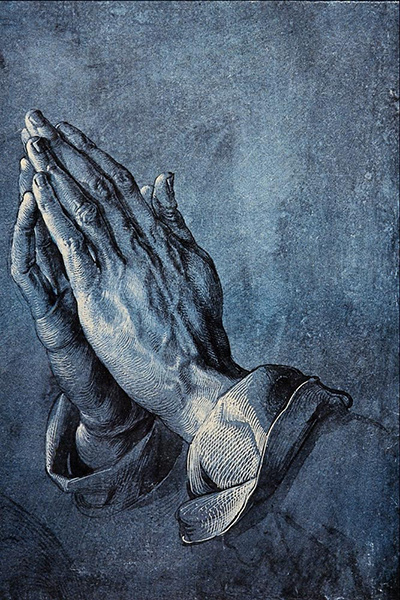
1502Praying Hands
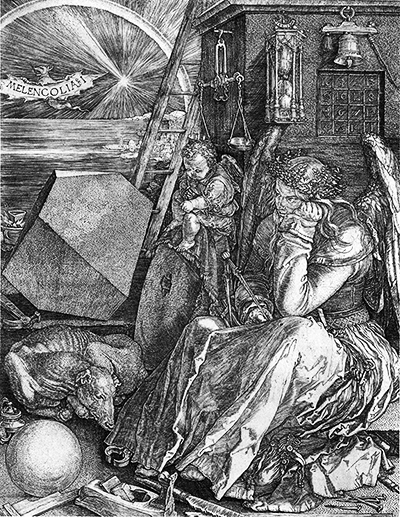
1508Melencolia I
1514Four Apostles
1526Contents
- A valley made with colour
- Finding the place
- How early is the sheet?
- A small sheet with a long afterlife
- Frequently Asked Questions
A valley made with colour
The distant blue ridge at the left is one of the smallest passages in the picture, but it has considerable power. Its cool colour establishes a depth beyond the broad, warmer ground in front. Towards the right, hills become higher, darker and more broken. Greenish shoulders alternate with reddish slopes, and deep shadows interrupt the continuity of the ridge. Even before we try to identify individual fields or trees, these changes make us feel the terrain folding and receding.
The foreground is handled differently at its two ends. On the left, small dark shapes remain scattered across light ground, allowing the view to breathe. At the right, a heavy cluster of rounded foliage closes the corner. It feels close enough to interrupt our access to the valley, although its individual leaves are unresolved. Along the bottom runs a dark, uneven band. These near accents give the distant hills something to recede from; the picture’s breadth does not dissolve into a single uninterrupted horizon.
At the centre, the warm ground becomes a meeting place for different directions. Pale, slanting strokes cross it, dark marks gather where the valley turns, and the hills beyond rise in overlapping stages. Some touches suggest small buildings or planted ground, but the force of the passage lies in the way these marks collect and disperse. Dürer supplies enough variation to keep the expanse from becoming empty, while allowing its larger slopes and hollows to remain legible.
The reddish areas are especially striking. They spread broadly across the lower slopes, then meet cooler patches and darker edges. In places, a light diagonal cuts through a warm hillside; elsewhere a dark brushstroke suddenly fixes the edge of a ridge. The changes in colour make separate surfaces visible without enclosing every one in a continuous outline. A slope can turn towards us because one patch is warmer or lighter than the next. The drawing is carried by the arrangement of coloured masses as much as by discrete lines.
There is also a productive difference in scale between the trees and the hills. A small round tree can be registered with a compact spot and a narrow downward stroke. The ridge behind it stretches through a much larger sequence of washes and irregular edges. Looking between the two, we continually adjust our sense of distance. The modest foreground marks allow the land beyond to feel expansive, even though the entire object could be held between two hands.
Watercolour and opaque colour offer different possibilities for that arrangement. A thin wash can leave the light ground active within a passage, while a more covering touch can establish a distinct accent. The reproduction shows light areas beside denser ones, with some boundaries flowing and others sharply checked. It does not reveal a complete sequence of application. What it does make clear is the variety of marks needed to hold together a view that initially seems so simple.
Finding the place
The title belongs to a history of identifying the landscape. The 1999 Basel and Berlin drawings catalogue credits Otto Mitius with locating it near Kalchreuth; it also records Albert Erich Brinckmann’s alternative proposal that the sheet represents part of the Main valley near Banz. A landscape without a prominent named monument leaves room for disagreement. Its hills are recognisable forms, but their relationship to an actual viewpoint has to be argued. [12]
Friedrich Winkler’s 1936 catalogue provides a more specific account. Citing a letter from Mitius to the Berlin curator Elfried Bock, he identifies the subject as the plateau of Honings with Hetzles, north of Kalchreuth. He also compares this narrow valley sheet with Dürer’s separate View of the Village of Kalchreuth , then in Bremen. He thought the valley had been seen from almost the same position, perhaps slightly higher, and suggested that the large trees at the right might correspond to trees shown more fully in the village view. [13]
The comparison helps explain what this sheet chooses to show. The village picture has an extensive inhabited foreground; here the land itself takes possession of the strip. A viewer can move from the nearer trees to the distant ridges without having to negotiate a large group of roofs. The omission changes the centre of interest. Open ground, an irregular skyline and the interval between the two become sufficient material for a complete pictorial experience.
A geological excursion published by the Naturhistorische Gesellschaft Nürnberg adds another way of understanding the view. Developed under Gottfried Hofbauer, it relates the Kalchreuth landscapes to the stepped terrain of the Franconian Alb. Its annotated comparison places the separate village watercolour over a modern photograph that has been compressed sideways. The study identifies a break in the western slope of the Hetzleser Berg with a clay-rich formation, the Ornatenton; farther ridges are identified as the Lange Meile and Friesener Warte. The same excursion presents a north window of the Hallerschloss as a reported viewpoint, rather than a documented account of a sitting. [14]
That comparison gives the skyline a physical explanation while keeping the artistic problem open. A plateau, a projecting shoulder and a distant ridge are features of the land; their spacing and prominence on paper are choices within the picture. Historian Hermann Ehmer, discussing Dürer’s treatment of topography in 2016, singled out Valley near Kalchreuth as an example of heightened hills and compressed horizontal distances. His account, referring to Hermann Leber’s earlier research, stresses the considered reshaping of a landscape impression. [15]
The effect can be felt without resolving every topographic correspondence. The right-hand hills seem both substantial and unusually close to one another. Their alternating hollows and projecting faces create a concentrated rhythm, while the lower land opens towards the left. The narrow format becomes a means of bringing unlike distances into contact. It offers the breadth of a panorama together with the compression needed to make that panorama readable at a glance.
How early is the sheet?
Such confidence of handling has complicated attempts to date the work. The 1999 catalogue reports scholarly proposals ranging from 1499/1500 to 1518/1520. It also records a bull’s-head watermark and a paper dating of 1492–1495, using that evidence to argue for execution before 1500. Berlin’s more recent exhibition listing places the work at about 1495–1500. The distinction between a proposed date and a written date on the object remains essential: the small monogram at the top was added by another hand. [12] [1]
Winkler’s earlier discussion shows how much weight colour and pictorial breadth had carried. He described the two Kalchreuth watercolours as exceptionally modern in their effect, even comparing them with Menzel and Cézanne. Nevertheless, following a proposal by Emil Waldmann, he favoured a date around 1500 over the later datings previously suggested. The comparison with later painters records a twentieth-century response to the sheets; it cannot establish their year of manufacture. [13]
Winkler also found one published reproduction of the valley too yellow, and another covered by a whitish veil absent from the original. His observations remind us how readily the balance of such delicate colours can change in reproduction. [13]
Paper evidence needs its own distinctions. The Germanisches Nationalmuseum’s watermark methodology separates an identical mark, a similar mark and a shared motif type. A bull’s head is therefore only the beginning of an identification. The page also explains that paper could remain in stock, with older sheets lying underneath newly acquired supplies. Even a close watermark match must be considered alongside the interval between manufacture and use. Dating the paper does not by itself create an absolute deadline for painting on it. [16]
The landscape’s appearance supplies a different kind of evidence. Broad colour areas, abbreviated trees and the concentration of a large prospect into a small format can all inform a stylistic comparison. They are harder to turn into a precise calendar. Here, it is useful to retain Berlin’s approximate range while recognising why the sheet has attracted wider debate. Its assurance is something we can inspect; the exact day, season and circumstances of execution remain outside what the image establishes.
A small sheet with a long afterlife
The recorded collecting history takes the work through the Festetics and Posonyi collections and an otherwise unidentified Wimmer collection in Vienna before Berlin acquired it in 1877. The 1999 catalogue also lists the Böhm collection on Posonyi’s authority, while noting the absence of a corresponding collector’s mark. Those qualifications belong to the history of this particular sheet, whose survival has made an expansive prospect on paper an object of sustained study. [12]
Its most persuasive quality remains the relationship between economy and extent. A dark tree, a pale passage of ground and a broken blue ridge each do a different job. None requires the finish of a miniature to contribute to the whole. As the eye moves across the surface, the landscape repeatedly expands beyond the small amount of paper carrying it. Dürer makes the valley comprehensible through its larger movements, while leaving the brushwork visible enough for us to follow the act of seeing.
Frequently Asked Questions
Artworks directory
These 187 records include individual works, reverse sides, detail views, paired panels and reconstructed arrangements. Three additional catalogue images repeat works already listed. Related views are not counted as separate originals; qualified attributions and published dating are retained.
Discussion
Look again at the images and ideas explored in Valley near Kalchreuth. These editorial prompts invite your observations.
Reader Insights
Which detail or idea in Valley near Kalchreuth most changed your reading, and why?
How does the discussion of “A valley made with colour” affect your understanding?
What comparison would you bring to the discussion of “A small sheet with a long afterlife”?
Join the Conversation
Share a detail, comparison or question about Valley near Kalchreuth below.
References
- Staatliche Museen zu Berlin , Kupferstichkabinett, Werkliste: Dürer für Berlin , 2023, p. 12, cat. 66, KdZ 5. German. View source .
- ALBERTINA, Selbstbildnis als Dreizehnjähriger, inv. 4839 (German). View source.
- Metropolitan Museum, Four Horsemen from The Apocalypse, 19.73.209 (English). View source.
- Bayerische Staatsgemäldesammlungen, Selbstbildnis im Pelzrock, inv. 537 (German). View source.
- ALBERTINA, Feldhase, inv. 3073 (German). View source.
- ALBERTINA, Das große Rasenstück, inv. 3075 (German). View source.
- Metropolitan Museum, Adam and Eve, 19.73.1 (English). View source.
- ALBERTINA, Betende Hände, inv. 3113 (German). View source.
- Metropolitan Museum, Knight, Death, and the Devil, 43.106.2 (English). View source.
- Metropolitan Museum, Melencolia I, 43.106.1 (English). View source.
- Bayerische Staatsgemäldesammlungen, inventory 545: current collection record (German; descriptive citation). View source.
- Fedja Anzelewsky , adapted and edited by Stefan Moret, “Valley near Kalchreuth,” in From Schongauer to Holbein: Master Drawings from Basel and Berlin , National Gallery of Art, Washington, 1999, cat. 53, pp. 135–136, including notes and illustration. English, translated from German. View source .
- Friedrich Winkler , Die Zeichnungen Albrecht Dürers , vol. 1, Berlin, 1936, entries 117–118, pp. 88–89 (continuation). German. View source 1 . View source 2 .
- Naturhistorische Gesellschaft Nürnberg , course contributors under Gottfried Hofbauer, “Mit Albrecht Dürer auf der Kalchreuther Höhe”, Digitale Bibliothek Geowissenschaften , conceived August 2019. German. View source .
- Hermann Ehmer , “Dürers Zeichnung von der Beschießung des Hohenaspergs 1519: Der Künstler als Kriegsberichterstatter?”, Zeitschrift für Württembergische Landesgeschichte 75, 2016, pp. 51–67, especially pp. 61–62 and notes 46–50. German. View source .
- Germanisches Nationalmuseum/BAM , “Wasserzeichenanalyse”, Dürer Tintenanalyse , last edited 7 March 2013. German. View source .
- Germanisches Nationalmuseum, Barbara Dürer (German and English). View source.
- Web Gallery of Art, Tucher–Rieter reverse (English). View source.
- National Gallery of Art, Portrait of a Clergyman (English). View source.
- Dürer Art, Portrait of a Man (English). View source.
- Hessen Kassel Heritage, Elsbeth Tucher (German). View source.
- Web Gallery of Art, Hans Tucher (English). View source.
- Germanisches Nationalmuseum, Emperor Maximilian I (German and English). View source.
- National Gallery of Art, Lot and His Daughters, reverse (English). View source.
- Bayerische Staatsgemäldesammlungen, Glim Lamentation (German). View source.
- Museo Nacional del Prado, Portrait of a Man (Spanish). View source.
- Bayerische Staatsgemäldesammlungen, Madonna of the Carnation (German). View source.
- Städel Museum, Job on the Dungheap (German). View source.
- Wallraf-Richartz-Museum, Piper and Drummer (German). View source.
- Italian Ministry of Culture / Uffizi, Head of Saint James (Italian). View source.
- Klassik Stiftung Weimar, Dresden Altarpiece (German). View source.
- Staatliche Museen zu Berlin, Girl with a Red Beret (German and English). View source.
- Dresden State Art Museums / Roland Enke, Bernhard von Reesen (German). View source.
- Royal Collection Trust, Burkhard von Speyer (English). View source.
- Dresden State Art Museums, Seven Sorrows of the Virgin (English). View source.
- Bayerische Staatsgemäldesammlungen, Mater Dolorosa (German). View source.
- Bayerische Staatsgemäldesammlungen, Lucretia (German). View source.
- Städel Museum, Young Woman with Her Hair Down (English). View source.
- ALBERTINA, Portrait of a Young Man (German). View source.