


 by
Tom Gurney
Tom Gurney BSc (Hons) is an art history expert with over 20 years experience
Published on June 19, 2020 / Updated on October 22, 2026
Email:
tomgurney1@gmail.com
/ Phone:
+44 7429 011000
The Virgin Nursing the Child: Introduction
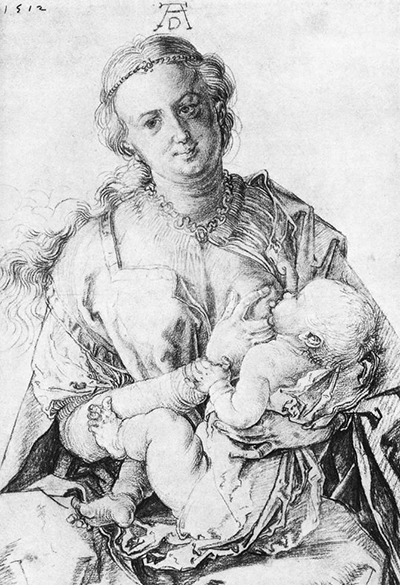
Albrecht Dürer brings the Virgin and her child almost to the edge of the paper. The infant lies diagonally across Mary's lap, his mouth at her breast, while her hands make the small adjustments that keep him supported and fed. Above this busy arrangement, her tilted head remains remarkably still. Known as The Virgin Nursing the Child , or Maria lactans , the drawing belongs to the ALBERTINA in Vienna. It is catalogued as a charcoal drawing of 1512, measuring 41.8 × 28.8 centimetres. The AD monogram stands above Mary's head. [1]
The size matters. This is a substantial sheet on which Dürer can give the child bodily weight and the mother's head the presence of a portrait. His figures occupy nearly all the available space. There is no distant town, garden wall or company of angels to draw attention away from the act of nursing. The picture's setting is the shelter made by Mary's body, arms and clothing.
At a Glance
This work across Albrecht Dürer’s career
Young Hare
1502Praying Hands
1508Melencolia I
1514Four Apostles
1526Contents
- The movement within the embrace
- A sacred subject in an ordinary action
- Charcoal, light and the scale of the sheet
- Other nursing Virgins
- A composition that remained available
- Frequently Asked Questions
The movement within the embrace
The child's head rests towards the right side of the drawing, while his bent legs extend towards the left and lower centre. His rounded limbs interrupt the sharper folds beneath him. One foot presses up near Mary's forearm; the other hangs lower, its toes individually marked. The knees and feet make the infant seem capable of another movement at any moment. He has settled into feeding without becoming a rigid, ceremonial figure.
Mary's hands perform different tasks. The raised hand steadies her breast close to the child's mouth. Her other arm and hand help support him through the cloth gathered around his body. Dürer makes the contact legible through overlaps: fingers against skin, the infant's small hand near her wrist, and the edge of fabric passing beneath his shoulder. These are the practical details from which the tenderness develops. The embrace feels convincing because its several points of support work together.
Mary's face is harder to summarise. Her head bends towards the child, but her eyes do not simply follow the line of his body. They look outward and somewhat downward, leaving her expression open to the spectator. The mouth is gently closed; the strong modelling around the eyes gives the face a seriousness that coexists with the ease of the pose. We can recognise attentiveness without claiming to know a particular thought passing through her mind.
The hair contributes another kind of movement. Held near the forehead by an ornamented band, it escapes into long waves on the left. The spreading curls answer the twisting folds below, linking the quiet head to the active lower half of the composition. Around the neckline, small repeating ornaments form a close chain, with a larger pendant at the centre. The bracelet and gathered sleeve make further accents along the arm. Dürer keeps these details clear without allowing them to become the subject: the richest ornament still leads the eye back towards the hand and the child.
A sacred subject in an ordinary action
Maria lactans means the nursing Mary. The subject joins a familiar physical dependency to the Christian belief that Christ became human. Here the infant needs holding and nourishment, and his mother supplies both. The close view makes the relationship immediate, even for a viewer unfamiliar with the image's devotional history.
An early apocryphal account offers a striking literary counterpart. In chapter 19 of the Protoevangelium of James , Joseph brings a midwife to the cave where Mary has given birth. A cloud and an overwhelming light precede the appearance of the infant; as the light recedes, the child takes his mother's breast. The story moves from a miraculous revelation to feeding within the same scene. This is a literary counterpart to the image, rather than a documented text consulted by Dürer. His drawing leaves out its witnesses and supernatural light. The encounter with the sacred takes place through the pair's physical closeness. [12]
The nursing Virgin also carried meanings extending beyond the relationship between one mother and one child. Historian Jutta Gisela Sperling discusses her voluntary nursing as an image of humility and of care available to Christian believers, within a visual culture that associated milk with spiritual nourishment. Her account places the subject beside representations of Charity feeding children and scenes in which servants and wet nurses care for newborns. This wider setting helps explain why an apparently domestic action could sustain religious contemplation. The hand at the breast can be understood simultaneously as a competent maternal gesture and as part of an image of generosity. [13]
Dürer's concentration on the two figures allows those meanings to remain close to bodily experience. The child is neither held apart for display nor turned towards the spectator. We approach a relationship already in progress. Mary's outward glance gives us a point of access, while the child continues feeding.
Charcoal, light and the scale of the sheet
The charcoal accommodates both soft transitions and decisive edges. Across Mary's face, pale passages meet denser shadow around the eyes, nose and jaw. Small strokes describe the child's hair, while broader dark areas give depth to the mantle at the right. In the clothing below, sudden turns from light to dark make the cloth appear folded and compressed beneath a weight.
The drawing is especially varied at the boundary between skin and fabric. The child's body is comparatively open and light; the surrounding folds gather into dark angular pockets. His rounded back and thighs emerge against them. Mary's exposed chest makes another broad light area, connecting her face to the infant's head through the central hand. The composition can therefore be followed as an arrangement of illumination as well as an arrangement of limbs.
The ALBERTINA records pinholes at the upper edge and notes that the written date may be by another hand. Its catalogue essays propose a relationship to an unexecuted or lost painting; no corresponding finished painting by Dürer is known. The sheet's ample scale and developed composition make that possibility understandable. Yet the drawing also gives a complete viewing experience: head, child, hands and drapery have a clear hierarchy, and the blank surrounding paper holds them together. Its possible usefulness for another work does not exhaust what Dürer achieved here. [1]
Other nursing Virgins
Dürer returned to nursing imagery in different formats. His engraving of 1503, often called The Virgin and Child on a Grassy Bench , sets Mary before a rustic fence. Princeton's impression measures only 11.6 × 7.2 centimetres; the museum relates the fence to the enclosed garden traditionally associated with Mary's purity. In the print, her bowed, veiled head closes the embrace around the infant, and the expansive folds carry the eye down to a foot projecting beneath them. The fence and bare upright branches give the figures a surrounding world that the charcoal drawing dispenses with. [14]
Cleveland's discussion of the same engraving identifies the dead tree and goldfinch on the trellis as allusions to Christ's future Passion. These details demonstrate how a feeding scene could contain a second timescale: the child's present needs and the suffering ahead. In the charcoal sheet, the absence of such conspicuous surrounding motifs leaves much more interpretive weight with the faces and their relationship. The viewer has fewer objects to identify and more reason to attend to a glance or touch. [15]
A further engraving titled The Virgin Nursing the Child dates from 1519. The National Gallery of Art's impression measures 11.8 × 7.5 centimetres. The shared English title can obscure the distinction between this small printed image and the large Vienna drawing. The dates mark separate treatments within Dürer's continuing investigation of the subject; a direct preparatory relationship remains unestablished. [16]
A composition that remained available
A particularly useful comparison is The Madonna with the Iris in London's National Gallery. The painting is currently attributed to the workshop of Albrecht Dürer with Hans Baldung Grien and dated possibly 1503–08. The Gallery explains that its plants draw on studies available in the workshop. Infrared examination has revealed several stages of composition, while the precise identities of the participating hands remain uncertain. This earlier dating places the picture within the development of motifs that Dürer could revisit in 1512. [17]
The likeness between the infants is clearest in the head thrown back towards the breast, the raised bent leg and the compact arm near the upper body. Around that shared physical idea, the two compositions behave differently. In the painting, the child sits within a much larger arrangement of red drapery, vegetation and enclosing architecture. In the drawing, the same kind of active little body becomes a major part of the picture's structure. The change of scale within the composition is as consequential as the change from paint to charcoal.
The ALBERTINA describes the drawing as entering Dürer's stock of workshop models and identifies reuse by Sebald Beham in a woodcut. A model collection could keep a successful solution available for renewed invention. The physical credibility of this group made it useful: a later artist could take up the arrangement while changing its surroundings, colour or intended effect. [1]
Daniel Fröschl's Maria mit Kind provides a tangible later example. The Kunsthistorisches Museum dates it around 1600 and records its support as parchment on wood, measuring 43.6 × 32.3 centimetres. It was in the gallery by 1619. The museum also identifies a youthful portrait of Dürer and the date 1484 in the lower right corner. [18]
Fröschl preserves the tilted head, streaming hair and nursing infant while giving the group red, blue, yellow and green clothing against a clouded sky. Gold ornament fills the corners. The small portrait turns the act of copying into an explicit remembrance of Dürer: the devotional subject and the honoured artist share one object. Looking back from this coloured version makes the charcoal's economy newly apparent. Much of the original's effect resides in the division between dark cloth and light flesh, without requiring a painted sky or decorative border.
The original drawing's own collecting history passes through Emperor Rudolf II, the imperial treasury and, from 1783, the imperial court library. In 1796 it entered Duke Albert of Saxe-Teschen's collection. These successive settings preserved a sheet whose appeal crosses several kinds of attention. It can be studied as a religious image, a practical resource for artists or a developed work on paper. Its strongest point of contact remains the small cluster at its centre, where Mary's fingers, the child's mouth and the enclosing cloth make the act of feeding immediate. [1]
Frequently Asked Questions
Artworks directory
These 187 records include individual works, reverse sides, detail views, paired panels and reconstructed arrangements. Three additional catalogue images repeat works already listed. Related views are not counted as separate originals; qualified attributions and published dating are retained.
Discussion
Look again at the images and ideas explored in The Virgin Nursing the Child. These editorial prompts invite your observations.
Reader Insights
Which detail or idea in The Virgin Nursing the Child most changed your reading, and why?
How does the discussion of “The movement within the embrace” affect your understanding?
What comparison would you bring to the discussion of “A composition that remained available”?
Join the Conversation
Share a detail, comparison or question about The Virgin Nursing the Child below.
References
- ALBERTINA , Maria mit Kind (Maria lactans) , inv. 4848, current object record, including Anna Scherbaum's 2003 catalogue text and Heinz Widauer's 2008 text. German and English. View source .
- ALBERTINA, Selbstbildnis als Dreizehnjähriger, inv. 4839 (German). View source.
- Metropolitan Museum, Four Horsemen from The Apocalypse, 19.73.209 (English). View source.
- Bayerische Staatsgemäldesammlungen, Selbstbildnis im Pelzrock, inv. 537 (German). View source.
- ALBERTINA, Feldhase, inv. 3073 (German). View source.
- ALBERTINA, Das große Rasenstück, inv. 3075 (German). View source.
- Metropolitan Museum, Adam and Eve, 19.73.1 (English). View source.
- ALBERTINA, Betende Hände, inv. 3113 (German). View source.
- Metropolitan Museum, Knight, Death, and the Devil, 43.106.2 (English). View source.
- Metropolitan Museum, Melencolia I, 43.106.1 (English). View source.
- Bayerische Staatsgemäldesammlungen, inventory 545: current collection record (German; descriptive citation). View source.
- Protoevangelium of James , chapters 19–20, translated by Alexander Walker in Ante-Nicene Fathers , vol. 8 (1886), New Advent edition. View source .
- Jutta Gisela Sperling , Roman Charity: Queer Lactations in Early Modern Visual Culture (2016), pp. 26–27. View source .
- Princeton University Art Museum , The Virgin and Child seated on a Grassy Bank , 1503, x1960-19. View source .
- Cleveland Museum of Art , The Virgin and Child on a Grassy Bench , 1503, 1934.335. View source .
- National Gallery of Art , Washington, The Virgin Nursing the Child , 1519, 1943.3.3541. View source .
- National Gallery , London, Workshop of Albrecht Dürer with Hans Baldung Grien, The Virgin and Child (‘The Madonna with the Iris’) , NG5592, current collection record. View source .
- Kunsthistorisches Museum , Vienna, Daniel Fröschl, Maria mit Kind , around 1600, Gemäldegalerie 1932. German. View source .
- Germanisches Nationalmuseum, Barbara Dürer (German and English). View source.
- Web Gallery of Art, Tucher–Rieter reverse (English). View source.
- National Gallery of Art, Portrait of a Clergyman (English). View source.
- Dürer Art, Portrait of a Man (English). View source.
- Hessen Kassel Heritage, Elsbeth Tucher (German). View source.
- Web Gallery of Art, Hans Tucher (English). View source.
- Germanisches Nationalmuseum, Emperor Maximilian I (German and English). View source.
- National Gallery of Art, Lot and His Daughters, reverse (English). View source.
- Bayerische Staatsgemäldesammlungen, Glim Lamentation (German). View source.
- Museo Nacional del Prado, Portrait of a Man (Spanish). View source.
- Bayerische Staatsgemäldesammlungen, Madonna of the Carnation (German). View source.
- Städel Museum, Job on the Dungheap (German). View source.
- Wallraf-Richartz-Museum, Piper and Drummer (German). View source.
- Italian Ministry of Culture / Uffizi, Head of Saint James (Italian). View source.
- Klassik Stiftung Weimar, Dresden Altarpiece (German). View source.
- Staatliche Museen zu Berlin, Girl with a Red Beret (German and English). View source.
- Dresden State Art Museums / Roland Enke, Bernhard von Reesen (German). View source.
- Royal Collection Trust, Burkhard von Speyer (English). View source.
- Dresden State Art Museums, Seven Sorrows of the Virgin (English). View source.
- Bayerische Staatsgemäldesammlungen, Mater Dolorosa (German). View source.
- Bayerische Staatsgemäldesammlungen, Lucretia (German). View source.
- Städel Museum, Young Woman with Her Hair Down (English). View source.
- ALBERTINA, Portrait of a Young Man (German). View source.







